Sunday, July 25, 2010

'YELLOW ROCK' ROLLS NEXT MONTH


<


(Updated 7/29/2010 - See Screenings)
I haven’t learned anything about the story yet, but it’s a western! It will begin lensing in Southern California on August 25th, toplining Michael Biehn, Lenore Andriel, James Russo and Peter Sherayko. Ms. Andriel is also writer and producer. Director Jay Miracle is a documentary filmmaker. Biehn, who made a splash in the TERMINATOR and ALIEN movies, starred in THE MAGNIFICENT SEVEN television series, THE LEGEND OF BUTCH AND SUNDANCE, and the legendary TOMBSTONE. Russo, whose credits include ONCE UPON A TIME IN AMERICA for Sergio Leone, has demonstrated his brand of western villainy in BAD GIRLS and the excellent BROKEN TRAIL. Peter Sherayko’s extensive western career was profiled in this space last week. More details are coming very soon.

AUTRY RECEIVES ACADEMY GRANT -- ‘SANTA FE’ SCREENING HERALDS AUTRY/U.C.L.A. COLLABORATION

The Saturday, July 10th screening of ‘SANTA FE’ at the Autry was preceded by a brief introduction by a representative of the Autry and Shannon Kelly, head of programming for U.C.L.A.’s Film and Television Archive. It was announced that, last year, the Autry received a financial grant from The Academy of Motion Picture Arts and Sciences to underwrite more screenings at the Wells Fargo Theatre. The Autry is using that money to partner with the extensive U.C.L.A. Archive, to present a series of films under the heading The Imagined West. As the Autry representative put it, “We’re working in 35mm now, which is a whole different animal.” And to prove it, they screened a flawless 35mm Technicolor print of ‘SANTA FE’, starring Randolph Scott, directed by Irving Pichel, and photographed by the great western cinematographer Charles Lawton Jr. It’s easy to forget how beautiful real Technicolor is until you see it on the big screen. The program began with Edwin S. Porter’s THE GREAT TRAIN ROBBERY, acknowledged to be not only the first western, but the first movie to tell a story. It was, I believe, a digital copy, but a high quality one, with orange hand-tinting on the gun-shots. If you, like I, haven’t sat down to watch it in twenty or thirty years, it’s quite incredible for the fluid editing, use of convincing rear-projection in the train office, and actually includes bad-guys shooting at a dude’s feet, to make him dance. And if memory serves, the dude became better known as Bronco Billy Anderson, the first western star.

JARROD BARKLEY FALLS OFF HORSE!

Now don’t panic! But Stephen Moyer, of the vampire TV series TRUE BLOOD, set to play the most cool-headed Barkley in the big-screen version of THE BIG VALLEY, while filming a scene, fell off of his horse and hurt his wrist. The weird thing is, it was during the filming of the blood-sucker show, not the western. Weirder still, though the story just went out this week, the accident occurred in January – I guess his press agent just wanted to make him look good before he starts his western. Hell, it coulda been worse: if it’d been his leg instead of his arm, they’d have to destroy him! (With a wooden stake?)

JULY 24TH IS FIFTH 'NATIONAL DAY OF THE COWBOY AND COWGIRL'

This is the first I've heard of this movement, probably because it's he first time the Autry has taken part, but the point is, obviously, to celebrate the contributions of the American cowboy to our culture and way of life. In 2005, then-president George W. Bush, sent a letter of support, and since then, people have erroneously thought this was a national holiday, but it isn't yet, and the folks at the National Day Of The Cowboy organization are working hard to make it a reality, state by state. So far they've succeeded in New York, Oklahoma, Texas, Kansas and Arizona, so there are forty-five states to go. There were celebrations all over the country, including Colorado, Arizona, Texas, Wyoming, Idaho, Ohio, Virgina, Florida, Pennsylvania, and at the El Paso Saloon in Pantigliate, Italy! Incidentally, of all of those places, only Los Angeles is so politically correct that they felt it necessary to make it the Day of the Cowboy and Cowgirl.

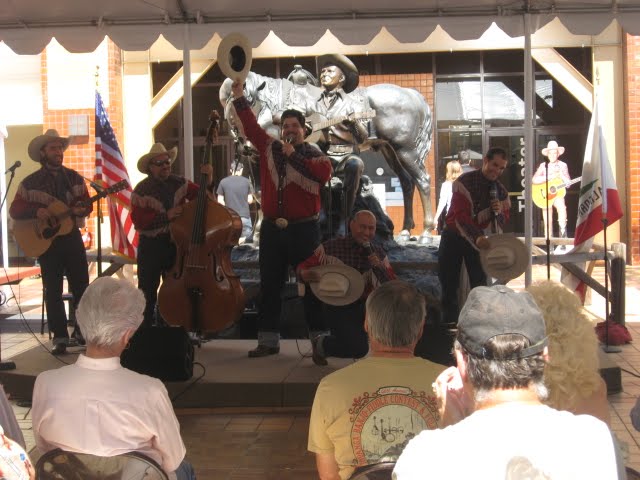
At the Autry, it was a huge and happy affair, involving music, food, crafts, screenings of Gene's TV series, book signings, clothes and art sales,trick roping and gunslinging demonstrations. If you'd like to find out more about the National Day of the Cowboy, CLICK HERE.

MORE ON COWPOKES WHO SERVED

This topic has brought me more feedback than any other (just beating out Kurt Russell’s behavior on the set of TOMBSTONE), and I’ll happily add any information you readers can send me about cowboy actors and western writers who served in the military. Here are my most recent updates: James Garner dropped out of school at 16 and joined the Merchant Marines. He was wounded in the Korean War, and received a Purple Heart. Clint Eastwood was a G.I. in the Korean War, serving as a boot camp swimming instructor. Paul Newman served in the Navy in World War II. Elvis Presley, at the height of his popularity, was drafted into the Army in 1958. Gene Hackman joined the Marines at age 16 in 1946. Robert Duvall, son of an admiral, surprisingly joined the Army for a two-year hitch in 1953. And here’s perhaps the most unexpected entry: Pat Brady, Roy Rogers’ comical sidekick, served with Patton’s Third Army in Europe, where he won citations for valor and two Purple Hearts. Fellow Sons of the Pioneers member Karl Farr recalled, “The top of his tank was blown off at close range just as he was bending over to pick up a shell.”

(Photos, top left to bottom: Michael Biehn, Lenore Andriel, James Russo. At Autry, Tumbling Tumbleweeds perform in courtyard,Julie Ann Ream signs books, silversmith Miguel Davalos Jr. does filigree work for belt buckle, details of the Nudie car.)

SCREENINGS

‘THE HARVEY GIRLS’ SCREENS AT THE AUTRY SATURDAY JULY 31ST

The delightful George Sidney-directed Technicolor musical tells the story of the building of the Fred Harvey Restaurants, and stars Judy Garland, Angela Lansbury, John Hodiak and Preston Foster, based on the novel by Samuel Hopkins Adams. This is part of the Imagined West series, in collaboration with UCLA. The Autry has confirmed that tickets are $9 for general admission, $5 for Autry members.

'REEL INJUN' AT TRAVERSE CITY FILM FESTIVAL

My favorite documentary of the year, REEL INJUN, is screening Saturday, July 30th at 9:00 a.m. at the Traverse City Film Festival in Traverse, Michigan. To read my review, CLICK HERE. For more information about the screening, CLICK HERE.

AROUND LOS ANGELES

THE AUTRY NATIONAL CENTER

Built by cowboy actor, singer, baseball and TV entrepeneur Gene Autry, and designed by the Disney Imagineering team, the Autry is a world-class museum housing a fascinating collection of items related to the fact, fiction, film, history and art of the American West. In addition to their permenant galleries (to which new items are frequently added), they have temporary shows. Currently they have HOMELANDS: HOW WOMEN MADE THE WEST through August 22nd, and THE ART OF NATIVE AMERICAN BASKETRY: A LIVING TRADITION, through November 7th. I've seen the basketry show three times, and am continually astonished at the beauty and variety of the work of the various tribes. The Autry has many special programs every week -- sometimes several in a day. To check their daily calendar, CLICK HERE. And they always have gold panning for kids every weekend. For directions, hours, admission prices, and all other information, CLICK HERE.

HOLLYWOOD HERITAGE MUSEUM

Across the street from the Hollywood Bowl, this building, once the headquarters of Lasky-Famous Players (later Paramount Pictures) was the original DeMille Barn, where Cecil B. DeMille made the first Hollywood western, The Squaw Man. They have a permanent display of movie props, documents and other items related to early, especially silent, film production. They also have occasional special programs. 2100 Highland Ave., L.A. CA 323-874-2276. Thursday – Sunday 12 p.m. to 4 p.m. $5 for adults, $3 for senior, $1 for children.

WELLS FARGO HISTORY MUSEUM

This small but entertaining museum gives a detailed history of Wells Fargo when the name suggested stage-coaches rather than ATMS. There’s a historically accurate reproduction of an agent’s office, an original Concord Coach, and other historical displays. Open Monday through Friday, from 9:00 a.m. to 5:00 a.m. Admission is free. 213-253-7166. 333 S. Grand Street, L.A. CA.

ON TV

TV LAND - BONANZA and GUNSMOKE

Every weekday, TV LAND airs a three-hour block of BONANZA episodes from 11:00 a.m. to 2:00 p.m. They run a GUNSMOKE Monday through Thursday at 10:00 a.m., and on Friday they show two, from 6:00 to 8:00 a.m.. They're not currently running either series on weekends, but that could change at any time.

NEED YOUR BLACK & WHITE TV FIX?

Check out your cable system for WHT, which stands for World Harvest Television. It's a religious network that runs a lot of good western programming. Your times may vary, depending on where you live, but weekdays in Los Angeles they run THE LONE RANGER at 1:30 p.m., and two episodes of THE RIFLEMAN from 2:00 to 3:00 p.m.. On Saturdays at 2:00 p.m. it's THE RIFLEMAN again, followed at 2:30 by BAT MASTERSON. And unlike many stations in the re-run business, they run the shows in the original airing order. There's an afternoon movie on weekdays at noon, often a western, and they show western films on the weekend, but the schedule is sporadic.

Later today I'll have the story that goes with the pictures of the National Day of the Cowboy and Cowgirl celebration at the Autry.

Until then, Adios!

Henry

All contents copyright July 25th, 2010 by Henry C. Parke -- All Rights Reserved

Sunday, July 18, 2010

MEET THE MAYOR OF PEETZBURGH, PETER SHERAYKO


Back in April, while attending the Cowboy Festival at Gene Autry’s Melody Ranch (click here), I saw a familiar face from the silver screen and blurted out, “You’re Russian Pete!” Indeed it was Peter Sherayko, who portrayed said villain in 6 GUNS, a new western which had just been released by The Asylum. One of the very few actors who today makes a living acting exclusively in westerns, Peter is a western fixture off-screen as well as on. He made his name in the business in TOMBSTONE where, in addition to portraying lawman Texas Jack Vermillian, he was in charge of the authenticity of guns, saddles, costumes and props, and supplied many of the riders from his personal posse, The Buckaroos.

He invited me to visit his ranch in Agua Dulce, where he is building the western town of Peetzburgh, already the location for a number of TV episodes and western movies. I was warmly welcomed by Peter, his charming wife Susan – a busy production manager, and a passel of big, beautiful dogs. Things were jumping at Peetzburgh. For the last few days, both acting and riding auditions were being held for COWBOYS AND ALIENS, making sure that actors could handle a horse as well as they claimed. And that morning, a director who’s preparing a film set in ancient Rome was learning to ride like a Roman.

Susan had been out of town, so Pete was left to his own devices. “At the Cowboy Poetry Festival, a guy told me where I could buy all of the Hopalong Cassidy movies on DVD, in a Hopalong Cassidy lunchbox. My wife was gone so I watched all 66 Hopalong Cassidy movies last week.” But that’s not to say he isn’t busy. “I’m writing a documentary series. It’s the 150th anniversary of the Pony Express, so that’s what we’re doing the pilot about. And I’ve got another documentary coming up for the Nation Geographic Channel called MAN CREATED DOG, about the domestication of dogs twelve thousand years ago.”

HENRY : When did you fall in love with westerns?
PETER: I was always a fan of westerns. A psychologist told me, if a man can make a living doing what he loved from the time he was ten years old, he’ll always be a happy person. Most people don’t do it. That’s why Henry David Thoreau said most men live in quiet desperation. When I was ten years old I played cowboys. They were all the rage on TV at that time.
H: What did you watch?
P: HAVE GUN WILL TRAVEL was one of my favorites. I remember it well because of one incident. I grew up on the east coast, in Brooklyn. Remember Zacherly (New York TV’s ‘Cool Ghoul’ horror host) ? I used to watch him on Saturday nights. I was a little kid. And they had THE MUMMY and DRACULA – I love all of the Universal horror movies. But then I don’t want to go to sleep – I’m afraid. One time I saw the curtains moving – the heat from the radiator was making them move – and I called my father. “Now what is it?” I said, “There’s something under the bed – there’s something in the closet!” He said, “It’s nothing, don’t worry about it.” Then we were watching HAVE GUN WILL TRAVEL, and Richard Boone, Paladin, was off in the desert, at night, by a campfire. And my father said, “See him? He’s not afraid of the dark.” And I said, “No. And he’s got a Colt .45.” That kinda got my interest. It goes back to the saying about Colts: ‘Be not afraid of any man, no matter what his size. Just call on me when you’re in need, and I will equalize.’ So I began learning about guns. And when I was ten I had a neighbor whose brother had a rental stable in one of the parks. I used to walk a mile to the park every day, and shovel up after horses, so I could get to ride them. I have a wonderful feeling towards horses.

Peter knew what he loved, but he went through a lot of careers to get to it. “1966, I was seventeen years old. I tried to be a baseball player, left field. But I hurt my shoulder, and that career was over.” Then there was the Air Force. “I was in instrument repair, worked on the last of the Flying Tigers. They sent me from Charleston, South Carolina, with the beach and warm weather, to Maine, where it was 25 below. And I said, what am I doing here? I volunteered to go to Vietnam, went there in 1967. Came back, finished my last four or five months at the 48th in Langley Virginia.” His next stops were radio, then college, at Florida State and the University of Maine. “I fell into radio, as a disk jockey. I went back to college, majored in speech. And my speech teacher got me a part in a play, where I kissed the prettiest girl in the school, and the whole audience applauded. So I changed my major to theatre.”

Peter and Susan lived in New Jersey, Peter acted in plays, and in 1980 landed a continuing role in a New York-based soap opera. Oddly enough, it was a beer commercial, one that he didn’t get, that gave him the final push to move to California. “It was in 1982. In ’80 I got a job on ALL MY CHILDREN. I was doing that, doing stage plays, I did stand-up comedy, western-oriented stuff. I had a horse; I lived in a log cabin fifty miles outside of New York City, no heat, no hot water. Only heat was the fire place. What made me want to come out here was a beer, Lowenbrau beer. My agent sent me up: “You have an audition at twelve o’clock.” So I went. It was for a guy cutting firewood to warm himself, and then drinking the beer. Well, I live in a log cabin, I cut firewood every day, and I drink beer. Perfect. And the casting director comes out, and he says, “You’re not right for this.” Now, as Jerry Seinfeld said, “Not that there’s anything wrong with that,” but everybody else is a gay guy in a borrowed flannel shirt, trying to look tough. Then they tell me I’m at the wrong audition – I’m here for a singing quiche commercial. As soon as my contract is up with ALL MY CHILDREN, I’m moving to California. I got a Winnebago, my horse trailer, pick-up truck, and my wife and I moved out, and drove across country. People said to me, why don’t you sell your horses, fly, and get more horses when you get to California? They didn’t understand. I love this country, I love driving cross-country. And how many people have the opportunity, with no place to go, with no time to be anywhere. It took about twelve weeks. We’d go about fifty miles a day, I’d say, that looks like a good place to ride! We’d park, have dinner, saddle the horses, and go up into the hills. We met a lot of wonderful people on the way. And I remember a lot of people saying to me, when I was leaving New York, I wish I was going.”

H: What was your first role here in California?
P: There was a nighttime soap, RITUALS, and I played the father of the main character. But only in flashbacks, when they had a kid actor playing him, in dreams. They wanted me to go on GENERAL HOSPITAL, and I kept on telling my agent, I want to do westerns. They’d tell me, you’re a New York stage actor – you can’t do westerns. And I’d say, I can outride and outshoot any stuntman in town. It took a long time, three or four years, doing a day-player here, a play there, until I did DEATHWISH 4. Everybody else had AK-47s and Uzis. I said to the director, J. Lee Thompson, “I shoot single-actions, why don’t we use a single-action?” (A single-action is a revolver that must be cocked each time before it’s fired) I play a mafia hit-guy who survives all the gun-fights, and I don’t get killed until the end. So I used a Colt single-action. Then I did TARZAN IN MANHATTAN. I starred in a movie called BLACK SNOW down in Texas. I started trying to figure out, how can I start a business, so that I can be in this business, make a living at it, act, and do something worthwhile. And there was a show over at Disney, a western. And the technical advisor told me, “Come on out and see this guy. He’s been in the business forever, knows everything.” And all the guns were the wrong period. I said to him, you know this is all wrong. Why are you doing it? And he said, “Ah, the audience is stupid, a western gun is a western gun!” So I’ve devoted the last eighteen, nineteen years, to making westerns and making them historically correct. We have a research library with over 5,000 volumes on the old west. And we try to make it right. When you’re doing a show, whether it’s about real characters or fictional characters, it doesn’t matter. I’ll take the time period and make sure they have the right guns, the right saddles, the right clothes, and that’s my passion in life.

H: How’d you get TOMBSTONE?
P: I did FLIGHT OF THE INTRUDER with John Milius. He became a friend of mine – because I like to shoot, he likes to shoot. I did ROUGH RIDERS for him, and MOTORCYCLE GANG. Kevin Jarre, who wrote TOMBSTONE and was to direct it, was John’s protégé, and we got to know each other. And for a year or two years we rode horses and fired shotguns. He was doing a movie about Dracula, and I was going to lead the Transylvanian Cavalry. He was over in Eastern Europe, scouting locations, and another company came out with their Dracula, and Universal pulled the plug on him. And he was just distraught. For about three months he just disappeared. A few months later he called me up and said, I’m ready to work on a western. Kevin and me and a couple of guys, Frank and Gary, who got Kevin his horse, would go out, two or three times a week. We’d leave at nine at night, ride up into the hills, everyone would have a pint of whiskey, a cigar, and a hundred rounds of ammunition. And we would be doing live-fire shooting, on horseback, from nine o’clock until midnight. We’d come back whenever the ammunition ran out, or the whiskey ran out and Kevin would write. First it was going to be about the Gold Rush, so I started doing research on the gold rush. Then it became TOMBSTONE. And we all worked together. Kevin would write a few pages, call me at one o’clock in the morning. I’d drive to his house, and he’d go, “Here! Here’s five pages! Go home and read them, and tell me what guns the guys should carry.” He wanted me to do the guns, and Frank to do the saddles.

H: How did George Cosmatos end up directing it?
P: The classic phrase in Hollywood: creative differences. Kevin wanted to do it so right! He was a big John Ford fan, he wanted to do it like Ford. You remember in his movies, even though John Wayne was the star, everyone had wonderful roles. That’s what Kevin wanted. But Kurt Russell wanted to star. So he literally took lines away from everybody. My part went from seventy-five lines to five. Kevin put his foot down, and the powers that be fired him and replaced him with George. But George didn’t really direct it – it was really Kurt Russell. You know, most of the guys in Hollywood, we’re all taller than Kurt Russell. The rule on the set was Kurt Russell had to have very high lifts on his boots, and everyone else had to have flat heels. But Kurt taught me one thing, by observation: he taught me what being a star is all about. I came from a repertory theatre background, and in rep, one week you’re the star, and the next week you’re the guy carrying the spear. But with stars in Hollywood, it’s I am the star, and everyone else is cannon-fodder. Look at movies made in the last twenty, thirty years, that’s the way it is. One or two major people are the stars, everything revolves around them, they get all the good lines. If you look at movies of the ‘30s and ‘40s, it was almost an equal thing, and everybody has wonderful parts.
H: And people thought that there was value to being surrounded by good actors.
P: And that’s another reason I do what I do. Will I ever be a star? No. But I love this business, I love telling stories. I often make the joke that I, like John Wilkes Booth, am not going to be remembered for my acting.
H: What are your favorite roles you’ve played?
P: Well, I do a one-man show on Buffalo Bill. I love doing that, I am Buffalo Bill. He loved the west so much that he wanted to bring it to the world.
H: He wanted to preserve it.
P: He made the cowboy a hero, he made the west what it is. He hired an awful lot of people. He paid everyone the same – he paid Indians as much as he did white guys.
And he was the one who kept Indians being Indians. Our society, our government Society, our government, sent the Indian kids to government schools, cut their hair, changed their names, telling them, you’ve got to be like the white man. And Buffalo Bill said, ‘No, be Indians, be what you are.’ Many people still don’t realize how beneficial he was. I try to do the same thing, I hire a lot of people, put a lot of people to work. I’ve got a lot of people their SAG cards.
H: I notice you’ve worked a couple of times with Ernest Borgnine. What is he like?
P: Worked with him on CHINAMAN’S CHANCE and THE LONG RIDE HOME. I love Borgnine, I love all of the old actors that I’ve worked with. Charley Bronson, Charlton Heston, James Garner, Kirk Douglas – every one of these guys was just so open, so much fun to be around. James Garner and I were sitting around and talking, doing a show for The Western Channel. They needed him in front of the camera, the guy says Mr. Garner, we’re ready for you, and he says, “Hey! I’m holding court now. I’m talking.” And Ernie Borgnine, he loves doing what he does so much. And Charlton Heston, when we worked on TOMBSTONE, he was telling all these wonderful stories. And he told me one from Edward G. Robinson. He said, “Acting, I love so much I’d do it for free. It’s the waiting they pay me for.” Because it’s a lot of waiting.


H: When did you work with Kirk Douglas?
P: They did a photo-spread for Vanity Fair, and I had to dress him. The photographer was Annie Leibovitz, and everyone was making a big deal about her. I had clothes for Kirk and Michael Douglas. This is just before Kirk had the stroke. And they’d rented a lot of costumes from me, but they’d also rented other costumes. I had a pair of chaps for Kirk, and she didn’t like them, because they were 1880s chaps. So they had gotten a pair of modern chaps with zippers on them, and they were too small for Kirk Douglas – he’s a big guy. They were very tight, and his..uh…his genitals were kind of exposed. And he’s going, “These are too damned tight!” And she’s saying,“But Mr. Douglas, you’re a sex symbol. This is what people are going to be looking at.” And he goes, “I’m eighty years old: who wants to f*ck me now? Pete, get me a pair of chaps that fit!”
H: I know you’ve worked a lot with The Western Channel.
P: Remember how before and after every show, they’d have a guy walk into a saloon, have a guy draw a gun, the boots coming down with the spurs – that was me. They used that for eight years, and I loved it. Since 1993, the Western Channel calls me for all their shows. I’ve been dressing it or hosting it, part of it somewhere along the line.
H: You recently did AMERICAN BANDITS: FRANK AND JESSE JAMES, for Fred Olen Ray.
P: I’ve worked with Fred a couple of times on a couple of movies, and I love working with him. He called me up. “Pete, I hear you have a western town.” “Yes, I do.” “Okay, I’ll be out there.” So he came out a couple of days later, took pictures. We’ve got about seventeen-hundred acres. He said, “Okay, we’re gonna do the movie in about two weeks.” “Great, can I read script?” He said, “No, I haven’t written it yet.” He wrote the script in those two weeks, and we filmed it. It was a good script, not historically correct, but it was a good story, and I like working with Ray. On another show I did right after, it was… I can work cheap. I can do everything – I call myself the Wal-Mart of westerns. The same quality that I put in TOMBSTONE, I can put in any movie, I don’t care what the budget is. I’ve worked with the first A.D. before. He said, “Peter’s got to do the guns because he knows how to do them right.” So I did the guns, but I wanted to do the costumes, the set dressing and the props, and they said no-no-no, we can’t afford that. They’re regular people that they had. Their art director, she dressed the saloon – she had barstools! I said, there’s no barstools in a saloon! Luckily I got along with the director, and he listened to me. So it was, fix this, fix that, get that out of here. But I get to ride a horse and shoot a gun. What more can I ask for? And I make a living at it.
H: You did the series WILD WEST TECH for the History Channel. And what did you do on that?
P: Everything. I was a talking head, they were all my costumes, props, guns, horses – I hired all the actors who did the reenactments. Those are my Buckaroos. I love working that kind of a show.
H: Your town, Peetzburgh, is your Corriganville. (Corriganville was a western movie-town built piece by piece by actor Ray ‘Crash’ Corrigan)
P: I travel across country twice a year. I leave here with an empty truck, and come back with a full one. Maybe five or ten years ago , I was at a flea market, and I found a pamphlet for a town named Peetzburgh from 1892, where you could buy a house for $846 even, a two-story house for $1200. And I said, Peetzburgh: what a great name! If I ever have a town, that’s what I’ll call it.
H: What’s your favorite western movie?
P: I haven’t made it yet. I like the old westerns best. Gregory Peck is one of my best western actors, GUNFIGHTER, BIG COUNTRY. Of course SHANE, THE WESTERNER. Joel McCrea, Gary Cooper, I have all of their movies on tape or DVD. There’s not a day that goes by that I do not have a western on the television. I love Randolph Scott
H: What do you think of the Italian westerns that came out in the 1960s?
P: Sergio Leone, in my opinion, changed the look of the western. You look at Hollywood westerns of the same period, they were dull. They were all shot onstage. There wasn’t the dirt and the grit and the – you’re in my house, I have dogs and horses, you see dust around, you see spider webs. I’ve seen westerns made in the late 1950s and early 1960s, and I’m looking at the walls, and it’s a sound-stage – look how clean it is. How come there’s no dirt anywhere. I’m not a big fan of late 1950s westerns. Sergio Leone changed that look, made it more gritty, made it more real.
H: How about Peckinpah?
P: You know, Peckinpah started doing THE RIFLEMAN series, and I enjoyed THE WILD BUNCH, but again, one of the reasons I do what I do, is because of movies like THE WILD BUNCH. Wrong guns, modern saddles – they used whatever was available to them. PAT GARRET AND BILLY THE KID, I can’t even watch it. And again he’s using modern stuff when you don’t have to. Most of the companies, most of the people that supply stuff, are just doing it for money, not doing it for art. I’m doing it for art. That’s the difference. You take the tour, I’ll show you the stuff that I have. And I welcome directors or producers, anybody that really cares about their project, to come out here and look at the stuff I have to offer you. Then go to all the other suppliers and look at their stuff. If you know the difference, we have the job.

I took the tour, and was astonished at his collection – the accompanying photos show you just a fraction. I called him yesterday to see what is new, and he told me in that he’s starting work on another western in about a week. A second edition of his book, TOMBSTONE, THE GUNS AND THE GEAR, will be available in early August. CLICK HERE to see Peter’s website.

GOING ONCE, TWICE, SOLD TO RFD-TV!

The Roy Rogers and Dale Evans auction at Christie’s New York is over, and netted $2.98 million. Trigger had been predicted to sell for between $100,000 and $200,000. The folks at Christie’s, concerned that they had overvalued the Smartest Horse in The Movies, considered lowering the estimate. Instead, on Wednesday, Trigger sold for $266,000 to Patrick Gottsch, owner of RFD-TV, which is known as ‘America’s Most Important Rural Network.’ On Thursday, Mr. Gottsch bought Roy’s Wonder-Dog Bullet, for $35,000, nearly twice the estimate.

Gottsch actually wanted to buy the entire collection, but as his chief financial officer Steve Campion explained on Wednesday, “(the auction) came to our attention a little too late. By the time we lined up the right financing and kind of got our arms around the value of the collection, it was literally 24 hours ago.” And on Thursday, Gottsch announced that starting on November 6th, RFD-TV will begin running Roy Rogers movies, introduced by Roy Jr., with Trigger and Bullet in the background. Mr. Gottsch has assured me that he will keep the Round-up apprised of future developments.

Christie’s low-balled the value of many items, all of which came from the shuttered Roy Rogers and Dale Evans Museum, which operated for four decades, first in Apple Valley, California, then in Branson, Missouri. The family dining set, which included a table made by actor George Montgomery, sold for $11,875, three times what was estimated. In their most absurd prediction they estimated that Dale’s hand-written lyrics and music to ‘Happy Trails’ would bring $500. They were $27,000 short. Pat Brady’s Jeep, Nellybelle, was sold to New Jersey horse-trainer Pam Weidel for $116,500, far above the $20,000 to $30,000 estimate.

All items sold, but at least one brought less than predicted, probably for sentimental reasons. Western clothes designer Nudie had given Roy a trailer shaped like a covered wagon. It was estimated to go for $5,000 to $8,000. But it was sold to a single bid of $3,000 to Nudie’s granddaughter Jamie, Mary Lynn Cabrall and Julie Anne Reames, who continue the Nudie Tailoring business. “For it to come back into our family – it’s amazing,” said Reames, who is also the niece of singing cowboy Rex Allen.

Much of this information came from articles by Eva Dou of the Associated Press.

NATIONAL DAY OF THE COWBOY AND COWGIRL AT THE AUTRY


Saturday, July 24th, the Autry celebrates the 5th annual event with a day of activities, all included with Museum admission. It runs from 11 a.m. to 5 p.m., and you’re encouraged to dress the part, with the exception of sidearms. Among the entertainments will be blacksmithing and chuckwagon demonstrations, roping demonstrations and lessons, leather braiding, gun engraving, musical performances, book signings, water-melon seed-spiting competitions, gold panning, one of Nudie’s cars, and episodes of The Gene Autry Show is the Wells Fargo Theatre. For more details, CLICK HERE.

THE HOLLYWOOD SHOW – FRIDAY THROUGH SUNDAY


Attention autograph hounds: from July 23rd through the 25th, the Burbank Airport Marriott Hotel & Convention Center at 2500 North Hollywood Way, Burbank, California 91505 will welcome movie and TV stars and their fans for one of their seasonal get-togethers. It’s a great way to meet some of your favorites face to face, take pictures and get things signed – you can bring your own items, or buy pictures from the stars, but they charge you either way, and the prices start at about $20. Admission is $20 a day, $15 for Friday only, and there are different deals for multiple days and early-bird admissions. And there is a big cowboy contingent expected. Among them: Angie Dickinson (Saturday only), Ann Rutherford, Anne Jeffreys (Saturday only), Dan Haggerty, Denny Miller, Don Murray, Earl Holliman, Chad Allen (Saturday only), George Hamilton (Sunday only), James Hampton – Dobbs from F-TROOP, Joe Lando, Keith and Kevin Schultz from THE MONROES, Lana Wood, Michael Parks, Morgan Woodward – GUNSMOKE’s most frequent guest star, Peter Brown, Robert Fuller, Robert Horton, DEADWOOD’s Stephen Toblonsky, Ty Hardin and William Smith. Western author and historian C. Courtney Joyner will be signing his books. The hours are Friday 6-9p.m., Saturday 10 a.m. to 5 p.m., and Sunday 10 a.m. to 4 p.m. For more information, CLICK HERE.


Adios!

Henry

All Contents Copyright July 2010 by Henry C. Parke -- All Rights Reserved

Friday, July 9, 2010

WHAT AM I BID FOR TRIGGER?


The good news is that the Roy Rogers and Dale Evans Archive, including key artifacts and 120 boxes of Roy and Dale-related stuff have been acquired by the Autry. It will take a few years for archivists to catalog and preserve it all, and make it available. The announcement from the Autry notes that, “Once the archive has been completely processed, key items will be exhibited in a dedicated case in the museum’s Imagination Gallery.”

The not bad but wistful news – good news if you have money to spend – is that 346 lots from the now defunct Roy Rogers and Dale Evans Museum in Branson, Missouri, formerly in Victorville, California, will be sold at auction, at Christie’s Auction Gallery in New York’s Rockefeller Center, on Wednesday and Thursday, July 14th and 15th. The preview starts today, Friday, July 9th. The vast array of items for bid include Roy and Dale merchandise, clothes, chandeliers, boots, saddles, spurs, collections of badges, and Trigger, the taxidermied Golden Palomino, the “Smartest Horse In The Movies”. Trigger, who is estimated at $100,000 to $200,000, is lot #38, the final lot for Wednesday. On Thursday, lot #230, Dale’s horse, Buttermilk, with an estimate of $30,000 to $50,000, will go under the gavel, followed by lot #231, “Roy’s Wonder-Dog, Bullet,” who is expected to fetch $10,000 to $15,000. Pat Brady's Jeep NELLYBELLE is estimated at $20,000 - $30,000. The catalog will set you back $30.00. Wednesday's auction starts at 6:00 p.m., Thursday's at 10:00 a.m..

To read the informative, if somewhat wise-ass story in the New York Times -- it starts with the line, “Wild West kitsch will take over Christie’s plush quarters at Rockefeller Center,” CLICK HERE. But be warned, those illiterate city-slickers call a 'chuck wagon' a 'chow wagon.' To take a look at the items up for auction, and to register to bid, CLICK HERE. To read a touching Christie-provided interview with Roy 'Dusty' Rogers Jr., CLICK HERE. (Photos from top: Roy and Dale with Trigger, Dale with Buttermilk, Dale with Bullet)

LUCAS AND SPEILBERG LET NORMAN ROCKWELL OUT OF THE VAULT

Remember that scene at the end of RAIDERS OF THE LOST ARK, where the Ark of the Covenant is sealed in a wooden crate and hidden away in a massive warehouse, never to be seen again? Well, enthusiastic Norman Rockwell collectors Steven Speilberg and George Lucas have lately been accused of the same thing by the art world, for refusing to lend their pictures to Rockwell exhibitions.

They’ve made up for it in a big way, by combining fifty-seven of the paintings in one exhibition at the Smithsonian American Art Museum in Washington D.C., entitled, “Telling Stories: Norman Rockwell From The Collections of George Lucas and Steven Speilberg.” The show will run until early 2011. Rockwell gained his greatest fame for the hundreds of covers he painted for THE SATURDAY EVENING POST, mostly depicting cheerful aspects of American life.

Speilberg notes, “I had a great deal of respect for how he could tell stories in a single frozen image. Entire stories.” Lucas notes, “To me the most important part of Rockwell’s work is that it illustrates compassion and caring about other people.” Lucas, who has lived too long in Marin County, adds, “You could almost say he was a Buddhist painter.”

HARRISON FORD TAKES BREAK FROM ‘ALIENS’ TO TIE KNOT

On location in Santa Fe, New Mexico, COWBOYS AND ALIENS star Harrison Ford took a break from acting duties to wed his steady of eight years, Calista Flockhart. The vows were said at the Governor’s Mansion, the wedding performed by Governor Bill Richardson under the legal supervision of New Mexico Chief Justice Charles W. Daniels.

FOLLOW-UP FROM THE 4TH OF JULY


Got a few interesting calls and comments after COWPOKE WHO SERVED. I was able to add Earl Holliman and Cesar Romero to out list. Ron Scheer had an interesting suggestion: Western writers who served might make an interesting list. I agree. Haven't had much time for research, but I learned that Louis L'Amour served in the U.S. Merchant Marines. Charles Marquis Warren, novelist (ONLY THE VALIENT), screenwriter, producer and director who shaped TV's GUNSMOKE and RAWHIDE, served in the Navy in the Photo Science Laboratory. Wounded by a Japanese grenade, he received a Purple Heart, Bronze Star, and five battle stars. And speaking of the 4th of July, that day in 1884 was the birthday of George Trendle, the man who thought up THE LONG RANGER.

And we would be remiss if we did not note the recent passing of a man of the real west, the very last of the Navajo 'code talkers,' who used their native language as a uncrackable code during World War II. Clarence Wolf Guts was 86 when he died, on June 16th, at the South Dakota Veterans home in Hot Springs.

AMERICAN BANDITS WINS TELLY AWARD

Congratulations to writer-director Fred Olen Ray, who has won the Bronze Telly Award for AMERICAN BANDITS: FRANK AND JESSE JAMES.

WESTERN ROUND-UP HAS A SPONSOR

I'm delighted to announce that the good folks from the Dish Satellite company are our first advertisers -- if you missed their ad, it's on the top left corner of the opening page! If you're looking for satellite service, please click on the link!

SCREENINGS

RANDOLPH SCOTT IN 'SANTA FE' (1951) AT THE AUTRY

How long has it been since you saw Randolph Scott on the big screen? You can, this Saturday, July 10th, at the Autry's Wells Fargo Theatre. It's part of The Imagined West Film Series, and is preceeded by the film that started it (westerns) all, Edwin S. Porter's THE GREAT TRAIN ROBBERY (1903). The show is at 2:00 p.m. And although membership or admission usually gets you in, for some reason it'll cost $5 for members and $9 for non-members. Regular readers of the Round-up may remember that in the April 17th entry, at an event celebrating the issuing of the Cowboys of the Silver Screen stamps, Autry CEO John L. Gray annnounced that, starting in mid-June, The Autry would present a western film festival, commencing with a Roy Rogers picture. June has come and gone, no Roy, no Gene. On August 14th we will get UNDER WESTERN SKIES, which launched Roy's career. The only Autry pictures expected to run this summer are TV episodes during July 24th's NATIONAL DAY OF THE COWBOY event. THE HARVEY GIRLS is running on Saturday, July 31st. Kinda slim pickings for western fans. Yet opening on August 17th is a show, HOW THE WEST WAS WORN...BY MICHAEL JACKSON. Yes, that Michael Jackson. I don't understand some people's priorities.


ANTHONY MANN FESTIVAL AT NEW YORK’S FILM FORUM

What a treat for all of you that live East but love West! From June 25th through July 15th, the Forum will be presenting 26 movies – most in double features and a few in triple bills! -- directed by the great Anthony Mann, whose post-war westerns brought a new-found maturity to the form, and gave James Stewart a chance to stretch as an actor as never before. In addition to the westerns being shown, Mann's fine crime and war stories will also be on view. Among the westerns: THE FAR COUNTRY (1955) and THE TALL TARGET (1951) on Friday and Saturday, July 9th and 10th. To whet your appetite -- and this is for everyone, not just New Yorkers - CLICK HERE to see trailers of several of the Anthony Mann westerns.

AROUND LOS ANGELES

THE AUTRY NATIONAL CENTER

Built by cowboy actor, singer, baseball and TV entrepeneur Gene Autry, and designed by the Disney Imagineering team, the Autry is a world-class museum housing a fascinating collection of items related to the fact, fiction, film, history and art of the American West. In addition to their permenant galleries (to which new items are frequently added), they have temporary shows. Currently they have HOMELANDS: HOW WOMEN MADE THE WEST through August 22nd, and THE ART OF NATIVE AMERICAN BASKETRY: A LIVING TRADITION, through November 7th. I've seen the basketry show three times, and am continually astonished at the beauty and variety of the work of the various tribes. The Autry has many special programs every week -- sometimes several in a day. To check their daily calendar, CLICK HERE. And they always have gold panning for kids every weekend. For directions, hours, admission prices, and all other information, CLICK HERE.

HOLLYWOOD HERITAGE MUSEUM

Across the street from the Hollywood Bowl, this building, once the headquarters of Lasky-Famous Players (later Paramount Pictures) was the original DeMille Barn, where Cecil B. DeMille made the first Hollywood western, The Squaw Man. They have a permanent display of movie props, documents and other items related to early, especially silent, film production. They also have occasional special programs. 2100 Highland Ave., L.A. CA 323-874-2276. Thursday – Sunday 12 p.m. to 4 p.m. $5 for adults, $3 for senior, $1 for children.

WELLS FARGO HISTORY MUSEUM

This small but entertaining museum gives a detailed history of Wells Fargo when the name suggested stage-coaches rather than ATMS. There’s a historically accurate reproduction of an agent’s office, an original Concord Coach, and other historical displays. Open Monday through Friday, from 9:00 a.m. to 5:00 a.m. Admission is free. 213-253-7166. 333 S. Grand Street, L.A. CA.

ON TV

TV LAND - BONANZA and GUNSMOKE

Every weekday, TV LAND airs a three-hour block of BONANZA episodes from 11:00 a.m. to 2:00 p.m. They run a GUNSMOKE Monday through Thursday at 10:00 a.m., and on Friday they show two, from 6:00 to 8:00 a.m.. They're not currently running either series on weekends, but that could change at any time.

NEED YOUR BLACK & WHITE TV FIX?

Check out your cable system for WHT, which stands for World Harvest Television. It's a religious network that runs a lot of good western programming. Your times may vary, depending on where you live, but weekdays in Los Angeles they run THE LONE RANGER at 1:30 p.m., and two episodes of THE RIFLEMAN from 2:00 to 3:00 p.m.. On Saturdays at 2:00 p.m. it's THE RIFLEMAN again, followed at 2:30 by BAT MASTERSON. And unlike many stations in the re-run business, they run the shows in the original airing order. There's an afternoon movie on weekdays at noon, often a western, and they show western films on the weekend, but the schedule is sporadic.

Unless something unexpected happens, that's it for this week's report. Have a great weekend! And by the way, readers tipped me about both the Norman Rockwell show and the Roy Rogers auction. If you hear something that'd interest the Round-up, let me know!

Happy Trails to you!

Henry

All Contents Copyright July 2010 by Henry C. Parke -- All Rights Reserved

Sunday, July 4, 2010

COWPOKES WHO SERVED!


Today, as we salute Independence Day with fireworks and barbecues, the Round-up would like to give a special show of gratitude to the folks involved in western movies who did their part to keep us free.

Tom Mix was an artillery sergeant in the Philippine campaign from 1898-1901. Ken Maynard fought with Gen. Pershing against Pancho Villa, and served in the First World War. Hoot Gibson was an Army Sergeant in the Tank Corps during World War One. With the outbreak of World War One, Tim McCoy organized a regiment of cavalry, and was commissioned Captain of Cavalry, later transferred to the Horse Artillery, was a Colonel by age thirty, and was appointed Adjutant General of Wyoming. He also served in the Second World War, and again achieved the rank of Colonel. Buck Jones enlisted in the Army in his teens, served first on the U.S. – Mexico border, then in the Moro uprising in the Philippines. Buck reenlisted in World War One, training horses for the Allies. During World War II, Buck took part in a cross-country series of Bond Rallies. He died with hundreds of others when a fire tore through Boston’s Cocoanut Grove nightclub.

The two most highly decorated American soldiers of the Second World War both went on to acting careers: Audie Murphy and Charles Durning. Not far behind in honors was Neville Brand, who won the Silver Star, Purple Heart, and three Battle Stars among many other decorations. One of the Hollywood cowboys who did not return from the war was Lee Powell, U.S.M.C., the screen’s first Lone Ranger, who was killed in action on Tinian, Marianas Islands.

Among the many western actors who served in the Navy during World War II were Richard Boone, Ernest Borgnine, Charlton Heston, Earl Holliman, Kirk Douglas, Strother Martin, Robert Montgomery, Jack Lemmon, Wayne Morris, Rock Hudson, Paul Newman, GUNSMOKE’s Dennis Weaver, and GUNSMOKE on radio’s Matt and Doc, William Conrad and Howard McNear. Harry Carey Jr. was a Navy Medical Corpsman in the Pacific. Henry Fonda won the Navy Bronze Star for Valor, Jason Robards Jr. was a radioman on duty in Pearl Harbor when Japan attacked, and Glenn Ford served in World War II, Korea and Vietman, retiring as Captain in the Naval Reserve. Humphrey Bogart, who was injured in World War One, tried to enlist in World War Two, but was turned down because of his age.

Those who served in the Army included John Agar, Charles Bronson, George Kennedy, Eli Wallach, James Coburn, and Gene Evans. Burt Lancaster was in the Army Special Services, and James Arness was wounded at Anzio. Mel Brooks (we’re counting BLAZING SADDLES as a western), a combat engineer, cleared German mines after the Battle of the Bulge. Gene Autry was an Army Flight Officer in the Air Transport Command. Those in the Army Air Corps included Jimmy Stewart, Clark Gable, Jack Palance, Ronald Reagan, Lee J. Cobb, Joseph Cotten, Van Heflin, Tim Holt, Arthur Kennedy, Alan Ladd, Ray Milland, Cameron Mitchell, George Montgomery, Clayton Moore, Robert Preston, George Reeves and Robert Taylor.

Among those who served in the Coast Guard were Alan Hale Jr., Buddy Ebsen, Cesar Romero, Jim Davis and Victor Mature.

And in the Marine Corps were Brian Keith, Lee Marvin, Steve McQueen, Tyrone Power, John Russell, Robert Ryan, Sterling Hayden and Jock Mahoney.

And because actors don’t make movies by themselves, Director John Ford commanded the photography group of the OSS and was present when the troops landed on Normandy. Ford left the Navy as a Rear Admiral. Director Howard Hawks was a Lieutenant in the Signal Corps during the First World War before joining the Army Air Corps and serving in France. Directors George Roy Hill and Sam Peckinpah were Marines. Directors William Wyler, John Sturges and Don Taylor served in the U.S. Army Air Corps, as did producers Jack Warner and Daryl F. Zanuck. Producer Saul David served in the Army. And Yakima Canutt, stunt man extraordinaire, was in the Navy during World War I.

I’m sure I missed a hundred people who should be mentioned. If you know of any omissions, please leave a comment so I can update! And have a great 4th of July!

’MAD WOMAN’ JOINS COWBOYS AND ALIENS!

Abigail Spencer joins the cast of Jon Favreau’s production of COWBOYS AND ALIENS, the sci-fi western based on the comic book – okay, graphic novel – created by Scott Mitchell Rosenberg. The lovely Ms. Spencer is best known for her role as ‘Miss Farrell’ on MAD MEN, a character described as ‘Don Draper’s mistress.’ Since every female character on the show can be described that way, I am including a picture (see above), so you can say, ‘Oh, that Don Draper mistress.’ Her character in Cowboys is described as ‘a prostitute (remember when they used to be saloon girls?) who romances Daniel Craig’s character.’

Along with Spencer and Craig, the cast includes Harrison Ford, Olivia Wilde, Sam Rockwell, Keith Carradine, Adam Beach and Buck Taylor. And if you, like I, have muttered, “Oh swell, another sci-fi western,” you will be happy to know that the filmmakers have no intention of following the footsteps of JONAH HEX into oblivion. Co screen-writers Robert Orci and Alex Kurtzman, taking a break from the Santa Fe location, gave an interview on the REELZ CHANNEL. They were ready to sign up when they heard the title, Orci recalled. “I heard the title COWBOYS AND ALIENS, and to me, it was like chocolate and peanut butter: I should have thought of that!” And Kurtzman adds that, “COWBOYS AND ALIENS is not a tongue-in-cheek movie. I think the key is for us to take it seriously. It’s a lot of fun, but it’s not ‘yuk-yuk.’ It’s embracing everything we love about the western genre, and everything we love about sci-fi, and finding a way to mash them together.”


SCREENINGS

RANDOLPH SCOTT IN 'SANTA FE' (1951) AT THE AUTRY

How long has it been since you saw Randolph Scott on the big screen? You can, this Saturday, July 10th, at the Autry's Wells Fargo Theatre. It's part of The Imagined West Film Series, and is preceeded by the film that started it (westerns) all, Edwin S. Porter's THE GREAT TRAIN ROBBERY (1903). The show is at 2:00 p.m. And although membership or admission usually gets you in, for some reason it'll cost $5 for members and $9 for non-members. Regular readers of the Round-up may remember that in the April 17th entry, at an event celebrating the issuing of the Cowboys of the Silver Screen stamps, Autry CEO John L. Gray annnounced that, starting in mid-June, The Autry would present a western film festival, commencing with a Roy Rogers picture. June has come and gone, no Roy, no Gene. On August 14th we will get UNDER WESTERN SKIES, which launched Roy's career. The only Autry pictures expected to run this summer are TV episodes during July 24th's NATIONAL DAY OF THE COWBOY event. THE HARVEY GIRLS is running on Saturday, July 31st. Kinda slim pickings for western fans. Yet opening on August 17th is a show, HOW THE WEST WAS WORN...BY MICHAEL JACKSON. Yes, that Michael Jackson. I don't understand some people's priorities.

ANTHONY MANN FESTIVAL AT NEW YORK’S FILM FORUM

What a treat for all of you that live East but love West! From June 25th through July 15th, the Forum will be presenting 26 movies – most in double features and a few in triple bills! -- directed by the great Anthony Mann, whose post-war westerns brought a new-found maturity to the form, and gave James Stewart a chance to stretch as an actor as never before. In addition to the westerns being shown, Mann's fine crime and war stories will also be on view. Among the westerns: July 4th and 5th; CIMARRON (1960) on Monday July 5th, THE FURIES (1950) and THE TIN STAR (1957) on Tuesday July 6th; THE FAR COUNTRY (1955) and THE TALL TARGET (1951) on Friday and Saturday, July 9th and 10th. To whet your appetite -- and this is for everyone, not just New Yorkers - CLICK HERE to see trailers of several of the Anthony Mann westerns.


AROUND LOS ANGELES

THE AUTRY NATIONAL CENTER

Built by cowboy actor, singer, baseball and TV entrepeneur Gene Autry, and designed by the Disney Imagineering team, the Autry is a world-class museum housing a fascinating collection of items related to the fact, fiction, film, history and art of the American West. In addition to their permenant galleries (to which new items are frequently added), they have temporary shows. Currently they have HOMELANDS: HOW WOMEN MADE THE WEST through August 22nd, and THE ART OF NATIVE AMERICAN BASKETRY: A LIVING TRADITION, through November 7th. I've seen the basketry show three times, and am continually astonished at the beauty and variety of the work of the various tribes. The Autry has many special programs every week -- sometimes several in a day. To check their daily calendar, CLICK HERE. And they always have gold panning for kids every weekend. For directions, hours, admission prices, and all other information, CLICK HERE.

HOLLYWOOD HERITAGE MUSEUM

Across the street from the Hollywood Bowl, this building, once the headquarters of Lasky-Famous Players (later Paramount Pictures) was the original DeMille Barn, where Cecil B. DeMille made the first Hollywood western, The Squaw Man. They have a permanent display of movie props, documents and other items related to early, especially silent, film production. They also have occasional special programs. 2100 Highland Ave., L.A. CA 323-874-2276. Thursday – Sunday 12 p.m. to 4 p.m. $5 for adults, $3 for senior, $1 for children.

WELLS FARGO HISTORY MUSEUM

This small but entertaining museum gives a detailed history of Wells Fargo when the name suggested stage-coaches rather than ATMS. There’s a historically accurate reproduction of an agent’s office, an original Concord Coach, and other historical displays. Open Monday through Friday, from 9:00 a.m. to 5:00 a.m. Admission is free. 213-253-7166. 333 S. Grand Street, L.A. CA.

ON TV

4TH OF JULY WEEKEND JOHN WAYNE SALUTE ON AMC!

Starting Thursday night, July 1st, AMC will run a marathon of John Wayne pictures which, with the exception of a few infomercials and Three Stooges Shorts, will run through Sunday night, Independence Day. The films will be hosted by the husband and wife team of Ty Murray and Jewel. He is the champion bull-rider who did so well on DANCING WITH THE STARS this season. She's the very attractive and talented singer/songwriter whose impressive acting debut was in the excellent Civil War film RIDE WITH THE DEVIL (1999). The movies, most of which will be seen more than once, and begin at 12:30 Friday morning with THE WAR WAGON, include THE COMANCHEROS, HONDO, RIO BRAVO, THE HORSE SOLDIERS, THE WINGS OF EAGLES, OPERATION PACIFIC, THE SHEPHERD OF THE HILLS, MCLINTOCK!, CAHILL, U.S. MARSHAL, NORTH TO ALASKA, CHISUM, THE COWBOYS and THE SHOOTIST. Check your cable of satellite system for the proper times -- and have a great 4th!

TV LAND - BONANZA and GUNSMOKE

Every weekday, TV LAND airs a three-hour block of BONANZA episodes from 11:00 a.m. to 2:00 p.m. They run a GUNSMOKE Monday through Thursday at 10:00 a.m., and on Friday they show two, from 6:00 to 8:00 a.m.. They're not currently running either series on weekends, but that could change at any time.

NEED YOUR BLACK & WHITE TV FIX?

Check out your cable system for WHT, which stands for World Harvest Television. It's a religious network that runs a lot of good western programming. Your times may vary, depending on where you live, but weekdays in Los Angeles they run THE LONE RANGER at 1:30 p.m., and two episodes of THE RIFLEMAN from 2:00 to 3:00 p.m.. On Saturdays at 2:00 p.m. it's THE RIFLEMAN again, followed at 2:30 by BAT MASTERSON. And unlike many stations in the re-run business, they run the shows in the original airing order. There's an afternoon movie on weekdays at noon, often a western, and they show western films on the weekend, but the schedule is sporadic.


I’ll have info on new casting in COWBOYS AND ALIENS on Monday.

Adios,

Henry

All contents copyright July 2010 by Henry C. Parke – All Rights Reserved

Monday, June 28, 2010

'BANDITS' TALK WITH FRED OLEN RAY


UPDATED THURSDAY JULY 1ST -- SEE AMC 4TH OF JULY SALUTE BELOW

I recently interviewed writer-director Fred Olen Ray on the eve of the release of AMERICAN BANDITS: FRANK AND JESSE JAMES. To read my review of BANDITS, CLICK HERE. I knew that Ray was a prolific director, but not how many times he’d sat in the director’s chair.
FRED: I don’t actually know. I stopped counting some time ago, but it’s close to 100.
HENRY: What year did you make your first?
F: The very first film I ever worked on was in 1975. The first one I directed was probably 1977.
H: You’re primarily known for crime and action, sci-fi and horror. Why did you decide to make a western this time?
F: Well, I don’t actually choose a lot of the projects that we do. We’re like anyone else, we get a job offered, and we take it or don’t take it. And we try to do the kind of films that other people are wanting to pay for. And I had made a western before that was very successful.
H: What was that called?
F: When we first did it, it was called THE SHOOTER (1997, starring Michael Dudikoff and Randy Travis). And then on the Western Channel they played it as DESERT SHOOTER. Plays pretty often on TV now. No one ever finances (westerns) any more, so you figure if you get a chance to do a western, that may be the only opportunity in your whole career, so we jumped at it. And it turned out pretty well. It had been nominated for a GOLDEN BOOT AWARD for best picture, but at the budget that it was made at, it wasn’t going to compete with the other films, and we lost out to LAST STAND AT SABRE RIVER (1997). That was a PBS or TNT thing.
H: Oh right, with Tom Selleck, from the Elmore Leonard novel.
F: Right now, the domestic market is actually looking for westerns again. There’s an upswing of westerns. Of course, when Buster Crabbe and those guys were making westerns in the 1940s, there were three or four western towns that you could film at for varying budget levels. Everyone had horses and everyone had wagons, and costumes and their stunt guys who did horse-work. Nowadays, because westerns have been pretty dead, these things don’t exist anymore. They don’t exist at the level that makes it easy to make a low-budget western, and everybody that comes to you wants it to be low-budget. You keep trying to tell them it’s very difficult to do a movie where every single item has to be a period piece. It means renting everything – a guy can’t even wear his own shoes to the set. Everything has to be rented – every prop, every gun. And you know they do a lot of CG (computer generated) gunfire now, but you can’t do that in a western, because there’s so much black-powder smoke that you feel obliged to use blanks. Then there are horses that have to be wrangled. You know, making a western now, if you don’t have a lot of money, that’s a tough way to go, but we did it. I don’t know if we’ll do it again. Everyone wants us to do another one, because the one we did was pretty well received, or at least it has been so far.
H: Talking about western towns, I just spent yesterday at Peetzburgh.
F: Well that’s where part of this was shot. I just spoke to Pete Shereyko two days ago, and that’s an interesting place. We managed to shoot a little bit outside of his buildings, but for the most part what was done there was done interior.
H: I was in the interiors, and they really looked very nice.
F: We actually cleared one half of the saloon area, and made it into the doctor’s office, and it worked pretty well. And Pete has a lot of clothes and he has a lot of guns and this and that, and it does make it a little more manageable, but you still need that all-important either country-side or exterior western town, and if Paramount Ranch doesn’t suit you, or Sable Ranch doesn’t suit you, the price starts going up dramatically. We shot at Melody Ranch for THE SHOOTER. And it was so expensive the producers wouldn’t let us shoot the interiors, because they didn’t want to pay for this big town and then be stuck inside a room. So all the sheriff’s (office) interiors and saloon interiors were all done at Sable Ranch on sets that were dilapidated and falling down, and then when they would walk out they’d be at Melody Ranch. (laughs) So as they came and went they were changing locations.
H: Now you wrote this one as well as directed it?
F: Yes, I wrote it because the budget was limited. I don’t consider myself a writer, I don’t actually like the act of writing. I do it sometimes because I know I can make the movie for the money the producers want to spend if I control that part. That’s the front line of defense, to write the script for the locations that you know, and in a way that you can make it for the money. I was interested in the Jesse James story because my family has a distant relationship to them. I studied up on that. And I am also a Civil War buff, I’m a member of Sons of Confederate Veterans. I was interested in the plight of people after the Civil War. It’s more of a post-Civil War film than a western. It’s pre-cowboy era. It addresses the tough times, the situations the people in the border states found themselves in after being on the wrong side of the war when it ended. We’re not too preachy, but I certainly portray that, and nobody’s busted me for that, so why not?
H: Why not indeed. Now Peter Fonda, coming off his recent success in 3:10 TO YUMA (2007) is top-billed. How did you like working with him?
F: Well, he may look like he’s top-billed on the box-cover, but he’s actually last-billed on the film. He was somebody we were really looking forward to having, because he’s very iconic. And for one moment in time it looked like it wasn’t going to happen. We had made the deal, and I had spoken to him in France, and coming back on the plane, he fell on the jet-way. He busted his jaw open, and he had to have stitches. And (his people) were saying, he can’t be there on this day, and he could probably be ready in a week.
And that’s a week after the movie shoot had ended. So we thought, let’s not get ourselves caught in a tough spot here. Let’s go ahead and film these scenes anyway with a different actor. And if Peter Fonda comes in, we’ll re-shoot them. But if he never shows up, we’re not sitting here with a movie that’s unfinished. So an actor named Greg Evigan came in filmed that role. It was really tough to let go of it because Greg gave it everything he had, everybody did it to the very best of their ability, we were very happy with it and a few days later, after the movie had wrapped, we heard, ‘Okay, Peter Fonda’s ready!’ So we shot the scenes over again with (Peter Fonda), and those are what we used in the movie.
H: I just saw Greg Evigan in the other recent western, 6 GUNS (2010).
F: Yuh, that was actually made some time after ours but came out before ours. The people who made it (The Asylum) are like a film machine – they just grind them out as quickly as possible, and they’ll wrap one week and two weeks later you see it on a shelf somewhere. (laughs) We don’t operate with that kind of speed or efficiency around here!
H: How about the casting of Frank and Jesse James?
F: Well, I brought in a guy named Tim Abell, who worked for me a lot. He was on SOLDIER OF FORTUNE, INC. (1997-1999), the TV series. I had been working with Tim since the very beginning of his career. I knew he was good with horses, I knew he was good with guns, and he had that look that I thought was the way to go. And when everybody saw and met Tim, everybody agreed: this guy is Frank James. And this isn’t really a movie about Jesse James, it’s a movie about Frank James that Jesse James happens to be in. If you watch the film, you may agree.
H: I noticed that Frank gets top billing in the title, which I thought was a nice change.
F: Well you know, it always has to be ‘Frank and Jesse James’ because if you were to reverse it, then the name ‘Jesse James’ would not appear in the title of the film. It would be ‘Jesse and Frank James.’ And it was always Frank and Jesse, because Frank was older. People were asking me if it was possible that a lawman wouldn’t know which one was Frank and which one was Jesse. And I said, absolutely. They were only four years apart, and with most wanted posters being drawings of people, and people growing beards and mustaches all the time, unless somebody was extremely distinctive, there’s a good chance that you’d have to ask which one they were. Now some of the Confederate history guys commented on a few things that were probably not (historically) correct. I said, look, I can’t be the art department, the wardrobe department, and the gun department. I’m the director, I’ll drop back and blame everybody else for every little technical imperfection. I was trying to tell a story.
H: What projects are you working on now?
F: Well, you know, we have another western in the hopper, and we were all set to make it. We’d raised the money and everything. And then we started having cold feet about the foreign territory not returning the money that would justify the risk. And we may yet make that if somebody else wants to put up the money for it. So we’re going back to what we usually do, which is a sort of sci-fi/monster movie. We’re making a movie about a giant shark next.
H: I saw something online about a Sasquatch meeting a Chupacabra (the perhaps mythical ‘goat–blood sucker’).
F: That’s something we had been developing in secret, and we got wind that someone else might be jumping on that bandwagon, so we decided to go ahead and promote the Hell out of it. I’m not planning to make it for a few months. But I wanted to let other people know that we did have this project and we were planning to make it, as a way of sort of warding off copycats. Once we announced that we got contacted by all kinds of people who either wanted to provide a musical score, or wanted to be the writer, or whatever. We actually did hire one of the guys who contacted us to write the shark movie, so I guess it worked out for him.
H: I guess so. What are your favorites of your own films?
F: You know, THE SHOOTER is probably at the top of my very short list. It was well-acted, it was staged properly, I really enjoyed that film. Most of the films we make, it’s like a contractor – which are the favorite houses that you built? Most of the films, we do because someone’s paying us to do it. It’s a job, this isn’t a hobby. Any film that I do that is successful, I’m happy about. I did a film called ACCIDENTAL CHRISTMAS (2007), and Lifetime Channel picked it up as a world premiere, and it plays five or six times a year. So, I’m really fond of that film just because it was successful. And I just did a movie the SyFy Channel has run a couple of times in just the last week called SEA SNAKES (aka SILENT VENOM 2009), with Luke Perry and Tom Berenger. I’m happy with that because it validated itself and people liked it. And if Paramount or Warner Brothers or 20th Century Fox buys one of my films, I’m happy with those films, because it’s hard to get a bigger, better. I’m still waiting for Universal to buy one of my films, but I’ve got all the other top labels.
H: What are your favorite westerns? What westerns have influenced you?
F: I enjoyed FOR A FEW DOLLARS MORE (1965). Of those Italian-type westerns, that’s probably my favorite. I worked with Lee Van Cleef in ARMED RESPONSE (1986), another of my very short list of films that are my top favorites. I like the Leone westerns. I liked DJANGO (1966), I liked a movie called KEOMA (1976) which was another Franco Nero film. In THE SHOOTER there are nods to KEOMA. In that film, I believe the guy looks up at one point, there’s a lightning flash, and an old woman looks like a young girl from his past. And I did that when Michael Dudikoff is crucified, he looked down at this prostitute holding an axe. And the lightning flashed, and he saw a woman who you’d only seen in a photograph in his Bible, which was he dead wife. You see her for one brief moment looking up, and then it flashes back, and it’s the prostitute. That came right from KEOMA. There’s probably some other things.
H: How about American westerns?
F: I watched STALKING MOON (1968) recently, I enjoyed that. John Wayne films from the late fifties to the late sixties are my favorite. I liked RIO LOBO, I liked RIO BRAVO, I liked CHISUM, BIG JAKE is one of my all-time favorites. Not a fan of THE WAR WAGON. I kind of like the one with Rock Hudson, where he’s the Confederate, UNDEFEATED. THE SHOOTIST is a great picture. I was lucky enough to connect up and direct John Carradine in some films as well, toward the end of his life, so we had a chance to talk about all of that. I’m doing Billy the Kid next – that’ll be the next one.
H: Can I announce that?
F: Well, that’s what everybody wants. It’s not what Fred wants, but you know what? People say, you’ve got to have a famous character name, and they want Billy the Kid. It’s going to bend all the rules, and we’re not going to follow the real history. I’m going to follow Billy the Kid as if Buster Crabbe was playing the role again. I’ll just make a story about him.
H: I love those old Buster Crabbe, PRC things.
F: You know it’s very funny because I directed Buster Crabbe in a movie.
H: Really, what was it?
F: It was called THE ALIEN DEAD (1980), and it was one of the last things he did. At one point his career sort of stopped. I said, Buster, why did you choose to stop acting? He said, “Well, I’ll tell you, kid. The budgets on these westerns had gotten so low. It was the end of the day, the sun was going down. The producer took me aside, he whispered in my ear. I got on my horse, I raised my hand to all the guys in my posse, I said, ‘Guys, we’re gonna ride to the bottom of the hill, we’ll dismount, and take ‘em by foot.’ And they all rode to the bottom of the hill, jumped off their horses and ran up the hill on foot because at five o’clock the horses went into overtime, and they didn’t want to pay for it.” Buster said, “That was it. When I went home that night I said, that’s it, I’ve had it!” And he retired from films for a while until he did CAPTAIN GALLANT in the fifties. But he sure did make a lot of films.
H: What more can you tell me about BANDITS?
F: We all very much enjoyed making AMERICAN BANDITS. It was originally called SCOFIELD .45, named after the gun, and nobody wanted to call it that but me, so I said, great, I’ll put that title in my back pocket, you’ll be sorry. They wanted to call it AMERICAN BANDITS, I said, dude, there’s a movie called AMERICAN OUTLAWS (2001) about Jesse James already. I don’t really care what you call it. But when you see the film, it’s not a shoot ‘em up. I said, we can afford to do some action at the beginning, some action at the end, and maybe something in the middle, but it has to be about something. And I think that is why people like it, because it’s about something, about these people, and you give a shit. And I felt like it plotted itself out really well. I thought Jeffrey Combs made a very good villain. You don’t think of him as a western star, but, you know, everybody wants to be in a western.
H: Certainly every guy.
F: Yeah, when you say you’re making a western, people come out of the woodwork. I don’t know if it’s because everyone wants to dress up like they were a kid again. They want to ride up, and they’ve got to have that hat and that gun – a lot of people will buy their own gun! They want that gun when the movie’s over, they want to take that gun home. They want to get on those horses, and people will tell you they can ride horses who haven’t a clue how to ride a horse. They get on and you can see they’re terrified. These horses – I don’t even like to stand next to them – they’re gigantic beasts that weigh a ton, and they’re not as controllable as people think. But I felt like the film succeeded because it had a good story between the people, it was sort of a bittersweet thing, and it’s not a rousing western, you know? It’s not cookie-cutter. But we’ll see, won’t we?
H: We sure will. (Photos, from the top, Fred Olen Ray, Tim Abell as Frank James, Tim Abell ans Siri Baruc, Michael Gaglio and Anthony Tyler Quinn, Ray directing Peter Fonda)

SCREENINGS

ANTHONY MANN FESTIVAL AT NEW YORK’S FILM FORUM

What a treat for all of you that live East but love West! From June 25th through July 15th, the Forum will be presenting 26 movies – most in double features and a few in triple bills! -- directed by the great Anthony Mann, whose post-war westerns brought a new-found maturity to the form, and gave James Stewart a chance to stretch as an actor as never before. In addition to the westerns being shown, Mann's fine crime and war stories will also be on view. Among the westerns: BORDER INCIDENT (1949) and DEVIL'S DOORWAY (1950) on Wednesday, June 30th; THE LAST FRONTIER (1956) and GOD'S LITTLE ACRE (1958) on Thursday July 1st; MAN OF THE WEST (1958) and a new 35MM print of THE MAN FROM LARAMIE (1955) on Friday and Saturday July 2nd and 3rd; BEND OF THE RIVER (1952) and a new 35mm print of THUNDER BAY (1953) on Sunday and Monday, July 4th and 5th; CIMARRON (1960) on Monday July 5th, THE FURIES (1950) and THE TIN STAR (1957) on Tuesday July 6th; THE FAR COUNTRY (1955) and THE TALL TARGET (1951) on Friday and Saturday, July 9th and 10th. To whet your appetite -- and this is for everyone, not just New Yorkers - CLICK HERE to see trailers of several of the Anthony Mann westerns.


AROUND LOS ANGELES

THE AUTRY NATIONAL CENTER

Built by cowboy actor, singer, baseball and TV entrepeneur Gene Autry, and designed by the Disney Imagineering team, the Autry is a world-class museum housing a fascinating collection of items related to the fact, fiction, film, history and art of the American West. In addition to their permenant galleries (to which new items are frequently added), they have temporary shows. Currently they have HOMELANDS: HOW WOMEN MADE THE WEST through August 22nd, and THE ART OF NATIVE AMERICAN BASKETRY: A LIVING TRADITION, through November 7th. I've seen the basketry show three times, and am continually astonished at the beauty and variety of the work of the various tribes. The Autry has many special programs every week -- sometimes several in a day. To check their daily calendar, CLICK HERE. And they always have gold panning for kids every weekend. For directions, hours, admission prices, and all other information, CLICK HERE.

HOLLYWOOD HERITAGE MUSEUM

Across the street from the Hollywood Bowl, this building, once the headquarters of Lasky-Famous Players (later Paramount Pictures) was the original DeMille Barn, where Cecil B. DeMille made the first Hollywood western, The Squaw Man. They have a permanent display of movie props, documents and other items related to early, especially silent, film production. They also have occasional special programs. 2100 Highland Ave., L.A. CA 323-874-2276. Thursday – Sunday 12 p.m. to 4 p.m. $5 for adults, $3 for senior, $1 for children.

WELLS FARGO HISTORY MUSEUM

This small but entertaining museum gives a detailed history of Wells Fargo when the name suggested stage-coaches rather than ATMS. There’s a historically accurate reproduction of an agent’s office, an original Concord Coach, and other historical displays. Open Monday through Friday, from 9:00 a.m. to 5:00 a.m. Admission is free. 213-253-7166. 333 S. Grand Street, L.A. CA.

ON TV

4TH OF JULY WEEKEND JOHN WAYNE SALUTE ON AMC!

Starting Thursday night, July 1st, AMC will run a marathon of John Wayne pictures which, with the exception of a few infomercials and Three Stooges Shorts, will run through Sunday night, Independence Day. The films will be hosted by the husband and wife team of Ty Murray and Jewel. He is the champion bull-rider who did so well on DANCING WITH THE STARS this season. She's the very attractive and talented singer/songwriter whose impressive acting debut was in the excellent Civil War film RIDE WITH THE DEVIL (1999). The movies, most of which will be seen more than once, and begin at 12:30 Friday morning with THE WAR WAGON, include THE COMANCHEROS, HONDO, RIO BRAVO, THE HORSE SOLDIERS, THE WINGS OF EAGLES, OPERATION PACIFIC, THE SHEPHERD OF THE HILLS, MCLINTOCK!, CAHILL, U.S. MARSHAL, NORTH TO ALASKA, CHISUM, THE COWBOYS and THE SHOOTIST. Check your cable of satellite system for the proper times -- and have a great 4th!

TV LAND - BONANZA and GUNSMOKE

Every weekday, TV LAND airs a three-hour block of BONANZA episodes from 11:00 a.m. to 2:00 p.m. They run a GUNSMOKE Monday through Thursday at 10:00 a.m., and on Friday they show two, from 6:00 to 8:00 a.m.. They're not currently running either series on weekends, but that could change at any time.

NEED YOUR BLACK & WHITE TV FIX?

Check out your cable system for WHT, which stands for World Harvest Television. It's a religious network that runs a lot of good western programming. Your times may vary, depending on where you live, but weekdays in Los Angeles they run THE LONE RANGER at 1:30 p.m., and two episodes of THE RIFLEMAN from 2:00 to 3:00 p.m.. On Saturdays at 2:00 p.m. it's THE RIFLEMAN again, followed at 2:30 by BAT MASTERSON. And unlike many stations in the re-run business, they run the shows in the original airing order. There's an afternoon movie on weekdays at noon, often a western, and they show western films on the weekend, but the schedule is sporadic.

I've got a few other items I'll try to get listed today or tomorrow.

Adios,

Henry

Copyright June 2010 by Henry C. Parke -- All Rights Reserved