INSP’S ‘BLUE RIDGE’ RETURNS SUNDAY 7-1
Updated July 20, 2026

This Sunday, Justin Wise, former Green Beret-turned-rural sheriff returns to the mountains of North Carolina in season two of Blue Ridge. Yes, it’s a contemporary police story, but as creator/producer and frequent director Gary Wheeler points out, “It’s certainly a modern-day Western in the vein of Longmire; some might call it Western adjacent. It's in the wide-open spaces.”
In technological terms, it’s a bit
of a throw-back to a simpler time, one that it’s star, Johnathon Schaech
responds to, even with his big-city background. “My father was a Baltimore City
cop. He had a beat that he had to walk, and he didn't have a radio. He had a
call box in the street. So he had to really rely on his neighborhood for
safety. So when I read (the original Blue Ridge script), I kept
thinking, this guy really needs to rely on this crazy town for his own safety. Phones
don't always work up in the mountains. There's a lot of similarities. And my
father's a pretty tough man, especially when he was working the beat. I just
thought, it's so funny: I've become my dad.”
Justin Wise has also come to town
in hopes of getting back together with his ex-wife Elli (Sarah Lancaster), and
to be a bigger part in the life of his daughter Maddie (Taegen Burns), another
part of his character that feels at home to Jonathon. “My parents separated
when I was younger. They did get back together, so I could see Justin trying to
win his wife back, the way my father was trying to get my mom to come back to
him. My mom left because of my father's work. He just couldn't calm down. He
saw horrible things, and he was stressed out all the time. It’s literally like
Justin; he’s always at work, and that's why Maddie left him, same as my father.
So he’s trying to deal with himself, to be softer and more present with her,
because he loves her and she loves him.”

“He's the lone hero who always
stands for what's right,” notes Wheeler. “He's a character that runs toward the
fire, not away from the fire, and that's very traditional, classic western
television. That’s Matt Dillon, that's the Cartwrights, The Rifleman -- that’s
probably my favorite from my childhood. Jonathan's character, Justin Wise, is
certainly cut out of the same cloth as Matt Dillon.”
Schaech is certainly in shape for
season 2, as the opening of episode 1 demonstrates. “We opened with this kind of ‘Rocky Balboa’
montage of him carrying logs, chopping wood and all that,” Wheeler recalls. “And
when Johnathon read it, he said, ‘I'm gonna do that scene shirtless!’” Johnathon
explains, “in between the two seasons, I did a bodybuilding contest, kind of a bucket
list thing of mine. So I (trained), dieted for about five and a half weeks, and
I went out to this bodybuilding contest up in Franklin, Tennessee, and I won
<laugh>! I won for over 50.” He looks amazing in the show, Wheeler notes:
“He got in the best shape of his life.”

As with season one, each episode
has a stand-alone plot, or as Wheeler calls it, “a case of the week or a
problem of the week.” Besides Juston’s ex-wife and daughter, the other regular
characters are back, including warring patriarchs Jeremiah Wade (Tom Proctor)
and Connor McGrath (A Martinez), and deputies played by Greg Perrow and Avianna
Mynhier are still working not out of the police station, which burned in the
pilot episode, but from the local history museum since, as Mayor Brady (Odessa
Feaster) explained, it’s the least-used municipal building.

Among guest stars this season,
Bruce Boxleitner returns as Oak Miller, a character he created in the TV movie
before the series began. Gary says, “He's one of my great friends, and I love
to text him and talk movies with him. We brought Oak Miller back, and that's
always a great adventure, because Oak Miller is a really tough character,
really a tough cowboy. Bruce grew up in that genre, the guy from The Gambler.
And one thing about Bruce is you can put him on a horse and say, hit that mark.”
Also, “the incomparable Doug Jones, who does all these creature features,” having
starred in Hellboy, The Shape of Water and Pan’s Labyrinth, “is in
episode three, (playing) a hermit.”
One highpoint will be Moving
Mountains, the final episode of season two, with guest star, the legendary
Keith Carradine as a preacher, Brother Rusty, who has a potentially deadly
accident that is the focus of the story. Saying more about his predicament
would ruin it, but Gary describes it as “the emotional core of the entire
season of Blue Ridge, I think.”
When I asked Keith Carradine if it
was his first time playing a man of the cloth, he told me, “Yes, I believe so. When
they came to me, I just responded to the material, and particularly because it
was a story of redemption, it was just a wonderfully positive message. I'm a
fan of Johnathon's, and I love that he has used that life experience to be a
part of what he's doing now in Blue Ridge. I was just happy to be
invited into that world and to be given a chance to tell the story of Preacher
Rusty and their sort of mutual redemption in the course of that episode.”

Wheeler says, “I had re-watched The
Grapes of Wrath, and Keith’s Dad, the great John Carradine, has an amazing
role as a preacher. Keith came to me and said, ‘I want to play my paw in the Grapes
of Wrath.’ That was one of the (motivations) for him to take the project. The
way he looked with the overalls, that hat he wears, just very ‘Joadian’, very ‘John
Steinbeckian’.”
It’s a very physically demanding episode,
and the first one that Johnathon Schaech directed. “The one thing I've learned
over the years of making movies is casting is everything,” says Schaech. “So
when you get an actor like that, who wants to come out and play a part for you.
You just make sure the camera is ready, make sure he's lit, and give him
anything he wants and needs. And he was such a trooper.”
I wondered if Taylor Sheridan’s successes had rubbed off on other rural shows like Blue Ridge. “I think anybody who is playing in our space would say, how could it not?” says Wheeler. “How could those doors not be opened for us? Wide open spaces, a sense of family, interesting mountain rural settings. You know, we shot on the Blue Ridge Parkway. Season two deals with the impact of Hurricane Helene. Blue Ridge season one was very successful, especially on the streaming platforms, and you know, I do think people want to watch PG Yellowstone, they want to see a PG version of Reacher. Blue Ridge aspires to be something hopeful. I hope that they can watch it with their family, and find that sense of community, and that it's fun and that it has action, has good mysteries, and all of those things.”
Season 2 of Blue Ridge begins on
Sunday, July 19th, 10 pm Eastern Standard time. Check your local
listings.
JOHNATHON SCHAECH ON HIS WESTERNS
Henry Parke: It's remarkable how
many westerns and sort of westerns you've been in. Are you a fan of the genre?
Johnathon Schaech: You know, I am. One
time at Creative Artists Agency (CAA), I sat down with this big agent, and he
said to me, you're like a cowboy <laugh>. And I'm like a smiling
goofball, trying to make jokes all the time. I'm like, how am I like a cowboy?
He goes, the presence about you. And it reminded me when I first started
acting, I had a legendary acting teacher named Roy London. And I kept saying to
him, I really want to be like Robin Williams. And he’d get so angry at me. He
goes, ‘You're never gonna be Robin Williams! <laugh> <laugh>. You're
like that guy, Clint Eastwood.’ And so I was like, but he's kind of angry all
the time. I think I'm a lot like my father, who’s very much like a cowboy. And those
Westerns find me. And I love doing 'em, and I can't wait to do more.
Henry Parke: Did you watch any of
them growing up?
Johnathon Schaech: Oh, my dad, we
watched them all the time. John Wayne films like Red River.
Henry Parke: Your first western that
I'm aware of is an episode of Brisco County Jr. in 1993.
Johnathon Schaech: Oh my God. Right.
That started my career as a cowboy.
Henry Parke: You were the youngest
attendee in a Bounty Hunter convention. Did you enjoy doing that one?
Johnathon Schaech: I had a frigging
blast. It was the first time I did something light like that, you know? And I
really was a very bold young actor. I really took center stage when it was my
time. “Nevada Cooper! Friends call me
Coop!” <laugh>. I watched it not too long ago, and I was like, wonder if
I offended the lead, Bruce Campbell? But I talked to him years later and he was
like, ‘Hey, you're such a pleasure to have on the show.’ And I thought, wow. They
like when you take those big chances; it's important for a young actor to know
they're allowed to take center stage and not to bow down. The actor wants you
to rise up.
Henry Parke: And it was inherent in
the character you were playing. He was not a wallflower at all. But tell me
about That Thing You Do. That was pretty soon after Brisco County,
and you are much more suave when you come into that. How did you get That Thing
You Do?

Johnathon Schaech: I used to journal,
and I remember journaling that I was going to work with Jessica Lang and Tom
Hanks: those were my goals. I remember putting that down on paper, and then I
got a phone call from my agent that I had an audition for Tom Hanks' next movie
that he was directing! I remember preparing for the role, and the sides (note:
screenplay pages sent to an actor before an audition). One of the scenes was, it
said, “I quit. I quit.” And he walks out, he quits the band and leaves. I
remember preparing it and thinking, he's a singer. He should sing it. So
I prepared myself to sing it for the audition. When I went in, Tom Hanks was there
with a reader, who would read the scenes with me. I dressed the part, I dressed
like 1960s; the Beatles is what I dressed like. Tom watched. And when that
moment came up, I tapped the microphone and I sang it, “I quit!”, and I walked
out the door. And Tom Hanks came and got me, said, “Get back in here kid.” And
I knew I got the part. I was like, I won. And once we were cast, we were
put in almost like a school, to learn how to play the instruments and sing. I
just was doing it nonstop for about eight weeks. And I learned how to play the
guitar, and I learned how to sing.
Henry Parke: So you were not a
musician coming in?
Johnathon Schaech: No.
Henry Parke: Wow! You're real
convincing. Do you do your own singing in the film?
Johnathon Schaech: No. Tom told me, “We're
not gonna have you sing in the movie, but we want you to learn how to sing so
you're hitting all the notes. And sometimes we'll do playback, and sometimes we
won't.” And it was hard once they got the singer, Mike Viola (note: of Dawes
and Panic at the Disco), it was even harder, because that guy’s singing really
high. But you know, it sounded great. By the end, I couldn't sing like him, but
I could sing a little bit better than I could before. But, you know, I get
credit for singing the, “I Quit song.” <laugh> I got to work with Tom
recently again, 30 years after we'd made That Thing You Do. He cast me
in Greyhound II, the sequel to
the first one. That movie is awesome. Tom wrote it, and he wrote a part for me.
So I just went out there to Australia and shot that.
Henry Parke: In 1998, you starred
as Harry Houdini in the biopic of that title. In addition to being a great
showman, magician, escapologist – a word I think he coined -- he was a
remarkable physical athlete. Much of what he did was more about muscle control
than misdirection. How'd you like playing him?

Johnathon Schaech: That's one thing
I really got involved in. I had to do all the tricks and I had to do all the
stunts. So there were some things I really couldn't do, like hanging upside
down and getting out of the straight jacket: it was very hard. So in my
training, I started doing Pilates every single day. It made my core incredible,
so I could do anything after I did that for three or four weeks And so I was, I
took all those stunts and I did all of them. Then I went to Vegas and I worked
with Lance Burton, Johnny Thompson. I even met with Siegfried and Roy, Penn and
Teller, like these different magicians to learn why they did what they did and
how they did it. And they were great.
Henry Parke: After Brisco, I
don’t think you did another Western until 2015 where you play another
historical character, besides Houdini, in Texas Rising.

Johnathon Schaech: Yes, Colonel
Sherman, not the Union soldier, but the head of the Calvary. I have been riding
horses in movies as long as I can remember now. And this was different. Because
it was now in Mexico, so they didn't speak English. <laugh>
<laugh>. So those horses, they'd still respond to the same things; your
legs, and tugging on the reins. I had to ride a great deal in that. The best
part of doing that thing was I got to be with Bill Paxton. And we spent a lot
of time just being buddies. And just seeing him on a horse: he was great on a
horse. And he had big speeches on the horse, you know, and sometimes a horse
would move. He'd be like, “Oh man, we gotta go back and start the speech up
again!”
Henry Parke: I just rewatched the
first episode last night, and I'd forgotten what a terrific series that was.
Johnathon Schaech: What a cast --
Brendan Fraser's in there, Ray Liotta's in there. Olivier Martinez, Jeffrey
Dean Morgan.
Henry Parke: And your director,
Roland Joffe. What's it like shooting in Durango?
Johnathon Schaech: That's where they
shot all the John Wayne movies. They still had some of his sets up. It was
neat. We would film out in the middle of the desert from sunrise to sunset. I
have one great story. I was head of Calvary. I had to lead the charge, literally, the sword
out front, full gallup – dadun! Dadun! Dadun! Dadun! Bill wasn't in the charge.
He was on the other side of the camera, watching me, he's giving me all this
encouragement -- You could do it! You could do it! I’ve got about a hundred
guys behind me when we did it the first time. And the horse to my left was
buddies with my horse. So my horse went to the left, <laugh>
<laugh>. And so by the time I got through all the cannon fire and smoke,
I was too far left of the camera. So I moved up in front of that other horse
for the second charge. So when they said action, I was way ahead of it. But
what happened was one of the blank charges from cannon fire split right in
front of my horse. And he reared up and I fell off the back of him with a
hundred guys charging up behind me! Oh man! The guy behind me, it was a young
kid, he was probably 13 years old. He had the Texas flag, and he stopped because he saw me,
but because he had the flag, all the guys went around him; therefore, they went
around me, or I would've been killed. And when they saw my horse, they come
charging over through the smoke to see if I was okay. I got back on my horse,
and did the charge again. This time, I'm going towards the camera, and I had my
sword out front. And Bill Paxton, I could see him, his hand out, and he was
telling me to lower my sword so that the camera could capture my face
<laugh>. So I'm charging, he's like, down, down, down!
<laugh>. So I lowered my sword just enough. Then I had to jump over this
barrier and ran past the camera. We nailed it. Third take. Pretty exciting
stuff.
Henry Parke: When you first started
acting, did have experience with horses before? Did you grow up riding?
Johnathon Schaech: I rode when I was
younger, but I wasn't around horses all the time. It was my first, I did a film
called Hush, with Jessica Lang and Gwyneth Paltrow --
Henry Parke: So you go to work with
the two actors that you most wanted.
Johnathon Schaech: Exactly. First I
went to Maryland. My cousin had a bunch of horses, and I told him what I had to
do, and so he just put me on a horse every single day. I just spent time out
there just riding and got really comfortable. And then I went to Virginia
probably a month prior to filming and got on the horses that they wanted. They
were all race horses, and I just would take the horse and go up into the woods
and just rode. That's the best way to do it. So that was my first real riding,
and I got really comfortable riding horses. I even learned how to ride English.
And I got another great story. You want to hear it?
Henry Parke: You bet!
Johnathon Schaech: <laugh>. It
was with Gwyneth Paltrow. We had this one scene where we're riding, and her
horse starts to gallop to the left, off camera, across the field. Riders chased
her down and brought her back. And she's like, I'm not getting on a horse
anymore. So we wind up getting on the shoulders of two of the biggest grips,
and doing this acting scene together as if we were on horse. You’d never know.
This is movie magic.
Henry Parke: In 2016, you began a
recurring role on Legends of Tomorrow as comic book hero, Jonah Hex. Has
there been any talk of following up the 2010 film?
Johnathon Schaech: Not with me. I
tried to get them to do the comic book version of Jonah Hex, I just
wanted to do it so badly. I just thought people would love the love to see the
real Jonah Hex from the comic book, at least that's what I got from the
fans. But I couldn't get it made.
Henry Parke: Is the comic book
version radically different from the Josh Brolin version?
Johnathon Schaech: Yes, it's vastly
different. They took liberties to the detriment of the movie, I think. Josh
Brolin is a great actor, so he brought like a lot of Jonah to it, but the story
elements took away from his portrayal. He's just a hardcore; basically, he’s
Clint Eastwood. He’s tough, gritty, and they made him almost like sci-fi, and
they just didn't need to do it. He just needs to be a gritty cowboy. That's
what he, how he's written in the comic book.
Henry Parke: How do you like
playing him in Legends of Tomorrow?
Johnathon Schaech: Well, I played
the comic book guy, but they had him dealing with real sensitive issues.
<laugh>. You know, it was kind of fun. He was dealing with like a female
co-star who's tough and he's gruff around her. But he's respectful to her,
which he would be in the comic books as well. It was different, but it was fun.
I enjoyed it. People really loved my portrayal of Jonah Hex from what I got
from social media.

Henry Parke: I guess it's probably
good and bad that you get that kind of feedback. That's something that traditionally
actors in old Hollywood didn't get.
Johnathon Schaech: Exactly. One
thing about social media is, we do something for the comic books, and there's a
million people involved. It's a big fan base.
Henry Parke: People could say,
technically it's not a Western, but Hawaiian or not, I think The Wind and
the Reckoning is for all practical purposes a Western. I don't think it got
nearly the attention it deserved. I thought it was a fascinating picture, and you
gave a great performance in it.
Johnathon Schaech: Well, thank you
for watching. I love that movie, John Fusco is my favorite writer.
Henry Parke: He's been very kind,
helpful to me over the years. He's a great guy. Tell me a little about making The
Wind and The Reckoning.

Johnathon Schaech: Well, that was a
COVID movie. I got the phone call that they wanted me to play that role, the marshal,
and I was like, wow -- I mean, first off
John Fusco! This is unbelievable. I call up Steve' Zahn (from That Thing You
Do), saying, I have to fly out to Hawaii. I’ve got to go get a COVID deal.
Do you know where I could go? And he's like, “You're kidding me. I'm going out
to Hawaii. I'm just gonna film this thing at the Four Seasons.” It was White
Lotus <laugh>. And so I'm going out. I'm not at the Four Seasons, on
the big island. It turned out to be a retreat. They rented the whole place so
that we could shoot the movie. And we had rats. So he was at the Four Seasons,
I’m at this rat-infested resort! <laugh>. And everything was shut down.
You couldn't even go to the beach in Hawaii.
Henry Parke: That's got to be
torture.
Johnathon Schaech: It was, it was
really in, but we were so remote. But you know, I really got close to the cast.
Jason Scott Lee and his family was there. David Cunningham, who wrote the
finale for Blue Ridge season two, he directed that. So there's a full
circle right there. But it was great to film it. The scenery was just as
beautiful. It's incredible. I said, we're shooting a Western in Hawaii. This is
fantastic. It doesn't get any better.
Henry Parke: You were talking about Jonah Hex, and that he’s
an Eastwood kind of character. If you were making movies, westerns or anything
else, in the 1930s, ’40, ‘50s those golden years, whose parts would you want?
Johnathon Schaech: Hmm, let's see.
Spencer Tracy.
Henry Parke: I can see that.
Johnathon Schaech: Now I could, because
I'm older now. Because he was always kind of like a man's man. He was a little tortured too. He's something
special, that guy.
HAPPY
BIRTHDAY PATRICK WAYNE AND ROBERT WOODS!
Wednesday,
July 15th was Western movie star Patrick Wayne’s 87th birthday,
and Sunday, July 19th was Western movie star Robert Wood’s 90th
birthday! A couple of weeks ago Rob Word, of Rob Word’s a Word on Western fame,
held a get-together luncheon at Celia’s Mexican Restaurant in Burbank, where we
celebrated both of those important events!

There
are a few gents in the photo whose names I don’t know, but I’ll update this as
soon as I do. Front row l to r, Woody Wise, Robert Woods, Patrick Wayne, Robert
Pine, Bruce Davison, Bill Burton. Back row, 2 men I don’t know, Bruce Scivally,
C. Courtne Joyner, a stranger, Darby Hinton, Mitch Danton, Rob Word, a mystery
man, and me – Henry Parke.

Here’s
a link to my True West interview with Patrick Wayne:
https://www.truewestmagazine.com/article/patrick-wayne-2/
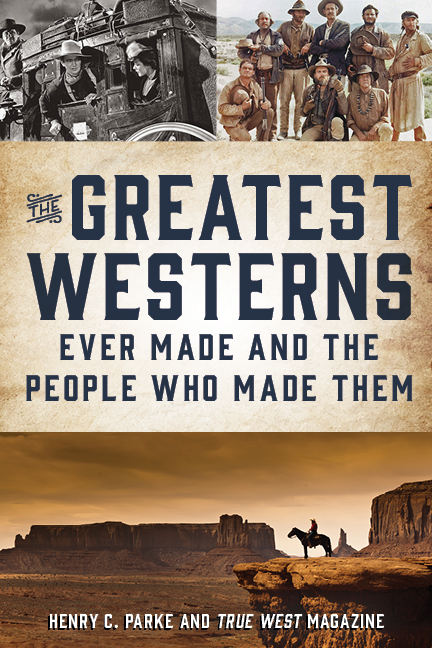
Incidentally, that interview is featured in my book, The Greatest Westerns Ever Made and the People Who Made Them, which is available from fine booksellers everywhere, including HERE.
Robert
Woods gave me my first movie-star interview for Henry’s Western Roundup 16
years ago. I’m reprinting it below.
While the mentioned Eddie Brandt’s Saturday Matinee is, sadly, gone, Spudic’s Movie Empire, though no longer a brick-and-mortar store, is very much in business online: check out his Facebook page to learn more. And Robert Woods’ films have become much more available. A search of his name on Tubi lists six titles: My Name is Pecos, Pecos Cleans Up, Black Jack, 7 Guns for the MacGregors, The Belle Starr Story, and Six Bounty Killers for a Massacre.
THE
MAN WHO WOULD BE PECOS

An
Interview With Spaghetti Western Star Robert Woods
A couple of Sundays ago, Spudic’s Movie Empire in
Van Nuys played host to an American star of European Westerns, Robert Woods.
During the 1960s and 1970s, he starred in fifty movies, at least half of them
spaghetti westerns. The event was to celebrate the digitally re-mastered DVD
release of THE GATLING GUN (1968), which kept firing behind us
during our conversation.
Born in Colorado and raised at a ranch near the Continental Divide, it seems
natural that he should want to be a cowboy actor, but that wasn’t his goal at
the start. “I felt there was a world out there – I loved Colorado, loved the
Rocky Mountains. But I always wanted to see far off lands. I had dreams about
Paris, about the places I’d read about in books, in school. And so I joined the
Navy during the Korean thing. When I came out I went to San Diego State, and I
wasn’t thinking of becoming an actor at that time. I was studying in a little
theater because it was quiet. And they were having readings for a play, VICTORIA
REGINA, and I laughed, because they were pretty bad. And the director said,
and I quote, ‘Are you gonna read?’ And I said, ‘No,’ and he said, ‘Then shut
the F up!’ And then I said, ‘Okay, I’m reading.’ So I went down and I read, and
he loved me, and I got the lead in the play.”
That led to more plays and musicals. “I did West Side Story in
San Diego, (and) they brought me to L.A. to test for the part of Tony in the
film. But it turned out they really already had a Tony, and they were gathering
people from all over the country as a publicity thing. I was pretty
disappointed. But I did a lot of musical stuff. I played valve trumpet, I
played jazz, I sang, I recorded for Fontana.”
He went from being a teaching major to a speech major, but the acting seed had
been sown. “I had letters of recommendation (for people) in L.A., and thought I
was going to set the world on fire. I ended up sleeping on somebody’s floor for
a month, starving, and running out of money, and no gas for my car. So I said
the hell with it, and went down to Central Casting, and got on line to be an
extra. They sent me out to MGM, where I became George Hamilton’s stunt
double for WHERE THE BOYS ARE (1960). There’s a scene in a
(mermaid-themed) nightclub with a (big cement) conch shell, and I dive over it,
(into the tank) where Barbara Nichols is swimming in two feet
of water. So I did this little stunt, and that day (producer) Joe
Levine was there, and he said, “You’re an actor!” And I said, “Well,
no, I’m doubling George. I’m just an extra.” He says, “No! You’re an actor! Go
stand over there by Chill Wills, I’ll give you a line.” It was easy
as that (he snaps his fingers). All this time I’ve been sweating it out,
wondering how I’m going to get a (S.A.G.) card without a film, I can’t get a
film without a card, and it was over in a micro-second.”
Now he had a S.A.G. card, but the work wasn’t exactly pouring in. He was
working as a singing waiter at the Chinese restaurant Flower Drum Song, “When
some guy came in and offered me a part in a film, and he gave me a script. I
went to read for the producer, and he was gay, and I didn’t understand any of
that at the time. The script was called THE NUN AND THE SERGEANT (1962),
and it was to be my first big break. And (when I understood the deal), I threw
the script in his face. He said, ‘You’ll never work in this town again!’ It was
one of those dramatic scenes. ”
He got a crash course in dealing with gay people when famous drag queen Lynne
Carter hired him to be the straight-man in her act. “Nineteen weeks in
(Greenwich) Village, right across the street from The Bon Soir, where Streisand was
doing her act. I’d go across the street and see her; she’d come across and see
me. It was a fun time. And Carter offered me to go on the road, offered me
great money to go to Australia, but I didn’t want that image, so I said no.”
When he auditioned for Otto Preminger for THE
CARDINAL (1963) casting director “Bill Barnes told me, ‘We
really like you, but we don’t have the budget to send you over to play this
priest. But if somehow you can find yourself in Italy, you’ve got the part.’
And I said, ‘Strangely enough, I’m going to be in Italy.’”
With his life savings, $450, in his pocket, and with time to kill before the
summer and THE CARDINAL, he flew to Paris, where he made some money
dubbing films. “And I’m sitting on the Champs Elysee, and a guy walks by me, I
thought he was gay, and he says, ‘Are you a model?’ ‘No, I’m an actor.’ ‘Well,
you should really try modeling. Here’s my card.’ So I stayed talking a little
longer than I should, wound up getting back to the dubbing studio late, and the
guy I was working for blew his cool. And I said, ‘What did I know, I didn’t
want to be rude.’ I gave him his card. It was Helmut Newton. He
said Newton was big: I have to do it. So I became a model – I was the highest
paid male model in Paris for a year. You don’t ever talk about that in acting
circles (laughs), but it was great money, and I got to go all over the world
with Newton -- and he was married, he wasn’t gay. Kinky, but not gay.”
Robert never got to do THE CARDINAL. But he was modeling and doing
theatre, “…when a guy came backstage with a contract and wanted me to do a
western. I said, ‘no, thank you.’ I was doing theater and modeling, and the
money he offered wasn’t that good. The next night he was back with a contract
for five pictures. Well that was a whole lot better. So I went down to do my
first film (1965’s PISTOLEROS DE ARIZONA – FIVE THOUSAND DOLLARS ON ONE
ACE in the U.S.) for (director) Alphonso Balcazar about two months
later.”
He was in Madrid, waiting to begin his second western, sitting in an ice cream
shop, “…and a guy says, ‘Man, you’re just right for the pilot in THE
BATTLE OF THE BULGE. Go see (director) Ken Annakan.’ And I
walked into his office, and he looked up and he said, ‘My God, you’re my
pilot!’ I didn’t even have to read, it was just done. I signed a contract and
was out the door. Two minutes later I get a call from the William Morris
Agency, from David Niven Jr., to be my agent.”
He didn’t know whose pilot he was playing. “I walk on the set and there he
is: Henry Fonda. He couldn’t have been more gregarious – what a
nice man. We hit it off. He once told me I looked more like his son than his
son. (laughs) We became life-long friends. My part was one week’s work, but I
had a nine-month contract. I was in Madrid, and a man walks up to me on the
street and asked me if I was an actor. I said I was doing BATTLE OF THE
BULGE, and he said, ‘You’ve got to come over and do Geraldine
Chaplin’s screen test.’ It was Roy Rizzotti, the right
hand of David Lean at the time, and they were making DR.
ZHIVAGO. And I said, ‘I can’t do that, because I can’t get out of the
contract (with Warner Brothers).’ Hank Fonda was sitting with me, and he said,
‘Just be quiet about it. How long can it take?’ So I did. And I have a great
story – I was sitting in the Hilton, with the cast of BATTLE OF THE BULGE,
hardly anyone knew who the Hell I was anyway, because I was just the pilot, and
there’s a lot of mingling, and (Rod) Steiger had just come in
for DR. ZHIVAGO. And at the far end of the lobby the door opened and
David Lean walked in. There was a hush over the crowd, and people whispered,
‘That’s David Lean! That’s David Lean!’ He walked straight to me, shook my
hand, and thanked me for doing the test. And everyone says, ‘Who the Hell are
you?’ And David Lean actually offered me something in (ZHIVAGO), but
Warner Brothers wouldn’t let me out of that damned thing I was doing (BATTLE
OF THE BULGE) – I mean, I was stuck in. I got paid well. There are a lot of
people in the business that I liked, but I didn’t really work with. David Lean
and Henry Fonda were, I think, the two most important people I worked with in
my career.”
His interest in music was put to good use in at least one of his westerns. “One
of them, STARBLACK (1966) I wrote the lyric and sang the
theme. It was funny because I had just come in from England, from a recording
gig, to do this movie, and they took me right over to this (recording) studio,
and in two hours I sat down and wrote this stupid lyric, and sang the song,
thinking, ‘They’re never gonna use this,’ and there it is, after forty years
it’s still playing.” Ennio Morricone did the soundtrack
for GUNS OF THE MACGREGGORS (1966), but it’s a little harder
to say who did the music for Woods’ movie with the biggest cult following.
“It’s strange, because the music for EL PURO (1969) was a
combination of three composers: Morricone; Alessandro Alessandroni,
who (officially) wrote the music -- he’s the one who wrote the original
‘whistle’ song for A FISTFUL OF DOLLARS (1964) -- and a guy
whose name I can never remember. The three composers had an agreement between
them to use each others’ material, so it’s a combination, a mélange of three
composers. So on EL PURO we had (some of) the same soundtrack as A
FISTFUL OF DOLLARS.”
Which were his best written scripts? “I like MY NAME IS PECOS (1966),
(written by Adriano Bolzoni). BLACK JACK (1968)
was a well-written film (by Luigi Ambrosini and Giuseppe
Andreoli), and was my first touch with what was intended with spaghetti
westerns. They had me way overacting is some scenes -- oh God, it was so hard.
‘Go, over the top, you’re laughing! Keep laughing! Keep laughing!’ Laugh
forever? I can’t laugh forever. But the script, though, was excellent. Allen
Bianquini wrote a script called HYPNOS (MASSACRE MANIA) (1967),
a modern film that I really liked, about subliminal suggestion over the
television.”
His favorite director was David Lean. As to the others, “I like (Franco)
Giraldi a lot, great feel to 7 GUNS FOR THE MACGREGORS
(1966). Paolo (Bianchini) I liked a lot, actually when I did GATLING
GUN (1968). I chose Paolo (for director) because I liked HYPNOS.
Alphonso Balcazar directed EL PURO – he was flexible. We sort of wrote
the film around him, while he was directing it.”
One of the unusual aspects of doing movies in Europe in the 1960s was the
international casts. “In the beginning it was all guide track, and you’d loop
it later. In fact the first film I went down to do, I spoke a little bit of
French, but not any Spanish, not since school, and I arrived there, and
everyone was speaking their own language. Helmut Schmid was doing German, there
were French guys, Italian guys, Spanish guys -- everybody spoke their own
language. I had to learn the whole script because it was my first film, and I
wanted to know exactly what this guy was saying -- I’m trying to react! I
learned everything. It was mostly guide-tracks and looping, except in France,
where they were allowed to shoot in nothing but French. I did a thing
called THE MERCENARY AND CAPTAIN SINGRID (1968), for French
Rank, shot it in Africa, and I had to speak classic French. Well, I speak
argot, I don’t speak classic French, and it was like sixteen hours a page
trying to get the dialogue down so I could perform it.”
Sometimes the number of productions Robert starred in made looping his own
dialog impossible. “I did it as much as I could. 7 GUNS FOR THE MACGREGGORS
was one where I really wanted to – it’s a Columbia Pictures release, it’s
great, they send me a ticket to New York. But I did seven pictures that year,
one right after the other, you can’t break away, and you can’t hold these guys
up from releasing their product because I can’t dub it. I said, ‘Just find
somebody good.’ And they didn’t. I was not pleased at all with the guy’s
performance, but it’s a good film.”
He did two films back-to-back, co-starring John Ireland: “GATLING GUN (1968),
where I played the lead,” and in the next picture, CHALLENGE OF THE
McKENNAS (1970), he played the lead. He almost always played the hero,
but in MCKENNAS he played such a villain that at one point he tries to
rape his own sister. Did he like to play bad guys? “Well I liked it, but I
wasn’t crazy about that film. I didn’t like (Leon) Klimovsky as a director. I
own the American rights to that film, I never wanted it released here.”
But one thing he did like about the experience was working with John Ireland.
“John became my life-long friend. He opened a restaurant in Santa Barbara, and
when I came back (to the U.S.) he threw this huge party for me. We became really
close friends. In fact, two days before he died, I was up in Santa Barbara, and
I said, ‘Come on, I’ve got a limousine, let’s go. We’re going to John Beck’s
and see a screening.’ And he said, ‘I’m sorry, I’m not feeling well.’ And he
died two days later. He didn’t tell me he was dying! I would have stopped
everything and just been there! He was great. I loved John, you know, he was
nominated for an Academy Award for ALL THE KING’S MEN (1949).”
Which are his personal favorites among his westerns? “7 GUNS FOR THE
MACGREGGORS, because it was a light comedy. It was violent, but it was light.
The other one was THE GATLING GUN. And MY NAME IS PECOS, I really
like that. It was an enormous success in all of these little third-world
countries. I’d been doing those awful – and I mean awful – WHITE
FANG (1974-1975) films in the Alps. And I just wanted to forget about
that and get some sun. I went on a vacation to Senegal, and a customs officer
asked me to come over, and I think, ‘I’m not hiding anything,’ and he asks,
‘Are you Pecos?’ Stores were named after Pecos, my guide was named Pecos! The
diplomatic corps of Senegal invited me to parties, I mean, it made quite an
impression – this whole country was so taken by this little film. It’s a dark
film, but where the little guy wins, and I think that’s why it appeals to these
third worlders.”
What are his favorite westerns that he’s not in? “THE WILD BUNCH (1969).
Before that I guess my favorite western movie was VERA CRUZ (1954),
with Gary Cooper and Burt Lancaster, and then I saw THE WILD BUNCH (1969), and
I thought that was the best western I’d ever seen – it’s an authentic display
of the west. You know, I grew up in the west, and some of the old guys I knew
were there when people were shooting each other in the back. Jack Elam became a
friend, and he was telling me about his grandfather, who was a Texas Ranger,
and he used to hide behind doors and shoot ‘em in the back: that was his
(method). And he said there was not any of this meeting guys face to face in
the street, there was no such thing. The quick-draw, I don’t think ever
existed, unless it was some kind of a contest.”
Would he want to do another western? “Yeah, probably, (if) we do it as a
comedy. Burt Reynolds talked to me about doing a thing called ‘Spaghetti
Western’, make it a comedy, make it a behind-the-scenes thing. Wake up in the
morning in the bunkhouse, and the guys get up and each has a glass with his
teeth in it. That kind of thing.”
And he has another movie in the works. “We’re starting a film called THE
HITMAN’S BIBLE, the story of a decrepit old hitman – perfect casting – he’s
popping pills all the time, but he won’t kill anybody unless they’ve sinned
against God. He has to rationalize it – it’s a very cool script. It’s not done
yet, it needs a little work, but the ideas are fantastic.”
GATLING GUN is available from Dorado Films Inc. Another
film, SAVAGE GUNS, is in the 20 Movie Pack from Mill Creek Entertainment entitled
MEAN GUNS. And at least a half dozen of his films can be rented, most or all
VHS, at Eddie Brandt’s
Saturday Matinee.
...AND THAT'S A WRAP!
ALL ORIGINAL CONTENTS COPYRIGHT JULY 2026 BY HENRY C. PARKE -- ALL RIGHTS RESERVED
NOT TO BE USED FOR A.I. TRAINING