The blog that brings you the latest news about western movies, TV, radio and print! Updated every weekend -- more often if anything good happens!
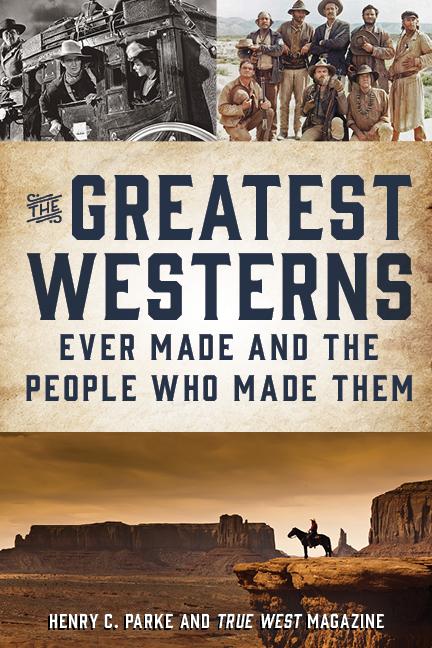
My new book, THE GREATEST WESTERNS EVER MADE, AND THE PEOPLE WHO MADE THEM is now available! It’s based on over 80 of my TRUE WEST articles, many expanded and updated! Buy it from Amazon, or wherever fine books are sold! Click the image to order!
OutWest!
HENRY ON TCM
click image to watch!
OUR FACEBOOK PAGE!
To follow Henry's Western Round-up on Facebook click the link below -- new updates (pretty near) every day!
TRUE WEST - My most recent articles. (TW lets you read 3 articles for free per month)
May/June 2025 -- I have 4 articles in this month's issue, each dealing with a different aspect of the AMERICAN PRIMEVAL miniseries. To find links to all of my earlier True West articles, just keep scrolling.
Every Thursday Bobbi and Jim Bell host the podcast Rendezvous With a Writer, and interview an author. On the first Thursday of every month I join them, present the news in the world of Western films and TV, and take part in their guest’s interview.
For our June 2025 show, our guests are authors of books about Reno Divorce Dude Ranches. Sandra McGee, with her late husband, William L. McGee, is the author of the memoir, THE DIVORCE SEEKERS. Peggy Wynne Borgman is the author of the novel, THE BETTER HALF.
For our May 2025 show, our guest is Anne Hillerman, daughter of Tony Hillerman. She has continued writing her father’s series of Leaphorn, Chee and Manuelito, Reservation-based mysteries. Her 10th, SHADOW OF THE SOLSTICE, has just been published.
Although I haven't gotten a western made yet, there's interest in a western series I've created (on paper). If you'd like to take a look at the sort of things I write, please visit my website, www.henrycparke.com. Thanks for looking!
As Film Editor of TRUE WEST MAGAZINE, every month I explore the world of Western film and television. Below are links to my columns, beginning with the most recent.
As Film Editor of TRUE WEST MAGAZINE, in each issue I explore the world of Western film and television. Below are links to my columns, beginning with the most recent.
On July 30th, 2015, I was the guest of hosts Bobbi Jean Bell and Jim Christina on ‘Writer’s Block’, their L.A. TALK-RADIO talk-show about the art and craft of writing. You can click PLAY to hear it, or DOWNLOAD to download it.
ROUND-UP ON THE RADIO!
Last Christmastime I was a guest on AROUND THE BARN, and had a great time talking about the Round-up, my writing, and Gene Autry’s Christmas music. To listen, click HERE.
Other Stuff I Write
While this blog is strictly about Western stuff, I also write another blog, Stalling Tactics, which is about anything else. If you'd like to read my most recent post, COSTUME DRAMA TRAUMA, go HERE.
MY INTERVIEW WITH BAT MASTERSON – INSP ‘WILD WEST CHRONICLES’ STAR JACK
ELLIOT
On
a day in January, I visited Morning Star’s studio in Acton, California, to watch
a day’s shooting of two INSP series, Elkhorn, about the early formative days in
Teddy Roosevelt’s life, and Wild West Chronicles.
For
three TV seasons, actor Jack Elliot has brought legendary lawman Bat Masterson
to life on INSP’s Wild West Chronicles, and he’ll be returning for a fourth
season starting on Wednesday, September 4th. He plays Bat engagingly,
with an air of gravitas backed by a sense of humor, and an unwillingness to
suffer fools and liars.
A
glance at photos of the historical figure and of the actor reveals another
likely reason for his casting. “It's freakish,”
Jack acknowledges with a laugh, referring to his startling resemblance to Masterson.
“I assumed I looked a little bit like him.” After all, in 2015 he portrayed
Masterson on an episode of Gunslingers. “But then I'll look at photos from set
and compare that to the original: even down to the mustache, the nose. It's a
little creepy.” Or to put a more positive spin on it, “It was meant to be.”
Jack Elliot...
...and the real Bat Masterson.
Later
in life, Bat Masterson became a journalist, and wrote about his friends and
acquaintances and adversaries, and his book, Famous Gunfighters of
the Western Frontier, was the inspiration to have the character of Bat
interviewing his contemporaries, and be the conduit for telling each episode’s
story. And in another example of life imitating art, Jack Elliot has become a
writer, scripting his first episode of the series. “I have: The Hunt
for John Wesley Harden. So many of the stories from the old West are bad guys,
and we don't want to glorify that. We want to glorify the good guys. So it's a
buddy cop drama basically, about the hunt for John Wesley Harden. We start
filming today. Actually, they're filming it right now. You wouldn't think it'd
be such a departure from acting, but writing is truly a departure. Realizing
that every single word that goes into a script, especially a 22-minute script,
is important. It has to be packed with information. You can't have any fat. And
you still have to be able to make it interesting, make the characters
compelling.”
Jack Elliot watches himself on playback.
HENRY
PARKE: When you were chosen to play the character of Bat Masterson, were you
very knowledgeable about him?
JACK
ELLIOT: Not super knowledgeable, but I did my due diligence, tried to read as
many biographies as I could, and watched a bit of the series, but I also didn't
want to do Gene Barry's Bat Masterson. I wanted to make him my own. I didn't
want a preconceived notion of who he was.
HENRY
PARKE: What do you think the Gene Barry show got right, and what did they get
wrong?
JACK
ELLIOT: I don't want to judge his work. I think that he had a great character
for the time. You know, the, the gambler, suave, debonair. Of course he didn't
have a mustache. But I think he did a lot right.Hopefully we're just kind of adding to the
history of the guy. Definitely doing our own thing, but I think they got a lot
right.
HENRY
PARKE: In your research, were there things about Masterson that surprised you?
JACK
ELLIOT: So many things. The guy was a renaissance man. A lot of these guys were
renaissance men and women, that didn't just do one thing. He did so many
things. And after 40 years of successful life in the Old West he decides to
move to New York and become a newspaper man. And he did that successfully for
20, 30 years. And hobnobbed with all these greats. He was great friends with TR,
called to the White House. Teddy made him a U.S. Marshall for the district of
Manhattan. I think he had to sit in on trials;
just a really interesting cat.
I'M PRESENTING 'NEWS OF THE WORLD' SATURDAY, JULY 13TH AT THE AUTRY!
Come join me at 1:30 pm on Saturday, July 13th for a screening of the excellent 2020 Western NEWS OF THE WORLD, starring Tom Hanks and Helena Zengel, directed by Paul Greengrass, co-written by Greengrass and Luke Davies, based on the wonderful novel by Paulette Jiles. For more details, go to The Autry Museum website HERE.
I will also be signing copies of my new book, The Greatest Westerns Ever Made, and the People Who Made Them. You may be able to buy them at the Autry Bookstore, or you can buy a copy from Amazon HERE.
TOM TYLER IS A 'RIP ROARIN' BUCKAROO' AT LONE PINE!
Details are still being finalized for the annual Lone Pine Western Film Festival, October 10th through the 13th, but I've just learned that on Friday the 11th at 11 a.m., I'll be interviewing Sandra Slepski, niece of Wester star Tom Tyler, then we'll be screening his 1936 film Rip Roarin' Buckaroo, which I believe was shot in Lone Pine. I'll have a whole lot more information as the Festival gets closer.
...AND THAT'S A WRAP!
Please check out the July/August issue of True West, featuring my article celebrating the 75th anniversary of She Wore a Yellow Ribbon.
And here's a link to my most recent article for the INSP blog, about the Joel McCrea Westerns, Stars in My Crown.
Happy Trails,
Henry
All Original Contents Copyright June 2024 by Henry C. Parke - All Rights Reserved
COME
TO THE L.A. BREAKFAST CLUB ON WEDNESDAY, MAY 1, FOR ‘THE GREATEST WESTERNS EVER
MADE’, WITH TRUE WEST’S HENRY C. PARKE
That’s
right, my book, The Greatest Westerns Ever Made, and the People Who Made
Them, has been published by TwoDot, and I’ve been asked to speak about it. If
you like Westerns, and you wouldn’t be reading this blog if you didn’t, and you’re
in the L.A. area, we’d love to have you join us, have a delicious breakfast, and you can purchase a book if
you’d like. The Los Angeles Breakfast Club is a fascinating organization,
started 99 years ago, to promote friendship, and the illustrious members over
the years have included all of the studio heads, from Disney to Zanuck, not to
mention Tom Mix. You can buy tickets, and learn all about the Club, here: https://www.labreakfastclub.com/event-details/greatest-westerns-ever
I’ve
been the Film and TV Editor of True West magazine for nine years, and the book
is based on about eighty of my articles. I don’t mean to brag, but here are a
few reviews:
“Film
and TV critic for True West, Parke presents a collection of his
essays that will be a treat for western film fans… There’s plenty of
behind-the-scenes detail and also sharp examination of the cultural impact of
western films and of the social changes that affected their content… Parke’s
enthusiasm is infectious.”
― Booklist
"A
great read... a comprehensive, carefully curated look at the western genre on
film and television. Chock full of personal anecdotes that bring humanity to
its pages."
--
Patrick Wayne, Actor, The Searchers
"Honored to be featured in this new book by Henry C. Parke, film and TV
editor for True West magazine. It’s an in-depth, on point, and eclectic review
of the Western film and TV genre, from John Ford to Taylor Sheridan. If you
love Westerns, you’ll get lost deep in this one."
--
John Fusco, Writer, Young Guns and Young Guns II
Here
are links to a couple of places where my book is available:
The
TCM Classic Film Festival is back in Hollywood, from Thursday, April 18th,
through Sunday the 21st, and as usual, they will be headquartered at
the Hollywood Roosevelt Hotel. The venues where films will be screening are the
Chinese Theatre IMAX, several of the Chinese Multiplex Theatres, the Egyptian –
newly refurbished by Netflix, the El Capitan, and there will be poolside screenings
at the Roosevelt. Check out their website here -- https://filmfestival.tcm.com/programs/schedule/20240418/
They
have, as always, a wonderful array of films that are almost never shown in
theatres. While the packages are insanely expensive, if you go on the stand-by
line for a movie that isn’t THAT popular, or one that’s in a HUGE theatre, you
can often get in: those tickets are only $20, and with a valid student i.d.,
only ten!
Among
the screenings that will be of particular interest to Western fans, on Friday at
9:30 a.m., at the Multiplex 4, they’re showing MIGHTY JOE YOUNG, the 1949
follow-up to SON OF KONG. A western? No, but it stars Ben Johnson, and it’s
introduced by John Landis, director of not only ANIMAL HOUSE, but THE THREE
AMIGOS! At 12:15 p.m. in the same theatre, Leonard Maltin is introducing the
1936 version of THREE GODFATHERS. This is not the John Ford, John Wayne 1948
Technicolor version. It’s directed by Richard Boleslawski, and stars the movies’
Boston Blackie, Chester Morris in the Wayne role, plus Walter Brennan before he
was cute and folksy, and Lewis Stone, when he was playing outlaws instead of
Mickey Rooney's father in the HARDY family films. Very tough, very gritty, very
good.
That
night at 6, still in theatre 4, it’s John Ford’s 1936 film THE PRISONER OF
SHARK ISLAND, starring Warner Baxter as Dr. Mudd, who treated John Wilkes Booth
after he assassinated Lincoln, and was sent to prison for it. The cruel prison
guard is the great John Carradine, and his son, Keith Carradine, will introduce
the film.
Robert Taylor teaches the women to shoot in
WESTWARD THE WOMEN
Saturday
morning they’ll be showing a rare 35mm nitrate print of ANNIE, GET YOUR GUN at
the Egyptian Theatre. At 6:15 at the Egyptian, it’s WESTWARD THE WOMEN, with
Robert Taylor leading an all-female wagon train, directed by William Wellman,
and written by Frank Capra – he wanted to direct it himself, but couldn’t get
it set up. Its premise might sound cute, but it’s a serious film, beautifully
done, and Robert Taylor does some of his best work as a man who truly doesn’t
expect many of his charges to survive. If you’d like to read the article I
wrote about Robert Taylor’s Westerns for the INSP channel, here’s the link: https://www.insp.com/blog/robert-taylor-hollywood-star-husband-to-barbara-stanwyck-and-cowboy/.
WESTWARD is introduced by this year’s honoree for the Robert Osborn Award,
Jeanine Basinger. I was not familiar with her until I interviewed Dana Delaney,
who told me of her college experience, “Wesleyan is more of an academic school
than a theater school. But they had a wonderful film department run by Jeanine
Basinger, and that was where I really developed my love of westerns.”
Sunday
at 9:30 a.m. in the Multiplex 6 they’re showing 1932’s LAW AND ORDER, the first
talkie version of the Gunfight at the OK Corral, starring Walter Huston as
Wyatt Earp, and Harry Carey as Doc Holliday, introduced by Brendan Connell Jr.,
C.O.O. of the Academy of Motion Picture Arts & Sciences.
And
at 3:15 p.m. at the Egyptian Theatre, see the premiere of the 70mm restoration
of John Ford’s THE SEARCHERS, introduced by the director of THE HOLDOVERS, and
two-time Oscar-winner for scripting SIDEWAYS and THE DESCENDANTS, Alexander Payne.
MASON
BEALS – THE MAN WHO WOULD BE TEDDY ROOSEVELT
ELKHORN,
the new INSP series which airs on Thursday nights, stars Mason Beals as 25-year-old
Teddy Roosevelt, a well-educated, socially prominent urban up-and-comer with a happy
homelife and a growing political career, who saw his life shatter when, in one
day, his mother died of Typhoid, and his wife died giving birth. Determined to
rebuild his life, the frail, sickly young man abandons east coast city life and
travels west, settling in the Dakota Territory.
Mason
Beals, who plays Teddy has, to put it mildly, followed a non-traditional route
to stardom. His self-generated career began as a reaction to desperate boredom.
“For about nine months, I lived in the middle of nowhere, Idaho, in this town
called Bonners Ferry. That’s because my dad had traded a Jeep for an acre and a
half of property. My parents wanted to live debt free, so we built this place
that looked like Noah's Ark, and lived there when the building was three-quarters
finished. We were really trapped inside in the wintertime, and my younger
brother and I were as bored as could be. I was just chopping and stacking
firewood all winter, and I just started making YouTube videos, doing silly
little vlog type things, and eventually started making stuff that was more scripted.
That's where I learned how to edit and shoot.”
Mason Beals as Teddy Roosevelt
When
his family moved back to his hometown of Coeur d'Alene, Idaho, the performing
bug had bitten him, “but there wasn't much of an acting scene out there, so if
you wanted to act, you had to make your own stuff.” He moved to Austin, “and I
worked for a production company as an editor, as a shooter, sometimes
producing, directing, and continued to make short films,” until his final move
to Los Angeles, when he “started to do work with other people.”
Unlike
many men his age, the Western genre is not foreign to Mason. “My dad’s a really
big movie fan. He’s a blue-collar guy, did hardwood floors for 30 years. I was reminiscing about how we were going to Blockbuster
every week, and I remember he and I had watched 3:10 TO YUMA for the first time
and I just loved it. And TRUE GRIT is great. So there were a handful of
westerns, and I always enjoyed them. And now having done one, anytime I watch a
Western, it's very much like, now I know how the sausage is made a little bit
more. So it's very fun to watch it from that angle; they’re such a fun genre.”
He
credits his father’s example in preparing to take on the responsibility of
playing a lead in a series. “A hard work ethic is needed for something like
this, and I definitely got that from my dad. I did hardwood floors with him for
a good period of time. I mean, he's just the hardest worker that's ever graced
this earth, and so learning from him, it teaches you a little bit of grit, and
learning how to be a little bit rough and tumble, going with the flow of
things. Keeping a positive attitude when things go wrong; he would always keep
a good demeanor. That kind of psyche skill.”
In
what ways was does Mason think he and Roosevelt are alike? “You know, when I
was reading about his time (in Elkhorn), he talked about how scared he was when
he came out here. And he said, by pretending to not be afraid, he became not
afraid. I really did relate to that, because the role is intimidating in a lot
of ways because he's such an icon. It's definitely an adventurous kind of a
shoot. I really relate to the fish out of water element. I was bullied in
school and TR was bullied.”
Teddy at his wife's deathbed
Mason
brought some Western-ish skills with him, but others he’s had to learn as he
goes. “Horseback riding was definitely new for me. Even though I had grown up
around people who had horses, I just had never had the opportunity. But it was a
pretty quick learning period; I had just a handful of lessons, and then the
experience came just being on-set. I learned a lot; I feel very comfortable on
horses now in a way I didn't really think I was going to. I'm kind of a coward
in a lot of ways. Riding, that's probably the biggest skill that I've like
taken away from this. But I grew up shooting guns, growing up in Idaho.”
AND
THAT’S A WRAP!
Coming
in the next Round-up, my interview with TOMBSTONE costume designer Joseph
Porro!
Happy
Trails!
Henry
All
Original Contents Copyright April 2024 by Henry C. Parke – All Rights Reserved
On Wednesday, February 24th,
season two of The Ultimate Cowboy Showdown returns to INSP.Some of the best working cowboys from around
the country compete in teams and as individuals in a wide range of challenges –
riding, roping, driving cattle, and complex relay-races.Country music legend Trace Adkins is once
again the host and, with the input of experts in various specialties, the
ultimate judge, and Trace sends at least one competitor home every week. This
time the field of competitors is larger – fourteen instead of a dozen – and the
already valuable winnings are bigger as well: the last man standing wins a
$50,000 herd of cattle, a Rawhide Portable Corral, an Arrowquip Q-Catch 87
Series Cattle Chute, not the mention the coveted Ultimate Cowboy Showdown belt-buckle,
and a lifetime of bragging rights.
I had the opportunity to
talk with Trace Adkins about the new season, and also spoke with Jennifer
Hudgins, one of this season’s four female competitors.
HENRY
PARKE: Back in 2019,
I visited you on location in Alabama. And now the shows moved to Texas. Why the
move?
TRACE ADKINS: They just wanted to do it in a different
place this time. And we had a lot, a lot open ground out there in Texas that we
could utilize.
HENRY
PARKE: How did the
change of locale change the show?
TRACE ADKINS: We were planning on shooting it in March, and
then COVID happened. We finally got
everything figured out, how we could do it during COVID. That took until the
1st of July. So doing this show in Texas in July was challenging, I'll tell you:
it was hot.
HENRY PARKE: I'll bet. Were you folks all quarantined?
TRACE ADKINS: Yeah, once everybody got there, the first day
everybody took tests, and then quarantined, and when all the tests came back
negative, we just stayed in our little bubble and did our thing.
HENRY PARKE: What's the best part of doing the show?
TRACE ADKINS: Just the opportunity to watch these
professionals at work. I mean, it's still amazing to me. There are still
working Cowboys in this country that still do it, the old school way. And it's
just really fun to watch.
HENRY PARKE: Has the success of season one changed the
kind of competitors you get?
TRACE ADKINS: Yeah, and I knew that it would. As I went
around last year, after the first one came out, I ran into a lot of cowboys
that were like, “You didn't have no good cowboys on there! I could do that.”
And I was like, come on, we're gonna do another one. You can throw your hat in
the ring and see what you got. Nothing against the contestants that we had the
first season. But, once you got down to that cream of the crop last year, those
final four we had; we started out with 14 of that caliber at the very beginning
of this season. So it was a horse of a different color this year.
HENRY PARKE: On every show, after the elimination
competition, you send at least one cowboy packing. In addition to being the host,
you're also the ultimate judge. When you question the competitors in the arena before
announcing your decision, are you actually making your final determination
based on their answers? Or have you
decided who's going out before you come out and tell them?
TRACE ADKINS:It was different; it could go two ways.Either I would go into the arena at sundown
pretty much having made up my mind, and then it was going to be up to them to
fight, to stay, or to say something that was going to change my mind. Or
sometimes I would go in not knowing who was going to go, and not even leaning
toward anybody. And then it was totally up to them as to how they conducted
themselves in the arena, as to who was going to go home. It was always my
decision.
HENRY PARKE: Your father was a rodeo cowboy. Does this
show bring back a lot of memories?
TRACE ADKINS: Well you know, he quit riding before I was
old enough to remember. I think my mother probably told him he needed to stick
with that good job, and stop chasing those rodeos around. But he was a good
horseman: he was the real deal. I know
that he would've really enjoyed this show.
HENRY PARKE: Did you ever
compete?
TRACE ADKINS: No.
HENRY PARKE: If you were as young as the contenders that
you have on the show, what competitions do you think you'd have done best in?
TRACE ADKINS: Probably just the strong back and the low
skill level type chores. (laughs)
HENRY PARKE: In the first
episode of this new season, someone says that it's pasture cowboys versus arena
cowboys. Is that accurate?
TRACE ADKINS: Yeah, some of it. But the way that the
competition was structured, nobody really had the upper hand because the tasks
were so varied.
HENRY PARKE: How life-changing do you think winning the
herd, the ranch equipment, and of course the buckle, can be?
TRACE ADKINS: Oh, I think it means a great deal to these
folks. That's why they just poured their heart and soul into trying to win. It
was very, very important to them.
HENRY PARKE: Was there anything you learned from season
one not to do in season two?
TRACE ADKINS: That's been the case and throughout most of
my career: the best lessons I've learned have been what not to do. But I don't think in this case that was
applicable.
Incidentally, I also
spoke to Trace about his Western movie career – you can read about that soon in
True West. He has two more Westerns in
the can, Old Henry and Apache Junction, and is currently shooting
a third, The Desperate Riders, in Nashville.
I watched the first three
episodes of the new season of Ultimate Cowboy Showdown, and saw Jennifer
Hudgins get roughly stomped on by a large calf, that left her hurting.
Jennifer Hudgins
HENRY PARKE: How are you feeling? The trampling that you
took looked pretty rough.
JENNIFER HUDGINS: It was pretty rough, and I was pretty sore
right after, but I'm good now.
HENRY PARKE: Very good. Pretty early on, someone makes the
point that the competition in a sense is arena cowboy versus pasture cowboy. Is
that true?
JENNIFER HUDGINS: In a lot of ways, it kind of was. You know, so many of the challenges were kind
of geared towards the arena, and the pasture cowboy is kind of a little
different game.
HENRY PARKE: Where do you fit in?
JENNIFER HUDGINS: I'm definitely more of pasture cowboy
rancher. I'm not that much of an arena
cowboy, and haven't been for several years.
HENRY PARKE: What exactly is a cow boss?
JENNIFER HUDGINS: A cowboy. Most people refer to the cow boss
as the guy who kind of runs things on the ground. The cow boss is the person
you're going to look to when you're gathering cattle, when you're sorting in
the pens; day-to-day, hands-on type operations like that.
HENRY PARKE: What’s a top hand?
JENNIFER HUDGINS: A top hand would be somebody that sure enough
good at what they do. Good horseman, good cowboy, knows how to handle cattle
the correct way. Keep things quiet and get things done efficiently.
HENRY PARKE: Do you know how much competition there was to
make one of the 14 spots in the show?
JENNIFER HUDGINS: I really don't. At one point I heard that thousands
of people applied and sent in videos, but I never heard an exact number.
HENRY PARKE: How did you audition? Did you send in a
video?
JENNIFER HUDGINS: They called me. A friend of mine had given
them my information and they reached out to me and then we did a Skype
interview. I did two or three Skype interviews, I believe.
HENRY PARKE: Did you do anything special to prepare for
the competition?
JENNIFER HUDGINS: Not really. I wouldn't say I did anything
that I don't really do all the time. I just tried to really prepare mentally
more than anything.
HENRY PARKE: How do you prepare mentally?
JENNIFER HUDGINS: Sometimes you just have to put your big girl
panties on and get your game face on and know you're going down there to win. And you're going to be competing against
people that are just as good or better than you. You really don't know. And you
just have to get yourself in the right head space.
HENRY PARKE: Sometimes there's touchiness us about
terminology. Do you prefer cowboy, cowgirl or something else?
JENNIFER HUDGINS: I prefer the term cowboy. There's nothing
wrong with the term cowgirl, but when you say it, people automatically picture
in their head like you're a rodeo queen type person. And while that's fine,
that's not who I am. I'm day-to-day doing a man's job in a man's world, and can
do it just as well as they can. So I feel like I should be on the same level.
HENRY PARKE: As a dad of a daughter myself, I love what
you said about working with your dad being your daycare. Tell me a little about
growing up with your dad in the cattle business as a kid.
JENNIFER HUDGINS: You know, my dad has been in the cattle
business my entire life. He is
definitely old school cowboy all the way to the core. And he's a tough man. He
expected a lot out of us growing up. From the time I was little bitty, he took
me along with him. He might be catching wild cattle for people, and he wasn’t
going to put me in harm’s way. He'd tell
me, “Stay right here on the back of this pickup, and do not get off for any
reason.” And by gosh, I stayed there. I'd have my crackers and my pop and toys
and just play there, as long as it took. Now on the days I could go, I had a
pony, and that pony knew to stay right behind my dad and I just went everywhere
they went.
HENRY PARKE: Growing up, what sort of things were you
learning to do on your ranch?
JENNIFER HUDGINS: We learned a little bit of everything. My
dad, he's pretty versatile. He knows how
to run a cow calf operation. He knows how to run yearlings. And we did all that
my entire life. I grew up learning how to ride a horse, how to gather cattle, how
to rope, how to sort, learning how to do all those things correctly and keep
the cattle quiet. We learned to process cattle the right way. I have a younger
brother, and any aspect of ranching, we grew up watching my dad do that and we
just tried to mimic him.
HENRY PARKE: Well now forgive me, because I'm a Brooklyn-born
city slicker, so there's a whole lot that I don't know about cowboying. I
didn't know you're not supposed to ride your horse in front of somebody, but I
sure learned it from the show. Why not?
JENNIFER HUDGINS: That's a big no-no. You don't ever ride in
front of another person like that. It's a major respect thing. When you're out
there gathering cattle, everybody has their spot and everybody needs to stay in
their spot. Because if we go to try and jump ahead, then we're leaving holes
for the cattle to get away from us. And by riding in front of another cowboy,
you're basically saying, you're not doing your job, so I'm going to ride up
here in front of you, cut you off because I feel like I need to be here, and
you don't. It's incredibly disrespectful.
HENRY PARKE: From the brief biography I read, work-wise it
sounds like you have a pretty full plate. Why did you decide to enter this
competition?
JENNIFER HUDGINS: I was kind of back and forth on whether I
really wanted to do it or not, because you just don't know what to expect. I'd
never in my life done anything like that. I had seen the previous season of the
Ultimate Cowboy Showdown, but I was a little leery, but then my dad kind of
pushed me and was like, this is a once in a lifetime opportunity. You go down there and win it and you've got
$50,000 worth of cattle, and that's a big deal.
HENRY PARKE: And the equipment that comes with it must be
very valuable,
JENNIFER HUDGINS: Like the portable set-up pen, those can be a
game changer, that can open opportunities for getting more land where there
weren't pens available, and not having to invest a bunch of money right off the
bat in building a full set of pens, because you have that portable corral.
HENRY PARKE: The show starts with 14 contestants, 10 men
and 4 women. Have you made any friendships?
JENNIFER HUDGINS: I really got to know Morgan and have a lot of
respect for her. She comes from a
totally different part of the country (Shell, Wyoming), and the way they do
things and the way we do things here in Oklahoma are vastly different, but I
had so much respect for the kind of cowboy that she is. I got to be really good friends with Ora (Brown)
and JP (John Paul Gonzalez) and we still keep in touch. We still talk two or
three times a week. Really good guys, good family men. And I will cherish those
friendships for life.
HENRY PARKE: I'm pretty sure you made at least one enemy
with Tyler Kijac.
JENNIFER HUDGINS: Yeah, Tyler is probably not my favorite
person, but at the end of the day, this happens when you're ranching and you
have guys come day-work for you. Sometimes there's a class clash of
personalities, like in any job in an office setting, or in the middle of the
pasture gathering cattle. Sometimes things get heated, you have somebody that
doesn't really know what they need to be doing, and they can't take direction
and it generally will get you in a bind. And that happened many times with
Tyler. He's not a pasture cowboy. He doesn't know how to read cattle. He's not
ever in the right spot when you're gathering or sorting. And so that causes a
problem for everybody trying to work with him. And I did get in the middle of
him a few times, but when it's all said and done, I just leave it there. I
don't carry it with me.
HENRY PARKE: Have you ever tried out for any other TV
reality show?
JENNIFER HUDGINS: No, I have not. But yes. I love reality TV. I
probably watch more reality TV than anything.
HENRY PARKE: Were you disappointed that there was no rose
ceremony?
JENNIFER HUDGINS: At the end of the day when Trace calls us all
down there to the arena and sends someone home, that was a pretty intense
situation at times. They didn't need to
give me a rose. I was happy to go sit on the fence. (Note: if Trace tells you
won’t be eliminated, you go sit on the fence.)
HENRY PARKE: How does cowboying in Texas compares with
Oklahoma?
JENNIFER HUDGINS: I would say there's a lot in common. The way they do things there is very similar
to the way we do things here. It gets
really, really hot in the summertime and it was that way there. Extremely hot. So
you kind of have to work around that, so you don't stress the cattle and you're
not overworking your horses. The heat does come into it.
HENRY PARKE: How did you like Trace Adkins?
JENNIFER HUDGINS: He was really, really intimidating at first.
He's such a big guy and he has such a deep voice. When he first walked up, I was like, Oh my
gosh! A very commanding presence. But after the first few days, when we were
around him a little bit more, he really seems like a good guy. He joked around
with us a time or two, kind of laid back and pretty easy going for the most
part. But when, when he gets down there in that arena at elimination time, he
means business.
HENRY PARKE: Can you tell me anything funny or interesting
that happened that we might not see in the show?
JENNIFER HUDGINS: When I got trampled by the calf, it ripped my
pants pretty much completely off of me on one side. So I don't know how much of
that will actually be on the TV because, literally, my whole butt is hanging
out and here it is like our first immunity challenge. That was something that
you just have to laugh about it and go on; you can't change it.
HENRY PARKE: Did you learn anything of value from your
competitors?
JENNIFER HUDGINS: There were a lot of things that I took away
from the competition. I have a lot of
respect for some of my fellow competitors that they are outstanding arena cowboys.
They're good at what they do, and being able to watch them in their element
when we had that type of challenge, you can really take a lot away from that.
Maybe they don't do what I do, but that doesn't mean they're not good at what
they do.
HENRY PARKE: Looking back, is there anything you would
have done differently in the competition?
JENNIFER HUDGINS: After it's all over with, you can always see
your mistakes. I think there's some things I would've done a little differently.
Maybe thinking things out a little longer instead of just reacting.
HENRY PARKE: Were there any big surprises?
JENNIFER HUDGINS: Going into it, I don't think any of us were
prepared for how mentally, emotionally and physically exhausting it would be. We
know we have to work hard, because we do every day. But being in that situation,
you’re away from home, away from the people that you care about that, are your
support system. And you're thrown in with all these strangers in this
competitive environment. It can be very, very mentally challenging at times.
And I don't think any of us were prepared for that.
Several European nations
have had a long association with Western filmmaking – Germany, Italy,
Spain. But France is among them. True, many Spaghetti Westerns were international
co-productions that included French financing and therefore some French cast
members. But aside from a pair of
Brigitte Bardot films, 1965’s Viva Maria, and 1971’s The Legend of
Frenchie King, there are very few Westerns from French filmmakers. So I was surprised and delighted to learn
that Samuel Goldwyn Films had acquired a new French Western, Savage State, which
is now available On Demand and Digitally.
It’s the story of a
French family in Missouri at the start of the Civil War, who make the tactical error
of allying with the Confederacy. They
quickly determine their safety demands that they return to France as quickly as
possible. They hire a mercenary to lead
them, and find themselves confronting not only Union soldiers, but the former
associates of their mercenary. The cast
includes Alice Isaaz, Deborah Francois, Kevin Janssens, and Kate Moran. With striking exteriors, from town to forest to
snow-covered fort, and elegant interior sets, particularly a ballroom where a
celebration goes startlingly all to Hell, Florian Sanson’s art direction and
Christophe Duchange’s cinematography combine to make one of the most beautiful
Westerns in recent memory.
Writer-Director David
Perrault first garnered admiration for his 2013 film Our Heroes Died Tonight,
a 1960s crime drama about a man who
leaves the Foreign Legion to drift, reluctantly, into a career as a masked
wrestler. Savage State is a heavily atmospheric film,
sometimes almost dream-like, and with that dream-like feel are some apparent
lapses of logic. I had the pleasure of interviewing
Perrault, and learning about his passion for the genre, and his adventures
making Savage State.
HENRY
PARKE: I was surprised to learn that Savage State is not your
first Western – that was No Hablo American.
France has produced great filmmakers since the Lumiere brothers, but not
usually Westerns. Why have you chosen
this genre twice?
DAVID PERRAULT: I love westerns since I was a child. I
had a Super 8 projector, and one of the 3-minute reels was the Indian Attack in
John Ford's Stagecoach. Much later I discovered his films and he remains
the greatest American filmmaker for me. Even though in writing and filming Savage
State, I tried to forget all of those classics and move towards something
almost radically opposed. We cannot redo what has already been done, it is unsurpassable!
HENRY PARKE: Is there
actual history behind your story? Were
there French nationals in the U.S. who thought it best to leave when the Civil
War broke out? Are your characters based
on real people? Or are they your invention? DAVID PERRAULT: While writing the screenplay, I
researched French settlers during the Civil War. The demand for neutrality by
Napoleon 3 during the conflict is very real, for example. On the other hand,
the characters are completely fictitious.
HENRY PARKE: I thought
you actually shot in the U.S., but IMDB says you filmed in Canada, France and
Spain. Have you been to the United
States, specifically the American west? DAVID PERRAULT: Yes, that was the challenge of making
people believe in the United States by filming in such different places. My
wife has an American aunt so it's a country that I know well. But I know it
especially through the films and in particular the classics of the Hollywood
golden age.
HENRY PARKE: I believe
your previous film, Our Heroes Died Tonight, while period, was not so
long ago, and was shot in town. Savage
State, by contrast, is set 150 years ago, in a foreign land, requiring all
manner of difficult-to-find costumes and props and locations, and was filmed in
three countries, on two continents. What
were the biggest challenges? What sort
of unexpected problems did you have to overcome?
DAVID PERRAULT: The biggest challenge was the weather.
You never knew what to expect. In Canada, for the final shootout scene, it was
snowing and extremely cold. The team was going crazy in these extreme
conditions. The guns, the kerosene lamps, the filming equipment… everything
started to freeze. The camera was covered with a survival blanket, but the
optics froze too!
HENRY PARKE: The film is
beautifully lit and shot, wonderfully atmospheric, sometimes almost
dreamlike. What look and mood were you
going for? Do you storyboard
extensively?
DAVID PERRAULT: No storyboard. I am an extremely visual
person, I have the film in my head and when I arrive on the set I adapt to the
actors, to the weather. At one point in Savage State, we see the convoy going
through the haze, it was not planned, but I jumped at the chance to make an
iconic shot. Overall, I wanted it to have a gothic feel, close to fantasy
cinema. As you say, the film is constructed as a daydream, sometimes
nightmarish. This was really the line I wanted to follow.
HENRY PARKE: You have
such a strong cast, so many talented women.
Is it hard to find performers who are convincing in historical
stories? Can you say something about the
casting process?
DAVID PERRAULT: I wanted to create a very strong group of
women on screen. So I chose actresses from very different horizons to create
relief. During the casting, I am very sensitive to the voices and the way they
go together. It's a very musical way of working.
HENRY PARKE: I understand
why the smugglers were masked during crimes, but why were they masked even when
sitting around the campfire, and presumably eating?
DAVID PERRAULT: It's an unrealistic bias that takes part
in the nightmarish and hallucinatory atmospheres that I wanted to give to the
film.
HENRY PARKE: Do you have
plans for your next movie? Is it a
Western?
DAVID PERRAULT: It's not a western, nor a movie. It's a
TV show about dreams precisely.
DVD REVIEWS
DON RICARDO RETURNS – or,
if Zorro and the Cisco Kid had a baby…
With his story The
Curse of Capistrano published in 1919, Johnston McCulley created Zorro, the
prototype for the swashbuckling Mexican hero in Westerns for years to
come. Douglas Fairbanks played him to
great success the following year, and he would later be portrayed by Tyrone
Power, Guy Williams, Alain Delon, and twice by Antonio Banderas, among others. McCulley would continue to write until his
death in 1958, and many of his stories were turned into movies. He was only credited with one produced
screenplay, ironically based on another writer’s famous character: Doomed
Caravan (1941), starring William Boyd as Clarence Mulford’s Hopalong Cassidy.
In 1946, P.R.C. released Don
Ricardo Returns, original story by McCulley, about a wealthy young
nobleman, Don Ricardo (Fred Coby), who is Shanghaied, and when he escapes and
returns to Monterey, learns that the culprit, his cousin Don Jose Luerra
(Anthony Warde), has had Ricardo declared dead, and is trying to claim his
property, and woo his intended, the lovely Dorothea (Lita Baron, aka
Isabelita), who is handy with a sword herself.
While the film is itself a poor cousin to 20th Century Fox’s Mark
of Zorro (1940), and Fred Coby is no Tyrone Power, it is an entertaining 63
minutes, with good dialog and swordplay.
Look quick, and Fred Coby looks like Tyrone Power.
That's the San Fernando Mission behind them.
Rather than being
studio-bound, director Terry O’Morsemakes ample and effective use of two historical landmark locations, The
San Fernando Mission, and the Andres Pico Adobe, both of which are happily
still standing, and open to visitors.
Of particular interest is
that the screenplay is co-written by Renault Duncan, the nom de plume of
actor Duncan Renaldo, famous for his portrayal of O. Henry’s the Cisco Kid in
eight movies and 157 TV episodes.
Renaldo also was associate producer on the film. He would go on to write three more
swashbucklers, Bells of San Fernando (1947), The Lady and the Bandit
(1951), and The Highwayman (1951), all with cowriter Jack DeWitt. Don Ricardo Returns is available from
Alpha Video HERE. https://www.oldies.com/product-view/8366D.html
THE PHANTON PINTO –
my first car
I’ve always had a
fondness for Westerns made during World War II, where the characters were
simultaneously fighting range wars and Nazi spies. In the tiny budget Phantom Pinto, when
rancher Wade (Milburn Morante) balks at selling apparently worthless land for a
high price to German accented Kurt Hank (Sven Hugo Borg), he turns up
dead. Wade’s daughter (Dorothy Short) is
eager to sell, but dad’s old confidante Jim (Dave O’Brien) and Wade’s 10-year-old
son Buzzy (Robert “Buzzy” Henry) smell a rat, or maybe a Schweinhund,
and
discover Hank and his minions want the land to mine valuable deposits of
strontium! Jim says that’s something
used to make fireworks, but the remarkable thing is that this film was released
in May of 1941, long before the U.S. entry into the war, and Strontium 90 is a
radioactive isotope produced during nuclear explosions! I don’t know who screenwriter E.G. Robertson
was listening to, but it was someone who talked too much!
Buzz Henry as a kid.
So cheap and crudely made
that it seems more like an early 1930s rather than ‘40s film, it even features silent-movie
style open-air sets pretending to be interiors, the most appealing thing about
it is Buzzy Henry. A talented for-real
child cowboy, in addition to riding and roping, he gets all the best lines: “Get
along there, you un-American polecat,” and “C’mon, Mr. Hand-kisser! You’ve got a date with Uncle Sam!”
As an adult, Buzz Henry
would become a much in-demand stuntman and stunt coordinator, and was
second-unit director on Our Man Flint, The Wild Bunch and Macho
Callahan, and in 1971 was doing the same job on The Cowboys when he
was killed in a motorcycle accident, at age 40.
The Phantom Pinto is available from Alpha Video HERE.