Showing posts with label Ross Hagen. Show all posts

Monday, December 31, 2012

'DJANGO' UNCHAINS TARANTINO!


DJANGO UNCHAINED -- Film Review

 
Christoph Waltz and Jamie Foxx
 

It’s virtually impossible for any film to live up to the anticipation of whatever is the next Quentin Tarantino project, but DJANGO UNCHAINED makes a pretty good stab at it.  The long-awaited ‘Spaghetti Southern’ would seem to owe as much of a debt to the Blaxploitation Westerns of the 60s and 70s as it does to the Spaghetti Westerns.  But in truth, the black Westerns of that period were so uniformly lousy that the debt is pretty thin, whereas the skills of the best Spaghetti Westerns filmmakers – the Leones, Corbuccis and Castellaris – were so fresh and original that virtually all good Westerns of the last few decades owe them plenty, this one included.


DJANGO UNCHAINED is neither a sequel nor a remake of Sergio Corbucci’s 1966 classic DJANGO, which established Franco Nero as Europe’s greatest Western star.  While to Americans, ‘Spaghetti Western’ has always been synonymous with Clint Eastwood and ‘The Man With No Name’, in Europe I am told that Nero and the character of ‘Django’ have always had a slight edge.  (You can read my brief chat with Franco Nero about his Corbucci Westerns HERE ) This led to roughly forty so-called Django films, and I say ‘so-called’ because European copyright laws are different from the U.S. ones, meaning anyone can call their film and their character Django. 

 
Franco Nero as DJANGO (1966)
 

Nero played many similar characters in other westerns, and a pre-TRINITY Terence Hill, made up to pass for Nero, played Django, but Nero only played Django once more, twenty-one years later, in 1987’s DJANGO STRIKES BACK, shot in Columbia, and co-starring Donald Pleasance.  Fortuitously, the new interest in the original Django character stimulated by the Tarantino movie has created the possibility of Nero playing him once again (see last week’s Round-up HERE  ). 


Franco Nero in DJANGO UNCHAINED (2012)


While Nero’s Django roamed the Spanish West dragging a coffin, and searching for his wife’s killers, Jamie Foxx plays a slave whose wife is very much alive, but after being caught trying to escape together, they’ve been recaptured and in a bit of cruel revenge, owner Bruce Dern sells them separately. 
 

As the picture opens, Django is among a group of slaves being transported by brothers James Russo and James Remar.  Dentist Dr. King (Christoph Waltz) meets up with them, offering to buy one of the slaves who came from a particular plantation – but it’s a ruse.  He’s quit dentistry for bounty-hunting, and when they won’t sell Django, who can identify three high-bounty brothers for Waltz, the guns blaze.


Bounty hunter and slave become friends – their friendship is the heart of the movie – and strike a deal: Django will assist Dr. King, learning the trade, and when the change in seasons permits, they’ll go to Candieland, the brothel-cum-plantation of the thoroughly despicable Calvin Candie (Leonardo DiCaprio), where they will try to liberate Django’s bride, German-speaking Broomhilda (Kerry Washington).  


From here the story is a swirling Techniscope kaleidoscope of beautiful vistas, invigorating action, unexpected humor, and a thirst for revenge.  While the plot, in broad strokes, holds no startling surprises, there are plenty of jolts for seen-it-all western fans, both in stirring fond memories of favorite shootings, and I-never-saw-it-done-quite-that-way moments. 


I’ll let the other critics point out each and every real and imagined reference to specific Spaghetti Westerns (“Is Christoph Waltz’s Dr. King a German in a nod to Klaus Kinski, or in a nod to the German Western stories of Karl May, or because Waltz has a German accent, and is he a dentist because Doc Holliday really was one, or because Bob Hope played one in THE PALEFACE…?) 

 
DeCaprio, Waltz, Jackson, Foxx
 

As is true in the best Western work of Leone and Corbucci, and Peckinpah and Hawks and Ford for that matter, there is plenty of humor.  Among the high points are a just-freed slave’s choice of clothing, and a pair of sequences, one beginning with a mixed-race visit to a saloon, and another, reportedly tacked on at the last minute, involving Klansmen and their hoods, that clearly contain a nod to Mel Brooks’ BLAZING SADDLES, even utilizing a Slim Pickens sound-alike. 

 
All must inevitably lead us to Candieland, the Mandingo fighters -- slaves who fight to the death for the entertainment of the decadent plantation owners -- the rouse to try and liberate Broomhilda, and the film’s ultimate climax.  There’s a lot of buzz about DeCaprio’s performance, and there is a lot to like in it.  In fact, there is too damned much to like in it, and in much of the film.  While Tarantino doesn’t present his story in chapters, as he has in previous films, there are several set-pieces, all of them good-to-excellent, and all of them a little too long.  One of the toughest jobs for a writer is to tell when a scene needs to end, no matter how much more good dialogue you’ve thought up.  There needs to be a sense of urgency to get to the next event, especially in a story where a man is trying to save his wife from ‘a fate worse than death,’ and the easy-going pace undercuts that urgency.  It’s true that Spaghetti Westerns tend to run long, but in Europe they were always shown with an intermission.  DJANGO UNCHAINED doesn’t need an intermission, but it needs a half-hour of trims of the excessive good stuff.


The performances are excellent – Foxx, Waltz, Don Johnson as a plantation owner, Dennis Christopher as DeCaprio’s consigliore.  DeCaprio is particularly striking in his Ante Bellum metrosexuality – the epitome of the rich and privileged guy who surrounds himself with hired real men, and kids himself that he is one.  Samuel L. Jackson, hardly recognizable, made up to look like the face on a box of Uncle Ben’s Rice, is chillinging real as the ‘old family retainer’ who terrorizes all of the other slaves.  In fact, one of the very effective themes throughout the movie is the social position of blacks: free blacks versus house slaves versus field hands, and can any black man be allowed to ride a horse?

 
Two Djangos meet.
 

The cast not only of characters but of cameos was impossible to keep up with.  Franco Nero makes much of his part, long on camera but with just enough dialogue.  James Remar plays two characters, and while I caught Tom Wopat, Michael Parks and Tom Savini, I missed Russ Tamblyn, Lee Horsley, Don Stroud and Robert Carradine.  I’ll try again on the next viewing.


In a movie world that largely believes that only the lead characters matter, Tarantino continues to think that all men are created equal – a capper line is as likely to come from an unnamed character as it is a star.  He excels in directing actors and action.
 

Thrice-Oscared DP Robert Richardson does his usual magnificent job, as he has repeatedly for Tarantino and Scorcese. 
 

The score is a mix of some new music, a new Ennio Morricone song, and others snagged from other sources, including of course Luis Bacolov’s original DJANGO theme, as well as his HIS NAME WAS KING theme, and one of the very best, Morricone’s theme from TWO MULES FOR SISTER SARAH.


I highly recommend DJANGO UNCHAINED.  No, it’s not Tarantino’s very best, but what he does is always so good, and so off-center from the mainstream that its faults are forgiven.  I’d just like to have seen what he could have done with less money and time.


Also, I feel I must comment on Tarantino’s recent interview, where he denounces D.W. Griffith, and says he’s no fan of John Ford.  The Griffith comment saddens me, because it’s kicking a man not only when he’s down, but when he’s dead and unable to defend himself.  Yes, Griffith directed BIRTH OF A NATION, the nation in the title being not the U.S., but the Ku Klux Klan.  I certainly understand and agree with the criticism for glorifying such an awful organization.  But it should be remembered that Griffith was widely denounced at the time, and not only apologized, but had his eyes so opened that he made the film INTOLERENCE as an apology, and a denunciation of man’s intolerance of man.  One of his very last films was an excellent portrait of his former ‘villain’, ABRAHAM LINCOLN, starring Walter Huston, scripted by the great Stephen Vincent Benet.  And while his artistry and contributions to the language of film can not be overestimated, Griffith’s even had his name stripped from a Director’s Guild annual award.  He didn’t murder anyone, and it’s been just shy of a century: will we never accept his apology?


As for John Ford, Tarantino criticizes him for being an extra in BIRTH OF A NATION, and playing a Klansman.  C’mon!  And despite what Tarantino may think of some of the portrayals of Indians in some of his films, even when they were playing the enemy they were always treated with respect.  Certainly the Indian actors who worked for Ford loved the experience and we eager to do it again.  John Ford is the one who made CHEYENNE AUTUMN, portraying the mistreatment of Indians by a hostile and contemptuous government who consistently signed and then violated treaties with the Indians.  And as for his treatment of blacks on film, Ford made SERGEANT RUTLEDGE in 1960, when the story of a black sergeant falsely accused of the rape and murder of a white woman was unbelievably daring.


MARK OF THE GUN – Film Review


One of the fascinating things about a time capsule is that, when someone opens it years after it was buried, the contents are a complete surprise.  MARK OF THE GUN is such a time capsule.  Made in 1966, forty-six years ago, this tiny, independent black & white Western was not only forgotten, it was as far as can be ascertained, never even seen!


Ross Hagen, a big, handsome tough guy with a trademark gravelly voice, was a prolific character actor in television and drive-in movies.  On film he appeared with Elvis in SPEEDWAY.  On television he guested frequently on GUNSMOKE, THE VIRGINIAN, HERE COME THE BRIDES, LANCER, as well as on many cop shows.  He produced, starred in, and sometimes wrote and directed, a number of low-budget epics like THE SIDEHACKERS, PUSHING UP DAISIES, BAD CHARLESTON CHARLIE and WONDER WOMEN.  Apparently, the first film he produced and starred in was MARK OF THE GUN.  Shortly before Hagen’s death in 2011, he found the negative of this never-released oater.  Director, producer and close friend Fred Olen Ray decided to snatch this film from the gaping jaws of oblivion, and give it its very first release through his company, Retromedia Entertainment. 


One of the novelties of a period picture that was made some time ago is that it reflects two periods, when the story was set, and when it was shot, and that is a lot of the campy fun of MARK OF THE GUN.  Set around the 1870s, but shot in the 1960s, all the girls have heavily sprayed hair, and many of the bad guys act more like juvenile delinquents than outlaws.  This is backed by the anachronistic jazz score by low-budget music stalwart Jaime Mendoza-Nava.  In fact, they treat the outlaws’ hideout so much like a nightclub that a girl gets upset that her sister won’t let her sing there, as if it’s a swank dinner spot rather than the hangout of the gang. 

 
Amazingly, this tiny black & white orphan of a movie is photographed by none other than the great Hungarian-born cinematographer Laszlo Kovacs.  Just before he made his mark shooting TARGETS for Peter Bogdonavich, EASY RIDER for Dennis Hopper and FIVE EASY PIECES for Bob Rafelson, Laszlo shot a number of soft-porn, biker, and no-budget horror films, although as far as I can determine, this is his only black & white feature.  He does a marvelous job composing his images and, as the great cameramen always did, using rich contrast in place of color.

 
Ross Hagen
 

Not willing to risk the audience making any mistakes about who to root for, the opening credits announce, ‘The Hero – Ross Hagen.  The Villain – Brad Thomas.’  The other actor title-cards are headed, ‘The Girls’, ‘The Gang’, and ‘The Law.’  There aren’t a lot of familiar names and faces, but there are at least a few: the goofy member of the gang is comic character actor Buck Kartalian, the man who, in the original PLANET OF THE APES, said of Charlton Heston’s behavior, “Human see, human do,” and then sprayed him with a high-pressure hose.  Another outlaw, Ned Romero, has played many an Indian, cowboy, and the occasional Klingon.  Tony Lorea, yet another outlaw, has played many a bartender, and specializes in Humphrey Bogart characterizations.  Under ‘The Law’, Paul Sorenson had a long career playing cops, deputies and gunmen, and ended up as a regular on DALLAS, playing Andy Bradley.  Among the ladies, Rita D’Amico did a lot of television in the 1960s, but only pretty blonde Gabrielle St. Claire is familiar, and she was Ross Hagen’s wife, usually acting as Claire Polon, and seen in many of Ross’ films.


The story begins with Ross getting the crap beaten out of him by Sorenson, as two deputies watch, until he gives them the slip.  He ends up at what he takes for an inn, but it’s actually the hideout for a gang of bank-robbers.  Being an outlaw himself, he fits right in, and they decide to take him into the gang for the next job – they’re down one man since he inadvertently shot one.  But there are problems within the gang.  There may be a spy in their midst – the last couple of jobs they cased were pulled off by a mysterious rival gang using their same plans.  Also, there are too many women around, which leads the men to constantly fight over them, and when Ross goes after pretty young Abigail, he is sternly warned off by her older sister, who owns the house.

 
Claire Polon as Abigail
 

When the gang heads out, they start fighting amongst themselves, and then they reach the scene of the planned crime just in time to see the rival gang pulling the heist.  Naturally, all Hell breaks loose.

 
The budget being tiny, most of the film takes place at the hide-out – they don’t head out for the bank robbery until halfway through the movie.  And when they get to the town, apparently the Iverson Movie Ranch, they don’t actually enter town, but watch it from above – I’ll bet money they didn’t pay the Iversons!

The horse riding is professional, the rural scenery attractive, and the gun- and fist-fighting is good except when it’s bad.  I won’t pretend MARK OF THE GUN is a great Western.  Author Earl Graves never wrote anything again, to my knowledge, and director Wally Campo quickly went back to what he did best – acting in Roger Corman movies.  But it’s a fun, camp Western, and everything that’s wrong about it makes it fun to watch, especially with friends.  Included in the special features are a collection of trailers for some of Ross Hagen’s wildest films, and an excerpt from his action-comedy PUSHING UP DAISIES.  It’s available from Retromedia Entertainment and Amazon.


HARRY CAREY JR. DIES

 
THREE GODFATHERS - Harry Carey Jr. flanked
by John Wayne and Pedro Armendariz
 

Sad news -- a last link with the films of John Ford is gone. Harry Carey Jr., son of silent Western star Harry Carey, was a fine actor and a good man. He appeared in sixty-nine television series and nearly ninety movies, the majority Westerns, and he always brought an understated integrity to all of his roles, serious or comic.  He wrote an excellent book, A COMPANY OF HEROES, about the John Ford stock company.  I met him at several signings, but actually got to know him better through e-mails. Some years ago, seeing that it was his birthday, I emailed him, wishing him well, and commenting that my wife and I always knew a movie that he was in was worth seeing.  Within minutes I’d heard back from him: “You obviously haven’t seen BILLY THE KID VS. DRACULA.”  He was not exactly crazy about his work in it, but he was proud of his mother, Olive Carey, who played the mad scientist in it.  We exchanged a number of emails after that, and he was always warm, funny and insightful.  Then a year or so ago, an email bounced back with a message that he wasn’t up to answering emails anymore.  All of us fans of Westerns, SPIN AND MARTY, and everything in between, will miss him.  Here’s to you, Dobe!


ENCORE WESTERN FANS UP IN ARMS OVER CHANGES

Encore Western Channel’s Facebook page is full of angry comments over two series being dropped from the line-up; RAWHIDE and WAGON TRAIN.  The good news is that METV will begin showing WAGON TRAIN on Saturdays, although they’re dropping BRANDED to make room for it.


HAPPY NEW YEARS, ROUND-UP ROUNDERS!

 
All Original Contents Copyright December 2012 by Henry C. Parke – All Rights Reserved


Sunday, November 11, 2012

HONORING WESTERN VETS


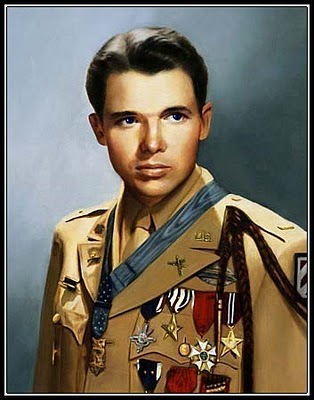
HAPPY VETERANS DAY -- HONORING WESTERN VETS

 
Audie Murphy
 
Back on the 4th of July, 2010, I wrote an article to give a special nod of gratitude to the Westerners, both in front of and behind the camera, who did their part to keep us free.  I’m doing an update for Veterans Day, but I know that there are many names left out, and I would be grateful if readers will contribute names for inclusion.

 
Charles Durning
 
Tom Mix was an artillery sergeant in the Philippine campaign from 1898-1901. Ken Maynard fought with Gen. Pershing against Pancho Villa, and served in the First World War. Hoot Gibson was an Army Sergeant in the Tank Corps during World War One. With the outbreak of World War One, Tim McCoy organized a regiment of cavalry, and was commissioned Captain of Cavalry, later transferred to the Horse Artillery, was a Colonel by age thirty, and was appointed Adjutant General of Wyoming. He also served in the Second World War, and again achieved the rank of Colonel. Buck Jones enlisted in the Army in his teens, served first on the U.S. – Mexico border, then in the Moro uprising in the Philippines. Buck reenlisted in World War One, training horses for the Allies. During World War II, Buck took part in a cross-country series of Bond Rallies. He died with hundreds of others when a fire tore through Boston’s Cocoanut Grove nightclub.

 
Neville Brand

The two most highly decorated American soldiers of the Second World War both went on to acting careers: Audie Murphy and Charles Durning. Not far behind in honors was Neville Brand, who won the Silver Star, Purple Heart, and three Battle Stars among many other decorations. One of the Hollywood cowboys who did not return from the war was Lee Powell, U.S.M.C., the screen’s first Lone Ranger, who was killed in action on Tinian, Marianas Islands.

 
Among the many western actors who served in the Navy during World War II were Richard Boone, Ernest Borgnine, Charlton Heston, Earl Holliman, Kirk Douglas, Strother Martin, Robert Montgomery, Jack Lemmon, Wayne Morris, Rock Hudson, Paul Newman, Strother Martin, Jeffrey Hunter, Robert Stack, Richard Jaekal, Lee Van Cleef, GUNSMOKE’s Dennis Weaver, and GUNSMOKE on radio’s Matt and Doc, William Conrad and Howard McNear. Harry Carey Jr. was a Navy Medical Corpsman in the Pacific. Henry Fonda won the Navy Bronze Star for Valor, Jason Robards Jr. was a radioman on duty in Pearl Harbor when Japan attacked, and Glenn Ford served in World War II, Korea and Vietnam, retiring as Captain in the Naval Reserve. Humphrey Bogart, who was injured in World War One, tried to enlist in World War Two, but was turned down because of his age.

 
Those who served in the Army included John Agar, Charles Bronson, George Kennedy, Eli Wallach, Robert Mitchum, James Coburn, and Gene Evans. Forrest Tucker was in the Cavalry, Dale Robertson was in a tank battalion in North Africa,   Burt Lancaster was in the Army Special Services, and James Arness was wounded at Anzio. Mel Brooks (we’re counting BLAZING SADDLES as a western), a combat engineer, cleared German mines after the Battle of the Bulge. Gene Autry was an Army Flight Officer in the Air Transport Command.

 
Those in the Army Air Corps included Jimmy Stewart, Clark Gable, Jack Palance, Ronald Reagan, Lee J. Cobb, Joseph Cotten, Van Heflin, Tim Holt, Arthur Kennedy, Alan Ladd, Ray Milland, Cameron Mitchell, George Montgomery, Clayton Moore, Robert Preston, George Reeves, Ken Curtis and Robert Taylor.  Parley Baer, radio’s Chester, was a Captain.  Morgan Woodward was in the Air Corps in World War II, and in the Air Force in Korea. 

 
Among those who served in the Coast Guard were Alan Hale Jr., Buddy Ebsen, Cesar Romero, Jim Davis and Victor Mature.

 
And in the Marine Corps were Brian Keith, Lee Marvin, Steve McQueen, Tyrone Power, John Russell, Robert Ryan, Sterling Hayden and Jock Mahoney.

 
Clint Walker served in the Merchant Marine.


And because actors don’t make movies by themselves, Director John Ford commanded the photography group of the OSS and was present when the troops landed on Normandy. Ford left the Navy as a Rear Admiral. Director Howard Hawks was a Lieutenant in the Signal Corps during the First World War before joining the Army Air Corps and serving in France. Directors George Roy Hill and Sam Peckinpah were Marines. Directors William Wyler, Sam Fuller, John Sturges and Don Taylor served in the U.S. Army Air Corps, as did producers Jack Warner and Daryl F. Zanuck. Writer and director Burt Kennedy was in the Army Cavalry.  Producer Saul David served in the Army. And Yakima Canutt, stunt man extraordinaire, was in the Navy during World War I.


Among those who have served since World War II are Clint Eastwood, Army; Peter Graves, Air Force; Buck Taylor, Navy; Luke Askew, Air Force and Navy; Robert Vaughn, Army drill sergeant; Clu Gulager, U.S.M.C., and James Garner and Ty Hardin, both Army in Korea. 
 

MARK OF THE GUN, ‘NEW’ B&W 1969 WESTERN COMING SOON!

 
Western fans will soon have the unique opportunity of seeing a ‘new’ black & white 1969 Western for the first time.  Fred Olen Ray, the talented and prolific director of films like BAD BLOOD: HATFIELDS & MCCOYS and AMERICAN BANDITS – FRANK AND JESSE JAMES, will be releasing the film to DVD this December.  The movie stars Ross Hagen, the handsome, gravel-voiced character actor that played likeable tough guys on both sides of the law, in cop shows and westerns.  He passed away in 2011.   

 
Ross Hagen
 

Making his first credited appearance on THE BIG VALLEY, Ross was a busy actor from the mid-sixties, when he made multiple appearances on series like GUNSMOKE, THE VIRGINIAN and HERE COME THE BRIDES.  He continued throughout his life, also writing and directing films like MURDER ON THE YELLOW BRICK ROAD (2006), and his final credits included the Western SHADOWHEART (2009), and the voice of Landon Ricketts in the RED DEAD REDEMPTION video games.

 
Hagen starred in MARK OF THE GUN in 1969.  Shot at or around the famed Iverson Movie Ranch, it’s the only directing credit of actor Wally Campo, who is still active, and worked frequently for Roger Corman in the 1960s.  Here’s the kicker – it was shot by one of the greatest cinematographers of all time, Laszlo Kovacs, just before he shot EASY RIDER!


Fred Olen Ray and Ross Hagen worked together on more than twenty projects.  “I bought the copyright and negative (from Ross’ estate)”, Fred told me.  “I couldn’t let it disappear.  I don’t know if it ever had a release.  There’s no evidence I can find.”  Although there is some info at IMDB (http://www.imdb.com/title/tt0312950/), there are absolutely zero comments, suggesting no one has seen this movie.  When Fred releases it in December, there will be extras, but I don’t yet know what they are.   I’ll be back with more details soon.

 
‘DR. WHO’ WESTERN AIRS MONDAY, NOVEMBER 19TH


Fort Bravo, in Almeria, Spain, a core of the spaghetti western world, was just the location for the Almeria Western Film Festival.  But it also remains a very active shooting location, and this summer the BBC sent their DR. WHO crew to Fort Bravo to shoot A TOWN CALLED MERCY.  In this episode, Matt Smith, as Dr. Who, becomes the reluctant sheriff of a Western town which is under siege by a cyborg.  It’s airing on BBC America on Monday, November 19th, check your local time.  For a preview, here is a two-minute montage from the episode, to the tune of GUNFIGHT AT THE O.K. CORRAL, posted by José Manuel Hita Segura.


‘HEATHENS & THIEVES’ ARE EVERYWHERE!


Just heard from writer/co-director John Douglas Sinclair that HEATHENS & THIEVES is now available on DVD from Amazon, Barnes & Noble, Best Buy, CD Universe and Family Video. It’s available streaming video-on-demand at iTunes, Amazon, Bright House, Charter, CinemaNOW, Comcast, Cox, Dish Network, Google Play, Time Warner, Verizon, Vudu, Xbox Live, YouTube Movies and Walmart.com.  It’ll be available at Walmart and Redbox some time in December.  John and company got a particular kick when they checked out the YouTube Movie Page ‘Staff Picks’ last week, and found out they were #1, ahead of PARANORMAL ACTIVITY and the TWILIGHT SAGA. 


‘SIX-GUNS AND SLAY BELLS’ SIGNING


If you’re looking for the perfect Western book to both delight and creep out your loved ones, don’t overlook SIX-GUNS AND SLAY BELLS – you can read my review HERE.  http://www.henryswesternroundup.blogspot.com/2012/10/slay-bells-ring-for-holidays.html.  And if you’re in Southern California, and would like a signed copy one of the authors, Courtney Joyner will be signing at Dark Delicacies on Friday, November 16th, at 6 p.m. http://www.darkdel.com/ .
 
 
TCM FANATIC - WESTERN NOW ONLINE!

And speaking of TCM (okay, nobody was), have I mentioned that the segment I was interviewed for is now viewable here?


THE AUTRY NATIONAL CENTER

Built by cowboy actor, singer, baseball and TV entrepreneur Gene Autry, and designed by the Disney Imagineering team, the Autry is a world-class museum housing a fascinating collection of items related to the fact, fiction, film, history and art of the American West. In addition to their permanent galleries (to which new items are frequently added), they have temporary shows. The Autry has many special programs every week -- sometimes several in a day. To check their daily calendar, CLICK HERE. And they always have gold panning for kids every weekend. For directions, hours, admission prices, and all other information, CLICK HERE.


HOLLYWOOD HERITAGE MUSEUM

Across the street from the Hollywood Bowl, this building, once the headquarters of Lasky-Famous Players (later Paramount Pictures) was the original DeMille Barn, where Cecil B. DeMille made the first Hollywoodwestern, The Squaw Man. They have a permanent display of movie props, documents and other items related to early, especially silent, film production. They also have occasional special programs. 2100 Highland Ave., L.A. CA 323-874-2276. Thursday – Sunday 12 p.m. to 4 p.m. $5 for adults, $3 for senior, $1 for children.


WELLSFARGO HISTORY MUSEUM

This small but entertaining museum gives a detailed history of Wells Fargo when the name suggested stage-coaches rather than ATMS. There’s a historically accurate reproduction of an agent’s office, an original Concord Coach, and other historical displays. Open Monday through Friday, from 9:00 a.m. to 5:00 a.m. Admission is free. 213-253-7166. 333 S. Grand Street, L.A. CA.


WESTERN ALL OVER THE DIAL


INSP’s SADDLE-UP SATURDAY features a block of rarely-seen classics THE VIRGINIAN and HIGH CHAPARRAL, along with BONANZA and THE BIG VALLEY. On weekdays they’re showing LITTLE HOUSE ON THE PRAIRIE, BIG VALLEY, HIGH CHAPARRAL and DR. QUINN, MEDICINE WOMAN.


ME-TV’s Saturday line-up includes BRANDED, THE REBEL and THE GUNS OF WILL SONNETT. On weekdays it’s DANIEL BOONE, GUNSMOKE, BONANZA, BIG VALLEY, WILD WILD WEST, and THE RIFLEMAN.


RFD-TV, the channel whose president bought Trigger and Bullet at auction, have a special love for Roy Rogers. They show an episode of The Roy Rogers Show on Sunday mornings, a Roy Rogers movie on Tuesday mornings, and repeat them during the week.


WHT-TV has a weekday afternoon line-up that’s perfect for kids, featuring LASSIE, THE ROY ROGERS SHOW and THE LONE RANGER.


TV-LAND angered viewers by dropping GUNSMOKE, but now it’s back every weekday, along with BONANZA.

Veterans Day Weekend is a three-day weekend, so if you haven't had a chance to thank a vet for his or her service, you've got another chance tomorrow.  And if you already have, find another to thank.  There are plenty of men and women out there who have put their lives on the line to make us free!


Happy Trails,

Henry

All Original Contents Copyright November 2012 by Henry C. Parke -- All Rights Reserved