The blog that brings you the latest news about western movies, TV, radio and print! Updated every weekend -- more often if anything good happens!
My new book, THE GREATEST WESTERNS EVER MADE, AND THE PEOPLE WHO MADE THEM is now available! It’s based on over 80 of my TRUE WEST articles, many expanded and updated! Buy it from Amazon, or wherever fine books are sold! Click the image to order!
OutWest!
HENRY ON TCM
click image to watch!
OUR FACEBOOK PAGE!
To follow Henry's Western Round-up on Facebook click the link below -- new updates (pretty near) every day!
TRUE WEST - My most recent articles. (TW lets you read 3 articles for free per month)
May/June 2025 -- I have 4 articles in this month's issue, each dealing with a different aspect of the AMERICAN PRIMEVAL miniseries. To find links to all of my earlier True West articles, just keep scrolling.
Every Thursday Bobbi and Jim Bell host the podcast Rendezvous With a Writer, and interview an author. On the first Thursday of every month I join them, present the news in the world of Western films and TV, and take part in their guest’s interview.
For our June 2025 show, our guests are authors of books about Reno Divorce Dude Ranches. Sandra McGee, with her late husband, William L. McGee, is the author of the memoir, THE DIVORCE SEEKERS. Peggy Wynne Borgman is the author of the novel, THE BETTER HALF.
For our May 2025 show, our guest is Anne Hillerman, daughter of Tony Hillerman. She has continued writing her father’s series of Leaphorn, Chee and Manuelito, Reservation-based mysteries. Her 10th, SHADOW OF THE SOLSTICE, has just been published.
Although I haven't gotten a western made yet, there's interest in a western series I've created (on paper). If you'd like to take a look at the sort of things I write, please visit my website, www.henrycparke.com. Thanks for looking!
As Film Editor of TRUE WEST MAGAZINE, every month I explore the world of Western film and television. Below are links to my columns, beginning with the most recent.
As Film Editor of TRUE WEST MAGAZINE, in each issue I explore the world of Western film and television. Below are links to my columns, beginning with the most recent.
On July 30th, 2015, I was the guest of hosts Bobbi Jean Bell and Jim Christina on ‘Writer’s Block’, their L.A. TALK-RADIO talk-show about the art and craft of writing. You can click PLAY to hear it, or DOWNLOAD to download it.
ROUND-UP ON THE RADIO!
Last Christmastime I was a guest on AROUND THE BARN, and had a great time talking about the Round-up, my writing, and Gene Autry’s Christmas music. To listen, click HERE.
Other Stuff I Write
While this blog is strictly about Western stuff, I also write another blog, Stalling Tactics, which is about anything else. If you'd like to read my most recent post, COSTUME DRAMA TRAUMA, go HERE.
DICK JONES – WHERE THE ACTION WAS, by Ann Snuggs - A Book Review
I was sad when Dick
Jones passed away, in the summer of 2014, not just because he was a very nice
guy and a fine talent, but because, although we’d met a half-dozen times, and
discussed doing it, I’d never convinced him to sit down for an interview about
his remarkable career. I was relieved to
learn that Maxine Hansen, Executive Assistant to Mrs. Gene Autry, had
interviewed Dick for her Western Television
Oral History Project at The Autry (you can read more about that HERE ).
And now I’m delighted
to learn that Dick also gave extensive interviews to author Ann Snuggs,
which have resulted in the highly readable and informative book DICK JONES –
WHERE THE ACTION WAS, from Bear Manor Media.
In the early days of television, in his twenties, Dick starred in a pair
of TV series for producer Gene Autry, THE RANGE RIDER, and BUFFALO BILL
JR. Those series are the focus of
Snuggs’ book; she’s writing another volume about his early career, and some of
his later films.
Dick Jones creating the voice of Pinnochio
Texas-born Dick Jones –
he was known as Dickie Jones when he was younger – was discovered by
cowboy-turned-stuntman-turned-Western star Hoot Gibson, who billed the four
year-old as ‘The World’s Youngest Trick-Rider and Trick Roper’. Hoot told the kid he ‘oughta be in pitchers’,
and Dickie’s mom said, “Whoopee!,” recalled Dick. “And away we went to Hollywood.” Dickie was busy in the movies from the
mid-1930s, quickly graduating from unbilled bits in OUR GANG comedies to good
roles in Republic serials like BLAKE
OF SCOTLAND YARD (1936), and parts in major films like THE BLACK LEGION
(WB-1936), working with Humphrey Bogart and Ann Sheridan. But he really made a splash in 1940, as the
voice of the wooden boy in Walt Disney’s PINNOCHIO. After a stint in the Army during World War
II, Jones returned to acting, and did five features with Gene Autry.
That association with
Autry led to Jones starring in his two TV series. THE RANGE RIDER, a fictional western hero,
was played by stuntman-turned-actor Jock Mahoney, and Dick played his
enthusiastic young wingman Dick West. The
show lasted from 1951 until 1953, producing 78 half-hour episodes. There were several other kid or family-aimed
action Western series at the time; the GENE AUTRY SHOW, THE ROY ROGERS SHOW,
THE LONE RANGER, HOPALONG CASSIDY, CISCO KID and RIN-TIN-TIN to name some of
the best. But what set RANGE RIDER apart
was the action. In addition to being likeable personalities
and competent actors, Mahoney and Jones were both spectacular athletes,
horsemen and stuntmen. The stars of many
of the other shows were starting to show their years, requiring a lot of
make-up, and the constant use of stunt doubles.
But when other shows’ cameras would pull back to a long-shot, the RANGER
RIDER’s could move in for close-ups as Jock and Dick rode, brawled, tumbled,
crashed through windows, and generally destroyed the sets, gleefully producing
the kind of choreographed mayhem that made life worth living to kids watching
at home.
In 1955 and 1956, Dick
Jones, sans Jock Mahoney, starred as BUFFALO BILL, JR., for 42 equally action-packed
episodes. Here, in shows often built
around historical characters, Jones was
the definite lead, with Nancy Gilbert as his kid sister Calamity (and no, they
weren’t really supposed to be related to Cody or to Calamity Jane), both being
raised by Judge Ben ‘Fair and Square’ Wiley (character actor Harry
Cheshire).
Ann Snuggs’ book
details the history of both series. She
looks at not only the star casts, but Gene Autry’s Flying A Productions’ ‘stock company’ of actors – the Lee Van
Cleefs and Denver Pyles – and the writers and directors, many from the B-Western
world, who made their series so entertaining.
Snuggs examines both series episode by episode, but no surprise, the
best parts are the insights from Jones himself, often extensive quotes, about
how the shows were made, memories of particular episodes and guest stars, and
his adventures with Jocko both on- and off-screen.
It’s hilarious to learn
that Jones always hated the opening trick-riding footage of him in the RANGER
RIDER credits because the horse wasn’t
moving fast enough – it’s sure fast enough to scare the heck out of
me! And it’s fascinating to learn some
of the clever secrets behind Autry’s production approach. For instance, they shot two episodes a week simultaneously,
so any guest star would do two episodes instead of just one.
In the 1970s, Gene
Autry was in the process of acquiring the rights of all his feature films, and
in order to raise the money, he made an understandable, but to my mind
regrettable, decision. He retained the
rights to THE GENE AUTRY SHOW, but sold off the rights to his other series,
both RANGE RIDER and BUFFALO BILL, JR., as well as THE ADVENTURES OF CHAMPION
and ANNIE OAKLEY. RANGE RIDER and
BUFFALO BILL, JR. have both since lapsed into the public domain. The good news is that episodes of both series
are readily available on DVD from a number of companies; the bad news is that
the condition and selection varies greatly.
The good folks at Alpha Video
have several volumes of each series, each volume a 4-episode disk. I checked out the first two volumes of each
series; the quality is variable, and some have a bit of ‘hiss’ on the
soundtrack, but all are perfectly watchable, and the shows are great fun. While the mix of episodes is random, volume 1
of BBJ includes the premiere episode, FIGHT FOR GERONIMO; volume 2 includes THE
DEATH OF JOHNNY RINGO, aired in the second season but believed to be the pilot
that sold the show, and featuring Angie Dickinson and James Best. You can find them HERE.
Dick Jones at the Silver Spur Awards
The book includes an
introduction by Western music legend Johnny Western, the man who wrote and sang
the theme for HAVE GUN, WILL TRAVEL, among many others. He credits his career to Dick Jones. You can buy DICK JONES – WHERE THE ACTION
WAS, HERE.
REMEMBERING ROBERT
HORTON AND PETER BROWN
Peter Brown and John Russell in LAWMAN
It seems so wrong to
lose them; they were the young ones. On
WAGON TRAIN, Robert Horton was Flint McCulloch, the young and cocky scout, the
only man not intimidated by the wagon-master, portrayed by Ward Bond . On LAWMAN, Peter Brown was Johnny McKay, the
brave but insecure deputy, opposite John Russell.
Diane Baker with Robert Horton in
THE DANGEROUS DAYS OF KIOWA JONES
Brown went on to
another great Western TV success, LAREDO, first as one of a trio, then a
quartet, of Texas Rangers. Horton next
starred in a series that was, in a way, a prototype for the continuing dramas
of today, starring as A MAN CALLED SHENANDOAH, a man beaten so badly that he
develops amnesia, and searches for his identity, and the reason for the attack.
Both men continued to
make Westerns, but neither restricted themselves to the form. Brown did many features, TV movies, and soap
operas. Horton did film and television,
and a great deal of theatre. One particularly
interesting Western project Horton starred in was THE DANGEROUS DAYS OF KIOWA
JONES (1966), where he played a drifting cowboy ‘guilted’ by a dying lawman
into transporting a pair of killers. A
TV movie meant as a series pilot, it’s a shame it didn’t sell.
Both Horton and Brown
made frequent appearances at Western film events in recent years, and seemed
happy to meet their fans. You can catch
Robert Horton in WAGON TRAIN on ME-TV, and in A MAN CALLED SHENANDOAH on
GET-TV. Peter Brown’s LAREDO is also
shown on GET-TV, and the Warner Archive recently released all seasons of
LAWMAN. All the shows hold up well. Like their stars, they’ve stood the test of
time. Not a bad legacy.
THAT’S A WRAP!
Kind of a short
Round-up this time out, but I hope to have more time to fill out the next one a
bit more. Check the April TRUE WEST on
newsstands now. It’s our LONESOME DOVE
issue, and features my interview with the great Robert Duvall, and my rundown
of all the DOVE-related events happening in Texas this spring!
Happy Trails,
Henry
All Original Material
Copyright March 2016 by Henry C. Parke – All Rights Reserved
It’s not by chance
that, although it was shot in Texas, filmmakers Duane Graves and Justin Meeks
have the main credits playing over vista shots chosen to look like Almeria,
Spain locations impersonating
Texas. The titles themselves are in the
Spaghetti Western style, and the fine score by John Constant and Nick Durham,
while not blatantly imitative, is surely influenced by Ennio Morricone. KILL OR BE KILLED is a Texas Western with
roots in Tabernas.
Graves and Meeks have
co-directed and co-written, and Justin Meeks stars as Claude ‘Sweet Tooth’
Barbee, in this story of the aftermath of a train robbery. It seems the robbery went well, and everyone
escaped except for ‘Slap’ Jack Davis (Paul McCarthy-Boyington), who managed to
hide the loot near Galveston before his capture. The gang – to call them a company of rogues
is to put it generously – springs ‘Slap’ Jack from a prison railroad
construction gang, and they head back to Galveston to claim their booty.
They have many
adventures along the way, with messengers, ventriloquists, parsons, whores, lawmen,
children, families, doctors – many of whom they kill. But then, the gang members themselves start
being killed off in eerie ways. Will any
of them be left to find the hidden cache of gold?
A low-budget indie
Western that belies its small cost, the film is highly professional in all
technical aspects, with convincing production design. It’s beautifully shot by Brandon Torres, who makes
full use of the richly varied landscape of Texas, from mountain to desert to
ocean to forest. A Horror film as well
as a Western, it is unflinchingly brutal: the camera goes in, not away, for
dangling entrails and bullet-hits to the head.
The cast, though largely
unfamiliar, are convincing in their roles, and there are a couple of well-known
faces: Pepe Serna as a man who runs a strange family business out of his home,
and Michael Berryman – the terrifying gargoyle from THE HILLS HAVE EYES – as a
kindly town doctor!
There is a growing,
creepy fascination to the tale as it wends its way. But the story has one striking flaw: with
absolutely nothing redeeming about any members of the gang, there is no one for
the viewer to care about, or root for, except for some of the victims.
Michael Berryman
KILL OR BE KILLED is
available on Amazon and other VOD services, and on DVD from RLJ Entertainment.
WEDNESDAY’S COWBOY
LUNCH – WESTERNS YOU MIGHT HAVE MISSED
Wednesday, March 16th Rob
Word again presents A Word on Westerns
at the Autry’s Crossroads West Café, his every-other-month luncheon, get
together and discussion of Western movies, featuring the folks the folks who
made ‘em. This time the topic is Westerns You Might Have Missed, and his guests include actor Tom Bower, whose Westerns
include BALLAD OF GREGORIO CORTEZ (1982) , Louis L’Amour’s SHAUGHNESSY (1996), and
APPALOOSA (2008). Also on board is Mitch
Ryan, who starred with Lee Marvin and Jack Palance in MONTE WALSH (1970), THE
HUNTING PARTY (1971), and THE HONKERS (1972) with James Coburn. Rand Brooks Jr., whose father was Scarlet
O’Hara’s first husband in GONE WITH THE WIND (1939) will be there to discuss
his father’s career as Lucky Jenkins in the HOPALONG CASSIDY movies. And for
your musical entertainment, there will be Will Ryan and the Saquaro Sisters. As always, the event is free – you just have
to buy your own lunch. The fun starts at
noon, and if you plan to attend, get
there early, because they always have a packed house for Rob’s events!
Rob attended, and recorded, the ceremony where composer Ennio
Morricone received his much-deserved star on the Hollywood Walk of Fame. Take a look.
And incredibly, he shot this on his I-phone!
‘HIGH CHAPARRAL’
REUNION STARTS THURSDAY MARCH 17TH!
March 17th
through the 20th, Old Tucson Studios, the original home of the HIGH
CHAPARRAL series, where Big John Cannon’s ranch-house still proudly stands,
will be the site of the HIGH CHAPARRAL REUNION 2016! Returning to their old galloping-grounds will
be series stars Don Collier, Rudy Ramos and BarBara Luna. They’ll be joined by a posse of stars from
other Western series, including Robert Fuller from LARAMIE and WAGON TRAIN,
Darby Hinton from DANIEL BOONE and the recent TEXAS RISING, Roberta Shore from
THE VIRGINIAN, frequent John Wayne co-star Eddie Faulkner, and Stan Ivar from
LITTLE HOUSE ON THE PRAIRIE. Also
on-board are HIGH CHAPARRAL producers Kent and Susan McCray, and writers and
historians Boyd Magers, Charlie LeSueur, Neil Summers, and Joel McCrea’s son
Wyatt McCrea.
Even if you haven’t
made your reservations in advance, you can still attend! You can find your options by visiting the
official site HERE.
And here’s something
special for all HIGH CHAPARRAL fans, and it’s free! Last year the Reunion inaugurated a live
Webcast of the event. It was not cheap,
but it was very entertaining and informative.
HIGH CHAPARRAL REUNION Top Hand Penny McQueen has decided that this
year’s Webcast will be FREE! You’ll be
able to watch it HERE starting Thursday!
‘THE SHOOTIST’ SCRIPTER
MILES SWARTHOUT DIES
Me interviewing Miles at the Cowboy Festival
All of us in the
Western writing community were stunned and saddened to learn of the death of
Miles Swarthout. A Western novelist in
his own right, most recently with the fine THE LAST SHOOTIST, Miles was also the
son of legendary authors Glendon and Kathryn Swarthout. He was a man of humor, and of strong
opinions, and mentor to a number of now-successful writers. I’m re-posting the interview I had with Miles
at 2014’s Santa Clarita Cowboy Festival
at Melody Ranch, at the OutWest Buckaroo
Bookstore.
MILES SWARTHOUT
INTERVIEW
HENRY: It gives me
great pleasure to introduce Miles Swarthout, a very talented author whose
writing about 90% of you have appreciated, even though you haven’t read
it. Because he’s a screenwriter. This is the man who wrote the screenplay for
THE SHOOTIST, John Wayne’s final film, and one of his finest. And in scripting THE SHOOTIST, he had the
rare challenge not only of adapting a great novel, but a great novel that his
own father, Glendon Swarthout, had written.
Glendon wrote sixteen novels, and several became movies, including 7TH
CAVALRY, starring Randolph Scott; THEY CAME TO CORDURA, starring Gary Cooper;
BLESS THE BEASTS AND CHILDREN, WHERE THE BOYS ARE, and premiering this May at
the Cannes Film Festival, THE HOMESMAN, directed by and starring Tommy Lee
Jones, and starring Hilary Swank and Meryl Streep. Welcome, Miles. Can you tell us a little about THE HOMESMAN?
MILES: THE HOMESMAN was
a novel that my dad wrote, and came out in 1988. That year it swept the Western genre awards, winning The Wrangler Award, from the Western
Heritage Association, affiliated with the National Cowboy Hall of Fame in Oklahoma City, and the WWA Spur Award for the Best Western
Novel of 1988. Paul Newman was the
original director who bought the film rights to THE HOMESMAN. I worked on the original drafts, adaptations
for Paul Newman. But Paul jumped around
studios; the Writer Guild Strike intervened in 1988 for about six months, and
several other screenwriters later on got attached to the project doing
different drafts. Paul became too old to
play the title role any more, as the rugged frontiersman, and had different
stars attached to play the lead role. It
just didn’t happen. He sold the rights
back to SONY PICTURES/COLUMBIA, when he had Bruce Willis attached to play the
homesman, but it fell into what’s called ‘development Hell.’ Nothing happened to it for a number of years
– they couldn’t get it financed. Paul
Newman died of cancer a few years after that.
But Tommy Lee Jones was looking around to direct and star in another
Western, and he had the same talent agency (as Paul Newman), Creative Artists,
that remembered this book that Paul Newman had tried a number of times to get
made with different stars. Tommy got the
financing from his buddy, the French director Luc Besson, who has his own films
studio outside of Paris, and his own film distribution company. Luc also financed Tommy Lee’s last western
that he directed in 2005, THE THREE BURIALS OF MELQUIADES ESTRADA. That was a contemporary western shot down in
Texas. That won a couple of awards at
Cannes in 2005. Creative Artists helped Tommy put together the cast for THE
HOMESMAN. It’s fantastic: Hilary Swank,
the two-time Oscar winner is Tommy’s co-star.
Tommy Lee Jones is an Oscar winner for THE FUGITIVE with Harrison Ford,
Best Supporting Actor. And they’ve got
Meryl Streep in the movie – she’s got a cameo role. And Streep’s youngest daughter, her name is
Grace Gummer; she has a bigger part in the film. John Lithgow, two-time Oscar nominee is in
it. James Spader, who’s in the NBC hit
THE BLACK LIST is in the film. They’ve
got an Oscar-nominated cinematographer, and a two-time Oscar-nominated
composer, Marco Beltrami, has done the music.
HENRY: Speaking of the cast, I understand that Barry
Corbin is in the film. Hasn’t he worked
with Tommy Lee Jones before?
MILES: He was in NO
COUNTRY FOR OLD MEN, playing Tommy Lee’s father in that.
HENRY: The premise of THE HOMESMAN is a little
outrageous. Could you give us a summary
of it?
MILES: The Homesman is a claim jumper. It’s set in the 1850s, the Great Plains state
of Nebraska. He’s a claim jumper, and
some of the local residents take offense that he’s sitting on one of their buddy’s
claims, while their buddy has gone back east to find a wife. They blast him out of this sod home that he’s
roosting in, and almost hang him, and a spinster woman, Hilary Swank, comes
along. She decides to let him go,
because she’s just been chosen by a lottery system by the community, in this
small frontier farming town on the Great Plains, to drive back east four women
who have gone insane after this very hard winter. They’ve gone crazy, and they can’t take care
of them in this remote area, so someone has to drive them across the Missouri
River, the Big Muddy, and back to civilization.
HENRY: Have you run
into any complaints about sexism – why do the women go crazy, and not the men?
MILES: Historically
some of the men went crazy, too. They
became raving alcoholics; they couldn’t keep them in the local jails. If they were disruptive and making people
angry or uncomfortable, somebody’d just shoot them, but they wouldn’t do that
to a woman. This is a very unusual
story, a female-oriented Western, a mismatched couple running this wagon east
with some women who have gone insane.
HENRY: Let’s talk about
THE SHOOTIST. What was it like to adapt
a novel to a screenplay with a man, not just the author, but your father,
looking over your shoulder?
MILES: Well, that was
my first screenplay adaptation, and you’re talking with the creative genius who
made up the story in the first place, so he’s got a lot of good input. My dad did not write screenplays. He worked on the very first one for six
months at Columbia Pictures, his
best-selling novel, THEY CAME TO CORDURA.
He was out in Hollywood, and he got job offers after that, to work for
Burt Lancaster’s company Hecht, Hill and
Lancaster, but he turned them down.
He said no, I’m going back to Michigan State in East Lansing, to teach
honors English. And I’m going to write
other books, and I don’t want people telling me how to make changes and how to
write stuff. So he gambled, and that
turned out very well for him. His second
novel was WHERE THE BOYS ARE, 1960, and it was a big hit for MGM, with Connie
Francis singing the theme. But your
question was about adapting THE SHOOTIST.
And of course I showed him drafts, and we discussed stuff. I did get a screen credit on that. They did make a lot of changes. Don Siegel, the director, had another writer
that he’d worked with before, a guy named Scott Hale, who was making changes on
the set constantly, for Jimmy Stewart and John Wayne, and big stars with big
egos who wanted things adjusted and changed.
So he wrote just enough of the rewritten script to get screen credit on
the film. But luckily, it turned out,
even though it was a very difficult shoot, in Carson City, Nebraska, and on the
backlot at Warner Brothers Studio in Burbank.
They had a lot of problems; Wayne came down with the flu and an ear
infection. And he was in the hospital
for a couple of weeks. They shut down
filming, and he came back and got sick again, and they put him back in the
hospital. They didn’t know if he was
going to live, and if they could even finish the movie. So a lot of stuff had to be adjusted. It was the last film he ever made. His health deteriorated after that, and about
two years later, John Wayne died. But
the movie, even though he was feuding all the time of the filming with this
tough director, Don Siegel, turned out very well. They had a great supporting cast. John Wayne was playing a gunfighter who was
dying of cancer in the film. It was
prostate cancer in the film. But Wayne
had lost one lung a couple of years ago to lung cancer, and he knew at the time
of shooting THE SHOOTIST that his cancer had come out of remission, and he
didn’t tell the doctors and he didn’t tell the filmmakers. So he was obviously in some pain while making
this movie. He’s playing a gunfighter
dying of cancer, and he’s got cancer at the same time: talk about a movie that
was hand-tailored for a famous actor as his last film. It just turned out very well.
HENRY: It certainly did. As you said, your father did not write for
the screen, but by the time he wrote THE SHOOTIST, he was well aware that he
had a real good chance of having his novels filmed. He’d had several movies already done very
successfully. Do you think he had a
movie in mind as he was writing the book?
Do you think he thought of John Wayne?
MILES: No, he didn’t think of John Wayne. The original guy that the two producers, Bill
Self and Mike Frankovich wanted to play the Shootist, was George C. Scott. And George C. Scott read the book and
screenplay and said, “I’d love to do this.
Don’t change one word of the script.”
We thought that sounds great. But
the producers took it around to all the studios with George C. Scott attached
as the shootist. And all the studios
went, ‘No, General Patton can’t be a cowboy.’
He’d already won his Oscar playing Patton, and they wouldn’t bankroll
it. But Wayne at the same time had heard
about this story, and he started lobbying for the role, because he was the
right age, and with Wayne attached as the shootist, they got half of the eight
million dollar budget from Paramount Pictures, for the North American
rights. And they got the other half of
the money from the famous Italian producer Dino de Laurentiis. He made that big monkey movie with Jessica
Lange – KING KONG, and a whole bunch of other movie. Dino didn’t speak English very well, so he
couldn’t read it; they had to tell him the story. And he said, “John Wayne, cowboy? Ya, he be good.” The Duke was cast, and then a whole bunch of
really good ‘name’ supporting actors – Jimmy Stewart, Lauren Bacall, Ron
Howard, Hugh O’Brien, all worked at lower than their normal salaries to be in
this, because word had gotten around that Wayne’s health was pretty shaky, and
it might be his last picture. Hollywood
supports its own – particularly its legends like John Wayne. So that’s how they got a great cast, and the
rest is film history. It’s now
considered to be one of his five best Westerns.
It’s past the test of time.
HENRY: I was just reading where Harry Carey Jr. was
saying that while John Wayne got his Oscar for TRUE GRIT, and deserved it, he
deserved it even more for THE SHOOTIST.
‘THE SHOOTIST’ SPOILER
ALERT!
HENRY: The book is a
very tight 158 pages, but still, no book reaches the screen without edits. What sort of changes needed to be made, to
make it into a movie?
MILES: You have to cut out some of the
characters. You have to trim it to get
about a 120 page script – about a page a minutes. The ending of the novel is different than the
ending of the movie. John Wayne dictated
the ending of the movie, and there was a lot of controversy over this. In the ending of the movie, John Wayne has
this big shootout in this fancy saloon.
And he shoots Hugh O’Brien, and he shoots Richard Boone – who was a late
addition. That was a different character
than the character in the book. And John
Wayne, after shooting these guys, and being wounded, and already knowing he’s
dying of cancer – sort of committing suicide – the bartender comes out with a
shotgun and shoots him – blows him in the back.
So he’s dying, when Ron Howard comes into the saloon, the bartender is
reloading. Ron takes Wayne’s Remington
.44, and shoots the bartender, and kills the guy who shot John Wayne. And then, as dictated by the Duke, Ron throws
the gun away. This is a kid, the
Shootist is his hero, and he wants to be a gunfighter, too. But now that he’s killed a man, he throws the
gun away, renounces violence, and goes home with his mother, played by Lauren
Bacall. The problem with this ending is
there’s no possible sequel. Hollywood
loves sequels. In the book, John Wayne
is dying. The kid doesn’t shoot the
bartender, but John Wayne asks Ron Howard to kill him, ‘Finish me off.’ And the Ron Howard character says ‘okay,’ and
he shoots him – it’s a mercy killing, and Wayne asked for it. And they had already made a deal in advance
that Ron gets his two Remington .44 pistols.
He takes them, and walks outside of the saloon – it’s a great ending
passage. And people are asking if they
can buy the guns, and what happened in there.
The Shootist has killed all the hard-cases in El Paso, and suddenly, the
kid is the one who killed The Shootist.
And that’s the sequel –
HENRY: If I ever heard
one! Somebody should write it!
MILES: (laugh) My new novel is called THE LAST
SHOOTIST, and it’s coming out in October from Forge Books-MacMillan in New York
City. And it’s the next six months in
this kid’s life. The Shootist is dead,
but this kid has got John Wayne’s matched pistols, and he’s got to flee 1901 El
Paso, because the sheriff is after him.
The sheriff wants those guns because they’re very valuable. The kid’s on the run, and he goes through
various adventures in New Mexico with a wannabe novelist, and then on to
Bisbee, Arizona, which was a copper-mining boom-town at that time. The character of the Shootist, my dad loosely
based on John Wesley Hardin, who killed 44 men, and was a real
gun-spinner. Hardin in real life had a
special vest made up with leather pockets, so that he could cross-draw his
guns. They tried to do that for John
Wayne in the movie, made a special vest for him, but Wayne was overweight and
too big, and couldn’t get the guns out easily from under his overcoat, so they
had to go back to the six-guns in holsters on his waist. But I’ve changed that
in my sequel. The kid is eighteen years
old and has terrific hand-eye coordination, and he is the last Shootist. If you like the original, hopefully you’ll
like my sequel.
HENRY: Speaking of your
novels, I notice you have another, THE SERGEANT’S LADY.
MILES: That was my first novel. That was based on an extension of one of my
dad’s short stories for the old Saturday Evening Post, and that won a Spur back
in 2004 as the Best First Western Novel of the Year, from the Western Writers of America.
THE LAST SHOOTIST is
now available, and if you’d like a preview, go HERE, to Miles Swarthout’s site,
where you can read the end of THE SHOOTIST and the start of THE LAST SHOOTIST.
AND THAT’S A WRAP!
Just as I was going to
post, I heard that Robert Horton, who played scout Flint McCullough on 187
episodes of WAGON TRAIN, has died at age 91.
He was a fine actor, with an amused twinkle in his eye, and the only one
who was never intimidated by Ward Bond’s Seth Adams. I’ll have more to say about this versatile actor,
and his other roles, in the next Round-up.
Happy trails,
Henry
All Original Content
Copyright March 2016 by Henry C. Parke – All Rights Reserved
GET-TV BRINGS BACK ‘HONDO’, ‘NICHOLS’ AND ‘MAN
CALLED SHENANDOAH’!
Robert Horton is A MAN CALLED SHENANDOAH
Three Western series from the sixties and early
seventies, two of which haven’t been seen since their original airdates, will
be returning starting September 12th on GET-TV, a SONY-owned antenna
company in some markets, and cable or satellite in others.
For years, series that had less than a hundred
episodes were not considered worth syndicating.
All three series had just one season each: A MAN CALLED SHENANDOAH
(1965) produced 34 segments, NICHOLS (1971) had 24, and HONDO (1967) just
17. But the recent success of very
short-lived programs, particularly ARRESTED DEVELOPMENT (2003), whose production
was actually revived after a seven-year hiatus, has proved there is life in a
good show no matter how few the episodes.
SHENANDOAH was developed by writer-producer E. Jack
Neuman, who previously created MR. NOVACK (1963), and would go on to develop
THE BLUE KNIGHT (1973), POLICE STORY (1973) and PETROCELLI (1974). It starred
Robert Horton – still going strong at 91 – who’d starred for years on WAGON
TRAIN as head scout Flint McCulloch. When
he left the series in 1962, he announced that he would not do a Western series
again, but was tempted back by the tale of a man who awakens from a savage
beating with no memory of who he is, or why anyone would want to kill him. As he travels the West looking for answers,
his adventures involve a stellar group of guest stars: Oscar winners Cloris
Leachman, Martin Landau and George Kennedy, as well as Bruce Dern, John
Ireland, Warren Oates, Sally Kellerman, L.Q. Jones and Strother Martin.
James Garner as NICHOLS
Between his great TV successes MAVERICK (1957-1962)
and THE ROCKFORD FILES (1974-1980), James Garner starred as the lead character
in NICHOLS, one of his personal favorites.
Set in the early 20th century, Garner plays a career soldier
now tired of fighting, who comes home to the town named for his family, and is
bullied into becoming its lawman, a job he does without packing a gun, and
riding an Indian chopper instead of a horse.
Created by Frank Pierson, writer Juanita Bartlett wrote several episodes
before moving with Garner to ROCKFORD FILES, and NICHOLS shares its humorously
savvy tone. Margot Kidder plays Ruth,
the Miss Kitty of the town, and unlike at the Longbranch, you have no doubts
about what goes on upstairs.
Ralph Taeger as HONDO
Of the three series, only HONDO had exposure after
cancellation. In 1988, Ted Turner bought
MGM’s library, and created TNT. HONDO
started getting a lot of play. A.J. Fenady, who created and produced HONDO,
as well as the just DVD-released THE REBEL starring Nick Adams, recalls those
early cable days. “Ted Turner and I
became pals. He loved THE REBEL, but
next to THE REBEL he loved HONDO. When
he was there at TNT, they played that thing time and again. I saw him one time and I said, ‘For God’s
sake, how long are you going to keep playing those same seventeen episodes of
HONDO?’ And he said, ‘As long as I’m
there.’”
An unusually cheerful HONDO moment.
Ralph Taeger had the unenviable job of taking on a
role that John Wayne made famous. Fenady
thought he was up to the challenge. “You
couldn’t draw a picture of a leading man any better than Ralph. He had the build of Tarzan, he was handsomer
than Randolph Scott, and he had a voice like Humphrey Bogart. If that isn’t a combination for a western, I
don’t know what the Hell is.” Even John Wayne was a fan of the show. “Now Duke used to watch the series, and he
said to me, ‘Ralph Taeger is as good a Hondo as I was.’ Parenthetical pause, ‘Almost.’ Well I loved Ralph Taeger. I talked to him at least once a month until
last year, when he died. And doing the
series HONDO led to (my) doing the movie CHISUM with John Wayne and his son
Michael Wayne.”
In addition to Taeger, the cast included Kathie
Browne, Noah Beery Jr., and Aussie-playing-Indian specialist Michael Pate. Among the guest cast did Fenady have a favorite? “Without doubt, it’s Robert Taylor. See, I’m the first guy who did a two-hour (theatrical)
western, HONDO AND THE APACHES, and used it as a pilot. MGM said, if you could get Robert Taylor to
be in it, we’ll do it. And I got Robert
Taylor, and he was the gentleman of all gentlemen; he was a consummate actor,
and a fine, fine man. And, I’m still
making money from that damned thing, because it’s still being featured
overseas.”
Each series will be re-introduced with a
‘mini-marathon’, starting at noon on Saturday, September 12th with
five episodes of NICHOLS; September 19th with five HONDOS; then
September 26th with ten episodes of A MAN CALLED SHENANDOAH. After,
they’ll be getting regular spots on Saturdays.
Saturday has always been an all-Western feature day for getTV, showcasing a lot of Tim McCoys
and Durango Kid films from the Columbia
Pictures vault, as well as big-budget oaters. Jeff
Meier, getTV’s senior veep of
programming is excited about adding the shows to the line-up. “Although each of these series originally had
a short run, they all feature classic Old West action that will have viewers
agreeing that they were cancelled far too soon.”
60TH
GUNSMOKE ANNIVERSARY CELEBRATED BY REEL COWBOYS SEPT. 18!
On Friday,
September 18th, the 18th annual Silver Spur Awards,
presented by The Reel Cowboys, will honor the 60th anniversary of
the Western TV classic GUNSMOKE! The
event, to be held at the Sportsmen’s Lodge in Studio City, will be attended by
many Western stars who can trace the start of their careers to GUNSMOKE. The event will benefit United Cerebral Palsy and The National Day of the Cowboy. Those planning to attend, subject to their availability,
include
members of the James Arness Family, Bruce
Boxleitner, Morgan Brittany, Angie Dickinson, Ed Faulkner, Mariette Hartley,Earl Holliman, Bo Hopkins, L.Q. Jones, Martin
Kove, Martin Landau, Michael Learned,Gerald McRaney, Mihaly 'Michu' Meszaros, Mayf Nutter, Jacqueline Scott,Jon Voight, Johnny Whitaker, and Morgan
Woodward – GUNSMOKE’s most frequent guest star!
There
will be a silent auction, an elegant Delmonico’s-worthy dinner, musical
entertainment, a panel discussion and Q&A led by Bruce Boxleitner, and the
awards presentation – and a chance to clink spurs with some of your favorite
Western stars. Tickets are $125, $175
for VIP seating, and $250 for premium seating.
For tickets, call 818-395-5020. To
learn more, go to the official website HERE.
There
you can also listen to a radio interview with the two folks who are running the
event, Reel Cowboys president Robert Lanthier, and historian and event
coordinator Julie Ann Ream, cousin of Glenn Strange, aka Sam the bartender at
the Longbranch.
‘SANTA FE TRAIL’ SAT., SEPT 12TH AT THE
AUTRY
On Saturday, September 12th, as part of The
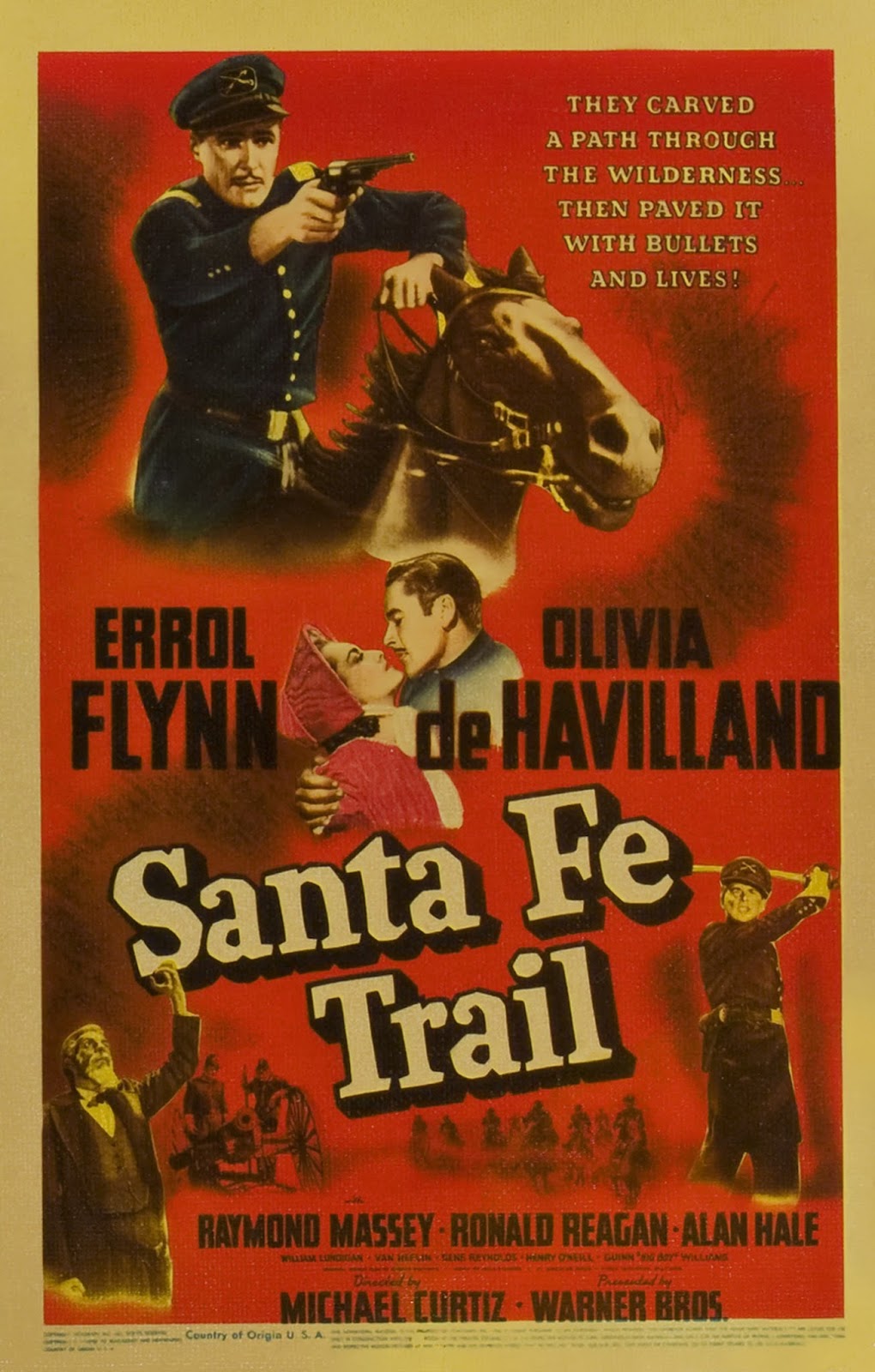
Autry’s long-running ‘What is a Western?’ monthly series, SANTA FE TRAIL (WB
1940) will be presented at 1:30 pm at the Wells Fargo Theatre. Admission is free with your admission to the
museum. Directed by Michael Curtiz, it
stars Errol Flynn as Jeb Stuart, and Ronald Reagan as George Custer, West Point
Cadets in the days leading up to the Civil War, with Olivia de Havilland, with
Van Heflin, Alan Hale, and Raymond Massey as John Brown.
One big change is that Jeffrey Richardson, The Autry’s Gamble Curator of Western
History, Popular Culture, and Firearms, who has for years informatively and
entertainingly introduced the films, will not be there; he’s left the Autry for
a curatorial job in New Mexico. Instead,
the film will be introduced by screenwriter, director, Western scholar and
author C. Courtney Joyner, who is very excited about the opportunity. “I consider
this one of Curtiz' best westerns - and it’s the last of the Flynn/de Havillandteam-ups.
There’s lots of history about it - and how far it strays from the
truth!” In compliment to the current,
fascinating exhibition at the Autry, Empire
and Liberty: The Civil War and the West, this and the next pair of films
will have Civil War themes. GLORY (1989)
will screen on October 10th, and THE OUTLAW JOSEY WALES (1976) will screen on
November 14th – I’ll be introducing that one!
‘REEL STORIES’ OF THE CIVIL
WAR AT SEPT. 23RD COWBOY LUNCH!
Following an always delicious lunch in the Autry’s Crossroad
Café, Rob Word’s ‘A Word on Westerns’
interview program will focus on how the Civil War has been portrayed on film,
from Keaton’s THE GENERAL to GONE WITH THE WIND and beyond. Confirmed guests include Bruce Boxleitner and
Alex Hyde-White of GODS AND GENERALS and esteemed historian Phil Spangenberger. The program begins at
12:45, but get there early for lunch, and to make sure you get a seat, because
these events always fill up. But don’t get there a week early – the
Autry’s ‘What’s Next? calendar incorrectly says this event is September 16th
– it’s definitely the 23rd!
ROY AND DALE’S APPLE VALLEY FORMER HOME FOR SALE!
Thanks to author Martin Gramsfor posting
about this in the Rick’s Placesite.The former home of
Roy Rogers and Dale Evans in Apple Valley, California, is up for sale. It sold in 2012 for $645,000, and is now
being offered for $770,000. Want to take
an on-line tour? The realtor has made a
ten-minute video, showing not only how the property looks today, but how it
used to look.
ALEX CORD LOOKING TO SELL HIS HOME IN TEXAS!Alex
Norman Rockwell's portrait of
Alex Cord for STAGECOACH
And speaking of desirable
cowboy properties, Alex Cord who, among many other roles, played the Ringo Kid
in the 1966 version of STAGECOACH, and starred in the spaghetti Western A
MINUTE TO PRAY, A SECOND TO DIE (1968), is looking to sell his home in
Texas. He says, “Quail Run Ranch (is) 30 acres with three fenced pastures, run-in sheds,
a pond and a creek running through a wooded area. A custom covered arena with
Bob Kiser footing, 200 feet long and 80 wide, built by Butch Reddish. Charming
house on a hill, 3 bdrms, 2 bth, granite counters, hardwood floors, Jacuzzi
tub, storm shelter. Insulated shop, 40 x 40 ft. Horse barn, 4 indoor stalls and
4 sheltered runs, large tack room, feed room and hay storage, wash rack. Three
connected round pens, 125 feet, 50 ft, and 25 ft. The place is dead quiet,
surrounded by 3 cattle ranches owned by the finest neighbors in the world. It
is secluded but not isolated. Twenty minutes to Denton, one hour to DFW
airport, ten minutes to Gainesville, Walmart, Home Depot, Tractor Supply.”
If you’re
in the market, or know someone who is, you can contact Alex through his
official website, HERE.
THAT’S
A WRAP!
I’ve
decided to make a change to the Round-up. Instead of publishing every weekend, I’m
going to publish every other weekend, or bi-weekly. The fact is, between writing the Round-up, being the Film Editor for TRUE
WEST, and teaching full-time, I’m not devoting any time to a screenplay I’ve been trying to finish for months –
and that’s the job that’s supposed to make me rich and famous! With that in mind, if you have any good tips
to pass along to me, or know of events that I should be covering, please let me
know a little earlier!
Happy
Trails,
Henry
All
Original Contents Copyright September 2015 by Henry C. Parke – All Rights
Reserved