Showing posts with label INSP-TV. Show all posts

Sunday, July 28, 2024

CONTEMPORARY WESTERN ‘BLUE RIDGE’ RETURNS TO INSP AS SERIES, PLUS INTERVIEW WITH ‘NIGHT THEY CAME HOME’ DIRECTOR PAUL VOLK


 CONTEMPORARY WESTERN ‘BLUE RIDGE’ RETURNS TO INSP AS SERIES

Sunday night, July 28th, 2020’s North Carolina set – and shot – contemporary Western/crime drama TV-movie, Blue Ridge, returns to INSP as Blue Ridge – The Series. Back in his role as lawman Justin Wise is Johnathon Schaech, who to me will always be the full-of-himself 1960s rocker in Tom Hanks’ delightful That Thing You Do. For Western street-cred, he’s played Horror-Western comic-book character Jonah Hex on DC’s Legends of Tomorrow, and will soon be seen as Sheriff Hitchcock in the gritty Hawaiian Western The Wind & The Reckoning. Returning as his ex-wife is Sarah Lancaster as Ellie Wise, with whom he shares a teenaged daughter – the also-returning Taegen Burns as Maddie Wise.

Johnathon Schaech as Justin Wise

In the town of Blue Ridge, the rural working-class community has for ages been dominated by two warring families, the Wades and the McGraths. Actor and stunt man Tom Proctor is back as Jeremiah Wade, but where the new story begins, the leader of the McGrath clan, Cliff McGrath, played by Graham Greene, Oscar nominee for Dances With Wolves, has died (you can read my True West interview with Graham Greene HERE  , or in my book), and his younger brother, Connor McGrath has returned home to take his place. Connor is played by A Martinez (you can read my INSP interview with A Martinez HERE ).

Always a strong, frequently intimidating presence, A, who was recently seen in INSP’s Far Haven, also plays Sheriff Gordo Sena in Dark Winds, and was memorably menacing as Jacob Nighthorse, the Native American opportunist/activist and casino operator on Longmire.

Avianna Mynhier and A Martinez

Tonight’s pilot episode, in which a random car break-down exposes a serious crime, Blue Ridge turns the small-town and small-budget limitations to its advantage: the local police force is convincingly underfunded and understaffed. The force’s entire budget has been spent on a new computer system, and when disaster strikes, the police are back to working on their Radio Shack computers, the force relocated to a shuttered local history museum. The premise and performances are strong, and I won’t spoil it by giving away any more plot.

Blue Ridge – The Series, premieres Sunday, July 28th, at 9 p.m., Eastern time.


THE RUFUS BUCK GANG’S STORY IS TOLD IN ‘THE NIGHT THEY CAME HOME’ – DIRECTOR PAUL VOLK SAYS: “I WOULD LOVE TO JUST DO WESTERNS: PERIOD.”


Until 2022’s high-profile Idris Elba Netflix Western, The Harder They Fall, few non-historians had ever heard of Rufus Buck or the Rufus Buck gang. But while that film was highly entertaining, and full of historical characters, they and Buck were tossed in so randomly as to true events, and what side of the law they landed on, that audiences knew no more when they exited than when they entered, aside from names.

The Night They Came Home -- an inexplicable title -- fills in a lot of those blank spaces. From the famously blood-stained pen of Night of the Living Dead author John A. Russo, who wrote Night They Came Home as both a novel and a screenplay, Rufus and his band of fellow mixed-race Native American and African American outlaws get an entertaining and unsentimentalized telling, and here the historical characters have purpose.

Rufus is played by Charlie N. Townsend. His gang’s members are portrayed by Phillip Andre Botello as Lucky Davis, Hugh McCrae, Jr. as Sam Sampson, Ivan Villanueva as Maoma July, and Nicholas Rising as Lewis Davis.

Charlie N. Townsend as Rufus Buck

Real lawmen portrayed powerfully by veteran Western actors include Tim Abell as legendary Indian Territory U.S. Marshall Heck Thomas, Sam Bearpaw as Deputy Marshall Sam Sixkiller, Peter Sherayko as Fort Smith hangman George Maledon, and Mike Gaglio as Hanging Judge Isaac Charles Parker.

The most familiar actors are two Rufus Buck victims, and our narrator, respectively, family-man Brian Austin Greene, bootlegger Robert Carradine, and Danny Trejo.

The film’s director, Paul Volk, worked with producer and frequent collaborator Patrick Durham.


PAUL VOLK: I've been doing this since about 1985. A few years ago, I kind of semi-retired. But if people come to me and offer me a show to direct, I'll come out of that semi, and it's happened once every couple of years now for the past few years. It's hard for me to stay out completely; it's kind of in my blood.

HENRY PARKE: Are you a Western fan?

PAUL VOLK: I actually always liked them, but just kind of a normal affection for them. But then in 1994, I directed a movie called Steel Frontier, which was a post-apocalyptic western, and kind of an homage to Sergio Leone. They threw it at me as a co-director because (Jacobsen Hart) and I worked for the same company, and he'd been begging them to direct. It was a bad mistake, but he was a very talented writer, and we got along well as far as writing together. We both just dived into all the Sergio Leone movies and used those as kind of a guide for the lead character. You can see it for free on YouTube. Joe Lara, and Bo Svenson and Brion James starred. Joe Lara, he was Tarzan on Tarzan, The Epic Adventures (1996-2000).

HENRY PARKE: What was the company you both worked with?

PAUL VOLK: PM Entertainment -- Pepin Merhi Entertainment. Through the eighties and the nineties, we did huge action for low budget movies, independent movies. We had the guy who coordinates and creates all the car chases for Fast and Furious. The big money came from foreign (companies), because foreigners loved our big action.

HENRY PARKE: So The Night They Came Home is your first historical Western?

PAUL VOLK: Yeah; and now I would love to just do Westerns, period. If every show I ever direct from here on in was a Western, I'd be very happy, because I really enjoyed this one. Immensely creative, you know, creating your own world. And everything in it has to be brought in, and everything has to be legitimate. Of course, it comes with its own set of problems, especially dealing with the horses. And the wagons. It was eye-opening.

HENRY PARKE: What surprised you most about making a Western? What were you not anticipating?

PAUL VOLK: All the problems with a horse. You can't just get off a horse and expect him to stay there. <laugh> You know, you've either gotta hand the reins to a wrangler who's hiding from the camera, or tie it around something. And the fact that none of our gang rode horses prior to getting to the set <laugh>. And because we're an independent film, fairly low budget, there wasn't a lot of time to give them lessons prior (to filming). So they got a quick little half hour lesson right before the first scene of the first day.

I originally had it written for them to ride up to the Robert Carradine bootlegger cabin. But what we got was they kind of walked (the horses) for maybe 25, 30 feet <laugh>. And I was happy that they got that. Charlie, the Rufus Buck guy, he was pretty good. He took control of his horse for the most part. I think a lot of them were kind of afraid, and the horses could sense it. But luckily they all approached the cabin fairly well, and were able to line up in a fairly straight line, to throw the rock at Bart's cabin, to get him out. So I was thankful for that. But that whole scene was crazy because there were power towers all around, creating interference with the lavalier microphones, the wireless mics. The gang was on horses and Robert Carradine was down on the ground, so covering everybody in wider shots with the boom mic was not working. Subsequently, we had to replace the majority of the dialogue in ADR (dubbing) for that scene, because just getting that boom up close, it was hard to do.

HENRY PARKE: Any other surprises?

PAUL VOLK: When Anna Florence, who played Ellie Patterson, was driving the wagon, the wranglers wouldn't let her do that at all. It had to be led by a guy holding the bridle. You see her whip the horse, and we cut to the back, and it takes off. Well, that was cut to the wrangler driving it as opposed to her. When we needed to see her with the Jolene character in the front, it was being led – the wrangler was trying to run, holding the bridle, the horses. It was not that easy, and we were trying to shoot it from the drone. It’s hard to make sure that you frame him out. Luckily, we're shooting in 4, 5, 6 K, so you can blow shots up tremendously, to get stuff out that you don't want seen.

HENRY PARKE: Whose idea was it to do a film about the Rufus Buck Gang?

PAUL VOLK: What happened was Patrick got the original John Russo script, and he called me and said, I got this Western; read it, I'd like you to direct it. So I read the script, and it was a bit more horrific and bloody, you know.

Evelyn and Paul Volk, Sam Bearpaw, 
Peter Sherayko at the premiere

HENRY PARKE: Well, this is the guy who wrote Night of The Living Dead.

PAUL VOLK: Exactly. <laugh>. I just felt that it was a bit over the top. I understood where he was coming from.  But in any case, I read the script and I liked it, but realized we couldn't shoot it for the amount of money and time we had. Patrick said don't worry, we'll rewrite it. And meanwhile, I got (Russo’s) novel, and I liked that quite a bit. The DP (director of photography), Morgan Schmidt had worked with this writer, James O'Brien (note: writer/director of 2015’s Western Religion), and he recommended giving the script to him, to make it more shoot-able for our budget. And James was wonderful. He's all about sensibilities; you know, sensibilities are everything. Does it work or does it not, bottom line. Then suddenly we had a script that we could do. Patrick scheduled eight days, which was insane. Come on, it'll take us at least 13, and then that's what it actually took us. We shot eight full production days with a full crew. And then we did five more ,what you would normally term pickup days, only they were full production days, but with a reduced crew and without a first A.D. (assistant director), which made my job more difficult.

HENRY PARKE: I found it very interesting that instead of portraying the Rufus Buck gang as heroes or anti-heroes, you explain clearly what their grievances were, but you made the white characters that were their victims into real people, and the audience cared about them. I was particularly struck that you used the most familiar actors, Brian Austin Green and Bobby Carradine as the victims. Why'd you make those choices?

PAUL VOLK: Well, the casting of Brian was a foregone conclusion. He was that character when I got the script, based on the fact that we only needed him, originally, for one day. But we had to bring him back; the whole hanging scene took two days. We shot that first day, and something really interesting, something good was happening, and we could all tell. The scene at the beginning where we meet grandpa and grandma and Jolene and the mom in the farm?  That was never part of the script; that was part of the novel. And then Patrick made a wonderful decision.

Danny Trejo tells his tale


He said, we need to shoot that scene: it's so much better to know somebody before you kill him. We get to meet Jolene, the dad, the whole family and then kill him. I was very happy about that. Of course, the Danny Trejo story, I might as well tell you. Danny Trejo was supposed to be in the movie, but he became unavailable when we were shooting it. About day four of the supposed eight days, Patrick says, we have to write scenes for Danny Trejo to be in this movie; and he has to be in throughout. At first I freaked out, and then I thought, he’ll be a narrator, ala The Princess Bride. And things that may not be real strong or not work so well, he can explain them! This is wonderful!

HENRY PARKE: How did you like working with Robert Carradine?

PAUL VOLK: I’d never worked with him before. I tried to talk a little bit with Bobby the first day, told him I was a bit of a fan. He seemed very congenial and nice and down to earth, but then he walked out of the trailer. <laugh> . I didn't really get to discuss much about his character. He was what he brought to the set; he had read the lines and he created his character, and I was basically just there, which was fine. It was a little bit of a surprise 'cause I guess I expected, in my mind's eye, more of a character. You know, a crotchety old kind of guy.  But what he brought to the table, he was a sincere guy, you know? And people liked it. So I'm very thankful.

Tim Abell & Peter Sherayko


HENRY PARKE: Peter Sherayko has a big role as George Maledon, and he’s also famous for his props and saddles.

PAUL VOLK: I'm so thankful that Peter was involved. Anything in the production that one could see was supplied by Peter. Thank God for all that. He's got that rough kind of exterior, but he's really just a teddy bear inside. We were so lucky having everything Peter could supply and, using his ranch, and then, that house, that 1895 house his character lived in, which was an amazing.


The Night They Came Home is available on DVD, Blu Ray, and to rent or buy on Prime Video.


AND THAT’S A WRAP!


I’m in a rush to get this posted a few hours before Blue Ridge premieres tonight on INSP, so I’ll just close with this question: If you haven’t bought and read my new book, The Greatest Westerns Ever Made, and the People Who Made Them, what are you waiting for? It’s available from my publisher, TwoDot, from Amazon, and wherever mind-improving books are sold!

Happy Trails,

Henry

All Original Contents Copyright July 2024 by Henry C. Parke – All Rights Reserved


Monday, November 28, 2022

TOM WOPAT ON HIS INSP ‘COUNTY LINE’ MOVIES, VITAGRAPH -- THE PERFECT GIFT BOOK FOR THE MOVIE-HISTORY LOVER, I’VE GOT A BOOK DEAL, AND MORE!

TOM WOPAT – NOT JUST A GOOD OL’ BOY


TOM WOPAT ON HIS INSP ‘COUNTY LINE’ MOVIES, BEING LUKE DUKE, HIS WESTERNS, AND MUSICALS

By Henry C. Parke

On Monday, November 28th, at 10 p.m. Eastern time, the second of INSP’s County Line movies starring Tom Wopat, County Line: All In, will play on INSP.  It’s also streaming on Vudu, and is available to purchase on Amazon.

No disrespect to Waylon Jennings, there’s nothing wrong with being a good ol’ boy, but fans who know Tom Wopat by his portrayal of rural characters in movies like County Line and series like The Dukes of Hazzard may be surprised to learn that he’s also a major Broadway musical star. Tom certainly has his country credentials, growing up in Lodi, Wisconsin, “On a farm.  Every other farmer had a little dairy farm.”  But his goals would soon draw him beyond his state’s border, and he credits Wisconsin’s education system for preparing him.

TOM WOPAT:  Back in the sixties. you remember when Kennedy said we we're going to the moon in nine years?  We did, you know. I think that our schools in Wisconsin were exceptional, in that decade especially. And I was fortunate enough to have really fine music teachers, even when I was a little kid.  The local music teacher kind of took me under her wing and encouraged me to learn songs and do solos. And then a guy from North Carolina came to the University of Wisconsin, and he, again, took me under his wing and taught me. I sang opera, I sang German Lieder art songs. I had a really wonderful musical education in our little high school.

HENRY PARKE: So you were first attracted to music, rather than acting?

TOM WOPAT: Definitely. I did my first musical when I was 12.  I kinda learned acting just in self-defense (laugh). I started getting better and better parts and, when I went to the University, (I did) West Side Story, and Godspell and Jesus Christ Superstar -- I played Judas in that. It was amazing. And also there were guys that, again, took me under their wing. I was directed towards the summer stock theater in Michigan, where I could get my [theatre actors’ union] Equity card. After I got my Equity card, I took my ‘68 Chevy and 500 bucks and two guitars and drove to New York.

When I got to New York, it was pretty quick. I got there in the fall of ‘77, and by the spring of 78 I was in an off-Broadway musical. I left that one to go to D.C., where I played the lead character in The Robber Bride Room, the Bob Waldman musical. I left that to go back to Broadway and replace Jim Naughton in I Love My Wife. So within six or seven months of being in New York, I was on Broadway in the leading role.

HENRY PARKE: When you were doing so well on Broadway, why did you go to Hollywood?

TOM WOPAT: To quote Larry Gatlin, they made me an offer I couldn't understand (laugh). It was shortly after I finished an off-Broadway run in Oklahoma. I read for Dukes, and that afternoon they called and said, you want to fly to LA and do a screen test? I said, I guess so. I don't know (laugh), I'm just a farm boy from Wisconsin. So I packed up a few things in a paper bag and got on a plane. And 10 days later, we were shooting in Georgia.  I mean, I went from Wisconsin in the fall of '77 to New York, and was on Broadway in the summer of 78. And in the fall of 78 we were making the Dukes of Hazzard.

Tom Wopat and John Schneider

HENRY PARKE: That's amazingly fast.

TOM WOPAT: Yeah, it was a bit of a whirlwind. When I found out I got the part, I was more frightened than relieved. I had just put my toes into the water in New York City, doing Broadway, and then all of a sudden I gotta go and do a role in an action series. I had no idea how to approach television. It's a different ballgame than being on stage.  But I figured I'd make a little money and go back to Broadway, but not so: Dukes was a big hit immediately. So then I moved to LA for a few years.

HENRY PARKE:  You mentioned going to Georgia to shoot. I thought the series was shot at Warner Brothers in Burbank.

TOM WOPAT:  We shot five shows in Georgia, and it was a little grittier, a little more adult show than what it ended up being. They started preaching to the choir a little bit. And some of the scripts got fairly cartoonish for a while. We even had a visitor from outer space in one episode (laugh), which is really bizarre.

HENRY PARKE:  How did you get along with John Schneider? 

TOM WOPAT:  I’ve got six brothers, but I count John as number seven.  I really, really enjoyed my time. I enjoyed our cast. Our cast was very close and still is, really a nice bunch of people.

HENRY PARKE: You worked with two of my favorite actors in that regularly, Denver Pyle as Uncle Jesse, and James Best as Sheriff Rosco Coltrane.

TOM WOPAT: Terrific actors, terrific. And Sorrell Booke [Boss Hogg] might have been the best of the bunch.  Denver and Jimmy probably had more visibility, but Sorrel was kind of ubiquitous for a while. He's in What's Up, Doc? He was on M.A.S.H. And he was a really, really talented guy. All three of them were very talented and very helpful to the younger crew.

HENRY PARKE:  Why did you and John Schneider famously walk out?   

TOM WOPAT: Well, they [the Dukes producers] sell all the dolls and the cars and all that merchandise stuff, and we were supposed to get a pretty good taste of that.  But the way they did it is they had a series of shell companies.  So they would buy the company that made the toys, they would buy the company that licensed everything. They were making half a billion dollars a year, and we were getting a check for a couple of grand. So we thought we were being cheated. And unfortunately, that's the word we used in our lawsuit, and they took umbrage to that and then sued us. In retrospect, it might not have been the best bunch of decisions that we made. However, it was the first time that two stars of a show had walked out together, and that meant something to other actors in the business.  We didn't really get a raise (laugh). They just dropped all the lawsuits. And we did get a couple of new writers, and I was able to direct a half a dozen episodes. I very much enjoyed that.  We had a little more control of the artistic input into the show. I mean, that could be an oxymoron for Dukes of Hazzard, but John and me, we had a lot of skin in the game. We were out there every week doing this stuff, and they kept shortening the shooting schedule.  And they wanted to use miniature cars and barns and stuff. They were doing stunts that weren't stunts, filming stuff with toys and presenting it like it was real. And that was kind of an insult. So, for one of my last episodes, I took out all the miniature stunts that they were gonna do, and I put in footage from earlier shows, different angles of jumps and crashes that we did that weren't used.  We had this huge backlog of stuff like that, and I put it to good use. And John got to direct; John directed the final one. In retrospect, we may have shortened the life of the show a little bit with our walkout, but you know, hindsight's 20-20. We moved on and had a lot of success. I started making records, and from 1991 until 2013, I was probably in a dozen different shows on Broadway.

HENRY PARKE:  Including your first historical Western role, as Frank Butler in Annie Get Your Gun. 

Bernadette Peters and Tom Wopat

TOM WOPAT:  We had so much fun!  Bernadette Peters is the perfect leading lady, and I worked with her for almost two years.  That's really the high point of my Broadway career.   Then Glengarry Glenn Ross opened up a whole different territory of parts to me. People were not aware that I had any range. They're used to seeing me as the big dog in a musical. And in Glengarry, I was the patsy, I was the one who got taken advantage of. That was interesting; that was hard. Because I'm so used to playing the hero.   Playing somebody that gets skunked, it's not a feeling I wanna walk around with all day (laugh), but I've had other interesting parts. I did a thing with Cicely Tyson, The Trip to Bountiful. That's the last time I was on Broadway.

HENRY PARKE:  And you played Sky Masterson in Guys and Dolls.

TOM WOPAT: Oh man, what a dream cast. Nathan Lane was Nathan Detroit, Faith Prince was Miss Adelaide, Josie de Guzman was Sister Sarah.  One of my favorite parts is playing Billy Flynn in Chicago, because he shows up late and leaves early, and he wears one outfit.

HENRY PARKE:  In 2010 you did the film Jonah Hex, which is certainly an edgy Western --somewhere between historical and steampunk.

Tom Wopat in Django Unchained

TOM WOPAT:  It's like, metaphysical.  I read for it and they decided I could wear a dental prosthesis and (laugh) pull it off. That was kind of a complicated situation. I think they went through three directors getting that thing filmed.  We worked in Louisiana.  I enjoyed it. It wasn't the most fun I've had; I'll tell you the most fun I’ve had doing a Western was Django Unchained. Oh my gosh. That was great. Basically, my part [as a U.S. Marshall] is kind of a one- trick-pony, but what I did in the movie is exactly what I did in the audition.  Tarantino was very, very gracious. People don't know, but Tarantino used to study acting with James Best. [Tarantino] would take a bus up from Torrance, and he would have a class on Thursday night, and then Jim would let him sleep in the classroom.  Then he would come over to Warner Brothers the next day, I think he's 18, 19 years old, and hang out on the set being one of Jim's guests. So now he has a habit of using TV stars in his films; like Don Johnson was so super in Django. I enjoyed Longmire, another Western.  I'm playing kind of a villain in a sense. It's always implied that I'm taking money from the oil companies to let them do what they want in my county. That was a quality organization. And one of the producers was the daughter of one of the people that worked on Dukes at Warner Brothers.


Tom Wopat in Longmire 

HENRY PARKE: You shot Django at Melody Ranch.

TOM WOPAT:  Right, the Gene Autry place.

HENRY PARKE:  As a singer, did you feel any Gene Autry vibes there?

TOM WOPAT:  No. But you feel the vibes of his horse that's buried there standing up -- you know that?  He buried Champion standing up. We had a good time. One notable thing that Tarantino does is, when you go to the set, you check your phone. There's no cell phones on the set.  Which I thought was genius, and it's not brain surgery to do that.  You want everybody focused on what they're supposed to be doing, not checking their email.

HENRY PARKE: Right. And there's way too much of that on sets these days.

TOM WOPAT:  When I was doing A Catered Affair one time, there was a kid down in the front row and he was looking at a cell phone and I was like six feet away.  I'm sitting at a table right at the edge of the stage and I just looked down there and I just shook my head back and forth and he put the phone away.

HENRY PARKE:  I was surprised to realize that the first County Line movie you made for INSP was four years ago.

TOM WOPAT: Yeah, it was a while back, and it was actually their first action movie. Their previous movies had largely been romcoms, maybe with a little bit of drama to them.  Ours was the first action one. I had so much fun. I had such a great time. And then, they asked if I wanted to do two more, two sequels back-to-back. I said, yeah, you bet. So we filmed them down in Charlotte and around there. And again, a lot of fun, the most fun, really, I've had since Django or Dukes. Because in these shows I'm kind of the big dog, the leader of the pack and I enjoy being able to set the tone on the set, and making sure everybody has a good time. So I take the cast and crew out bowling, or I'll bring in a big pot of chili that everybody has to have a taste of, or make ribs for everybody. I enjoy that kind of hosting situation, and being the alpha male.  It's not probably the most attractive thing to be the alpha male, but (laugh) I enjoy it.

HENRY PARKE: And you need one.

TOM WOPAT: Usually there's a leader on the set. When we were doing Dukes, the leader on our set was a director of photography, Jack Whitman, may he rest in peace. He set the tone. He had come from shooting Hawaii 5-0, so him and his crew had all come from Hawaii. And there was a certain vibe on the set that was focused but gentle. And erudite. He was a real leader in a very soft-spoken way. He was a good guy to learn from.

HENRY PARKE: For folks who haven’t seen the first County Line movie, and don’t know your character, Sheriff Alden Rockwell, what does the title refer to?

TOM WOPAT:  There’s a café, basically a diner, that sits on the county line, on the road.  There's a line that runs down the middle of the café, a line drawn across the table exactly where the county line is, so if I have a beer, I have to put it in the other county, because we don't drink in my county.  There was cooperation between me and the sheriff in the next county [Clint Thorne, played by Jeff Fahey], and we had actually served together in Vietnam as Marines, so we’re heavily bonded. 

HENRY PARKE:  I don’t want to give away too much, because it’s a good mystery as well as a rural crime story.

TOM WOPAT:  It's a little bit like Walking Tall. 

HENRY PARKE:  Yes. Alden Rockwell became a widower in the first film.  And the diner’s proprietress, Maddie Hall, is played by Patricia Richardson. 

Patricia Richardson

TOM WOPAT:  And Pat Richardson has a really nice quality. It gives you a sense of comfort to see somebody that you know and recognize. I mean, being kind of my girlfriend and also running a diner and looking after my health, there's a comforting part of that. I think one of the real attractions of Dukes to families is that it's about family, and it's about taking care of your family, and making sure that nobody comes to harm. And when we're talking family, we talk extended family. So if Boss or Rosco got their tail in a crack somewhere, Jesse would make sure that we helped them out of it. I liken it to The Andy Griffith Show.

HENRY PARKE:  Oh, I can see that immediately. In the County Line films Abby Butler plays your daughter, and it’s a very interesting and very unusual relationship between you two, with her as a recently returned Iraq War vet. 

TOM WOPAT: Well, she's a pistol, man! She didn't take any guff off me. I'm proud of her for joining the service, but I'm frightened for her at the same time.

HENRY PARKE: Right.

TOM WOPAT:  There's that one scene in the original County Line where we're out on the porch and breaking down pistols that we've just taken from a bunch of nefarious dudes. And I asked the director, I said keep this in a two-shot. Because it really works, and any cuts back and forth would be more of a distraction than a help. If you look at old movies, a lot of the really good scenes are shot in a two shot.  They let you decide who you want to watch for the reactions and who you want to listen to. It's not like [single close-up] ‘talking heads’, which television in the eighties got into a lot. We had a lot of fun making County Line and we had just as much fun making these two new movies.

Tom Wopat and Kelsey Crane

HENRY PARKE:  Someone who’s new to the mix is Kelsey Crane, who plays Jo Porter, who is now the sheriff across the county line.

TOM WOPAT:  She's terrific. She's got a lot of talent and she also has the moxie to know how to work a set and how to let people do their jobs without getting in their stuff. Cause a lot of actors will kind of try to be the center of attention all the time. And that gets pretty old.

Tom Wopat and Denim Richards

HENRY PARKE:  If there are going to be more County Line movies, or possibly a series, the determining factor will probably be how audiences relate to your character.  Why do you think viewers will keep coming back?

TOM WOPAT:  Because Alden is the kind of a guy who, if he sees an injustice, he's gonna try and do something to make it right. Whether he really has the power to do that, the agency to do that, that doesn't matter. He's going to do what he can, legally, mostly.


THE PERFECT GIFT FOR THE MOVIE-HISTORY LOVER:

VITAGRAPH – AMERICA’S FIRST GREAT MOTION PICTURE STUDIO


BY ANDREW A. ERISH 

ARTICLE BY HENRY C. PARKE


NOTE: The videos you’ll see embedded throughout the article are not merely clips, they are complete films, some running just three minutes, others nearly half an hour.

While most film biographers and historians set out to teach you more about the films and personalities you’ve already grown to love, educator, historian and author Andrew Erish has set himself a more ambitious task: he seeks out the film pioneers who have been undeservedly written out of the histories.  The depth and detail of his research is astonishing, and his prose is accessible and entertaining.  With his previous tome, the fascinating Col. William N. Selig, the Man Who Invented Hollywood, he told of the life and work of a film pioneer whose name belongs alongside D.W. Griffith, Jesse Lasky, and Cecil B. DeMille.  He wants to save Vitagraph from the same sort of obscurity. 

The output of this initially Brooklyn-based movie studio was remarkable.  “They were leading the way,” Erish explains.  “From 1905 on, they were producing more movies than anyone else in America. They were the first to consistently release a film a week; then it became two films a week until, by 1911 or 1912, they were releasing six shorts and one feature every week. It's just an astounding output, and covering every kind of movie imaginable.”

The men who formed Vitagraph were unlike any of the other movie moguls.  Sam Goldwyn was a glove salesman. Louis Mayer was a nickelodeon theatre operator. They all came to movies from business.  But not Vitagraph’s J. Stuart Blackton and Albert E. Smith.  “They started out as vaudeville entertainers.”  Both English immigrants, who arrived in America at the age of ten, Smith was a magician, ventriloquist, and impressionist.  Blackton was a cartoonist and quick-sketch artist.  “They understood the aesthetic that ruled vaudeville, which was a variety of entertainment that would appeal to the widest possible audience, with something for every segment of the audience. And understanding firsthand what audiences reacted to, as stage performers, they had insight that really no mogul coming after them had; they had experience.”

Erish makes a convincing case that Blackton created the first animated films.  “There's absolutely no doubt about it,” he asserts. “A lot of history books mistakenly credit, a Frenchman named Emile Cohl, but Cohl's first animated film was made after Blackton had already made four or five. And Cohl's very first film is actually aping a film which Blackton had made a year earlier.”

Below is Blackton’s wonderful 1907 film, The Haunted Hotel. 

The Haunted Hotel – 1907 dir. Blackton

While Blackton was pioneering animation, “Smith, on the other hand, was very interested in making action-oriented films, and great with moving camera ideas and staging dramatic moments and action to their greatest effect, in real locations, so that these stories would appear more real. And if he was staging something at a steel mill, he would photograph at real steel plants, and put real steel workers mixed in with his lead actors, and it all looked real.” 

They excelled in Westerns, eventually. “The very first Westerns Vitagraph made were in Prospect Park in Brooklyn. And they're really bad, there’s just no getting around it. But they had a great story guy named Rollin Sturgeon, who they promoted to director. The guy had such a strong story sense and such a strong visual sense, and they sent him out to Los Angeles to open up a second studio, primarily to make Westerns. He made a film about the Oklahoma land rush called How States are Made.  When the starting cannon is fired, he covers everything in an amazing, extraordinary wide-angle shot that starts with an empty hill.  And you start to see the crest of the hill is covered in these little dots.  Then they start to move down the hill and you realize these are people on horseback, covered wagons, the horse-buggies -- they're all coming towards the camera. That shot lasts over three minutes and it's absolutely stunning to let it play out in real time in a single shot.”

How States are Made -- 1912


While Thomas H. Ince is credited with “inventing” the Western, and the studio system (and for dying on William Randolph Hearst’s yacht while sailing with Marion Davies and Charlie Chaplin), his younger brother Ralph Ince was one of Vitagraph’s finest Western directors. “I think Ralph Ince is second only to [D.W.] Griffith (for) his contributions to the language of cinema.  In The Strength of Men, with the two guys shooting the rapids with no protection, and then fighting in the midst of a real forest fire! It's in front of your eyes, the way it would be if that dramatic story were really happening for real.”

The Strength of Men – Ralph Ince -- 1913


Vitagraph also excelled in comedies, creating the first great movie comedian with John Bunny, here seen assisted by fourteen-year-old Moe Howard!

Mr. Bolter’s Infatuation – John Bunny -- 1912


Another huge comedy star was cartoonist-turned-actor Larry Semon.  Although his hilarious sight-gag comedies are forgotten in America today, “Around the world, Larry Semon's movies have been shown, non-stop to this day on TV in Spain, Germany, throughout South America, and Italy.” 

You can watch Semon perform with a yet-to-team Stan Laurel…

Frauds and Frenzies – Larry Semon, Stan Laurel --1918


… and Oliver Hardy.  If you’re offended by black-face jokes, you can skip Hardy.

The Show – Larry Semon, Oliver Hardy – 1922 Norman Taurog


While the story of the demise of the Vitagraph company is by turns infuriating and heartbreaking – they barely survived into the sound era -- their influence on film is inestimable.  Many of their discoveries went on to notable careers both in front of and behind the camera.  “Edward Everett Horton made his first movies at Vitagraph, and became a big silent star. Adolph Menjou started at Vitagraph, playing suave, debonair characters. Frank Morgan, who played the Wizard of Oz, got his start in Vitagraph movies, as a much younger man, back in the teens. And Larry Semon hired a young guy who had directed one or two films, a kid named Norman Taurog, to be his co-director and co-writer. And Northern Taurog went on to have an illustrious career. He directed Bing Cosby and Bob Hope, he directed six Martin and Lewis movies, he directed nine Elvis movies – he was Elvis' favorite director.”

Vitagraph is the winner of the 2022 Peter C. Rollins Book Award and received an award from the Popular Culture Association as one of the best books of 2022.  It’s available directly from The University Press of Kentucky, in hardcover and paperback, here: https://www.kentuckypress.com/9780813195346/vitagraph/

It can also be ordered from independent bookstores, Barnes and Noble, and Amazon.

I’VE GOT A BOOK DEAL!!!!!!!!!

I am thrilled to announce that I am writing a book for TwoDot Publishing!  Tentatively entitled The Greatest Westerns Ever Made, it will feature many of my articles from True West magazine.  It’s the perfect Christmas gift – but not this Christmas.  It will be in book stores in the spring of 2024.  

THE INSP ARTICLES

Just about a year ago, the very fine folks at The INSP Channel, whom I’ve known for a decade, and written for a little bit, hired me to write a couple of articles about Westerns for them every month.  I’ve been having a great time doing it, although between writing for them, and being the Film and Television Editor for True West magazine, I am sure you can understand why The Round-up has been appearing less frequently than it used to. 

One really exciting thing that has come from this was to chance to interview John Wayne’s son, Ethan, on camera.  I’m including below a link to that interview, and links to several of my INSP articles enjoy!

ETHAN WAYNE INTERVIEW:

w

ROBERT TAYLOR

https://www.insp.com/blog/robert-taylor-hollywood-star-husband-to-barbara-stanwyck-and-cowboy/

LANA WOOD INTERVIEW

https://www.insp.com/blog/exclusive-interview-with-lana-wood-child-star-of-the-searchers-with-john-wayne/

KATHARINE ROSS AND SAM ELLIOT

https://www.insp.com/blog/katharine-ross-and-sam-elliott-marriage-careers/

REDFORD, NEWMAN, AND GEORGE

https://www.insp.com/blog/redford-newman-and-george/?utm_source=hs_email&utm_medium=email&utm_campaign=newsletter&mi_u=a53c941bef4f26da066e8b43bd542dac4f7d4aa4&_hsmi=223373055&_hsenc=p2ANqtz-9u5a1POqAkJUmj5-acWe7hQ2uqDPvfq6xoKeDFNl_IU_kisDRtZglcWJBc8fB08X&fbclid=IwAR0L1CTWJn3jfFYfWiOAzwxnz2Acf1Thyffg1zmpvb_IzXrniWqxG4YAi4s

JOHN WAYNE AND JAMES ARNESS - WHEN THE STARS ALIGN

https://www.insp.com/blog/john-wayne-and-james-arness-when-the-stars-align/?utm_source=hs_email&utm_medium=email&utm_campaign=ddom0520&mi_u=%25%25emailaddr%25%25&_hsmi=213805588&_hsenc=p2ANqtz-8WdYG89h0ACFnY5hsam7usu14ojQcTfqAPuo_uWTHfO_0NjUhbaeFlGKLdUyC9ZFk46i2sxSUiwM7YbjAuikuqfXDpjOfZ3CbNUVgXcIEPRphq_b8&utm_content=213805588&fbclid=IwAR21saXKfQ-vXHEyCBRguGzUJhueMeq2rSuaNqtctgXyciqyimMeFHGRdSc

…AND THAT’S A WRAP!

What better possible way to follow up my interview with Tom Wopat?  I’ll be talking with John Schneider about Dukes of Hazzard, his Westerns, and his new movie, To Die For.  Please check out the December 2022 issue of True West, with my article on the best mountain man movie ever made, Jeremiah Johnson!  And if I don’t get to post before the holidays, have a very merry Christmas, a happy Chanukah, a happy New Year, and a joyous anything and everything else that you celebrate!

Happy Trails,

Henry

All Original Content Copyright November, 2022 by Henry C. Parke – All Rights Reserved


Sunday, June 9, 2019

‘LEGEND OF 5 MILE CAVE’ PREMIERES ON INSP TONIGHT! READ MY ON-THE-SET JOURNAL! PLUS ROY ROGERS DVD REVIEW, AND MORE!!


LEGEND OF 5 MILE CAVE
SHOOTING INSP’S NEW WESTERN AT OLD TUCSON
By Henry C. Parke

The INSP network has long been a home to quality Western films and television, beginning with their Saddle-Up Saturday, which expanded to include Sunday, and then chunks of the weekdays as well. They’ve been making original movies for a few years, and Western-adjacent programming, most notably the hit reality series The Cowboy Way, for some time. So it was inevitable that someday they would bite the bullet and make their own Western movies. Now they’ve made their first, hopefully the first of many, with The Legend of 5 Mile Cave. I was absolutely delighted when INSP invited me to come to Old Tucson for a couple of days, and watch the fireworks.

There is no other place in the world quite like the Old Tucson Movie Studio, just outside of Tucson, Arizona. It was first used as a filming location in 1939 for the Columbia Pictures Western Arizona. The epic tale of the 1860s settling of Tucson, which required the construction of fifty buildings, starred William Holden and Jean Arthur, and was produced at a then-staggering cost of $2 million. Actual ancient adobe walls were incorporated into the new Western streets, and they’re still visible today.

Over 400 movies and TV shows have been filmed there since then, including recent favorites like Tombstone and The Quick and the Dead, and classics like Winchester ’73 and Broken Arrow. John Wayne starred in four films there: Rio Bravo, McClintock!, El Dorado and Rio Lobo.  In addition to the dozens of Western TV series that visited there, it was home base for The High Chaparral, whose ranch house still stands.

To keep things going when the popularity of Westerns seemed to have crested, parts of the studio were turned into a Western-themed amusement park; coincidentally, that’s what was also done to Sergio Leone’s film locales in Spain, for the same reasons, and both are again very busy production locations.


Jeremy Sumpter, as Shooter Green, takes aim


The Legend of 5 Mile Cave is a story set in two time-periods. The 1880s story is about Shooter Green (Jeremy Sumpter), a dazzling marksman who takes on a dangerous job so he can afford to marry the woman he loves, banker’s daughter Josie Hayes (Alexandria DeBerry). The 1920s story centers on a young boy named Tommy (Jet Jurgensmeyer), whose dime-novel-fueled obsession with Shooter Green is enhanced by ranch-hand Sam Barnes (Adam Baldwin), who in his youth knew Shooter.
I arrived at Old Tucson at 8 a.m., two hours before the park opened to the public. There is always something magical about Western movie sets and streets, whether deserted, or in the midst of production. I made my way along the Rio Bravo Street, skirted a remaining piece of the O.K. Corral, to Town Hall, the base camp for the film.


Adam Baldwin as Sam Barnes


As I entered the rotunda, the pharmacy set to my left had been converted to the make-up department. To my right, the bank interior set – scene of countless hold-ups – had been commandeered by wardrobe. Straight ahead was town hall, or a courtroom, depending on how the set was dressed.  The man on the judge’s bench directed me to the assistant director, who introduced me to a tall young man who was one of the film’s producers, Jason White. We hopped into his RV, along with his assistant, and headed out to location.


The route into the Sonoran Desert was a baffling series of random-seeming switchbacks, hills and valleys dominated by countless saguaro cactus, mesquite plants, and creosote bushes covered with tiny yellow flowers and tiny cotton-like puffs. In a moment, all signs of civilization were gone. En route, Jason and I talked about movies in general, and 5 Mile Cave in particular, and producer Gary Wheeler gave me more details when we met up on location.   

GARY WHEELER & JASON WHITE - Producers

Henry Parke:   How did 5 Mile Cave come about?

Gary Wheeler:  I did a movie with Nancy Stafford called Heritage Falls a couple of years ago and she said, you have to meet this actor/writer named William Shockley. I live in Charlotte, and William was scouting Charlotte for a movie, and I said sure, how can I not? I knew William’s work from Dr. Quinn. We met at a little restaurant, and he started talking about all the scripts that he'd written with his partner, Dustin Rikert, that he wanted to get made, everything from a modern-day love story to an action movie, and kind of buried in the middle of them was, “and we wrote this one family Western about Legend of 5 Mile Cave.” And then he kept going, and I said, let's go back to that little one you mentioned in the middle. He vowed to send me all the scripts, and he sent a bunch, but the one I kept looking for was 5 Mile Cave, and I even said, hey, send me that one. And I read it, liked it, my executive producers liked it. We put a deal together quickly, and we're in production less than a year later.

Henry Parke: Wow -- that is fast!

Gary Wheeler:  You know, I've done movies where it's taken years to develop, and then I've done movies where it comes together very quickly, and usually when that happens, it turns out well.

Henry Parke:  How long have you been working together?

Jason White: Just about two years. Not too long, but we've done about five movies so far together, ranging from romcoms to action movies to family dramas. So, yeah, it's been fun.

Henry Parke:   Could you explain for a layman what a producer does?

Jason White:   It’s kind of like you’re building a house, and I'm a general contractor. It takes a lot of people to build a house; takes a lot of people to make a movie. We assemble a team, and I try to get out of their way, and let them do what they do best. We work together great; we always have good crews. This time in particular we're blending a crew. We shoot a lot of our movies out east, in Georgia, so about half our crew is from the east coast, and half our crew is from here, and they've just melded together great. Which, you know, doesn't always happen. It's kind of nice. It's kind of like a family.

Henry Parke:   How much of this film was shot in Georgia?


Tommy reads about Shooter Green


Jason White:   About two thirds. Legend of 5 Mile Cave is a retelling, from an older gentleman to a younger kid, who’s gotten a pulp novel, and thinks he knows the real story. But this older gentleman says, no, I'll tell you what really happened to Shooter Green. We have a lot of flashbacks, and that's what we're shooting here in Arizona.  Georgia is present day, which is 1920s, so not really present day, but within our movie it's present day. And it was fun, too. We had a lot of 1920s Model A Fords, a lot of period 1920s costumes. Amazingly, we found a 1920s house in Georgia totally redone inside, like the 1920s, which is hard to find because once electricity came in, houses changed. This one had electricity, but we worked around that. And it looks great.

Henry Parke: How did you go about casting the film?

Gary Wheeler:  Beverly Holloway is our casting director. We had several people in mind. You make your lists like any movie, and you find cornerstone people.  We had worked with Jill Wagner before, and I texted Jill, hey, we got a Western. She's in the Georgia portion. And Jet Jurgensmeyer plays her son, and he's a kind of a cowboy kid anyway, so he loved it. We called William (Shockley) and I said, how about playing this character? You wrote him. He was like, I'm in! And then we got Adam Baldwin, and I've always been a big fan of Adam’s dating back to My Bodyguard – that was a sentinel eighties movie for me. Then I have always been a Jeremy Sumpter fan, I liked him from Friday Night Lights. I knew he was a cowboy, and I saw footage of him cutting cattle, and I thought he would be a great Shooter Green.

Henry Parke:   How many horses do you have in this picture?

Jason White:   We have six on the stage-coach, and probably another five or six, so like 12 or 13. Jesse Bell has bred and trained all these horses. He's from Tombstone originally and he runs the stables here at Old Tucson.

Henry Parke:   What are the biggest challenges you found doing a period film with two periods?

Jason White:   That you can't show anything modern: can't show a power line, can't show a car, can't show a Coke can. When you shoot a non-period piece, if you happen to see a bicycle or a Ford Focus or something, it's not a big deal because you know those things exist. But we're in a time when there’s no electricity, no telephone. It's easier to make a movie if it happened World War II or after, because a lot of things existed from then on, that didn't exist before that. 1920s, not everyone had indoor plumbing.

Henry Parke:   So you've got two time periods that are both challenges.

Jason White:   Yes. As far as getting the period stuff right, the one in the West was actually the less challenging because at Old Tucson they've really preserved it. It's here on county park land where no one has built behind them. So it's very easy to imagine what the 1880s looked like, easy to get lost in that.

Henry Parke:   What are your favorite Westerns?

Jason White:  I love Glenn Ford; I love John Wayne. Lately I've been watching Rio Bravo and El Dorado a lot, and I know they get a lot of flak for being similar, but I kind of like that, because you get to see what (Director Howard) Hawks was thinking.  I always liked Westerns, but when I got older, the good versus the bad, that became stronger imagery to me. I just fell more in love with them, especially Clint Eastwood movies. My stepfather was a very John Wayne-esque type person. In fact, at his eulogy, my wife referenced John Wayne in comparison to him.  So John Wayne has a special place in my heart because it reminds me of him.

Henry Parke: What's your favorite movie that got shot here?

Gary Wheeler: I really loved El Dorado . I just rewatched it, and there's a scene where John Wayne has to come and tell the family that their boy is dead. He tells him and then he takes his horse and he backs up, covering the family with his rifle. He's such a large man on this horse and the way he backs that horse up is amazing. Other than that, I would say Tombstone. And then after I scouted here I went back and rewatched The Three Amigos and I loved itYou could tell that they had studied.

Henry Parke:  How do you like working at Old Tucson?

Jason White:  I love it. People here are great. I mean, this is where Westerns were made, and we're standing on what we call ‘film sacred ground’, where iconic American Westerns were born, where we have the idea of what a Western is and what a cowboy is. It's not just an American thing: people all over the world identify with the Western, and that idea was born here, created here. From 1939, from Arizona to Rio Bravo to TV shows like High Chaparral, those were made here, so people's idea of the what the west looks like is Old Tucson.

Henry Parke: Are you planning to make more Westerns?

Jason White:   I'm hoping to. We really love the Western, and I think audiences really love the Western, and kind of miss it. And I think it's making a comeback. I hope we're part of that comeback and I hope we make more,

Henry Parke:   Do you think kids relate to westerns today?

Jason White:   Oh yeah. There's always that adventure that comes from a western. Kids like horses, they like challenges they have to overcome. I think kids will always be drawn to those types of stories.


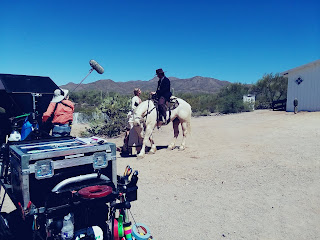
We crested a hill and were suddenly in the location’s parking area. “Always park by the porta-potties,” Jason advised me. “You can be sure your car won’t be in the shot.” Sound advice. A short, steep, winding desert path brought us to the black tent that shaded the pair of video monitors for the two cameras that covered the action.  Brent Christy was watching a scene replay. Brent is both the cinematographer and the director of 5 Mile Cave, a very rare combination. Satisfied with what he saw, he left the tent and returned to the action.

They were shooting a series of gallop-bys – Shooter Green rides by camera, pursued by a posse of more than half a dozen riders.  It was exciting stuff, with lots of pounding hoofs and dust and riding around saguaros. They did several takes.


Tom Proctor fires straight at camera


The next set-up featured the head of the posse – Virgil Earp no less – taking a shot at the fleeing Shooter Green. Tom Proctor, an experienced stunt-man and stunt coordinator as well as an actor, was playing Earp, and he was to fire the shot directly into camera. It was a blank, of course, but at point-blank range, a person or a camera can certainly be hurt by a blank. A sheet of thick, clear plastic was mounted on a stand between gun and camera, and it was the plastic that took the impact.

I got a lift to the next location from a man I’d met before, but didn’t recognize. William Shockley, co-author of 5 Mile Cave, has had a long and impressive acting career, starting with Robocop, and is best remembered from Dr. Quinn – Medicine Woman, where he played Hank Lawson, the long-haired, tough, cynical saloon and brothel-owner, who often surprised people with his basic decency.  In the last several years, he and writing partner Dustin Rikert have had quite a few movies made, including the Westerns The Gundown, Ambush at Dark Canyon, and Hot Bath an’ a Stiff Drink. Without his long, scraggily hair from Dr. Quinn, he was unrecognizable. He looks much more respectable, and much younger, without it. “I had to lose it for the part. That kind of hair wouldn’t go for a 1920s lawman.” In addition to co-writing the movie, he plays the antagonist of the 1920s storyline.

WILLIAM SHOCKLEY – Writer and Actor

Henry Parke:   What is it like, as a writer and actor, delivering lines that you wrote?

Wm Shockley: Well, I've had the privilege to be cast in many of the films that I've written with Dustin Rikert. This one, they cast me in the brilliant role of Sheriff Small, who's the bad guy ultimately. To be able to watch other actors, as a hired actor along with them, participate and see it come to life, it gives you goosebumps. I mean, it's a beautiful feeling.

Henry Parke:   When did you start specializing in Westerns?

Wm Shockley:  I was talking to the executive producer yesterday and he said, not every actor is correct for a western. So I think the western found me.  I think there's a sensibility that an actor and an actress have to have, and the look, to participate in the truth and authenticity of the old west. So I think they found me. I fell in love with Hank Lawsen on Dr. Quinn, clearly. And then, when I started working with Dustin, there's just such a beautiful truth about the old west that I can really relate to.

Henry Parke:  How do you like shooting at Old Tucson?

Wm Shockley: Well, this is the seventh time I've filmed here, and I love it. Honestly, I feel like a little kid the first day whenever I'm back. It's just awe-inspiring. Tucson's almost like my home away from home.

Henry Parke:   Where is your actual home?

Wm Shockley: Los Angeles. I've been there my whole life, since I left Texas. I claim Austin (as my hometown) because it's such a fabulous city. I went to school there and had a restaurant there.

Henry Parke:   It's seems that Westerns are going through a revival, and a lot of the really good stuff is on television rather than theatrical.

Wm Shockley: What's the golden age of television? You know, with the shrinking economy of DVDs, it's harder to monetize an independent film. And with the advent of Netflix and Hulu and Amazon and all the great opportunities in television, there's exposure for everything, including Westerns. In the perilous times that we live in, this unusual moment in history, I think the world feels great about watching something that feels authentic and good, like a western. There's such pure honesty in the old west, you know? Steal a man's cattle, you get killed. Straight up truth. And one man can make a difference. There were bad guys, (and that) creates drama. I think people enjoy looking back to a time with no cell phones, and no computers and no Facebook: none of the clutter.


The next morning, I caught up with Jeremy Sumpter, who stars as Shooter Green.  He first made a splash in 2003, starring in the title role in the live-action blockbuster Peter Pan, so I was startled that he had no English accent.  It turns out he’s all-American.  He gave me a bit of a walking tour of the main street, excitedly pointing out the sights.


JEREMY SUMPTER – Shooter Green


Jeremy Sumpter and Alexandria DeBerry
between takes


Henry Parke:   I understand that you were a fan of Westerns long before you starred in this one.

Jeremy Sumpter:  Absolutely. It's been a dream of mine to do a Western, and to finally have that dream come true, I mean, I couldn't be happier. And being a part of this, in Old Tucson, where they made, Rio Bravo -- like right over here is where Dean Martin went into the horse-trough. And you see some of these foundations, that's where the old original sets were, when they built the place in '39 and shot Arizona. Seeing it all here and being part of that, and making my stamp in the history of the place, it's pretty spectacular.

Henry Parke:  Did you grow up western?

Jeremy Sumpter:  Yeah, I did.  I grew up in Kentucky, but I really grew up in L.A.  Been out there for 19 years, so 10 years in Kentucky first, riding thoroughbreds.  And then I went to Texas, and did a lot of horse cutting, and using what I've learned over the years. I'm a modern-day cowboy in the sense of my whole mentality, so to take that into my character (Shooter Green), the period seemed pretty easy for me.


Shooter and Josie


Henry Parke:   What are your favorite Western films?

Jeremy Sumpter:  The Shootist is great. The Outlaw Josey Wales. But my favorite is Unforgiven. Clint, he's one of my favorite directors too.
Later that morning, I would be acting in a scene with Jeremy. It was Shooter and Josie’s wedding, and I would have to be costumed for it.


Meeting Jenna Miller  on-set, you would probably assume that she was an actress rather than the costume designer. Despite growing up with a mother who was a seamstress, she took a very circuitous route to costume design. “She tried to teach me how to sew when I was a kid, but I was out with the horses too much.” Jenna was a wrangler first, and eventually got interested in sewing her own period costumes at the ranch where she worked. She assisted another costumer designer for some time. 5 Mile Cave is Jenna’s second film as head designer. “I grew up here in Arizona, born and raised an Arizona cowgirl. I was immersed in the old west history growing up and it's always fascinated me. I've done a lot of research and learned a lot about the west, and I just really like doing this particular era.”

JENNA MILLER – Costume Designer


Henry Parke:   What are your biggest challenges in doing costumes on a Western?

Jenna Miller:    Making sure that we keep it as historically accurate as possible, and make the accuracy work with how we're filming it, to make it play into the scenes and work with the camera angles, as far as hats and things like that are concerned.

Henry Parke:   Which is a more demanding, the women's clothes or the men’s?

Jenna Miller: It depends on the scene. The men, like right now they're out riding and, in the dust and dirt. There's the challenge of making sure that their clothing’s aged enough, with the right amount of dust and the right amount of dirt. So it looks like they've actually been out there all day riding. The women's clothes are pretty simple and easy to do, unless we get into some of the more upscale scenes where they're wearing clothing with extra layers, the bustle skirts and fancier stuff. It gets a little more complicated.  I'm a specialist in women's clothing of that era. It was really important to me for female lead, Josie, to have period correctness all the way through the costume from every single layer. So I was painstakingly making sure that even her undergarments, that you don't ever see on film were historically accurate, because there's a certain silhouette that the women had to have in their clothing back then, that Victorian era silhouette. It's really important that the corsets and things that she's wearing underneath make the right silhouette for the outside of the clothing.

Alexandria and Jeremy - note she's standing on
an apple box to bring her up closer to him


The wedding scene was shot in the church set, a small, perhaps secret wedding attended only by the couple, the minister and his wife, and two seated witnesses seen from behind, a bald-headed man and a striking blonde. I am not the striking blonde.

Outside of the church, they shot the scene with Shooter leaving his bride to do that dangerous job that would give them financial security. After that I had a chance to talk with Director Brent Christy, and experienced cinematographer directing his second feature.


BRENT CHRISTY – Director and Cinematographer


Alexandria DeBerry and Brent Christy


Henry Parke:   Quite a few screenwriters and some editors have segued into directing, but it’s unusual for a cinematographer to do so. How do your camera skills help you as a director?

Brent Christy: I think what has worked for me is having a vision for where the light's coming from, and what I want to see from a camera move. That has helped give me confidence when it comes to the things that I'm still learning, which is having a relationship with the actors, and making sure that every little bit is as good as it can be.

Henry Parke:  This is your second film as a director?

Brent Christy: That's correct. The first one's called Legal Action.  It’s a courtroom drama that also has a little bit of detective work in it.

Henry Parke: How do you like doing a western?

Brent Christy: It's been a great experience, coming out to Tucson specifically. And doing my first western project really on any level, it's the scenery: it's hard not to make it look Western. And when it comes to a place like Old Tucson Studios, it's really built in. The same can be said for a lot of the set design, the costumes; it's all really here and the people here are great.

Henry Parke:   Growing up, were Westerns a favorite genre?

Brent Christy: No, Western fandom has come later in life. It's only been the last three years that I dove into Westerns, and really saw the potential in film history of good guy versus bad guy. A lot of it is entrenched in the things that John Ford and Howard Hawks did.

Henry Parke:   I think you’re pretty near to wrapping this film. What have been the biggest challenges?

Brent Christy: I'd say dealing with the elements. We've had some high winds, some high heat, and working out in the sun, making sure everybody stays hydrated, stays cool. And staying on time with the job ahead has been a difficult balancing act.

Henry Parke:   What particular challenges have you found in doing a period story rather than a contemporary one, and two different time periods at that?

Brent Christy: You know, regardless of the facility, everything is basically outfitted for electric these days. So we have a lot of help with our VFX (Visual Effects) department when it comes to light switches and light sockets and things like that. It's hard to make sure every one of those is disappeared. But overall, we've been very fortunate with the locations that we've had.

Henry Parke:   Except for Old Tucson, you’ve been shooting in Georgia?

Brent Christy: That's correct. They were all on location, preexisting buildings. So we had to adapt them to our needs, but thankfully the structures that we chose were all 1900 buildings, and we were very fortunate to be working with location owners that were excited to have us recreate something from that era.

Henry Parke: It's an unusual story in that you've got the same group of characters in two very different times in their lives. Did that pose any particular challenges?

Brent Christy: Casting is very important when you're doing a story where a character is decades older in one scene, and decades younger in the next. We've been very fortunate that the cast (members playing the same characters) wanted to collaborate with each other and find the little idiosyncrasies that make them who they are, and try to infuse a little bit of those into each other's roles.

Henry Parke:   How do you like working with horses?

Brent Christy: It's been a great experience working with horses, in really being able to respect an animal that you can tame. But at the same time, we have to respect their needs as well. It's been a good experience and a great challenge at the same time.


Stagecoach shootout


The last sequence I watched being filmed was a stagecoach chase and robbery.  I’d known that popular Western filming locations often had a “chase-road”, a long, straight path without obstructions, where running horses could get up a good speed, and an insert-car could drive beside them, filming, but I’d never seen a chase-road before. This one was a large perfect circle, meaning that a camera in the center could pan around, and always maintain the same distance from the coach – even if the coach drove endlessly. There was a shoot-out at the end of the chase, with a paint-ball gun providing convincing bullet-hits.  

All too soon, that last day of filming was over, and everyone was packing up and heading out. The Legend of 5 Mile Cave is completed now, and will have it’s world television premiere on Sunday night, June 9th, 2019, on INSP. Check your local listings to see when it’s on in your area.


LEGEND OF 5 MILE CAVE – A Movie Review by Henry C. Parke

In Kentucky, in 1929, it’s a few months before the Stock-market Crash, but the Great Depression is already here for recently widowed Susan Tilwicky (Jill Wagner) and her son Tommy (Jet Jurgensmeyer).  Without her husband to work the ranch and break the horses to sell, the mother and son seem destined to lose their homestead. Things are already bad enough that Susan is looking to take in boarders. Tommy escapes these worries by immersing himself in dime novels about the adventures of a fabled cowboy sharpshooter named Shooter Green. There’s a ray of hope for the Tilwickys when an older roaming cowboy named Sam Barnes (Adam Baldwin) agrees to break the horses in trade for room and board. Better still, Sam claims to have known Shooter Green in his youth, and happily gives Tommy the real story about his idol.

Interwoven with the 1929 story is the 1896 Tucson-set story of Shooter Green (Jeremy Sumpter), a young man who makes a living by demonstrating his shooting prowess to audiences for a price. He’s more than a little cocky, and would come off as arrogant except that he’s every bit as good as he claims to be. Shooter becomes smitten with lovely – and equally gun-skilled – Josie Hayes (Alexandria DeBerry), the daughter of the town banker. To earn the money to be able to marry Josie, Shooter tales on a dangerous job, which leads betrayal, disgrace, and loot from a robbery that’s still being sought in 1929.

Writers Dustin Rikert and William Shockley, and director Brent Christy have fashioned a Depression Western that is anything but depressing. It’s full of adventure and action and heart, engaging performances, with plenty of surprises along the way. Best of all, at a time when all the good recent Westerns contain little that would interest kids, or even be appropriate for them to see, Legend of 5 Mile Cave is a Western with an elegant balance of adult interest and kid interest, action and romance, so that the whole family can watch it, and enjoy it, together, not because it’s been rendered harmless, but because it’s good entertainment.  The bond that grows between young Tommy and Sam is particularly genuine.

Shot in the two beautiful, but very different, locales of small-town Georgia and Old Tucson, Arizona, the movie is handsomely lensed by Brent Christy, Cinematographer as well as Director, and shows off Arizona’s Sonoran Desert, at times using a drone to reveal that familiar landscape from a completely new perspective. The grand score by Tom Gire is in the tradition of great, stirring Westerns scores of Elmer Bernstein and Alfred Newman and Dimitri Tiomkin, without being derivative of any.  

The Legend of 5 Mile Cave makes its television premiere on Sunday night, June 9th, on INSP. It’s also available on DVD, as well as Amazon Prime and Fandango. 


THE ROY ROGERS ‘HAPPY TRAILS’ COLLECTION – DVD Review


If you’re a fan of the King of the Cowboys and the Queen of the West, this twenty-film collection for about a dollar a movie from Mill Creek Entertainment is an unbeatable deal, and it’s authorized by The Roy Rogers Estate, compiled with the help of Roy’s son, Roy “Dusty” Rogers Jr. and Jeffrey Kramer. 

While the movies themselves, almost all directed by Republic Pictures action wizard William Whitney, many guest-starring Gabby Hayes, would appear to be the main attraction, if you love Roy and Dale, the even greater appeal of this set is its source: the 1980s Nashville Network series, Happy Trails Theatre, which they hosted.  The introductions are heartwarming, and full of insights into the making of the films. Better still, the introductions usually feature guests, including Dusty, co-stars like Iron Eyes Cody, Penny Edwards, Ruth Terry, and Roy’s friend and rival Gene Autry with sidekick Pat Buttram. There are several good documentaries as well.

On four DVDs, and also featuring a digital copy, the shows have all been digitally remastered. But while I strongly recommend this set, I want to make a couple of clarifications. While all the movies I’ve viewed so far are perfectly watchable, these versions of the movies are the ones that were originally included in the TV series, and I know that in some cases there are higher quality versions now available.  And at least some of the movies are cut. Originally, B-westerns ran about 60 to 65 minutes. But when they were first sold them to television in the 1950s, they were cut to 53 minutes, to fit into a TV hour, with seven minutes for commercials. In some cases, the missing footage is simply lost. I don’t know if there is a more complete version of 1944’s delightful Along The Navajo Trail, but it was released at 66 minutes, and this version is 53, with at least one musical number obviously missing.

But it’s a wonderful deal, and even if I already had all of the movies complete, I’d buy the set for the intros. Disk one features Sons of the Pioneers (1942) and Trigger Jr. (1950) in color, and Pals of the Golden West (1951), Young Bill Hickok (1940), and Don’t Fence Me In (1945) – the only Roy Rogers Western with a Cole Porter theme – in black & white.  You can see the entire list of films, and order the set, here:


JONAH BLUE - by Jim Christina – a Book Review
Tuscany Bay Books – 280 pages


With Jonah Blue, author Jim Christina takes a break from his popular The Hunter Western novel series to tell a story that begins with 10-year-old Jonah Bleu, growing up in 1830s Ohio. One of three children, their father is so cruel to the family that his wife can take it no more, and hangs herself. Jonah finds his mother’s body. When his father shows no remorse, seeing it as an excuse to whup the boy, Jonah grabs his few belongings in a kerchief and takes off for the Rocky Mountains.

The bulk of the adventure tells how Jonah, with the help of a succession of Mountain Man mentors, starting with Rensfeld Dogget, learns to be a Mountain Man, to live off the land, to be self-reliant, to protect himself from enemies both White and Indian.  He must also, inevitably, deal with the fates of the brother and sister whom he left behind.

In his autobiographical appendix, Jim Christina notes, “If you are looking for Louis L’amour, you won’t find him here.” This is absolutely true. Eschewing pastoral passages and detailed descriptions, Christina’s prose cuts to the bone. There are no taboo subjects here. Heroes are not always heroic, language is coarse, and the details of action are unflinching: nobody is simply “stabbed in the gut.” You will learn precisely what happened to the victim’s entrails.  With a hero every bit as compelling as The Hunter, one must suspect that there will be many more Jonah Blue novels to look forward to.
JONAH BLUE is available from Amazon, in Kindle and paperback, here: https://www.amazon.com/dp/B073NP2VP2


One More Thing...

I wanted to make sure I posted my article and review about The Legend of 5 Mile Cave before the show actually aired, and I'm down to the wire to do it. As I type these words, it's 2:42 a.m. , Sunday morning, and I still have to choose the pictures to go with the articles. In the next day or two I'll be updating this post with a book review (now included), a video review (now included), and some upcoming events. Please check back in during the week!

Much obliged,

Henry

All Original Contents Copyright June 2019 by Henry C. Parke - All Rights Reserved