Showing posts with label Guns of the Magnificent 7. Show all posts

Tuesday, June 24, 2025

HAPPY 90TH BIRTHDAY MONTE MARKHAM! HERE’S OUR ‘GUNS OF THE MAGNIFICENT 7’ INTERVIEW, PLUS 'ELKHORN' RETURNS TO INSP OCTOBER 2!


Monte shooting low


Monte Markham, who in 1967 starred in the series The Second Hundred Years, is closing in on his first hundred! A busy actor on film and television since his 1966 debut on Mission: Impossible, and Debbie Reynolds’ co-star in 1973’s Broadway hit musical, Irene, he’s still very in-demand. But beginning in 1992, with son Jason Markham and wife Klaire Markham, Monte founded the independent documentary production company Perpetual Motion Films, and they have produced hundreds of hours of documentary television, including the first 10 episodes that premiered the landmark A&E series, Biography.

At 2022’s Lone Pine Film Festival, I had the pleasure and privilege of interviewing Mr. Markham onstage before the screening of 1969’s Guns of the Magnificent 7, speaking mostly about that film, and also about his first Western, 1967’s Hour of the Gun.  So much of our talk was punctuated by laughter, both Monte’s and the audience's, that I left the “laughs” in. I’m particularly happy that Monte shared a great story about the late Joe Don Baker.


Me and Monte against the Sierra Nevadas 

Henry Parke: Hello, I'm Henry Parke, Film Editor for True West Magazine, and we are so lucky to have with us one of the magnificent people of The Magnificent 7, Monte Markham. To put Guns of the Magnificent 7 in a historical context, in 1960, director John Sturges took his crew to Cuernavaca, Mexico, along with Yul Bryner, Steve McQueen, Eli Wallach, and a script based on Akira Kurasawa's Seven Samurai, and made The Magnificent 7. It's a wonderful western and it made stars of James Coburn, Charles Bronson, Robert Vaughn. It introduced Horst Buckholtz and gave Brad Dexter his best-ever film role. In 1966, The Mirisch Company sent director Burt Kennedy to Spain with a script by Larry Cohen, with Yul Bryner back as Chris, Robert Fuller in Steve McQueen's role of Vin, and Warren Oates, Simon Oakland, Fernando Ray, Emiliano Fernandez, and Rudolpho Acosta, to make Return to the Magnificent 7. It's widely considered to be, well, a movie, but nobody's best work. Then in 1969, working in Spain with a script by Herman Hoffman, Paul Wendkos directed what is clearly the best of the three sequels, and we won’t even discuss the remake, Guns of the Magnificent 7. George Kennedy, fresh from his Oscar win for Cool Hand Luke, played Chris, and as his right hand, in what would be the Steve McQueen role, the first of the new 7 he'll recruit, as you know, is Monte Markham. We're so fortunate to have him with us tonight. Monte, Guns was early in your film career, but not your first Western.

Monte Markham: No, the first Western was called The Law and Tombstone, and I was cast and got down to Mexico, and it was John Sturges directing. It was the sequel of the Gunfight at the OK Corral. They hated the name, because it would translate only to The Law and the Grave Marker in the European market -- that wouldn't have the same cache that Tombstone means in America. (Note: It was eventually retitled Hour of the Gun.) And that was just a hell of an experience. I gotta tell you. It was my first film; I had just come into town. I hadn't done any television, hadn't done any film, and we were in Torreon, Mexico and it was the first time anything was shot there. And in the cast was Sam Melville (as Morgan Earp), his first film; Johnny Voight (as Curly Bill Brocius), his first film; Frank Converse (as Virgil Earp), his first film. And we were surrounded with some of the finest character actors in New York and Hollywood. And it was such a great experience. Jason Robards playing Doc Holliday and Jimmy Garner playing Wyatt Earp. They became lifelong friends. It was a great time.

Monte in Hour of the Gun

Henry Parke: And of course, you played Sherman McMasters.

Monte Markham: Yep. He was the deputy sheriff out of Arizona.

Henry Parke: What was John Sturges like to work with?

Monte Markham: John was a very impressive and a very reticent man, a man of few words. He loved to party. Jason Robards was known to be in his booze. He was divorcing Lauren Bacall at the time. And he spent every night in the whore-house, not whoring necessarily, he just loved the company and he had a great time, <laugh>, and he drank a lot.

And the next morning, they'd be bringing him onto set with cucumbers on his eyeballs. It was an interesting time for all. We were all in the hotel dining room and having dinner. And Jason came in and said, “Hello everybody.” When he was not drinking, he was just the sweetest man in the world. "And John, " he said to Sturges, like a hurt boy, "I said hello to you on the street, and you didn't even acknowledge it." John looked at him and said, "I never speak to strangers on the street." Jason was so upset. But it (became) a joke between the two of them.

When I got the call to do the film, they said report to Los Angeles. And I had a great wife, a 2-year-old child, and I was off to Mexico. It was raining, I got a taxi, arrived at LAX, then a Mustang pulled up and spun around and stopped. Out stepped Lonny Chapman and Jason Robards and Bill Windom, drunk as coots. Got on board the plane and we flew to El Paso, Texas, had a brief news conference, and everybody was drinking the whole time. Bill Windom and Jason were wearing their wardrobe, and we flew to Mexico, to Torreon, on a DC 3 plane. We got off the plane and I ran down and said, "Hello." Mr. Sturges was standing there. And I’ll never forget the look on his face when Windom and Robards just crawled off the plane and fell down the stairs <laugh>. It was like that the whole shoot. But it was just very exciting, particularly for a young actor; just great.


Monte guesting on High Chaparral

Henry Parke: You'd also made a couple of TV Westerns, episodes of Iron Horse and Here Come the Brides. Did those, and Hour of the Gun help prepare you for Guns of the Magnificent 7?

Monte and Ed Begley on The Mod Squad

Monte Markham: Nothing really prepares you for any of that. You are all fans of Westerns, you love it, and we have the great Cowboy poems, and the writing, and it's all true: there's no greater fun. That’s when the stables were all working in Sun Valley, and the north section of the Valley; that's where all stunt men had their horses. And you want to understand that at that time, everybody had three horses. Jimmy Garner got James Stewart's horse, that was Henry Fonda's horse. Jimmy Garner had three horses, they were Buckskins. Jimmy didn't own them; the people running the studios had them. The stunts were all worked out there, at the barns.

And when I went to Hal (Note: sorry, I couldn’t decipher the last name), who was a good friend of somebody, and he introduced me, and we became great buddies. He said, come on out and we'll fix you up. And instead of having lunch I was trying to learn everything. I would learn how to jump over the butt of a horse, and mount this way, and mount that way. It was just wonderful. And Dustin Hoffman was training for Little Big Man. I remember him standing over in the corner learning how. He was just in from New York. He was working his butt off. It was great. There's the horse sequence where we get on and again, it was the American cowboy horses, the ones that we had down in Mexico, the ones that we didn't have in Spain. They'd be all over the place; they were agitated all the time.

George (Kennedy) runs up, says "Mount up," and I ran to the horse to mount, and boom, the horse ran away. <laugh> Paul (Wendkos), the director, was furious. We kept trying. And that horse would not wait for me. He said, “How are you doing?” Then, Boom. “Get away from me!” “Don't jump at me like that!” We had to tie the horse, and finally it took three different cuts to make it work so I could take off, and it was a nightmare for him. But it was just a different way of filming everything. I didn't get to jump on a horse after all that hard work. That's my story, and I'm sticking to it. But, don't tell me I'm not having a good time. It was just great. Great.

Reni Santoni, Monte, George Kennedy, James Whitmore

Henry Parke: Had you seen the original Magnificent 7?

Monte Markham: Several times, as we all have. I remember Jimmy Coburn, and it was like, my God, who is that? And the various actors; McQueen! It was great. It was an honor to do the film. I felt very strongly about it. Madrid was like the hub, and we would drive out every day, 30, 40 miles to the different locations. It was four months and it was great preparation. Paul Wendkos was the great New York director. John Frankenheimer and he were competitors all the time. And Paul just never got the role of the director that he should have. And unfortunately, he died early.

But it was just a great shoot. Joe Don Baker, just a wonderfully spooky guy. We had a great time. In Madrid at that time, it was bullfighting season. Up until a certain young man appeared on the scene, bullfighting had really degenerated into corruption, et cetera. They would drop sandbags on the bull's back to weaken them. They shaved the horn, because the bull would think, I got you. Well, I thought I got you, but they took about an inch off his horn. They were cheating all the time. Then came a young guy named El Cordobes. Many of you here may remember the name and remember seeing some of his work, those of you that are into bullfighting. We had that to go to on Sundays, and it was just wonderful. I hated the picadors, I hated a lot of it, but it was really spectacular.

George Kennedy and Joe Don Baker in
Guns of the Magnificent 7

Joe Don bought a cape, and he wore that cape, <laugh> walking down the street. A guy would look at him on the street as they're passing, like, what? What the hell you lookin' at? Whatcha looking at? Whatcha looking at? And he had a stunt girl in Spain that he dated, and she wore like the first mini skirt. This is ‘68, and we'd be in the Great Plaza Ventas, the magnificent bullring stadium there. And he'd make his entrance in that cape and have a grand time and look around. Everybody -- whatcha looking at? Whatcha looking at? It was a great time. It was a crazy time. James Whitmore -- it was an honor to know James. He was one of the finest men and finest actors I've ever worked with, one of the finest human beings. The work that he started with actors and theater all over the country that's resonating to this day.

George Kennedy, he said, “Hell, what a stroke of luck! Yul Bryner decides he doesn't want to do it, and I’d just won an Oscar, and here I am.” And he was thrilled to be doing it. He said, “We're all doing cowboys and Indians, cowboys and Mexicans.” Frank Silvera; what a gift, what a man. Tragically, shortly after we made the film, he died installing a damned garbage disposal: electrocuted himself. Bernie Casey is a great artist. Had an incredible career as a painter. That was his first film. You aren't necessarily Los Angeles Rams fans, but you remember that was the winning team, and Bernie was a great wide receiver. So it was a thrilling, thrilling shoot.
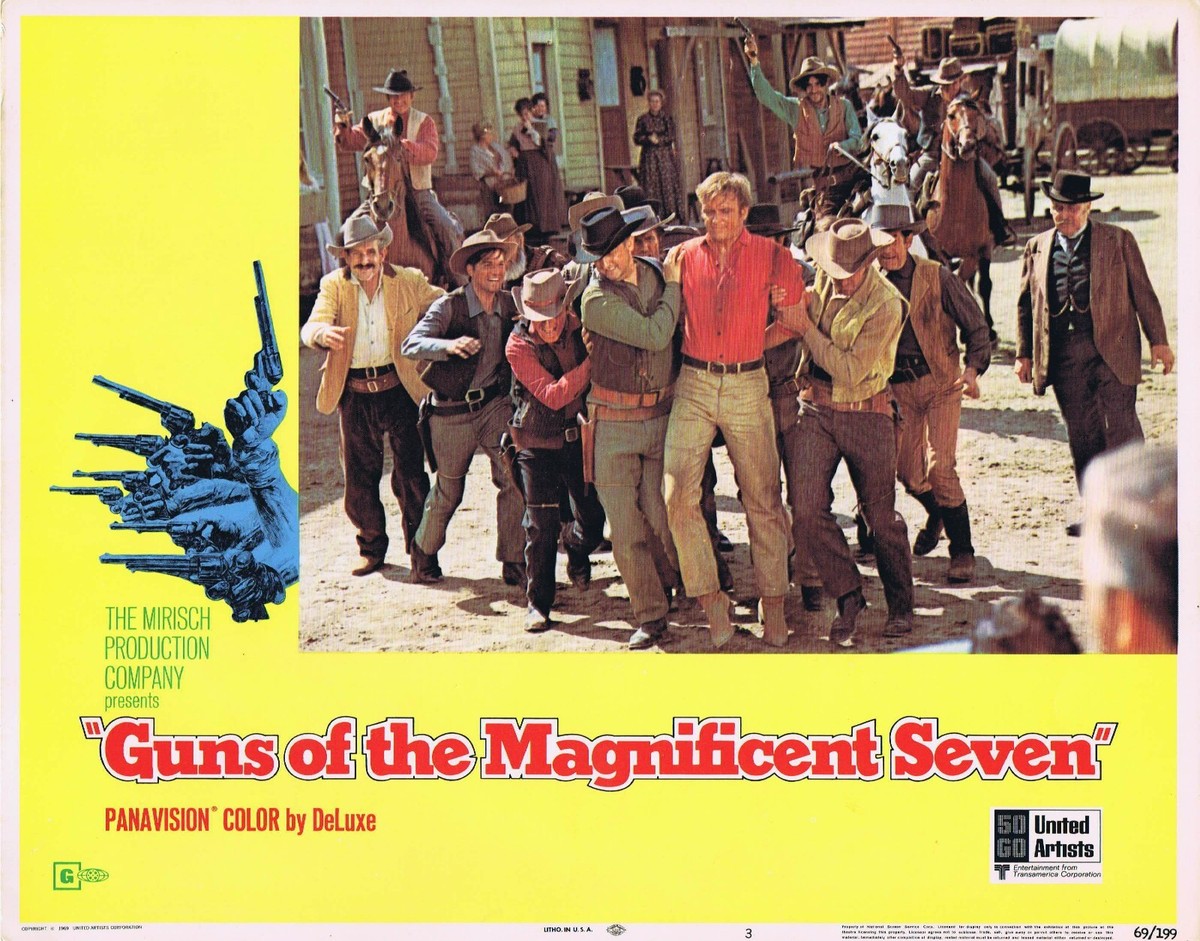
Monte about to get his neck stretched

Henry Parke: As long as you talked about most of the 7, how about Reni Santoni?

Monte Markham: Reni, I didn't know very well. And he really was pissed off when I jumped off that horse and knocked him down. I just kicked him down and knocked him down, and he kept going, "You son of a bitch!" We never really got along. I would point out that Fernando Rey, the little dove, I don't know how many remember, but he was The French Connection, another great film. Fernando was a very elegant man and a very well-known Spanish actor and spoke beautiful English.

All 7 left to right: James Whtmore, Joe Don Baker, Bernie Casey
George Kennedy, Reni Santoni, Scott Thomas, Monte

Henry Parke: And as far as elegant, evil people, Michael Ansara as Colonel Diego --

Monte Markham: He was cool, very, very cool. Married to Barbara Eden at the time, but he had a good time in Spain.

Henry Parke: With all of the location work, was it a physically difficult shoot to do?

Monte Markham: I'd like to say yes, but it was just...no. It was great people, great locations. But I will say that for me, that first day of the shooting, me just being hauled out of the saloon and down the street. We fought, and guys got shot, and finally it was the end of the day. And it was this hot hot, day. The guys were sweating like pigs. The next day it was freezing cold. I remember Jimmy Whitmore, he was working on other scenes that day. And (to match how they looked the day before) a guy was spraying (water on everyone) And Jimmy kept saying, "Don't do that. Please don't do that. If you do that again I'm going to kill you." Each time, “Just one more time.”

The difference in location shooting is we had a lot of time off. As my character, Keno. I do some tricks; I do karate and all that. So there were three guys with me on the train. And one guy, Ray, they were making a joke. He had a straw hat on. Again, this is 1968, and he took off his hat, and he had long, I mean really long hair. And they called him El Indio. He fought bulls dressed as an American Indian chief, and he was well known. We had been working, working, working. They said his village is having a fiesta, and they invited me. He's gonna fight a bull, and we'd like you to join him in the ring, and be his assistant. And I said fine, that's great. 200 kilometers north of Madrid. They picked me up on Friday night at about nine o'clock, after shooting, and we drove all night. We got there about two a.m., went into the hotel. The next morning, they were singing and dancing in the street. It was like choirs. And in the middle of it is Ray Olo, the big barrel-chested guy. And so we go down, looked at the bulls. The bulls were not bulls, they were just big, big bull cattle. And it was for charity; in fact, the mayor was one of the guys to fight a bull. And Ray was gonna take one. So we got there. I was tall, blond hair, white shirt, marching with the crowd. They gave me brandy and we're having a great time. We got to the arena, and it was like something in Sun Valley in 1938. I stood there in the ring. And the first guy introduced himself, and then he got on his knees in front of the entrance and had the cape in his hand. And the bull ran out and ran right over, knocked him down.

Monte from the book Western Portraits,
photography by Steve Carver, written 
by C. Courtney Joyner

The mayor took on his bull, and he got hit several times. And he kept saying, "My God, the things we do for charity!" <Laugh>. So in comes Ray, and Ray had the full regalia on, and I've never seen the like of it. And the bull came and it was a big one. Big -- hell, about this high at the shoulder. And Ray had stripped off his vest, he ran toward the bull, and the bull was running toward him. He was running straight at the bull, nothing in his hands. And he did a vault over the bull!

I was thrilled. I stood up applauding, like it was a football game. So then they said, “It’s your time.” I went out and they gave me a cape, the lavender one with the yellow side. I’d watched them do it. So I stood like this, the bull's charging me. And I got mixed up to where I was, and the bull hit me and ran right over me, right across my chest <laugh>. I said, I must get up. And I did. And I ‘passed’ the bull. And then ‘passed’ him again. And I looked over at Ray, and he said, "Anytime you're ready. It's my bull." It was great. It was a great time, but my chest looked like hamburger.

Henry Parke: Do you have any favorite memories from shooting the film that you haven't mentioned yet?

Monte Markham: That was a big one.

Henry Parke: I should think so.

Klaire and Monte Markham

Monte Markham: Not a favorite, but my wife was able to join us for 10 days and we were able to travel around, but Franco was still in power. All around town you would see that everything was stopped and there'd be a parade of tanks, and Franco coming through town. There'd be a big event, and Juan Carlos, the son of the ex-King was being groomed. They knew he would take over and be King, and that's the only time Franco would have let it happen. But he seemed to be everywhere. More police than I had ever seen anywhere. We were in the massive -- maybe it was about the size of the Rose Bowl -- the famous Casa de Toros in Memphis. Before one of the fights, the picadors come out. But some guy in the crowd, he kept yelling something, and he was cursing; he was drunk and he was making comments. Everybody was very shocked and quiet. And then they started laughing, and he was going on, and all of a sudden a voice went -- (Shouting in Spanish). And that was one of the policemen. 150,000 people stopped in silence. There were several different kinds of uniforms. They took him away. It was something. I mean, you were safe (from crime). You could do anything. If I came back to my room, and I’d left my money laid out in denominations on the bureau, it was (untouched), because it was a pure dictatorship. And 50 years later, my wife and I, we went back and they'd removed Franco from where he was buried. (Note: Franco was originally buried at the Valley of the Fallen, a memorial built by the forced labor of his political enemies. In 2019 Franco’s body was exhumed, and was reburied in a regular cemetery.) So there was a mix of great memory of a great people, and the rise of really artistic bullfighting with Cordobes, and us being able to play-act like that and yet have such a great time and love each other. And I can't describe it more to you, how great the memory is and how great the opportunity was. You hear it from all the guests, but I truly am one of the most fortunate people who's ever been able to act. And I thank you all for that.

Henry Parke: We have a question from an audience member.

Audience Member: The Magnificent 7 theme song is pretty iconic. It's like the James Bond theme: everybody knows it. I'm just curious, when you guys were doing those group riding scenes, did you ever think about that theme?

Monte Markham: Every moment! <Laugh> Bernie Casey was a big man, and they needed to have a particular grey, a beautiful grey, for him to ride. And the first time we were all together, for those who will remember, we came over the hill. It was early morning, dawn, dew was on the mountain and a lot of grass. And we all come over, it's George and me, and then I hear, "Whoa! Whoa! Whoa!" I looked over my shoulder, and Bernie's horse, that big grey, had just sat down on his butt and was sliding down the hill. <laugh>

And Bernie, it was all he could do to stay on. We did it twice more, and it still happened. And finally the sheepish wrangler said the horse had a saddle sore. But you always did (think of the theme). You remember in school, if you had a track meet, you’d tie a number on your back. I went to a sporting goods store, and I bought seven numbers. They set up another morning shot. We all came riding into camp. Long shot. So we're up there, we're over the mountain, and I'm passing out the numbers. George put on 1, I put on 2, and we had the music playing, we come over the mountain, they're riding in, riding in, riding in, Paul Wendkos saw it, "Very funny! Cut! Cut! Cut! " But yes, you always knew it; I'd even hum it sometimes.

INSP'S 'ELKHORN' SEASON 2 BEGINS OCTOBER 2ND

The INSP Channel just announced that season 2 of Elkhorn, their series about the young Teddy Roosevelt, will begin airing on Thursday, October 2nd. If you haven't seen it, it's quite a show, and good history. Mason Beals stars as the rising New York politician who suffered the double tragedy of losing his young wife and his mother in one night. In despair, he travels to the Dakota Badlands, where he begins the process of remaking himself as the vigorous outdoorsman we would come to know. Beals won Best Actor, and the show won Best Western TV Series in the Cowboys & Indians Movie and TV Awards. Here's a sneak peek!


And that’s a wrap!


I need to get this posted, and get ready for the interview I’m doing in a few hours with Alexander Nevsky about his newest Western, The Wide West!

To see my most recent other writings, check out the left hand sidebar near the top, where you’ll find links to my most recent articles for INSP, about Westerns at the Drive-in, and my 4 pieces in the May-June issue of True West, on different aspects of the miniseries American Primeval. And catch me on Thursday, July 3rd, on the Rendezvous With a Writer podcast!

Much obliged,

Henry

All Original Contents Copyright June 2025 by Henry C. Parke – All Rights Reserved


Sunday, May 25, 2025

INTERVIEW WITH “LEGEND OF MOLLY JOHNSON” STAR/DIRECTOR/WRITER LEAH PURCELL, PLUS REMEMBERING JOE DON BAKER, AND MORE!


LEAH PURCELL -- THE WOMAN BEHIND, AND IN FRONT OF, THE CAMERA ON THE LEGEND OF MOLLY JOHNSON, A.K.A. THE DROVER'S WIFE

Back in 2022, when I interviewed Leah Purcell, the writer, director and star of the excellent new Australian Western, The Legend of Molly Johnson, I’d intended to run the article immediately. But the film had not yet been released in the U.S., and so I decided to wait until it was. I don’t know exactly when it was finally released here – I think it’s been a while – but it’s available now, streaming on Hulu, Plex, Prime, Roku, and Tubi, and I strongly recommend that you pick one, and watch it! 

Some of the then-upcoming projects which we discussed are still in the works. Leah Purcell has also recently starred in the Amazon Prime series The Lost Flowers of Alice Hart, and stars as a police detective in the Australian BINGE network’s series High Country, which is not yet available in the United States.

In the U.S., the film is called The Legend of Molly Johnson, but in Australia, that’s the subtitle; the main title is The Drover’s Wife.  In fact, it would be something like blasphemy Down Under to remove the original title from Henry Lawson’s story. ( HERE is a link to Lawson’s original story.)  Purcell, explains, “You could compare him to your Mark Twain: he's considered one of the greatest storytellers of our country. He was looking at the colonial period when he was writing. Henry would go on walkabouts as they say in Australia, and meet up with people and sit and observe. But he also based The Drover's Wife loosely on his mother's experience, and his mother was a newspaper proprietor. She actually published his first poetry, and she was a writer herself.”

Lawson’s story takes place on a single night, with a woman and her four children alone in their farmhouse in the bush, waiting for her drover – a man who drives livestock – to return.  A snake gets into the house, into a hollow woodpile, and the wife and her dog spend the night awake, protecting the family from the snake.  Forty years ago, another Australian classic, Banjo Paterson’s poem The Man from Snowy River, became a tremendously successful film, and the filmmakers took great care to elaborate, but not stray from, the original, beloved story.  Purcell has taken a very different route, using the original story as what she calls, “A Trojan Horse,” as a springboard to a much more complex tale, with a backstory that is slowly revealed as the main story moves ahead.  It is a beautiful but unflinching film, brimming with suspense, hate, brutality, violence, and hope.

Purcell, who played Queenie, Danny Huston’s girlfriend, in The Proposition, and has an extensive resumé as a television writer, director, and actor, already had created a successful stage version of Drover’s Wife before she filmed it.  You’ll learn in the interview why it’s a profoundly personal story to her.


Purcell directing

HENRY PARKE: How long have you known Henry Lawson's story, The Drover's Wife?

LEAH PURCELL: When I was a five-year-old, my mother would read that story to me. She had his little book of short stories, first published in 1892. And that was the first time I used my imagination, where I put myself and my mum in that story, because my story was very similar. My mother's Aboriginal, and my dad is white, but he was not in my upbringing. So it was just me and her. We lived on the outskirts of a small country town. We had a wood heap; she could swing an axe. She taught me to split logs to chips, and she taught me to stack wood. She would say, "Don't stack it hollow, or the snakes will get in under." So words in my life were sort of echoing the story. My mom passed away, and when she did pass, that book was the one thing I took. I carried that story with me for 42 years.

I was a director in a writer's workshop, but I got very frustrated with these writers because they just kept churning out the same 12 pages. So then I thought, maybe it's time for me to write. I wrote the play in 2014, and we world premiered it at the Belvoir Street Theater in Sydney, one of our prestigious theater houses, (and) we sold out. I'm a bit crazy, Henry. I'd get the feedback from the audience, (then) go home at night and work on the film script. I always try to leave my work open-ended, so I leave them wanting more. And they did want more, and I said, well, I can do that in the film. Once I got the first draft up, and we got into pre-production, I was then finishing off the novel. We got a book deal from Penguin, Random House. And that was amazing because what I could do with those chapters on the characters was to give their chapters to my actors. So it was an enriching project and a process for our film; they came with a strong understanding of those characters. And it just all built upon one another and it made for a rich, rich film, I think.

HENRY PARKE: How ingrained is The Drover's Wife in Australian folklore?

LEAH PURCELL: Henry Lawson is considered one of the greatest storytellers of our country.

And in the film, The Dawn, that Louisa (played by Jessica De Gouw) writes for, is a homage to Henry's mom: her name’s Louisa Klintoff, after Louisa Lawson. The Dawn was her paper and she was writing about battered wives, temperance. She was before the Suffragette movement; she really pushed it in Australia when it came. She was a woman before her time. So the story The Drover's Wife is a classic. And when I had my producing hat on, I knew that it could be the Trojan horse to bring his loyal fans, where they might have thought they were getting a literal interpretation, but were pleasantly surprised – a majority of them – with the indigenous flavor that I put through.

Through my work, I want my audience to sit, think and have conversation. And I've witnessed that; I've gone to the film, sat at the back and watched the audience sit there until the credits roll. I'm listening to the conversation, and the ushers are telling us to get out because the next session is starting. So I've done my job. And as an indigenous person, as a storyteller, a truthteller on my people's plight, I wanted to open those conversations up, and hope people can take an interest, an understanding from an indigenous perspective, and maybe have their own interest to research more, to find their own understanding on those issues.


HENRY PARKE: In Lawson’s story, you learn her children’s names, even that her dog is called Alligator, but the drover’s wife’s name is never said. But you named her.

LEAH PURCELL: Well, she's a woman and she needs a name. The funny thing is when I sat down to actually write the play, I grabbed the book and put it beside me. And I said, I'm not gonna reread it. I'm gonna remember what my mother told me. And once I'd done the first draft, I gave it to my partner in life and in our production company. I said, you read this and tell us if we're onto something. And while he read that, I went back and read the book. And the first thing I said was, he doesn't give her a name! What's going on? It was important that I gave her her identity. I understood in those times, for protection, it was important for a woman to be married, to have her husband's name, and to be able to mention it, because of the danger of being on a property on her own while her husband is away; it gave you some status. So I understand that, but I wanted to play on that. And Molly does that: whenever she introduces herself at the beginning, “I'm Mrs. Joe Johnson.” He's the boss. He'll be home soon. That's her way of protecting herself. But then when she finally finds the friendship, she clearly gives her name, and that's such a big thing because she's owning her identity in that moment. And then, without giving too much away, that opens up even further with the indigenous man, what he's there for. The name Johnson actually came from my great-grandfather, who was non-indigenous and who loved his black wife and his Aboriginal children. My grandmother was part of the stolen generations. (Note: from the 1910s to the 1970s, in a policy that echoes earlier ones in the U.S. and Canada, as many as 300,000 Aboriginal and mixed-race children were forcibly taken from their families by the Australian government, to be raised as white.) She was stolen, and he tried to save her and her sister and brother; he managed to save his son, but not the two girls. And that's where Johnson came from: paying homage to the men in the family who stuck by their Aboriginal women.

HENRY PARKE: Was it very difficult for you to move the story from the stage to the screen?

LEAH PURCELL: No. I loved the challenge, and I wanted each experience to be different. So I really thought about those processes. I can't wait to do the play again, because if you read the book and you’ve seen Molly on the screen, now come and meet her in person on the stage. With the novel, you get more of a spiritual and an internal thought process about what happens to her. And in the film you get the raw, in-your-face: here it is. I've had a lot of people say that they've read the novel, and they cried.  “But when we got into the film, we wanted to get angry. We wanted to get even.” The women were empowered. So no, I really enjoyed the process of finding the difference.

HENRY PARKE: You have extensive experience directing television, writing episodic TV, and I'm sure that was wonderful preparation for you. But why did you decide to do your own stunt fighting?

LEAH PURCELL: Because I I'm a very physical actor. I love my sports. I come from a boxing family. My brothers and nephews were all Australian champions. My non-indigenous father was a boxing trainer; that was how we could get close to him, by going boxing training. And, I just wanted to show off my skill. It was an opportunity. Because my dad said to me, if you were a boy, you'd be an Australian champ. I was 49 when I ventured out on this, and I said, I'm gonna give it my best shot, and do my fight stuff. I had a ball! All the producers were on-set. When Molly takes the fall, I did that 12 times, and they're going, “Stop! Stop!” And I'm going, “But I'm having so much fun doing it!” Even the stunt coordinator, he said, “You're a man.” And I said, “Yeah, I know.” I said, “When I grow up, I'm gonna become a stunty in my seventies.”


HENRY PARKE: Great. I do know stuntman who are in their seventies and they're stunting for actors in their eighties. I was wondering what Western filmmakers, Australian, or American, or both have influenced you?

LEAH PURCELL: The biggest one for me is Clint Eastwood. My mum was a big fan, so I watched a lot of his movies. Growing up in a small country town, you don't have a lot of choice in what you watch. So we grew up on westerns; a few spaghetti westerns found their way out, The Good, The Bad, and the Ugly. There were other movies; Unforgiven, Clint Eastwood. Hondo, with John Wayne. I got a bit scared because, oh my gosh, some of my lines (in Molly Johnson) are in these films. I hope people haven't thought I ripped it off; I want it to be an homage to them. Shane was another film that we looked at, Deadwood of course, and in Australia, The Proposition.  John Hillcoat was the director, and I acted in that one as well. I played Queenie, Danny Houston's girlfriend. And that was shot in my great-grandmother's traditional land of Winton. So that meant a lot. And Mudbound was the other one, just looking at the female character, Carey Mulligan, as the protagonist in that. And I threw in 12 Years a Slave. Just for the sort of character, that he was wrongfully arrested, and trying to get home. So, they were the main ones that I looked at. And the one with Leonardo de Caprio, The Revenant. That was another one that I was looking at, the shots of the action, the low angles. And so for when Molly has that fall, when Leo was fighting the bear -- we really studied it. We've got a scene where a horseman is coming down the hill at pace; that’s a little homage for the fans of Banjo Paterson and The Man from Snowy River. They were the main ones.

HENRY PARKE: What is your next project? Are you tackling another Western?

LEAH PURCELL: No, I've been advised to try something different. I'm acting in a film at the moment. So on my downtime, I sit and I write. I've finished a treatment that I think will be my second film, but I've gone totally the other way. It's PG, it's family. I'm really excited about it. There's an indigenous component in it, which is loosely based on my family's history again, as a foundation. It's a bit of animation in there as well. And you know who I am as a writer, so there's this subtle subtext of an issue; of a few issues; I'm excited about that. But also I've just finished the bible for the The Drover's Wife limited premium, TV series; about to go shopping it. It starts in 2020, and the little girl in the film, Delphi, it's her great, great, great, great granddaughter in 2020, and an incident happens and she's got to go back to the high country. She's been estranged from Australia and her family. She's been living in America as a defamation lawyer. She comes back home and her work sends her back to the high country. And then her history starts running back to her. She finds out that she's connected to Molly Johnson, and you find out what happened to the children. So that's exciting to do. And we've been offered an opera version or a musical version, like Porgy and Bess. The composer has been chasing me for nearly a year now, and we finally sat down and had the conversation, and contracts have been drawn up. It's exciting. I think for me, the TV series will wrap it up and I'll put Molly to bed. And then of course, hopefully I'd like to do the play again at some stage, because we only did a short season in Australia, we only did one city. So I'd like to do a tour. I'm just on this trajectory of film and television at the moment, so I might have to give over the role of Molly to another person to get it back out there. But I love that role and I want to play homage to it again. And I know that my fans in Australia do want to see me in that role on the stage again, so there's plenty of stokes in the fire to keep me busy for a good while.

If you’re in Southern California, and would like to see Leah Purcell on the big screen, On Sunday, June 1st, The Proposition is an opening night film for the American Cinematheque’s 4th annual Bleak Week, at the Aero Theatre in Santa Monica. Director John Hillcoat and actor Robert Morgan will be there for an in-person Q&A, and and Ray Winstone, Danny Huston, Guy Pearce and Emily Watson will take part virtually. Here’s the link: https://www.americancinematheque.com/now-showing/the-proposition-6-1-25/


 REMEMBERING JOE DON BAKER


Joe Don Baker died earlier this month, at the age of 89. Best known for starring as lawman Burford Pusser in
Walking Tall (1973), from his first screen credit, a 1965 Honey West episode, to his last, the exceptional 2012 film Mud, he had a screen presence that was unmistakable, and upped the ante of every scene he appeared in. The towering Texan served in the Army, graduated from North Texas State, and studied at The Actors Studio. His Broadway debut was 1963’s Marathon ’33, about Depression-era marathon dancers, written by June Havoc, with a cast that included Julie Harris, Lonny Chapman, Gabriel Dell, Conrad Janis, Doris Roberts, and Ralph Waite. The following year he was in Blues for Mr. Charlie, directed by Burgess Meredith, and co-starring with Rip Torn, Pat Hingle and Diana Sands. He was in 3 James Bond movies, sometimes a villain and sometimes a good guy, tough crime pictures like The Outfit and Charley Varrick, and was nominated for the Best Actor BAFTA award for the BBC miniseries Edge of Darkness, and a Best Supporting Actor Cable Ace award for playing Alabama Governor Big Jim Folsom in the George Wallace miniseries.

Joe Don Baker on THE BIG VALLEY

He did a fair number of Western television episodes, playing a wide range of white hats and black hats.  On one of his Gunsmoke shows he blames Doc for letting his wife die in childbirth, for instead attending a wounded outlaw. On The Big Valley he played a college-educated Modoc who ascribes all of his problems to white racism. He also appeared on Bonanza, Iron Horse, High Chaparral, and on 3 episodes of Lancer, one of which was the model for the episode-within-the-movie of Quentin Tarantino’s Once Upon a Time in Hollywood, with DeCaprio reprising Baker’s role.

George Kennedy and Joe Don Baker in
GUNS OF THE MAGNIFICENT 7

On the big screen, Joe Don starred in 1969’s Guns of the Magnificent 7, the best of the sequels, playing a bitter one-armed former Confederate officer who forms an unexpected alliance with formerly enslaved Bernie Casey. He supported William Holden and Ryan O’Neal in Blake Edwards’s 1971 Western The Wild Rovers, and in 1977 was again an ex-Confederate, this time hunting for stolen diamonds in the supernatural Western Shadows of Chikara, opposite Sondra Locke. Perhaps most memorably, he was Steve McQueen’s real estate sub-dividing brother in Sam Peckinpah’s 1972 film Junior Bonner.

Steve McQueen, Ida Lupino and Joe Don Baker
in JUNIOR BONNER

To me, Joe Don Baker’s most important film was 1977’s car-crash crime-thriller, Speedtrap, because it was my first film credit -- I co-wrote it with Fred Mintz during my last year of college, and we were credited with the original story. I was on the set in Phoenix for the last few weeks of filming, and Joe Don was particularly welcoming, friendly, and easy-going. Back then, every film production had its official t-shirt, and the silent way to show off your resume’ , was to wear a different movie’s crew t-shirt every day for as long as you could. Our shirt was yellow, with blue type, and said, “FIRST ARTISTS, SPEEDTRAP” on the front, and “SCREW THE DIALOG, LET’S WRECK SOMETHING!” on the back. They destroyed 136 cars making the film. Joe Don was so kind, he thought my feelings would be hurt by the slogan, and apologized for the shirt, assuring me that they really did care about the dialog. He seemed relieved when I was wearing my, “SCREW THE DIALOG” shirt on-set the next morning.


I’d written a
film noir script called Unfinished Business, with him in mind as the lead, and the morning after I’d given it to him, he told me he loved it, “And I love how you make me sound like Humphrey Bogart.” After we wrapped that day, and after a lot of us had had a few drinks – I know I did – someone said, “let’s go to Malibu Grand Prix and race!” In case that’s before your time, Malibu Grand Prix was a chain of family race tracks with mini formula-one cars. Joe Don said to me, “Ride with me and we’ll talk about the script.” We’re tearing along the freeway, talking about the script, and Joe Don says, “Grab the wheel – I want to roll a joint.” And he lets go of the wheel and gets out the makings. Terrified, and drunk, I reach for the wheel, miss the near edge, and grab the far edge, falling into his lap the process, BOUNCING us over the divider, into on-coming traffic. Joe Don is frozen for a moment, Zig-zag papers in one hand, a shaker-bottle of weed in the other. Then he throws them in the air, grabs the wheel out of my hand, BOUNCES us back into our own lane. We’re both silent and shaking for a moment, and then he says, “Henry, what the hell’s wrong with you?”

I said, “Joe Don, I don’t know how to drive.”

“You don’t know how to drive? No wonder you write these fucking movies!”


Joe Don Baker and Tyne Daly in the
German SPEEDTRAP poster

After some initial failed attempts to get Unfinished Business made, we were both on to other things, and were rarely in contact besides Christmas cards. I’ll always remember my surprise and delight when, maybe twenty years later, out of the blue, may agent called me. “Guess what? Joe Don Baker just took an option on Unfinished Business.” We still never got it made, but it brought us back in touch for several years.


A few years ago, my Christmas cards started coming back as undeliverable. The phone number I had was disconnected. I’d been interviewed for a documentary, and the guys making it wanted to interview Joe Don. I tried to put them together, and failed. I checked IMDBpro, to see if he had management that I could go through. His manager had four clients listed. Besides Joe Don, they were John Saxon, Stuart Margolin, and Dick Gautier. All dead but Joe Don, and now he is as well. I was, not surprisingly, in the mood to watch a Joe Don Baker movie, so I checked my streaming services, to see what was available, and to my amazement I saw that Speedtrap is streaming on Tubi. Here’s the link!

https://tubitv.com/movies/100028258/speedtrap


MY RECENT WRITINGS


Please check out my newest articles. The May/June True West is our All American Primeval issue, and I have four articles in it! Here are links to two of them. The first is about the Indigenous Consultant who made sure the portrayals were correct ...

https://truewestmagazine.com/article/an-indigenous-consultant-ensures-accuracy/

...and the second is an interview with the actors who play the most interesting characters in the story, Jim Bridger and Brigham Young.

https://truewestmagazine.com/article/showdown-bridger-vs-brigham/


My newest article for the INSP Blog is What Makes a Great Western Movie? Unpacking the West, where in I reverse-engineer some classic Western films to see what traits they share.

https://www.insp.com/blog/what-makes-a-great-western-movie/


On the first Thursday of every month I'm a guest on Bobbi Jean and Jim Bell's podcast, Rendezvous With a Writer. I give an update on what's new in Western film & TV, and stick around as they interview a guest author. Their guest this time was Anne Hillerman, who has continued her father Tony Hillerman's Leaphorn, Chee and Manuelito novels, and has just published her 10th, Shadow of the Solstice, which is excellent! Give it a listen, won't you?

Listen HERE.

or watch HERE.


AND THAT'S A WRAP!

I've got a bunch of up-dating to do on this site, but I need to get this posted NOW, so I'll be polishing the site up in the coming days. Tomorrow is Memorial Day, so don't forget to take time out to think about the millions of brave American men and women who have given their lives in war to keep us free!


Happy Trails,

Henry

All Original Content Copyright May 2025 by Parke -- All Rights Reserved