


UPDATED TCM FEST INFO!
‘CALL OF THE WILD’ Reviewed

Over the years, Jack
London’s brilliant, ground-breaking novel about a dog kidnapped and forced to
pull sleds during the Yukon Gold Rush has been filmed many times. The chief
human role of John Thornton has been portrayed by a remarkably fine collection
of actors, starting in 1923 with silent star Jack Mulhall, followed by Rutger
Hauer, Charlton Heston, Nick Mancuso, and my personal favorite, Clark Gable, in
William Wellman’s 1935 version, co-starring Buck, the St. Bernard offspring of
Buster Keaton’s remarkable pooch.
The problem has always
been that while the book is about the dog, the films have always been about the
humans, the filmmakers never figuring out how to direct a dog through a
performance that would carry the story.
Ironically, director Chris Sanders has scaled that mountain in the same
way Willis O’Brien humanized an ape in 1933’s King Kong: with animation.
The difference here, of course, is that instead of stop-motion, the magic is
done through CGI.

Harrison Ford meets Buck
Sanders has succeeded
remarkably. While a first-time director of live action, as a writer he scripted
Mulan, and created Lilo & Stitch, How to Train Your Dragon,
and The Croods. He directed the last three, and was thrice
Oscar-nominated for Best Animated Feature.
Screenwriter Michael Green (Murder on the Orient Express, Blade
Runner 2049) has preserved and polished the most important elements of the
story, made a few PC changes, and softened elements for a younger audience, but
maintained the integrity and purpose of the tale. There are few if any deaths
of me or dogs onscreen, but you’ll notice who doesn’t return. And they’ve
preserved included Buck’s gradual drawing away from humans and their
civilization.

Buck -- not bad for a CGI pooch!
Harrison Ford has the
confidence and presence to play John Thornton without the human interaction his
predecessors in the role had, perfectly involving when alone, or with the dog
as his only companion. Of special note
is Terry Notary, who played the role of Buck, although his image is, of course,
entirely removed, and the glorious cinematography by two-time Oscar winner for Schindler’s
List and Saving Private Ryan, Janusz Kaminski. There are literally
so many hundreds of people involved in animating Buck that I don’t know where
to start giving credit. Call of the Wild
is that rarity, a fine family film, with nothing patronizing meant by that
label.
COMING ATTRACTIONS -- EVENTS
THIS WEEK OR SOON AFTER!
‘THE HISTORY OF PARAMOUNT RANCH’ THIS THURSDAY!

Paramount Ranch in Wyatt Earp's Revenge
On Thursday, February 27th,
7 p.m. at the New Life Church, 10650 Reseda Boulevard, Porter Ranch 91326, The
San Fernando Valley Historical Society presents Mike Malone. Mike spent the
last 16 years of his Park Ranger career at the Santa Monica Mountains National
Recreation Center, home of the Paramount Ranch. He’s spent years researching
the extensive film history of the area, and will give a PowerPoint presentation
incorporating his extensive photo collection.
The event is free, but contributions
are welcome.
The ranch, once one of
the busiest filming locales in California, celebrated it’s 90th
anniversary in 2017, and tragically burned to the ground in 2018, a victim of
the Woolsey Fire. It is set to begin rebuilding this year. The Ranch’s history
is as convoluted as it is long, and should make a fascinating presentation.
Just to give you a teaser, after the original Paramount Ranch fell into ill
repair and disuse, the Hertz family from back east bought a large section of
RKO’s Western Town in the San Fernando Valley and hauled it to the Paramount
Ranch location. And when that one wore out, it was rebuilt by the
producers of DR. QUINN, MEDICINE WOMAN.
‘TRAFFIC IN SOULS’ FRIDAY
AT THE EGYPTIAN!

On Friday, February 28th,
at 7:30 pm, Retroformat presents the biggest hit of 1913, the first feature
released by Universal Pictures, TRAFFIC IN SOULS – OR WHILE NEW YORK SLEEPS, a
dramatic exposé of the white slave trade, presented with a live accompaniment
by Retroformat Musical Director Cliff Retallick. Also on the two hour program,
two Mack Swain comedies, Ambrose’s First Falsehood (1914) and Willful
Ambrose (1915). Tickets: https://fandan.co/2um98Iu.
ARCHAEOLOGY WEEKEND FEB. 29
– MAR. 1 AT BORREGO SPRINGS
Colorado Desert Archaeology
Society and Anza-Borrego Desert State Park present pottery-making demonstrations,
Native American crafts displays, tours of the Archaeology Lab, and field trips.
Learn more at www.anzaborregoarcheao.org
‘WESTERN PORTRAITS’
SIGNING MARCH 6 AT BOOK SOUP

On Friday, March 6th,
at 7 p.m., at Book Soup in West Hollywood, Steve Carver and C. Courtney Joyner will
be joined by several of their book’s subjects, including Bo Svenson (“Kill
Bill”), Jeff Kober (“The Walking Dead”) and L. Q. Jones (“The Wild Bunch”), for
a panel discussion, moderated by Film historian Stephen B. Armstrong. Copies of “Western Portraits: The Unsung
Heroes & Villains of the Silver Screen” will be available for purchase and
signing. Book Soup is located at 8818
Sunset Boulevard in West Hollywood, 90069.
My interview with Courtney is later in this column.
KICKSTARTER CAMPAIGN FOR
‘LEGEND OF BEN HALL’ DIRECTOR’S CUT

If you’ve been reading
The Round-up, or my articles in True West, for a while, you’re probably
familiar with Australian filmmaker Matthew Holmes, and his film The Legend
of Ben Hall, the true story of the legendary bushranger – highwayman to us
Yanks -- which True West named Best Foreign Western Movie for 2016. (If you’d like to refresh your memory, you
can read my first Round-up piece HERE, and my True West article HERE.)
Last week I spoke to
Matthew about his new Kickstarter campaign to produce a Director’s Cut of Ben
Hall, which would add more than an hour of scenes that he was required to
cut for the theatrical release. As of this writing, 132 backers have
contributed over $26,000 Australian of the $90,000 Australian (about $59,482
U.S.) goal. You can check on their progress – or better still, become a backer –
by clicking this LINK.
Q: The released version
of Legend of Ben Hall runs a little over two hours. How much longer will
it be with the added material?
A:
The Director’s Cut will boast an additional 60 minutes at least. We anticipate the
running time will fall between 180 – 200 minutes. It’s going to be quite a
different experience for the audience compared to the Theatrical Cut, not just
in length, but in tone as well. It’s a darker version of the story. I’m planning
the Director’s Cut to be a more sensory film experience.
Q:
Will the added footage be additional scenes, or will it be making the existing
scenes longer?
A:
Both. For the Theatrical Cut we had to reduce scenes down substantially or
remove them entirely to bring the running time down. It was a painful process for
me because there were so many wonderful moments and important scenes that had
to be sacrificed for that reason. We have 30 new scenes to be added and at
least 45 scenes that will be expanded upon.

Q:
We’ve all heard stories about movies being taken away from their creators and
being badly chopped. Is that the case here?
A:
Not really. At no point was the film taken away from me, but there was a lot of
debate between me and my editor and producers as to what should stay and what
should go. But I was told I had to bring the film closer to two hours and ultimately,
I had to be the one to make the hard choices. We delivered a version that was
closer to 2 hours, but after watching it I truly felt we had broken the movie by
removing too much. Fortunately, my producer Russell Cunningham allowed to me
reinstate about 15 minutes, which was great. But even at 139 minutes, the
Theatrical Cut feels rushed and limited to me. That’s because I know there’s
just so many more layers to the story and characters.
Q:
Which will you be adding more of, acting, or action?
A:
It’s probably about 20% more action and 80% more drama. There’s a whole action
sequence that had to be lifted entirely, and most of the existing action scenes
will be expanded upon. The majority of
the deleted material is character-based drama, and expands the world they live
in and the emotional journeys they are on. The new additions will also include
a lot more historical references and nuances.
Q:
Any new characters?
A:
Yes. There are at least four new characters and several of the minor characters
will be given more to do. It was heart-breaking to have to tell those actors
that their scenes had to be dropped. One of those actors was my brother Darren
who played a policeman that gets taken captive by the gang. Darren took the bad
news well, knowing that’s how these things go sometimes. But we’ll both be so
thrilled to have it reinstated. He did a marvelous job.
Q:
As I recall, Ben Hall began with a Kickstarter campaign. Was that how you
financed the original movie?
A:
In 2014 I launched a Kickstarter campaign to fund an ambitious short film about
Ben Hall, which was essentially the last reel of the feature. We managed to raise
$40,000 above our target goal, which allowed us to get even more ambitious. The
footage we created enabled us to raise some private investment to expand it
into a full-length feature. ‘The Legend of Ben Hall’ would not exist if it weren’t
for our generous Kickstarter pledgers back in 2014. Now 6 years later, I just
hope they are willing to go on one last ride with me.

Jack Martin as Ben Hall, left. Director Holmes with backwards cap.
Q:
There are a lot of choices of benefits to claim, depending on the level of
pledge. If you were contributing, which option would you select?
A:
I always try to make Kickstarter rewards as generous as possible because ultimately,
I’m not asking for charity. Pledgers are essentially pre-buying this Director’s
Cut, which in turn allows me to go make it for them. So it’s an absolute
win-win for everyone and we all get want we want. That’s the beauty of
crowd-funding, when it’s done correctly. I
would probably pick the $250 pledge for the Blu-Ray and Book - because I’m a
struggling filmmaker I couldn’t afford a higher pledge than that!
Q:
I notice one of the options is to be a featured extra. Does that mean that
you’re going back to camera? What did you miss the first time?
A:
Yes, we are absolutely doing some more filming. For the Theatrical Cut, we used
some deleted scenes footage to create a montage because we ran out of time and
money to film the dedicated shots we planned for that montage. So when we
restore those deleted scenes back into the movie, that will create some gaps
that need filling. So it means we can offer people the experience of being on a
film set, meeting the actors and they get to feature within this Director’s Cut.
What’s
even more exciting: if we over-finance the Kickstarter by $10,000 or more –
that will afford us the chance to shoot some bonus scenes that were in the
original screenplay but were removed before filming began. In short, we can
make this Director’s Cut even better if we get enough people pledging toward
it. It really is up to the fans as to how epic this Director’s Cut will be.
Q:
If you don’t reach your goal of $90,000 Australian, what happens to the money?
A:
When someone makes a pledge on Kickstarter, no money is removed from their
account unless we reach the target amount. It’s all or nothing. So people can
safely make a pledge at anytime knowing that their money is not withdrawn until
the end of the campaign - and only withdrawn if the campaign is
successful. If we don’t reach our
minimum target by March 29th, then no money ever comes out… but the
Director’s Cut will never happen. That would be such a tragedy because all this
amazing footage is sitting on my hard drives waiting to see the light of day.
Cinematic
glimpses into Australia’s Wild West are so rare, so for audiences to miss out
on the wealth of material we shot would be very unfortunate. We really want to make
this extended edition not only for the fans, but the rest of the world, because
it’s going to be a much richer movie experience.
‘The
Legend of Ben Hall’ has been a big seller in the home entertainment market the
United States, even more-so than in Australia. So I would urge our American fans
to make a pledge toward this Director’s Cut so they can discover the story the
way we originally set out to tell it.
Personally,
I won’t ever at feel at rest until this version of the film is completed. The
Ben Hall story has been burning in me since 2007, and that passion for this
story is not easily extinguished. So I
live in hope that the fans will support me in completing this journey I started
13 years ago. In return, I promise to deliver the most epic Ben Hall movie I
can manage!

Jamie Coffa takes aim.
Q: What about your next project. Do you have anything
going?
A: Aside from this Ben Hall Director’s Cut
campaign, I have a low budget horror film called ‘BlackJack’ that I’m chasing
finance for. Horror is a new genre for me, but its one I’m looking forward to
working in.
I also have a script entitled ‘The Legend of
Frank Gardiner’ that is a prequel to ‘The Legend of Ben Hall’. It’s slowly
gathering some interest in the USA. The film chronicles the rise and fall of
Ben Hall’s friend and criminal mentor Frank Gardiner and will feature the true
account of largest gold robbery in the British Empire at that time. Many actors
from the first film will be reprising their roles such as Jack Martin (Ben
Hall) and Jamie Coffa (John Gilbert). It will be very exciting if that happens,
because the US will finally discover just how wild Australia’s ‘wild west’
period really was!
TCM
CLASSIC FILM FESTIVAL – APRIL 16-19!

The Hollywood American Legion Post
is TCM's newest venue
For
the eleventh year in a row, for four days in April, Turner Classic Movies will
once again take over Hollywood! This is
my one can’t-miss film festival, an unbelievable embarrassment of cinema
riches, with so many wonderful films shown on big screens in wonderful venues.
The films are always introduced by someone knowledgeable, often by someone
involved in its making – stars, directors, writers, special effects
people.
This
year’s theme is Grand Illusions: Fantastic Worlds On Film. Among
the venues you’ll be dashing between are two of Sid Grauman’s classic palaces,
The Chinese Theatre – now an IMAX – and The Egyptian Theatre, as well as The
Chinese 6 Multiplex, poolside at The Hollywood Roosevelt Hotel, and the newest
addition, the beautifully restored Legion Theatre at Post 43, in Hollywood’s
American Legion Post.
The
list of films to be featured is still growing, and at the moment there are no
Westerns on it, but they have never ignored our genre before, and I’d be shocked
if they did so now. The festival will open at The Chinese with a 35th
anniversary screening of Back To The Future, to be attended by stars
Michael J. Fox. Other events include presenting the 3rd Annual Robert
Osborne Award to film critic and historian Leonard Maltin. And the delightful
Lilly Tomlin will be immortalizing her hand- and foot-prints in cement at the
Chinese Theatre. Among the guests attending
the festival – with more to be added – are Bruce Dern, Piper Laurie, and
animator Floyd Norman.
Last
year’s Festival featured a varied line-up, the high points including a double-feature
of rarely seen Tom Mix Westerns, THE GREAT K&A TRAIN ROBBERY, and OUTLAWS
OF RED RIVER. As New York Museum of Modern Art Film Curator Anne Morra
explained, these films were ‘lost’ in the United States, until copies were
given to MoMA in the 1970s from the Czech Film Archive in Prague. They were presented with
a live musical score by famed Silent Film Organist Ben Model. At the premiere of the restoration of
WINCHESTER 73, author Jeremy Arnold revealed that director Anthony Mann, who
would go on to his greatest fame in collaboration with James Stewart, was a
last-minute replacement for Fritz Lang, and that Stewart only agreed to do the
film so that the studio would also make HARVEY. Paramount now owns the Republic
library, and Paramount Pictures Archivist Andrea Kalas presented a very
entertaining programs of cliffhanger chapters called WHAT’S NOT TO LOVE ABOUT
REPUBLIC SERIALS? Other screenings included BUTCH CASSIDY AND THE SUNDANCE KID
introduced by its Oscar-winning composer Burt Bacharach, Shirley Temple in THE
LITTLE COLONEL, SERGEANT YORK introduced two of the real Sgt. York’s sons, and
GONE WITH THE WIND on closing night. I particularly enjoyed seeing CITY
SLICKERS star Billy Crystal get his prints in cement in the Chinese Theatre
ceremony.

Billy Crystal at his footprint ceremony
While
this years’ Festival doesn’t list any Westerns yet, only 28 films have
been announced thus far, and I’ll be checking daily, and updating the
information in The Round-up. Among the non-Westerns of note on the list are
COMING HOME, with star Bruce Dern; DINNER AT EIGHT; HARVEY; THE HUSTLER, with
star Piper Laurie; JASON AND THE ARGONAUTS; LOST HORIZON; SOMEWHERE IN TIME;
and THE TIME MACHINE.
UPDATED 3-5-2020

The first Western has been added to the schedule, the 1954 Musical Western '7 BRIDES FOR 7 BROTHERS', directed by Stanley Donen. Stars Russ Tamblyn and Ruta Lee will attend!
UPDATED 3-5-2020

The first Western has been added to the schedule, the 1954 Musical Western '7 BRIDES FOR 7 BROTHERS', directed by Stanley Donen. Stars Russ Tamblyn and Ruta Lee will attend!
Festival
passes run the gamut from $349 to $2449, but happily there are individual movie
tickets available for $20 apiece for remaining seats, although the most popular
movies do fill up. Make sure you arrive at least a half-hour early. You can learn more at the official TCM
Festival website HERE.
‘WESTERN PORTRAITS’ – A
TALK WITH ESSAYIST C. COURTNEY JOYNER

C. Courtney Joyner, photographed by Steve Carver
When novelist,
screenwriter and film director C. Courtney Joyner agreed to write an essay for
each portrait in Steve Carver’s Western Portraits – The Unsung Heroes &
Villains of the Silver Screen, it’s safe to say he didn’t know what he was
getting into: there would be more than eighty articles. But the author of Nemo Rising and the Shotgun
Western series was more than up to the task.
And the book, a big Christmas-time seller, quickly sold out its 1st
printing. (You can read my interview with Steve Carver HERE)
I spoke with Courtney about Unsung Heroes a few months ago, so some of the future events he
mentions towards the end have already come to pass.
HENRY: How did you first
get involved with Western Portraits: The Unsung Heroes and Villains of the
Silver Screen?
COURTNEY: Well, I've known Steve Carver since the 80s,
and L.Q. Jones is the one that introduced us. I wrote a screenplay Steve was
going to direct, Cynthia Rothrock was going to star in it with David Carradine,
Christopher Lee was going to be in it, and then the financing didn't come
through. Later I was asked to come in on a picture Steve was doing at Cannon,
to do some revisions on things. So, we’d had a long-standing relationship. And years ago when Steve had a studio in
Venice, he showed me portraits he'd taken of Brian Keith and a few others, and
they were wonderful. But the project really didn't have any form yet. And then a couple of years ago, out of the
blue, he called me because he'd been talking to (director) Mark L. Lester (Commando,
Class of 1999). Mark sends me a little note that Steve Carver is going to
call you about this book about Westerns that he wants to do. We got together,
we went over to House of Pies, and Steve was there with Indiana, his beautiful
Australian Shepherd. And he told me and how many people he'd photographed, and
that he really wanted to turn this into a book, but with accompanying essays.
So that was really the start of it. But he was pretty far along with the
photography and honestly Henry, I think one of the reasons that he wanted to
push forward on the book project was that a number of the people he
photographed had died, and these would be their last images. And they were
beautiful. He showed me that portrait of Denver Pyle and, you know, it still
haunts me. I mean, it's absolutely incredible. I think it was taken 10 days
before he died.
HENRY : How long have you
been involved with Steve on this project ?
COURTNEY: Three and a half years.
HENRY: What appeals to
you about the project? What's special about the photography?
COURTNEY: Well, he got very interested in photography
from the Old West, particularly Edward Curtis, who used to do the portraits of
all the tribal chiefs. Steve decided to
approach this the way those photographers approached their work, with the same
technical limitations. That was what was so interesting about this. Even when
it was digital photography, it was going to be printed in the old way. And the
exposure was going to be, you know, between 15 and 18 seconds; all these things
that were the truth in 1885. Obviously, technology and photography is much
different now. But that was his approach and it comes through, because here you
have people in period costume, and the process of taking the photograph itself
was also appropriate for the time period, as if your portrait of Bo Hopkins was
literally taken on the trail in the 1880s.
HENRY: And because the
exposures were so long you've just got a tremendous amount of detail that you
don't get now.
COURTNEY: Yes. But it
also was a strain, because in older photographs you'll notice if it's not like
a candid, and sometimes there's blurring. That's because the person's moving
while the shutter is still open. Especially some of our older people, like (87
year old) Edward Faulkner, staying in those lights, keeping your eyes open for
that length of time, wow, that was difficult.
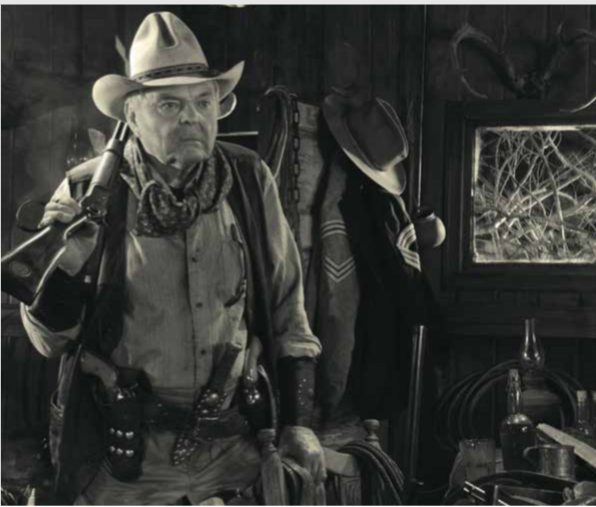
Edward Faulkner
HENRY: You can't smile.
COURTNEY: There are
absolutely no smiles.
HENRY: What were your
duties on this project besides the writing?
COURTNEY: Steve asked me who among the actors I knew
might be interested in participating. We wanted people who had some sort of a
pedigree with westerns obviously. So I called Clu Gulager, I called Tim
Thomerson, folks that we knew and were friends with, and they came on board and
they're all represented very well in the book. And when people were
enthusiastic and wanted to do it, like Robert Forster for example was an old
friend of Steve's. Rob Word brought in
some folks like Bruce Boxleitner, and that was so great. I was not there for
every photography session; I was there probably for 10 or 15 of them. But there
are 85 subjects in the book. Steve
wanted more women represented, and we got some terrific ones: Jacqueline Scott,
Rosemary Forsyth, Stephanie Powers. That was really cool. Jackie Scott, she's
just a pistol. When I did my sit-down with her, she was so funny. She started talking about the fact that she
did all these westerns, and she cannot ride a horse. Every time they put her in
a Western, she said for God's sake don't put me on a horse!

Jacqueline Scott
HENRY: In your essays you
talked to many of your subjects about favorite directors.
COURTNEY: We have actors
who are associated with one particular director, like Bruce Davison talks all
about his experience with Robert Aldrich. Bo Hopkins, L.Q. (Jones) of course
they talk about Sam Peckinpah. L.Q. also talks about Raul Walsh. Jackie Scott
talks about Don Siegel, and Johnny Crawford talks about Howard Hawks. So, all
these iconic filmmakers are in there, and there are a couple of really big
behind-the-scene boys are included too, including Robert Evans.

Johnny Crawford
HENRY: Ah, The Fiend Who Walked the West.
COURTNEY: (Producer) Gray
Frederickson is an old friend of Steve Carver's. I was not there when they did
his session, but I had to do the interview with him. And I told him, look, I am
going to burst into tears in the middle of this interview. And he's like, why?
I said, because you are responsible for three of the greatest films in the
history of American cinema: The Godfather, The Godfather 2, and Apocalypse
Now. Of course, he was the original producer of Unforgiven (1992) and he
was the unit manager on The Good, The Bad, The Ugly. He talked all about
that. Mark Richmond was discovered by William Wyler, so he talks about that.
HENRY: How many
interviews did you conduct?
COURTNEY: Eighty, eighty-three. When I started, a lot
of the subjects were some were already deceased, but many people have
unfortunately passed away since we did the sessions. Like Dick Miller, for
example; Bob Forster. But I had already sat down with them, and I knew Bob, and
Dick. That was great. We got Dick really towards the end, and he had had the
autobiography come out the movie, and a very nice book about him, but he was
terrific. No one had talked to him about doing Gunsmoke and all that
stuff in probably 50 years because they all want to talk about Little Shop
of Horrors. All the Roger Corman films.
And that was really great because he goes, “God, I’ve got to think; wait
a minute.” And then he just would reel off these terrific anecdotes and these
stories. And it was like finding this vein of gold when you were talking to
him, because again, this had been shuttled away in memory and nobody had
touched it for so long.
HENRY: It was not a
rehearsed story.
COURTNEY: Exactly. And
that was also something that was consistent, even with folks who weren't
necessarily associated with Westerns. Like Fred Dryer for example doesn't
really have an association with Western movies, because he hadn't done anything
along those lines. But we got one of the best essays about Fred, because what
he wanted to talk about, and it was wonderful, was growing up in the era of
Hopalong Cassidy and Roy Rogers and Gene Autry. Growing up in California,
having access to horses. And it was the impact of these Western heroes/Cowboys
on his growing up. He attributes his wanting to excel in athletics because of
his interest in Jay Silverheels, and things like that. So that was where our
conversation took us. It was a different slant.

Fred Dryer
HENRY: It's a link that
you would never have guessed was there.
COURTNEY: Exactly.
HENRY: Which were your
favorite interviews?
COURTNEY: George Hamilton
was probably my favorite interview. He was great, and just so interesting. He
loved doing westerns, and he was so entranced with the equestrian lifestyle and
being out on location. But he talked very frankly about why he is not in How
the West Was Won when he was under contract MGM, when that movie was being
made. So you'll have to buy the book to read that story. But, but he also
talked about being a young contract player at MGM, who at the time was engaged
to the daughter of the President of the United States (he was engaged to LBJ’s
daughter, Lynda Bird Johnson).
HENRY: Pretty cool.
COURTNEY: And he was considered just this fan magazine
boy by a lot of these old veterans. So guys like Richard Boone gave him a hard
time and he always felt like he had to prove themselves over and over again,
and it bugged him. But George said when he was just starting out, he was so
glad he did one of his very first movies with Robert Mitchum. Who was
fantastic, and said, “Kid, look, let me tell you how to handle this.”
HENRY: If I remember
right, you really enjoyed interviewing Monte Markham.

Monte Markham
COURTNEY: Oh, Monte
Markham is just the greatest guy. He was terrific. First of all, his memory is
clear as a bell. There was no prompting. And because he went from being an
actor to being a very successful documentary producer, and branched out into
all of these other areas, he’s just a fascinating guy and also a very, very
nice man, too. And Ed Faulkner; who's nicer than Ed Faulkner? (Note: Ed
Faulkner has been in six movies with John Wayne) He's an old friend, so I was
so glad to have him involved. Oh my God, the portrait of R.G. Armstrong is
just, just incredible. And of course we did Morgan Woodward before Morgan
passed. (Note: Morgan Woodward was Gunsmoke’s most frequent guest star, almost
always as a villain). And he loved that
picture. Fortunately he got to see it and he just thought it was sensational.
HENRY: How do you write
83 articles about older character-actors and not have them seem too similar?
COURTNEY: By taking a
different tack; like with Bill Smith (Laredo), and I’ve known Bill and
Joanne for years. But what I wanted to do was to build the essay around Bill's
poetry. So I did that, because I wanted just for my own creative mojo, to be
breaking patterns. I didn't want every single essay to read like the ones
immediately before. And fortunately, everybody's story is really different. We
have people who are strictly character actors. Some who were movie stars. And a
movie star perspective is going to be completely different than the perspective
of the producer.
HENRY: What was your interview with Clu Gulager?

Clu Gulager
COURTNEY: Oh, Clu was terrific, of course. And what he
did, because he discussed the technique that Steve was going to use to take the
photographs and the costuming, and really adopt a character. So Clu really went
to the floor. He came in and John, his son, did this great makeup on Clu, and
he became this mule skinner. I mean, he approached this like he would have a
role in a movie. One thing too, one of the true unsung heroes of this thing is
Rob Word. Rob stepped up so many times to help, getting folks involved with the
book. He was terrific, and his
suggestions were always great. For example, Rosemary Forsyth was a one of his
suggestions. She was wonderful.

Rosemary Forsyth
HENRY: Of the portraits,
which are your favorites?
COURTNEY: Again, I think
the Denver Pyle is just amazing. L. Q.’s is iconic. I love the R.G. Armstrong.
I really liked what we did with Bruce Davison because it is his character from Ulzana's
Raid brought forward to his current age. And that was just a neat visual.
Stephanie Powers, she's very much a cowgirl, very equestrian. I think she looks
just tremendous; she looks beautiful in her portrait. So there are a few. You know, on Facebook a lot of the production
shots had been posted a lot. Most of them, all of them. Steve's been posting
have been in color. And they're
terrific, but they are nothing compared to the black and white and sepia ones.
They just knock your socks off.
HENRY: The cover with David Carradine is wonderful.
COURTNEY : And that's the
thing, when you just see this stuff, and it's just like, my God, in some cases
this image sums up that entire career, certainly an entire screen image, which
is what Steve wanted to do. That was his intention and I think he sure achieved
it.

Robert Carradine
HENRY: What are your next projects?
COURTNEY: The next things
that are coming out are more Blu-ray commentaries. The Far Country comes
out in the middle of November from Arrow. And we did a really nice documentary
about Anthony Mann's career at Universal. And we've got a lot of upcoming
commentaries for Mill Creek, on the Lon Chaney Jr. Inner Sanctum series
from Universal. And this is fun. Steve Carver, L.Q. Jones, Robert Beltran,
Yoren Ben-Ami and I did a commentary on the Blu-ray release of Lone Wolf
McQuade. And that should be out in December.
HENRY: Is there anything
else I should have asked?
COURTNEY: I would say the
one thing is that Steve built a great crew of people around him, and they did
just such a terrific job. And everybody came in to help with costumes and
makeup. As you said, it was really a labor of love. Everyone really wanted to
turn this project into something, and at the end of the day, you have to say,
well, they did.
JUST ONE MORE THING!
With today’s post, Henry’s
Western Round-up begins its 11th year of publication! I know quite a
few of you have been reading it since 2010, and I thank you, and all of my
readers, for your continued interest and support. And please post comments –
that’s how I know what’s working and what is not.
…AND THAT’S A WRAP!

In the next Round-up I’ll
be reviewing INSP’s new Western, THE WARRANT, talking with TRAVELS WITH DARLEY
host Darley Newman, and filling you in on what I know about Martin Scorcese’s
new Western, KILLERS OF THE FLOWER MOON.
And by the way, did I mention that THE CW is planning a reboot of KUNG
FU, but a female version? And please
check out the February/March True West, with my article, 33 American Indian
Movies That Get History Right!
Happy Trails,
Henry
All Original Contents Copyright
February 2020 By Henry C. Parke – All Rights Reserved


