Showing posts sorted by relevance for query copperhead review. Sort by date Show all posts
Sunday, September 15, 2013
WEST FESTS IN LONE PINE AND ALMERIA IN OCTOBER!
First up is the Almeria Western Film Festival on
October 2nd through the 5th. The Almeria and Tabernas area was the center
of spaghetti western production in the 1960s and 1970s; several hundred
westerns were shot there in that comparatively brief period. Mini-Hollywood, Teatro Municipal deTabernas
and Fort Bravo will be the locations for screenings and events. Films shown in competition include many
featured in the Round-up: COPPERHEAD (http://henryswesternroundup.blogspot.com/search?q=copperhead+review) , HANNAH’S LAW (http://henryswesternroundup.blogspot.com/search?q=hannah%27s+law+review
) , ABRAHAM LINCOLN VS. ZOMBIES (http://henryswesternroundup.blogspot.com/search?q=abraham+lincoln+zombies+review)
, GOODNIGHT FOR JUSTICE – QUEEN OF
HEARTS (http://henryswesternroundup.blogspot.com/search?q=queen+of+hearts+review
) , and THE MAN WHO SHOOK THE HAND OF VICENTE
FERNANDEZ (http://henryswesternroundup.blogspot.com/search?q=the+man+who+shook+the+hand+review
) . Also in competition are A PEZZI:
UNDEAD MEN, WEST OF THUNDER, DEAD MAN’S BURDEN, and EL APARECIDO. Classic Spaghetti Westerns to be screened
include THE MOMENT TO KILL (1968), THE RETURN OF CLINT THE STRANGER (1972), and
$1000 ON THE BLACK (1966). There will
also be a panel discussion with Spaghetti Western stars Robert Woods, George
Hilton, Monica Randall, Simone Blondell and Carlos Bravo. Last year’s festival brought together
filmmakers who decided to work together, and they just shot a new Spaghetti
Western on the same locations, SIX BULLETS TO HELL (read about it here: http://henryswesternroundup.blogspot.com/2013/07/six-bullets-to-hell-is-shooting-up.html
). Learn more about the festival at the
official site: http://almeriawestern.es/index_en.php
Then catch your breath, get over your jet-lag, and
head to the 24th Annual Lone Pine Film Festival. Lone
Pine, Where the Real West Becomes the Reel West is this year’s theme. Blessed with breath-taking vistas, stark
desert and the famed Alabama Hills, Lone Pine was a favorite locale for
Republic, Paramount, Universal, and Warner Brothers westerns. Among the many guests attending are Mariette
Hartley, Clu Gulager, L.Q. Jones, Andrew Prine, Peggy Stewart, stunt
coordinators Diamond Farnsworth and Loren Janes, and Billy King, who appeared in
four Lone Pine-shot Hopalong Cassidy films in the 1930s. Leonard Maltin and Ed Hulse will host
celebrity panels. There are many tours and events scheduled,
from visits to the Bar 20 ranch to the sets of GUNGA DIN. I don’t have a list of all the films to be
screened, but they include HEART OF ARIZONA and other Hopalong Cassidy films;
RIDE LONESOME starring Randolph Scott; Sam Peckinpah’s RIDE THE HIGH COUNTRY,
which introduced Mariette Hartley; WESTWARD HO starring John Wayne; SHOWDOWN
starring Audie Murphy, and many others.
To learn more, go here: http://www.lonepinefilmfestival.org/
DISCOVERY CHANNEL ORDERS ‘NORTH AND SOUTH’ REMAKE!
The Discovery Channel has ordered a remake of NORTH
AND SOUTH, the 1985 ratings giant mini-series, to be produced by Lionsgate, exec
produced by John Jakes, whose novels are the basis for mini, and its two
sequels. The original, which starred
James Read as Patrick Swayze as West Point friends who find themselves on
opposite sides of the Civil War, averaged an astonishing 40 million viewers per
episode. The tremendous supporting cast
included Elizabeth Taylor, Johnny Cash, Hal Holbrook, Robert Mitchum, and
dozens of other famous names and faces. More details soon!
AMERICAN TREASURES FROM THE NEW ZEALAND FILM
ARCHIVES ON SALE SEPT. 24
As
I reported back in June of 2010 (the article is HERE if you missed it ) seventy-five silent American films, thought to be lost, were
discovered in a search of the New Zealand Film Archive. Ironically, the New Zealand archive holds a substantial
number of rare non-Kiwi movies because, by the time a film, being distributed
around the world, reached far-away New Zealand, it was cheaper to just leave
the film there than to pay to have it shipped back to the States. In N.Z.
Archive manager Steve
Russell's words, "It's one of the rare cases when the
tyranny of distance has worked in our and the films' favor." Two of the
westerns are THE GIRL
STAGE DRIVER(1914), and Selig
Polyscope picture, THE SERGEANT - TOLD IN THE
YOSEMITE VALLEY (1910).
The New Zealand
Film Archives and National Film Preservation Foundation have been working to
preserve the films ever since, and on September 24th, their fruits
of their labor will be available. LOST & FOUND - AMERICAN TREASURES FROM THE NEW ZEALAND FILM ARCHIVES, a 3 ¼
hour DVD will feature the preserved films, and while a complete list is not yet
available, it will in include John Ford’s UPSTREAM (1927); a trailer for his
lost film STRONG BOY (1929); the opening reels from Hitchcock’s earliest
surviving film, THE WHITE SHADOW (1924); FAMOUS RIDE ON A RUNAWAY TRAIN (1921);
WON IN A CUPBOARD, directed by and starring Mabel Normand, and many more. Selling for $24.95 from onlinedealers, the
DVD has music by silent movie maestros Michael D. Mortilla and Donald Sosin,
and includes a 56 page catalog with film notes and credits. You can learn more at www.filmpreservation.org. and you can see a trailer by clicking HERE.
PETER SHERAYKO SAYS, “I WAS JAMES FENIMORE COOPER’S
NEXT DOOR NEIGHBOR!”
Got a very amusing call from
actor/author/armorer/prop man Peter Sherayko (If you don’t know Peter, Texas
Jack Vermillion from TOMBSTONE, read my interview with him HERE ) . He’d been catching up on the
Round-up, and was amazed to read the continuing saga of the search for James
Fenimore Cooper’s home in New York City.
(If you missed this, the link to the final chapter of the story is in
the Round-up entry HERE .) With the help of the James Fenimore
Cooper Society, and the New York Historical Society, we finally determined that
the Last of the Mohicans author had
lived at 6 St. Marks Place from 1834 to 1836.
Peter Sherayko, who knows more about Western literature
than just about anyone I know, used to live right next door, at 8 St. Marks
Place. I had hoped to pump him for ‘what
was Fenimore really like?’ stories, but their periods of residence did not
overlap. Fresh from the Air Force, Peter
lived in the apartment for six months in the early 1970s, while attending
NYU. “I had no idea one of my heroes had
lived next door!” I tactfully mentioned
that the neighborhood had taken a downturn during the War Between The
States. Peter didn’t think it had improved
much by his time. “It was pretty
funky. I remember the bathtub was in the
kitchen, and there was one toilet for all the apartments on the floor.”
One of the busiest men I know, Peter will be working
in various capacities on a string of up-coming productions. Among them, WESTERN RELIGION will soon be
rolling at the Paramount Ranch. Then
he’ll be heading to Old Tucson to work on the sequel to HOT BATH AN’ A STIFF
DRINK (if you missed my piece about that film’s rough cut, go HERE ). Then there’s THE HEADLESS for FRIDAY
THE 13TH impresario Sean Cunningham.
In January he’ll be at the Melody and Veluzat Ranches for SOUND OF
THUNDER. And from September 27th to the 29th
he’ll be at Calico Ghost Town for the annual CALICO DAYS celebration, hosting a
series pilot, BIG HISTORY, that would travel the country, spotlighting historical
celebrations.
THAT’S A WRAP!
That’s it for this week’s Round-up! I just conducted a fascinating interview with
Karla Buhlman, President of Gene Autry Entertainment. She had a lot of insight into Gene’s approach
to television; next week I’ll be running that interview in conjunction with my
review of the release of the final season of THE GENE AUTRY SHOW on DVD. And hopefully the following week I’ll have my
review of the new Western SWEETWATER, starring January Jones, Ed Harris and Jason
Isaacs.
Happy trails,
Henry
All original contents copyright September 2013 by
Henry C. Parke – All Rights Reserved
Thursday, June 27, 2013
‘GETTYSBURG’ DIR. MAXWELL RETURNS TO CIVIL WAR WITH ‘COPPERHEAD’
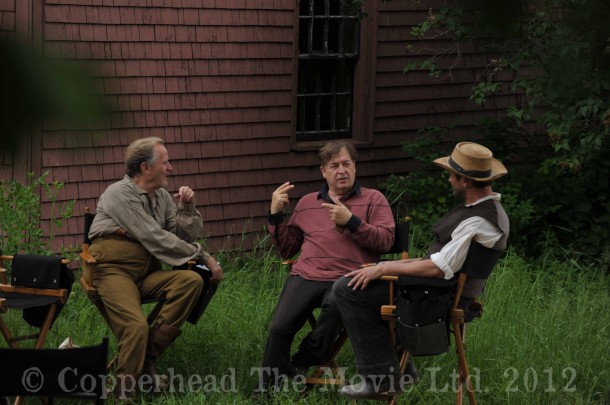
Ron Maxwell directing new recruits
‘COPPERHEAD’, the new Civil War film from ‘GETTYSBURG’
and ‘GODS AND GENERALS’ director Ron Maxwell, opens on Friday, June 28th,
at select theatres around the country.
It will open wider depending on its reception in its first week, so if you are interested in seeing it, and
in seeing other serious historical dramas, I urge you to make a point to catch
it right away. You can learn more about COPPERHEAD HERE.
RON MAXWELL INTERVIEW – Part One
Henry Parke and Ron Maxwell
Moviegoers in general, and Round-up readers in
particular, are likely most familiar with writer-director Ron Maxwell from his
previous two Civil War masterpieces, GETTYSBURG and GODS AND GENERALS, both
based on novels by Michael Shaara – the film GETTYSBURG is actually based on
Shaara’s Pulitzer Prize Winning novel THE KILLER ANGELS. But before he took on the War Between The States,
Maxwell had directed a wide and varied group of films. SEA MARKS (1976) was a
two-character TV movie based on a play by Gardner McKay. VERNA:USO GIRL (1978), an episode of PBS
GREAT PERFORMANCES, based on a Paul Gallico story, starring Sissy Spacek, won
supporting actor Howard deSilva an Emmy, and a best director nomination for
Maxwell. Next came LITTLE DARLINGS
(1980), featuring Tatum O’Neal and Kristy McNichol as summer-campers in a race
to lose their virginity; THE NIGHT THE LIGHTS WENT OUT IN GEORGIA (1981), a
drama based on the country hit of the same title; KIDCO (1984), a comedy about
kids in the fertilizer business; PARENT TRAP 2 (1986), a reworking of the
Disney hit, again with Haley Mills in two roles; and a documentary, IN THE LAND
OF POETS (1987). For some weeks, Maxwell
has been traveling around the country previewing his new Civil War drama,
COPPERHEAD. He was kind enough to meet
with me before his Santa Monica preview, to discuss his newest film, as well as
GETTYSBURG and GODS AND GENERALS, and future plans that include a Western!
HENRY: Did you always intend your Civil War films to
be a trilogy?
RON MAXWELL: Well, the third part of the trilogy is
THE LAST FULL MEASURE, which we haven’t yet done, and perhaps will never
do. Like the first two, it’s another movie
that is in the epic form, it’s going to be a long movie; it’s huge battle
scenes. It’s got all the other elements the
other two have of the epic, and that is an entirely different kind of movie
than COPPERHEAD. COPPERHEAD is more in
the realm of traditional story-telling, within two hours. So in that sense it’s more like what most
movies smell and feel like. The other
two are huge departures, and they have more to do with the epic form, where you
have Abel Gance’s film (NAPOLEON), D. W.
Griffith, you think of the theatric form, it’s its own genre, and it predates
cinema. It’s Der Ring des Nibelungen (a
series of four heroic Richard Wagner operas), it’s Milton; it’s a different
tradition. COPPERHEAD, it’s fair to say,
is in my Civil War anthology, but not my trilogy, because THE LAST FULL MEASURE
would deliver the third part. But certainly
a third movie in the Civil War. And it’s
added up to dedicating a huge part of my life invested in making movies about
that part of history.
HENRY: I was
wondering if you’d decided to space the films ten years apart, or if that’s
just how it worked out.
RON MAXWELL:
It’s just how it worked out, because these things are not easy to set
up, to finance. There certainly is time
involved in research, in writing a screenplay, for sure – you don’t rush into
these kinds of movies. But the bulk of
the time between the movies is setting up the financing, because I’ve been
forty years making movies, and thirty of those have been in Hollywood. And I’ve yet to see or hear of any weekly
meeting at a studio when the executive in charge says, “Does anyone have a
Civil War movie we can do?” (laughs)
HENRY: (laughs) I specialize in Westerns, so I know
exactly what you mean. Now you’re
another NYU guy, right?
RON MAXWELL:
Yup. I graduated NYU School of
Film & Television in 1970, with my MFA.
My class (included) Jeremy Kagan, Martha Coolidge, a few others – a
pretty neat bunch of people.
HENRY: Why is the Civil War such an important
subject to you?
RON MAXWELL: The first connection from a movie-making point
of view came with THE KILLER ANGELS, because I read that book in ’78 and I just
connected with it as a great story, great literature, great characters, that
happened to be about the Civil War. If
it was about a different war I probably would have connected to it as well,
because I was responding to a piece of literature and a story that I felt
called to tell; people that I felt very compelled and interested about as a filmmaker. Having said that, back up. From the time of my childhood, my daddy took
my younger brother and I to historical sites.
I grew up in northern New Jersey, so where we would go on weekends and
family trips were places that were Colonial history, French & Indian War,
American Revolution. We visited Ft. Ticonderoga,
Ft. William Henry, Saratoga, and this informed my childhood. As soon as I could read I was reading about
Nathan Hale and Ethan Allan and Robert Rogers – I grew up with this stuff. And I walked on the places and I sat on the
canons. It was a wonderful
childhood. I was a Boy Scout, overnight
camping and all that stuff. And so I
grew up really steeped in and enjoying American history. And then when I got older I took in European
history as well. So that by the time I
read THE KILLER ANGELS in my late twenties, I had already read the works that
those of my generation should have read by then, which were Bruce Catton and
Shelby Foote – that generation of historians.
I was predisposed to subject matter taking place during the Civil War,
but I didn’t visit my first Civil War battlefield until after I’d optioned the
book, which might have been in ’80. I lived in Manhattan at the time, and I drove
down to Gettysburg for my first-ever visit to a Civil War Battlefield. And Michael Shaara, who wrote the book, flew
his own little plane, landed it at the grassy little landing strip at
Gettysburg, and we spent three days together.
And he walked me through the battlefield, as he wrote about it in THE
KILLER ANGELS: day one, day two, day three.
I had one of the best guides you could ever have to experience your
first Civil War battlefield.
HENRY: How
did you like Tom Berrenger, your Lt. Gen. Longstreet’s performance in HATFIELDS
& MCCOYS?
RON MAXWELL:
I didn’t see it, because I was filming.
That came out last summer, and I was
in Canada making COPPERHEAD; otherwise I would have seen it. I heard it was wonderful.
Martin Sheen as Lee in GETTYSBURG
HENRY: With
GETTYSBURG, you popularized the use of Civil War reenactors, instead of
standard issue extras in standard issue Western Costume uniforms, to play the
battle scenes. It really revolutionized
the look of war movies in general, and Civil War movies in particular. Why did you do it? What were the advantages?
RON MAXWELL:
Well, when I started on GETTYSBURG, anybody that works in the movie
business knows, the first thing your confronted in is what is the upside potential,
and what is the downside risk. You can
apply that to almost any business, but those are the terms you hear in the
movie business. So for the upside
potential, most people, when they play that game, mean “Get me Brad Pitt,” or
“Get me Steven Speilberg.” Because
unless you get those big names, it’s hard to even guess the upside potential of
anything. As we know repeatedly, little
films can suddenly do big business, anything can happen – you’re in a very
volatile area. That’s part of the
excitement of the business. The downside
risk, that’s something to address as a filmmaker. When I looked at the Battle
of Gettysburg, the only point to make a movie like this is to show the scale,
otherwise don’t do THE KILLER ANGELS – do something else. Find a short story by Ambrose Bierce. Like OCCURRENCE AT OWL CREEK BRIDGE is one of
my favorite short films, and you can do that with ten people. But because it was the Battle of Gettysburg,
and the expectation of people is you’ve got to have Pickett’s Charge. If you
don’t, you’re going to get hounded out of the business, and maybe hounded out
of the country. So you know you have to
deliver scale. At the time we started
this, shooting in the United States seemed like an absolute impossibility. Before CGI became CGI, nobody was making movies like that in North America anymore;
nobody. The last ones that were made like
that shut the studios down, like
CLEOPATRA in the ‘60s, and even that was made in Italy. With that many extras and that many costumes
and that many people to support, you’re in the D.W. Griffith world, the C.B.
DeMille world. This was in 1980 when the
process started, and I was looking at Eastern Europe. That’s
where Dino DiLaurentis did WATERLOO with Rod Steiger, Christopher Plummer. Because you could get the Red Army. It’s sort of ironic, because here we are doing
an archetypical American story, and you have to go to the Soviet Union in the
height of the Cold War to make it! I
didn’t get to the Soviet Union, but I did go, in the ‘80s, to Hungary and
Poland, to set up working with their armies which were, as we know, variations
on the Red Army. And you could sort of
rent an army. You still had to
manufacture the costumes and all that stuff, but your costs would come down if
you could shoot in Eastern Europe, and people were doing it, especially cavalry
scenes. So as I was investigating that, what
was happening in the late ‘70s and late ‘80s was the burgeoning ‘Reenactor
Movement.’ It started with a few
thousand, and grew to tens of thousands.
I was tracking that, and I was going to reenactments, and what you’d see
at reenactments was people who took it very seriously. There was nothing generic and, like you said
correctly when you were talking about the costume houses that had done war movies in the past; they spent a lot
of time on the costumes for the leads, they have the best costume designers in
the world. But the background would be
generic grey or generic blue. The
difference was here, every single reenactor was portraying a specific soldier. They knew the private that they were doing,
or the corporal they were doing; they knew their name, and what battle they
were killed at, or whether they survived.
So as a result their uniforms were meticulously put together. They’re known as living historians. They went to all that research and homework
which no film crew would ever have time to do.
And they looked right, because they had the face hair, they had the
mustaches, they had the eyeglasses. So,
you multiply this by 100 people or 200 people.
Now think of the cost savings – you’re not having to build those
uniforms anymore. And the more
sophisticated reenactors, they would do what you know as galvanize; which means
they could go both ways, they could do a Confederate impression – they call it
impressions – and they could do a Federal impression. They could do an officer; they could do a
private. Or they could do a Tennessee regiment;
they could do a Massachusetts regiment.
And then, they also had the flags – just so authentic: they’d done all
the research. The cannons! Five or six guys, mostly blue-collar guys –
you’d find the occasional doctor or dentist or businessman, but mostly
blue-collar guys – working nine to five at a job. They’d pool their savings and manufacture
these cannons! These were thousands of
dollars! Real cannons, on carriages,
that could really fire munitions! Could
you imagine if a movie company had started to manufacture, to make this stuff? Forget it!
So on GETTYSBURG, a couple of things happened. 1989, the Berlin Wall fell – goodbye to that option. Their whole film industry collapsed a few
years later. After I made GETTYSBURG I
was in Bucharest, I was in Sofia. And I
met accomplished filmmakers, DPs, directors, writers, department heads that
were driving cabs, who were shining shoes.
They were reduced to beggary, in the first years after the Wall fell,
because everything collapsed; (the film industry) was completely state
funded. It was a sad thing to see. Thankfully that industry has rebounded. But the other thing, the coincidence of that
collapsing, was that the reenactment movement was growing, so that’s why we
really did something. So that’s what we
did, and you’re quite right, there had been little videos made with reenactors
before, but never a major motion picture.
The one movie that used them before us was GLORY. GLORY was made in ’89; our movie was filmed
in the summer of ’92. They used
reenactors. They went to the 125th
Anniversary of Gettysburg – we’re actually coming up on the 150th –
and they filmed it. But they put their
cameras on the outside, and they captured.
So the Antietam sequence at the beginning of GLORY, that’s from that 125th
reenactment. They sat on the outside
with long lenses, and they were able to get some very good footage. And they augmented it with some tighter work
with their actors. What we did that was
innovative is we built the reenactors in from the get-go. So we didn’t go to a reenactment; we used
thousands and thousands of reenactors.
We scheduled them in. We choreographed them to do exactly what we
wanted, and we decided the camera moves, through them, over them, around
them. That was innovative; we were the
first big film to use reenactors that way.
And without the reenactors – I’ve said this a million times – there’s no
GETTYSBURG, and there’s no GODS AND GENERALS.
They were an essential pillar to making those movies, so you could see
the scale. You’d have the camera back,
but also, you could move the camera in from a long shot to an extreme close-up,
and you’re still in the 1860s. The big
difference, from my point of view, between the two movies, was on the first
movie, we didn’t have the heart, and the chutzpah, to turn anybody away. We thought, these are volunteers. We gave them three meals a day, gave them
fodder for their horses, gave them a place to put their tents, but they were
still volunteers, and we didn’t have the heart to say, ‘You can’t
participate.’ And so we accepted people
who were overweight, and too old. And we
tried to put them in the background as much as we could, but it was a problem
for us, constantly. And the ADs
(assistant directors) were trying to keep them in the back, keep the younger,
leaner ones up-front. On GODS AND
GENERALS we said look, we’re making a movie here, and we’re just going to be
really strict about this. We had a much
more stringent recruitment process, so nobody on GODS AND GENERALS was older
than thirty. Everybody looked like they
were a real Civil War soldier. They were
young; they were lean. And that, in
terms of using the reenactors, was the big difference in the two movies.
HENRY: Now,
while KILLER ANGELS and GODS AND GENERALS were current or recent best-sellers at
the time that you made the films, COPPERHEAD, by Harold Frederic, was pretty
obscure, being a best-seller in 1893.
How did you come upon it, and how long were you aware of it?
RON MAXWELL:
I read THE COPPERHEAD sometime after the release of GODS AND
GENERALS. I’m always looking for Civil
War fiction, and I’ve got what’s got to be one of the best collections around;
I’ve been collecting for a long time.
And most of it’s out of print, but you can get it now, thanks to the
internet, and second-hand bookstores.
You can get out-of-prints works now much easier than you could have even
ten, fifteen years ago. And I’ve had
friends at different universities – David Madden, recently retired head of the English
department at LSU. He’s written
extensively about Civil War fiction, essays and articles. He was a great guide for me, to find books I
didn’t know to look for. And there is a
lot there that is out of print, really worth discovering. It’s like all the arts. Every now and then I come across a piece of
literature, or a poet, or a piece of music, an opera that I’ve never heard
before, and I think, how did I miss this?
This outstanding work. But it’s
because we can’t have it all on our radar all the time. And things fall in and out of fashion. Harold Frederic is a very interesting writer. In Edmund Wilson’s book, PATRIOTIC GORE, that
was published sometime in the 1960s, which is a very important work, because
he’s writing literary criticism of a hundred years of Civil War fiction. And he singles out COPPERHEAD in that book as
a singular work, unlike anything else written about the Civil War. It’s unlike it because it’s about the North,
about dissenters in the North, ‘copperheads’, if you will. And he writes with great authenticity about
middle-of-the-19th-century rural America, and through his eyes you
can see that part of the world in the same way that, through the eyes of
Charles Dickens you can see Victorian England, without reading any other
histories, just through the eyes of the fiction writer.
Jeff Daniels as Chamberlain in GODS AND GENERALS
HENRY: And
see it, really, more clearly through the fiction than you could through
history.
RON MAXWELL:
Absolutely; because he’s writing characters. He’s also writing dialogue that he
heard. There’s a line, for instance, one
of many, when Esther is handing the ear of corn to Jimmy, and she says, “It’s tougher
than Pharaoh’s heart.” If I spent the
rest of my life, I wouldn’t come up with that line. That was from Harold Frederic, and he must
have heard it. He must have heard it in
a community saturated with Biblical references, from cradle to grave. So 90% of the dialogue, give or take, is from
the book. The other 10% Bill Kaufman
wrote while turning it into a screenplay.
But Frederic is a wonderful author, and he had two moments: his own
moment when it was published. He was a
very successful writer, and he made a good living at it; he was popular in his
own time. Then he fell into obscurity in
the anti-war years. Then he was
rediscovered by Edmund Wilson, and you can see at that time there was slight
rebirth in recognition – he was back in print.
Then he fell back into obscurity again until now. We’re reissuing the COPPERHEAD novel. We had to re-set the type because the one
that’s currently available is very difficult to read – there are typos and grammatical
errors. So we re-set the type, and
published in the same book, at the same time the movie comes out, is the
screenplay.
HENRY:
COPPERHEAD is a set in Utica, New York, about two families torn apart by
the Civil War. Several characters go to
war, with dramatic results, but the war never reaches the town, and is never
shown. Was it a difficult choice, to
keep the physical war out of the film entirely?
RON MAXWELL: Yes.
Of course, it’s not in the book, but you’re quite right; we had
discussions. Should we have a flash-back
or a flash-forward, or cut to where Jeff is?
All the boys leave, and as they come back, we learn that they were all
caught up in the Battle of Antietam. Some come back wounded; some don’t come
back at all. And we know through the
testimony of (the survivors), who was shot and killed. We discussed it. We thought, why go there? Because the movie is about the village in the
North. It’s about their not
knowing. They don’t have an omniscient
eye. They don’t have CNN. They only know it, and they only knew it at
the time, from newspapers, and people coming back. So let’s keep it really where they live. It’s about Abner; it’s about Jee; it’s about
the families, the mothers and fathers.
So when those people in Watkins’s store, when (soldiers) first come
back, they’re listening to every word, and that’s when they hear what happened
to (the boys from the town). It’s more
effective, more dramatic, more emotional.
And later on, when (another soldier) talks about his experiences, it’s
not in the book, but we put that in the blacksmith’s shop, so we have an excuse
to have the bellows and smoke, and the hammering that then becomes gunfire, to
at least atmospherically make it feel like battle.
HENRY: Billy
Campbell as Abner Beech is a very unusual hero for a movie. He’s branded a copperhead because he lives in
the North, but opposes going to war over cessation. He’s politically incorrect both in his day
and ours. His scathing comments about
Lincoln, and his belief that ending slavery is not a good enough reason for one
group of Americans to go to war against another. Did you consider softening his stance to make
him more likable and PC?
RON MAXWELL: The only thing we did, and anyone who
reads the novel will see it, is dispensed with the ‘n-word.’ We just don’t need that, and we can portray
this authentically without offending people.
But other than that we portray him honestly as he was. He is on a spectrum of people who were generically
called copperheads. It’s like today we call
people conservatives, we call people liberals.
That’s a pretty broad label to put on people, considering how different
we all are from one another. Copperhead
was a term of derision, a contemptuous term used by pro-war Republicans against
anyone who disagreed with the war effort. But within those people who disagree you get
people who were racist then, and racist now, and they could care less what
happened to the black man. But then
along that spectrum you had people like Abner Beech, who was absolutely against
slavery, pro-Union, but just did not think that this was the solution. As he articulates in the film, sometimes you
can take a bad situation, even an intolerable situation, and make it
worse. We’re having this debate now
about Syria. There’s a massacre going on
there. But if we go in there with the
U.S. Army, and bombs and airplanes, how do we know we’re not going to make it
even worse? So these kinds of questions
are always with us, they’re ethical dilemmas.
But the feedback we’ve gotten from audiences so far – we’ve had twelve
or thirteen public screenings – enjoy the fact that it’s a film that presents
ethical, moral dilemmas, where it’s not easy to sort it out. Because it wasn’t then and, guess what: it
isn’t now. Now I have to share with you,
because I know what you write about. I
am planning to do a Western. It’s called
BELLE STARR; it’s based on the extraordinary book by Speer Morgan, that was
published in ’79. I had it set up in ’79
and ’80 at United Artists. And they were going to do it, and then HEAVEN’S
GATE came out, and my Western, and every other Western collapsed. That’s how long I’ve been going to do
it. But we have a new script; it was
co-written by Alan Geoffrion, who wrote BROKEN TRAIL. We’ll see how well we do at the box office
with COPPERHEAD. If we do well, there’s
a good chance that BELLE STARR will be made next summer.
HENRY: I’ve enjoyed
your wide range of films, including LITTLE DARLINGS. Now this might sound to some like an
out-of-left-field reference, but many of your non-Civil War films – PARENT TRAP
2, KIDCO – have focused on young people making a transition to adulthood and
independence, which is a central theme of COPPERHEAD.
RON MAXWELL: You’re the first one to bring this out,
and it’s very true. Thank you for the question,
because people that were invested in this film are young, and again, as in the
earlier question you asked about the former movies, they were preoccupied with
officers. They went to West Point, they
were veterans together. They were
relatively highly educated, for their age.
But the guys who fought the war, and died in huge numbers, were boys,
what we would consider boys, under twenty years old. So it was very important that we cast this
picture young. And the actors are young. Lucy Boynton turned eighteen just before we
started filming – which was good, we didn’t need to have a social worker on the
set, and a teacher. So we cast it young,
because that’s the truth, that’s the true image of the war. I love stories with young people. We had in our marketing meeting, we forget,
we tend to think that people who are interested in the Civil War, in American
history are a quote – unquote, older audience.
But this movie is about young kids, so we keep on saying, in our
marketing efforts, don’t neglect the young audience. The young audience can connect with this movie
just as much as an older audience.
We weren’t actually done at this point, but Ron
Maxwell’s people had to hurry him to a screening in Santa Monica. He promised to call me, to answer the rest of
my questions, and two days later, en route to a screening in Atlanta, he
did. I’ll have part two of this
interview in the Round-up very soon.
‘COPPERHEAD’ REVIEW
After a map shows the relative positions of Virginia
and New York, and the voice of a lad we’ll come to know as Jimmy suggests what
the Civil War, already a year old, will do to his home, we see six boys
strolling down a green country lane.
It’s so idyllic, their exuberance, their all-so-different hats that each
thinks makes him an individual, that you can’t help thinking of Huck and Tom in
Hannibal, though these boys are a shade older.
Their discussion of the war is fanciful and childish. And yet they are the very age – and some will
be the very boys – who will cause, and be victims of, the carnage that ravaged
America in the War Between the States.
If you, like I, are a fan of writer-director Ron
Maxwell’s two Civil War epics, GETTYSBURG and GODS AND GENERALS, then
COPPERHEAD is decidedly not the movie
you would expect to conclude his war-between-the-states trilogy. And while Maxwell intends indeed to make it
a trilogy – read my accompanying interview with Maxwell – this is not that
film. Those films are about military
officers, professional soldiers. This is
a film about privates; at worst, about cannon fodder, the world and the homes
and families that produced them. The
war, in fact, is never seen, though it is a perpetual off-screen presence whose
effects upon a remote community in upstate New York are the core of the
story. Harold Frederic wrote the novel
in 1893, basing it on the memories of his youth in Utica, New York, during the
Civil War.
Abner Beech & family in church
Because it is the parents who produce these lads, it
is also the story of the title character, Abner Beech (Billy Campbell), a
dairyman and lumberman who sides neither with the Union nor the
Confederacy. While he has no love of
slavery, he is more concerned that President Lincoln is ordering Americans to
fight Americans, a demand he believes to be unconstitutional. For this, Abner Beech is labeled a ‘copperhead,’
the pejorative the anti-slavery Republicans used to describe Democrats who
would rather negotiate a quick peace with seceding southern states than end
slavery and preserve the Union. It is
also the story of Jee Hagadom (Angus McFayden), a barrel-maker, crushed after
the death of his wife, his life taking on new meaning with his abolitionist obsession.
Fonda, Maxwell, Campbell
But mostly it is the story of the callow youth, and
most of us can see ourselves, to our chagrin, in either the ones who blindly
parrot their parents’ political beliefs without understanding them, or those
who arbitrarily reject those beliefs as a sign of their independence. And some of us can see ourselves in
both. Abner has a son, Jeff (Casey
Brown) a bright and likable fellow, smitten with Hagadom’s daughter, schoolmarm
Esther (Lucy Boynton), and he maddens his father by spouting Hagadom’s
opinions. Abner suspects Hagadom is
directly responsible for the growing hostility the community is showing to him,
sabotaging his ability to make a living, so he’s not open to his son’s often
sensible comments.
Esther is having things no easier – her father has
told her it would kill him if she married Jeff.
Her brother Ni (Augustus Prew), who has no wish to be a soldier, is crushed
to be a disappointment to his father.
Jeff’s parents have raised an orphan, Jimmy (Josh Cruddas), nearly as a
son, and he, too, is torn between loyalty to his adopted family, and his desire
to think for himself.
Some looking for adventure, some to impress a girl, some
in a fit of pique, the boys go off to war, and Abner and his family are not
only minus a son, but soon become the stand-in victims of a populace that wants
to get their hands on their Southern enemies, but cannot. The rising level of abuse and cruelty,
inevitably reaching its brutal, destructive crescendo, is as upsetting as it is
familiar, because times may change, but human nature does not.
Peter Fonda
All of the international cast is strong, but worthy
of particular note is Peter Fonda, in a low-key performance as the blacksmith, sounding
board for Abner and others, who has strong opinions, but a rarely encountered open
mind as well. COPPERHEAD is about the
effects of war, and the people who fight wars, but it is not about war
itself. You won’t get that rush of
thrill and terror, because the battles never reach the screen, since they don’t
reach the town, though the often shattered remnants of the war do come
back. COPPERHEAD is a thoughtful,
well-made, involving film that raises difficult issues without presenting
facile conclusions. There is much food
for discussion here. My one criticism is
that the tone is at times overbearingly solemn, in a way that, combined with a sometimes
perfect but sometimes somber score, grinds all action to a halt. A house-fire that promises some excitement is
drawn into slow-motion at a time when you desperately want things speeded
up. But for all the darkness, it is a
hopeful, inspiring story that will transport you to a world you’ve only read or
dreamed about, populated by people you know all too well.
SONY MOVIE CHANNEL CELEBRATES WESTERNS IN JULY WITH MARATHONS
AND ‘BACK IN THE SADDLE’ SWEEPSTAKES
The Sony Movie Channel regularly features
Westerns in their line-up, but they’re pulling out the big guns in July. For the first week of the month, every night
will include a western double-feature, every Wednesday night will be all
westerns, and July 7th and July 28th will be all-day
Western marathons!
In addition to the Western
films, Sony Movie Channel is
providing one lucky winner the chance to experience what it is like living the
cowboy way with its “Sony Movie Channel Back in the Saddle Sweepstakes.” One
grand prize winner of the sweepstakes will enjoy a trip for two to Lost Valley
Ranch in Colorado. The winner will get to experience the western lifestyle for
3 days and 2 nights at the dude ranch, plus airfare to Denver and $500 cash for
incidentals. Also, six weekly first place prize packages will be awarded, where
winners will receive a pack of Western movies and a pack of limited edition SMC
hot sauces. The sweepstakes has started, \ and ends July 31, 2013 at 11:59PM
Pacific Time. To enter, go to https://www.facebook.com/SonyMovieChannel
or www.SonyMovieChannel.com.
See Official Rules for complete details.
It’s an interesting mix of sagebrush sagas, from
1948 to the 21st Century. Among
the Westerns they’ll be featuring are Audie Murphy in ARIZONA RAIDERS and 40
GUNS TO APACHE PASS; Randolph Scott in A LAWLESS STREET and DECISION AT SUNDOWN;
Gary Cooper in THEY CAME TO CORDURA; Tom
Sellick and Sam Elliot in THE SHADOW RIDERS; Robert Duvall in BROKEN TRAIL; Brad
Pitt in LEGENDS OF THE FALL; Matt Damon in ALL THE PRETTY HORSES; West Studi in
GERONIMO: AN AMERICAN LEGEND; Glenn Ford in JUBAL; George Montgomery in THE
PATHFINDER and BATTLE OF ROGUE RIVER; Van Heflin in GUNMAN’S WALK; Fred
MacMurray in FACE OF A FUGITIVE; Robert Young in RELENTLESS; and James Garner
as Wyatt Earp opposite Bruce Willis as Tom Mix in SUNSET. Visit HERE for details.
HALLMARK’S CANADIAN-SET WESTERN SERIES TO BE SHOT IN
COLORADO!
How’s this for a switch? Hallmark’s new Western series, WHEN CALLS THE
HEART, (read my March 25 article here: http://henryswesternroundup.blogspot.com/2013/03/hallmark-greenlights-when-calls-heart.html)
based on the
best-selling CANADIAN WEST book series by Janette Oke, set in 1910, involves the romance between a
school-teacher and a Royal Canadian Mountie, and will be shot not in Canada,
but in and around Telluride, Colorado. Colorado Governor Hickenlooper and Hallmark
President Bill Abbott made the joint announcement, noting that it’s the first
TV series shot in the area since FATHER DOWLING MYSTERIES in 1991!
The series will have a extended pilot premiere on
October 5th, with three-time Emmy winner Jean Smart, and Lori Loughlin,
the series proper beginning in January 2014, starring Erin Krakow (“Army Wives”
“Castle”) and Daniel Lissing (“Last Resort”) in the romantic leads, and it’s
not yet determined if Smart and Loughlin will be returning.
Based on the best-selling CANADIAN WEST book series by Janette Oke,
set in 1910, it’s the story of
Elizabeth Thatcher, a cultured teacher who, with misgivings, gives up her
comfortable city life to become a teacher in a prairie town on the western
frontier. She’s determined to prove her independence to her doubting
family, and her doubting self. She’s helped in part by drawing
inspiration from a late Aunt’s secret diary. It seems the Aunt had a
similar adventure, and similarly had a romance with a Royal Canadian Mountie.
Author
Janette Oke and the Hallmark Channel have had a long and successful partnership
since 2003, when they first adapted her book LOVE COMES SOFTLY. It’s
led to a dozen titles from the series since then, most or all of them westerns,
many with LOVE’S (ADJECTIVE) (NOUN) titles. The WHEN CALLS THE HEART
movie was written and directed by Michael Landon,
Jr.
I should be back on schedule with the next Round-up on Sunday!
Happy Trails,
Henry
All Original Contents Copyright June 2013 by Henry C. Parke -- All Rights Reserved
Sunday, July 7, 2013
LONE RANGER'S FIGHT FOR LIFE, PLUS RON MAXWELL PT. 2!
SEE ‘LONE RANGER’ – OR ELSE!
I did – I saw it and I thoroughly enjoyed it, as Round-up regulars know from my review (HERE’s the link if you missed it). I knew the purists – whether devotees of Fran Stryker, Brace Beemer or Clayton Moore – would have some problems with it, as did I, but I thought overall it was so well done that I strongly recommended it. I was relieved to see, on various internet posts, that many (though not all) fellow traditionalists agreed with me.
J.R. Sanders, Western writer, and creator of the Read‘em Cowboy program that’s become a big part of the National Day Of The Cowboy, made the following post, which I’m quoting in its entirety:
“I, for one, have given this movie the horselaugh from the moment I first heard about it. A Disneyfied Lone Ranger? Johnny Depp as Tonto? Give me a break! Like many others, I reserved particular scorn for the goofy hats and Depp’s dead crow headpiece.
“Yesterday, I went to see the film, for a couple of reasons:
1. Henry Parke gave it a glowing review, and Henry’s usually spot on.
2. I figured I couldn’t legitimately criticize a film without actually seeing it for myself.
“Long story short, I had a hell of a good time. Yes, it’s campy, it’s inauthentic, and it’s cheesy in spots. In short, it’s a Disney film. But I’d maintain that for the most part, it’s not much more campy, cheesy, inauthentic or implausible than many of the classic Westerns we self-proclaimed hardcores cut our teeth on. Think back for a moment…Roy Rogers, riding the range in a sequined shirt, saving the umpteenth ranch from an evil banker/land baron, on behalf of the poor widow du jour. Realistic? Hardly. Entertaining? You bet. How about Gene Autry, in sometimes less/sometimes more gaudy duds, swapping horses for planes, trains and automobiles at the drop of a cowboy hat, often all in the same picture. What the hell year was it supposed to be, anyway? Did we ever know? Did we care? And you could be sure that if a guitar appeared, either of those fellows would abruptly pause in the midst of his heroic derring-do and burst into song. Historically accurate? Man, I hope not, or America’s a sillier place than Camelot.
“Now consider the standard against which most detractors are judging this film– the Clayton Moore/Jay Silverheels versions. There was Tonto, wearing a costume than looked like it came from a bad Thanksgiving pageant. There was the Masked Man himself, wearing a form-fitting, unicolor outfit that would be more at home on a figure skater than a Western icon, and strapped with a double buscadero gun rig so blingy and pimped-out it would be the envy of any modern-day rapper. Did that bother anyone?
“My point, of course, is that Western films and TV shows have always been escapist, and have always included the fanciful as well as the factual - some going for realism and historical fidelity and others made for pure entertainment. And as long as the filmmakers and producers are honest about which sort they’re making, I think that’s o.k. There’s room for both. There always has been.”
“Yesterday, I went to see the film, for a couple of reasons:
1. Henry Parke gave it a glowing review, and Henry’s usually spot on.
2. I figured I couldn’t legitimately criticize a film without actually seeing it for myself.
“Long story short, I had a hell of a good time. Yes, it’s campy, it’s inauthentic, and it’s cheesy in spots. In short, it’s a Disney film. But I’d maintain that for the most part, it’s not much more campy, cheesy, inauthentic or implausible than many of the classic Westerns we self-proclaimed hardcores cut our teeth on. Think back for a moment…Roy Rogers, riding the range in a sequined shirt, saving the umpteenth ranch from an evil banker/land baron, on behalf of the poor widow du jour. Realistic? Hardly. Entertaining? You bet. How about Gene Autry, in sometimes less/sometimes more gaudy duds, swapping horses for planes, trains and automobiles at the drop of a cowboy hat, often all in the same picture. What the hell year was it supposed to be, anyway? Did we ever know? Did we care? And you could be sure that if a guitar appeared, either of those fellows would abruptly pause in the midst of his heroic derring-do and burst into song. Historically accurate? Man, I hope not, or America’s a sillier place than Camelot.
“Now consider the standard against which most detractors are judging this film– the Clayton Moore/Jay Silverheels versions. There was Tonto, wearing a costume than looked like it came from a bad Thanksgiving pageant. There was the Masked Man himself, wearing a form-fitting, unicolor outfit that would be more at home on a figure skater than a Western icon, and strapped with a double buscadero gun rig so blingy and pimped-out it would be the envy of any modern-day rapper. Did that bother anyone?
“My point, of course, is that Western films and TV shows have always been escapist, and have always included the fanciful as well as the factual - some going for realism and historical fidelity and others made for pure entertainment. And as long as the filmmakers and producers are honest about which sort they’re making, I think that’s o.k. There’s room for both. There always has been.”
Also, press reports on the ‘failure’ of LONE RANGER at the box office are misleading. Stan Smith, manager of Big Sky Cinema in Dillon, Montana, explains it this way. “Just to give some insight on the release schedule, Disney released RANGER on Wednesday to limited screens as their other current film, MONSTER U, was ending its 2nd week. They went wide on Friday with RANGER on a weekend that is considered the busiest of the summer for outdoor activities. DESPICABLE ME 2 was released wide on Wednesday with many more screens than RANGER. Out of fairness RANGER opened well for the release it had. It was up against an animated family film. Also, film critics are notoriously hard on westerns. I, for one, never regard anything critics have to say as worthy of my attention. I run a first run movie theatre and we opened THE LONE RANGER to sold out shows, 3 shows a night. Everyone I talked to enjoyed it thoroughly! I thought it was a good direction to take the story. Much like was done with the PIRATES OF THE CARIBBEAN films. I knew Clayton Moore in his last years. He was a gracious gentleman. I am certain he would have loved their take on this story.”
And I would like to add that this is the first theatre-released Western I can recall in decades that is making an active play to get kids in the seats – there are even two ten-ish boys with major roles. And many of the negative reviews are from critics who have no knowledge of or sympathy with the history of the American West, whether factual or fanciful.
I’m not saying it’s perfect; I am saying it’s damned good, and great fun, and if people don’t buy tickets, then studios will conclude understandably that audiences don’t want Westerns, and this mini-boom of Western production, which has been growing since 3:10 TO YUMA (2007), with miss-steps like JONAH HEX and COWBOYS & ALIENS, but triumphs like APPALOOSA and TRUE GRIT and DJANGO UNCHAINED, will run out of track. Let’s not forget that LONE RANGER was initially cancelled by Disney, due to the disappointing box office of COWBOYS& ALIENS.The success of every Western helps our cause, and the failure of every Western hurts it. You know Disney, and you know Gore Verbinski and Jerry Bruckheimer: they want this to be a franchise; they want to make more, and it’s in our best interest to help them.
And while we’re on the subject, if you haven’t caught Ron Maxwell’s COPPERHEAD yet, in theatres or on pay-per-view, I’d suggest you do it. It’s not a big war movie like his previous Civil War pictures, but the story of those at home deserves to be told as well. Besides, he wants his next picture to be about Belle Starr, and he wants to do the third movie in his Civil War trilogy from the books by Michael Shaara, and the success of one leads to the possibility of the next. Spend your money!
RON MAXWELL INTERVIEW – Part 2
As I detailed in the June 27th Round-up,
my interview with Ron Maxwell, the director of GETTYSBURG, GODS AND GENERALS,
and the new Civil War-at-home drama THE COPPERHEAD (read part 1 of the
interview, and my review, HERE http://www.henryswesternroundup.blogspot.com/2013/06/gettysburg-dir-maxwell-returns-to-civil.html)
was cut short because we were having too much fun, and went over time – other interviewers
were waiting in the wings. Ron promised
we’d find time to finish our talk and, good as his word – always a surprise in
Hollywood – two mornings later the phone rang, and it was Ron, in Atlanta, en
route from the airport to a meeting. We
completed the interview as he rode along.
My next question was about novelist Bill Kaufman, who scripted THE
COPPERHEAD from the novel by Harold Frederic.
HENRY: Bill
Kaufman is a well-respected writer, but as far as I know, this is his first
produced screenplay.
RON MAXWELL:
It’s his first produced
screenplay, but it’s his second screenplay.
He and I worked on a project before this one. The working title is ANTEBELLUM – it takes
place in the 1830s and the 1840s. It’s
an original screenplay based on real events.
I think he’d be the first one to admit I am his tutor as far as screenplay
writing, but he’s a quick learner and, as you know, a very accomplished
writer. I work very closely with writers
when we start to work on a screenplay. When
I first met him at a conference, I was impressed with his wit, his
intelligence, his sense of humor. He’s a
man who’s free of cant, and who’s free of political correctness. He’s a free man. And those are the kind of free-thinkers that
I appreciate.
HENRY: Now
Billy Campbell played General Pickett in GODS AND GENERALS, for you. What was it like to work with him again?
RON MAXWELL: Well,
we actually did three movies together, because he plays Lt. Pitzer in
GETTYSBURG. He has that one kind of
‘laugh-line’ in the picture, when Chamberlin asks where the 20th Maine
should be positioned on the third day, and he says the safest place in the
battlefield, right smack-dab in the
middle. He had just that one scene in
GETTYSBURG, then he had the one scene playing Pickett during the Battle of Fredericksburg. He’s a very accomplished actor, and so when I
began this project I thought of him right away; he was just role of perfect
casting for the role of Abner.
HENRY: By the
way, have you seen him playing Lincoln in the Bill O’Reilly KILLING
LINCOLN?
RON MAXWELL:
I did – that was actually filmed and aired while we were in
post-production. We filmed COPPERHEAD
months before he filmed that; but being a big movie, we’ve got to take a lot of
time in post-production. So during the
ten months of our post-production they filmed that and it aired, and I thought
he did a good job. And he got to play
Abraham Lincoln, and an Abraham Lincoln critic, all in the same year.
HENRY:
(laughs) That’s range for you!
How’d you like working with Peter Fonda?
RON MAXWELL:
Oh, he’s a lot of fun; he’s an icon.
He comes from a dynastic family.
In the film, there’s one scene where he meets Abner, and they speak
about the issues that are dividing the town.
And that first shot, when you first see him, is an exact replica, to
every detail, to his father playing YOUNG MISTER LINCOLN in John Ford’s 1939
film. The only difference is that film
was in black and white, and ours is color.
After we finished filming that scene, Peter looked up in the sky and
said, “Dad, I hope you’re proud of me.”
HENRY: All of
your Civil War films have been shot by Holland-born Kees Van Oostrum. What special gifts does he bring?
RON MAXWELL: This
is our third picture together, so we don’t have to spend too much time talking
about things anymore, because we share an aesthetic. We have a style; all three movies have a
certain style, I refer to it as the classical style. We all have our own personalities, our own idiosyncrasies
of course because we’re all individuals, but it’s the same style that Speilberg
works in; that the Coen brothers work in; that Ang Lee works in. The classical style which has been practiced
for a hundred years of filmmaking. It’s
been refined and revised, and we make it our own, but it’s antithetical to what
is the fashion today; moving the camera constantly, and fast cutting. It’s a different way to make movies. And Kees and I work in that tradition, that
classical style, which is meticulous composition, meticulous lighting. You just set up each shot one at a time, and
design them. So it’s a very deliberate,
well-composed, well-lit filmmaking. And
within that style, Kees is a master. He
paints with the camera. I don’t think
it’s an exaggeration to say COPPERHEAD is like a Vermeer painting from
beginning to end, come to life.
HENRY: You have a very talented cast, but aside from
Billy Campbell and Peter Fonda, I wasn’t familiar with many of them. How did you assemble them?
RON MAXWELL: Rene
Haynes did our casting out of Los Angeles, which was international casting – we
cast from the entire Anglophonic world of actors for the six or seven
leads. And then the remainder of the
cast, the other twenty-five or so parts, we cast right out of the Maritimes
where we knew we were going to be filming.
Sheila Lane was our casting director in Halifax, and she did a good job
of bringing forward some of these regional actors; and what talent, what depth
there was there. We found some veteran
actors like Hugh Thompson who plays Hurley, and total newcomers who’d never
done film before, like Josh Cruddas who played Jimmy. And then on the international casting out of
Los Angeles, we found Casey Brown, who plays Jeff Beech, and he at the time was
a junior at USC; this is his first film.
So we’ve got first-time actors alongside veterans like Angus McFadyen,
Billy Campbell and Peter Fonda. They all
worked really well together; seamlessly, I would say. I think it’s a wonderful ensemble of actors;
I’m very pleased and very proud of their work.
HENRY: Where
in Canada did you shoot?
RON MAXWELL: We
shot it in New Brunswick, along the St. John River. They have a historic settlement called King’s
Landing, and that enabled us to make a movie that otherwise would have been off
the charts; it would have been hugely expensive, and therefore probably not
even producible to make an independent, serious-minded film. So it just gave us the opportunity to shoot
it with scope and breadth, depth, really create the nineteenth century.
HENRY: How a
long a shoot was it?
RON MAXWELL: Thirty-four
days. You can do that when you have
enough pre-production; we had four solid months of pre-production. Enough time to do your homework, and a couple
of weeks with the actors on the set. So
you prepare a movie properly, you can shoot at a pretty fast clip.
HENRY:
Speaking to the whole question of doing a serious-minded film, a
historical film, does it bother you how difficult it is to get a historical
film made, and yet it seems easy to make ABRAHAM LINCOLN: VAMPIRE HUNTER, with
a $69 million budget?
RON MAXWELL: Well,
as you know, our budget was ten. Look, vampires
and zombies, that’s all the rage now, so that’s what the studios are
doing. They’ll be doing something
different a year from now. I’m in a
different game. That’s the studio game,
and they can find very accomplished filmmakers to deliver the goods. I’m an independent filmmaker; I do what interests
me, not what the factory wants to produce.
And what interests me is where I spend my time. It’s a little more difficult to put things
together, but I’m an entrepreneur as well as a filmmaker, and you’ve just got
to figure these things out.
HENRY: In
1939, when my mother was in high school, her American History teacher fell
behind, so she skipped teaching the Civil War, and assigned her classes to see
GONE WITH THE WIND – which they were tested on.
I have a number of friends in their 20s and 30s that saw GETTYSBURG and GODS
AND GENERALS in high school, as part of their study of the Civil War. Are you surprised at the films’ longevity,
and growing reputation, that they are taught?
RON MAXWELL: Well, I’m delighted. I was surprised initially, when I realized
what was going on, not just in junior high schools and high schools, but in
colleges, and in graduate programs.
There are people, executives, who get on a bus, to visit Gettysburg for
leadership training, and going up and coming back, they’re watching GETTYSBURG
on the bus! It speaks to people of all
ages, all kind of professional levels, and I’ve just been so profoundly pleased
that the film has taken on this life.
And I’m not exaggerating, Henry; it’s more important to me than what the
critics say, what the box office results are; because that stuff was important
on the day. But when the dust settles,
it’s the life that the movie has afterwards.
And the fact that neither of those movies, GETTYSBURG or GODS AND
GENERALS, has been forgotten. On the
contrary, they’re being rediscovered, reaching wider and wider audiences. And I meet people all the time, and they can
recite the script, they’ve seen these movies so many times, they know them
better than I do. I think they are respected because people
realize we really tried to be honest to the time, honest to the people, honest
to the history. We knew we were never
going to get it all right, I would
never make that claim, but I think people understand that we made a best-faith
effort to get to the truth of what made those people tick, and that’s why they
like the movies; that’s why they connect with the movies. Hopefully the same connection will be made
with THE COPPERHEAD.
HENRY: Your battle scenes, and the moments leading
up to the battle, are unusual because, in some unspoken way, you communicate
the terror of individual soldiers going into direct combat to a degree that
other filmmakers don’t. Do you know what
you do differently, that it registers the way it does?
RON MAXWELL: Well first of all, I write the scenes that you
have to have. And you’re quite right:
very few movies, and I would never say ‘none’, but very few movies spend time
anticipating the battle, building up to the battle. And anybody who’s ever been in combat will tell
you – and I’ve never been in combat, but my father was in World War II, and I have
friends who were in Vietnam – and they’ll tell you. The joke is, it’s weeks of boredom punctuated
by moments of sheer terror. And it’s the
anticipation of battle that’s so important to see. Not just to set it up in terms of what’s
going on logistically; so the audience knows who’s where, and what the stakes
are, tactically. But also, the character
of the men, see the adrenaline building, the fear building. All the energy that breaks through before
they have contact. Because until it
happens, no one knows if they’ll survive it.
It’s so important to establish, before the clash occurs. Otherwise, all you’re left with is that
action, which can be visually interesting, but it won’t be emotionally
interesting.
And the other thing, from a camera point-of-view is
you’ve got to get close. It’s all well and good to have the big
panoramic action scenes, but you have to get close, you have to have big
close-ups, with your leading actors, and see what they’re going through, and I
think that’s what really connects with the audience and makes it emotional.
HENRY: While
most war movies have traditionally focused on action, yours focus as much on
tactics, especially with Gettysburg and Little Round Top. Do you think most of your audience can follow
it?
RON MAXWELL: Yes;
I think it’s very important to be specific.
What you know, having watched these movies as carefully as you have, is
that no two battles – you can look at the three-days battle in GETTYSBURG, and
the four battles that are in the director’s cut of GODS AND GENERALS – no two
are the same. Why? Because the terrain was different. Time of year was different. The protagonists are different. Rivers were involved in some; rivers were not
involved in others. You had to have
pontoon bridges. The time of day;
whether the light was in the eyes of the soldiers, or not. The tactic that a particular commander used. Whether it was cavalry; whether it was
infantry; whether it was artillery. You have
to take all these things into consideration.
And then, they’re different battles, so they’re going to be photographed
differently. I think that’s what these
films have; they have a unique way of presenting mid-nineteenth century
battles, and nothing is generic. It’s
the generic fighting, where the director takes the movie, and he treats the
fighting of the Peloponnesian War
as
he would the Civil War as he would World War II… There’s a sameness that is deadening, because
the camera isn’t looking at specific things.
I think that one of the things that makes these movies work is they’re
very specific, in terms of how people fought, the weapons they used, that kind
of thing. And another thing that we
chose to do is just to limit the violence.
You could make these movies horrifically violent; blood and gore
non-stop, and you know what? It would be
authentic. But the problem with that is,
first of all you move to an ‘R’ rating, which eliminates all the kids under
seventeen years old – which is ridiculous, because these are movies about
American history. They should see
them. Secondly, I want to communicate
with people’s hearts and souls. I don’t
want to make them feel sick. What’s
important to me is that Armistead dies.
That’s a man; that’s a human being.
It’s not about the particular wound, about how the bullet entered his
abdomen, how the blood gushed out – that’s not what’s it’s about. We know those graphic things happen. What it’s about is that the man died; that the
human being perished. The man we’ve been
with through the movie, and cared about.
My emphasis is on the people, not on the wound. We show the wound, but we don’t show it
graphically, and I think that is another thing that distinguishes me, distinguishes
these movies from what other filmmakers do.
But I don’t criticize other filmmakers who do that – it’s just not my
style.
So you take all those things together, the feelings
of the people, the feeling of the men in the battle, and the fact that you understand
tactically what’s going on. Another
thing we try to do is to not confuse the audience. It’s a thin line to walk, because war is
confusing; there is chaos. So you’ve got
to capture the chaos, but at the same time, not confuse the audience. If the audience is confused, then they tune
out. So the audience has to understand
who is where, and understand at the same time that the characters are in a
state of chaos. So that’s why it’s
story-boarded, thought through, and shot in a very deliberate manner.
HENRY: Your first two Civil War movies were made
with the legendary entrepreneur Ted Turner.
What was your working relationship like?
RON MAXWELL: It
couldn’t have been better. I’m in
Atlanta as we’re talking, and we’re going to screen the film tonight, for a
charity of his choosing. We’ve been
doing benefit screenings for six weeks now, all across the country, and I
called Ted and said we’d love to do a screening for one of your charities, so
he selected the Atlanta History Center; that’s where we’re showing it
tonight. He’s a great guy. I didn’t have contractual final cut on either
one of those movies, but in reality I did have final cut, thanks to Ted
Turner. Because as we know, he’s a man
with strong ideas; he lets you know his opinions, and they’re mostly really
good, mostly really good ideas. But
every time he would say, “Ron, it’s your film.
Do it the way you want.” So in
fact, thanks to Ted Turner I was able to make the movies I wanted to make,
without any pressure of any kind.
HENRY: Your films brought a lot of overdue
recognition to Jeff Daniel’s character, Col. Joshua Chamberlain. His home in Brunswick, Maine, long split into
apartments, is now the Chamberlain Museum.
With the 150th Anniversary of Gettysburg a few weeks away,
have you heard President Obama is being lobbied to award him a posthumous Medal
of Honor? Think he should?
RON MAXWELL: That
shows you how ignorant I am – I didn’t know that Chamberlain didn’t have a
Congressional Medal of Honor. I thought
he did. Well he certainly deserves
one!
HENRY: I was curious; why did you leave Custer out
of Gettysburg?
RON MAXWELL: Well
Custer was part of the cavalry battle on the third day, what we know as Cavalry
Field, and it’s separated from the current National Park; it’s part of the National
Park, but it’s separated by a mile of town.
The reason it’s not in the film is the reason a lot of stuff is not in
the film. A huge part of the Battle of
Gettysburg is not in the movie GETTYSBURG because it’s based on Michael Shaara’s
book, THE KILLER ANGELS, and it tells the story of those characters, which is a
work of fiction. It won the Pulitzer
Prize for fiction, not for history. So
it’s the Battle of Gettysburg from the point of view of those characters who
were in THE KILLER ANGELS. There are
parts of the battle that needs to be commemorated by other filmmakers.
HENRY: If someone who had not seen your Civil War
films, in what order would you suggest they be watched?
RON MAXWELL: They
probably should see the two previous ones on their own, because they are of a
piece, they follow the same characters.
And I think the best order to see them in is chronologically, even
though GODS AND GENERALS was made ten years after, I think you start with GODS
AND GENERALS because it takes you from 1851 through the spring of 1853, it ends
soon after the Battle of Chancellorsville, and GETTYSBURG picks up in June of
1853. The director’s cut of GODS AND
GENERALS is five hours; the director’s cut of GETTYSBURG is four and a half
hours, so that’s nine and a half hours: that’s more than enough for a
weekend! COPPERHEAD stands on its
own. It can be seen before or after, because
it’s a different story; a different time.
HENRY: You directed two of our finest actors, Martin
Sheen and Robert Duvall, in the role of Robert E. Lee. Which performance was your favorite, or more
historically accurate?
RON MAXWELL: Again,
if you look at the title of the book that GETTYSBURG was based on, it was THE
KILLER ANGELS. And there’s a scene in
GETTYSBURG when Killrain and Chamberlain are talking about the rights of man,
and he refers to the quote, ‘What a piece of work is man,’ etc. The title comes from Shakespeare, and so if
you look at those two actors, who are both terrific actors, they both brought
things that are authentic to the role of Robert E. Lee, but they’re very
different, in the same way that two actors can play Hamlet, and you’ll have the
same text, but two different interpretations.
So if you think of the title of the book, Martin Sheen’s Robert E. Lee was
more of the angel, and Robert Duvall’s tended to be more of the killer.
COPPERHEAD is playing in theatres around the country,
as well as on pay-per-view. To find out
more, visit their official website HERE.
THE WRAP-UPWell folks, that's about it for this Round-up! Hope you have a great week! If there are a lot of little boxes around words, and stuff highlighted in blue, I have no idea why, but I couldn't figure out how to get rid of it.
Hi-yo Silver! Away!
All Original Contents Copyright July 2013 by Henry C. Parke - All Rights Reserved
Subscribe to:
Posts (Atom)