Showing posts with label Lone Pine Film Festival. Show all posts

Friday, February 7, 2025

A CONVERSATION WITH CLAUDE JARMAN JR


Robert Sterling and Claude Jarman Jr. in Roughshod

Last month, Claude Jarman Jr. died at the age of 90. Growing up poor, in Nashville, the son of a railroad worker, in 1945, 10-year-old 5th-grader Claude loved going to the movies, but becoming a movie star was the last thing on his mind. And then 6-time Oscar nominee Clarence Brown, one of MGM’s top directors, came to Claude’s school, looking for an untrained, natural, blond southern boy to star opposite both Gregory Peck, and a new-born fawn, in the film of Marjorie Kinnan Rawlings’ novel, The Yearling. For his performance, he would receive a miniature Oscar (which would later be replaced with the full-sized statuette) as the Outstanding Child Actor of 1946.

In his excellent 2018 autobiography, My Life and the Final Days of Hollywood, Jarman tells not only the story of his brief -- by choice -- but distinguished acting career, but also the story of the final great days of Hollywood in general, and Metro Goldwyn Mayer in particular.  You can buy it from Amazon HERE, or elsewhere.


In October of 2022, at The Lone Pine Film Festival, in Lone Pine, California, I had the pleasure of interviewing Claude onstage, after a screening of one of my favorite Westerns, and one of Claude’s best films, 1949’s Roughshod. One of the first and finest noirish post-war Westerns, it was directed by Mark Robson, who had previously directed 5 films for Val Lewton. Its story was by the writer of Hitchcock’s Saboteur, and Eastwood’s White Hunter, Black Heart, Peter Viertel. The screenplay is by Daniel Mainwaring, who wrote Out of the Past, and would write Invasion of the Body Snatchers; and Hugo Butler, Oscar-nominated for Best Writing, Original Story for Edison, the Man.

The film stars Robert Sterling, later famous as George Kirby on Topper, and Claude, as brothers transporting horses to their ranch near Sonora. En route they run into four saloon girls stranded by a crippled wagon: Gloria Grahame, Jeff Donnell, Martha Hyer, and Myrna Dell. Knowing he’s being hunted by three escaped convicts, led by John Ireland, the last thing Sterling wants is the added responsibility of the women.

L to R, Claude, Myrna Dell, Gloria Grahame, (kneeling)
Sterling, Jeff Donnell, Martha Hyer

One more reason that I was excited to be interviewing Claude was that one of the four women, Myrna Dell, had been a good friend of us both.

Henry Parke: Back in 1945, Metro Goldwyn Mayor Studios held a nationwide talent search to select a young man to play Jody Baxter in the film of Marjorie Kinnan Rawlings’ Pulitzer Prize-winning novel, The Yearling. Twelve-year-old Claude Jarman Jr. was discovered in Nashville, and went to Hollywood to star opposite Gregory Peck and Jane Wyman. If you haven't seen it, you must. It's a beautiful, joyful, heartbreaking classic. And for this first professional performance, Jarman was presented with a miniature Oscar. As his career continued, he'd be adopted by Jeanette McDonald in The Sun Comes Up, grow up to be Ben Johnson in High Barbaree, grow up to be David Bryan in Inside Straight. But much of his best work has been in Westerns. He stars with Joel McCrea in The Outriders, with Randolph Scott in Hangman's Knot, with Fess Parker in The Great Locomotive Chase. He plays John Wayne’s and Maureen O’Hara’s son for John Ford in Rio Grande, and we’ve just seen him as kid brother to Robert Sterling in one of the really fine noir westerns, 1949's Roughshod. It's my pleasure to introduce to you, Claude Jarman Jr.

Claude Jarman Jr.: Yeah. After talking about all these Westerns, I forgot to wear my Western hat again. At any rate, it was interesting that Roughshod was where I really learned to ride. We spent two and a half months living in tents up in Bridgeport. Every day you saw a lot of activities with the horses. And every day I would ride with the wranglers. And I really learned how to ride during that, and it certainly paid off later, when I made Westerns, particularly with Rio Grande, where I did a lot of horseback riding. At any rate, it was a fun movie. The people were very talented, and they were all just at the beginning of their careers, which I think was really remarkable. And it was for that reason, we were all a very happy, happy group on location. And the people were wonderful to be with. The women were great. Myrna Dell, who played the one who wanted to stay with the miner, she was a real kick. She decided she wanted to be an actress, but she did not want to be someone who was a beauty queen. She wanted to just be somebody who could be the dance hall girl. That way she could have a full career. She'd end up making about a hundred movies doing that sort of thing. (Note: The Falcon’s Adventure, Fighting Father Dunne, The Bowery Boys – Here Come the Marines, etc.) And we sort of kept in touch. Every now and then, I would get a letter from her. In 2001 I was at the Academy Awards. That was the year that everyone who had received one was on stage. So I was on stage, and she wrote me a letter and she said, “I just saw you, on stage at the Academy Awards, and you looked terrific. All I can tell you is, when we made the movie together, you were too young for me then, but you're too old for me now.”

Myrna Dell 

Henry Parke: Myrna told me that story, too.

Claude Jarman Jr.: Did she? Anyway, it was Gloria Grahame who went on to win an Academy Award. (Note: Nominated in 1948 as Best Supporting Actress in Crossfire; won in 1953 as Best Supporting Actress in The Bad and the Beautiful.) She was 25 years old, so they were all very young. Martha Hyer, who played the first one to leave the group, to go back with her mother. She kept acting (Note: Nominated in 1959 as Best Supporting Actress in Some Came Running), and then she ended up marrying Hal Wallis, who was one of the great producers in Hollywood (Note: The Maltese Falcon, Casablanca, True Grit, etc.), and I think she just passed on in the last couple of years. So everyone had a career. They all had something that they grew into. It was wonderful. It was really a good experience. It was funny because that was the fourth movie that I made. First I made The Yearling, High Barbaree, and then the Lassie movie, The Sun Comes Up. I was still at MGM, but they loaned me out to RKO. That was one of the unique things that they would do. They wanted somebody, they would loan them, they would pay MGM; not me. At any rate, it was a great experience. And I think the movie still kind of looks pretty good.

Claude, Gloria Grahame

Henry Parke: Really good. Did you audition for the role of Steve?

Claude Jarman Jr.: No, I did not. I was just told I was gonna work at RKO. I remember at that time, there was a wonderful little school at MGM. I was a student with Elizabeth Taylor and Jane Powell. There was one little student in there all by herself, and that was Natalie Wood. Somehow, she was there by herself.

Henry Parke: Your director, Mark Robson, had gone from assistant director on Citizen Kane, to director of five films for RKO horror czar Val Lewton. And just before Roughshod, he directed Kirk Douglas to an Oscar nomination in Champion. What was he like to work with?

Claude Jarman Jr.: It was obvious to me that he was a very hands-on director who knew what he was doing, because he had just started, this was like his third or fourth film. He knew exactly what he wanted, and how to get a performance out of the actors. It was not surprising he went on to have a very successful career, and he was a very nice man, too. (Note: Best Director Oscar Nominee for 1958’s Peyton Place, and 1959’s Inn of the Sixth Happiness.)

Henry Parke:  Now, Robert Sterling, I think a lot of us grew up watching him and his later wife, Anne Jeffries, as George and Marion Kerby on the TV series Topper. He had a film career, just prior to the war, (Note: Two-Faced Woman, Johnny Eager, etc.) when he was married to Ann Southern, when they had met on one of her Maisie films, Ringside Maisie. But then he'd been away in the war. He'd joined the Army Air Corps and trained pilots in London. And so this was his big sort of comeback film.

Gloria Grahame, Robert Sterling

Claude Jarman Jr.: Yeah. But he was a good actor. He was good looking, came across as being very attractive. I'm surprised he didn't have a longer career than he did. Although I guess the TV thing was something that went on for a while. Then Jeff Donnell, who played the other woman who was sick, who got left behind, she went on and she had a TV career also. (Note: In a Lonely Place, The George Gobel Show, General Hospital, etc.) Everyone there ended up working. Except me. <laugh>.

Myrna Dell, Sara Haden, Jeff Donnell

Henry Parke: Myrna Dell was a good friend of mine. She told me a story about something that happened when Gloria Grahame's husband visited the set unexpectedly. She was married to the actor Stanley Clements. A tough guy in films, he's probably best remembered for taking over from Leo Gorcey in the Bowery Boys films, playing Stash. And Gloria was not that enamored with him at that point. She used to introduce him by saying, “This is my husband Stanley Clements, or as I call him, Humphrey Bogart after taxes.” Anyway, he dropped in on the set, and caught Gloria with Robert Sterling, who was still married to Ann Southern, and Sterling took the hills, and Clement slapped his wife Gloria around. And Myna said they had to use make-up to cover up the marks.

Claude Jarman Jr.: News to me.

Henry Parke: Do you have any thoughts on the villain of the piece, John Ireland?

John Ireland, James Bell, Sara Haden

Claude Jarman Jr.: That was the only time I worked with him. I thought he was a very good actor. My favorite actor after that was Lee Marvin, who was in Hangman’s Knot.

Henry Parke: One last question. Do you have any favorite memories from making the film?

Claude Jarman Jr.: I loved being outdoors; the summertime, the Highs Sierras and Mono Lake. It was just heaven to a kid at that age. And I didn't have to go to school in the summer, so I didn't have to worry about that. It was a wonderful, wonderful experience for me. Anyway, thank you very much, folks!

Henry Parke: And thank you!

Claude and Henry
Roughshod is out on DVD from Warner Archive, available through Amazon. Here's a clip!


 COMING ATTRACTIONS!


I’ll soon be posting my interview with actress and martial arts legend Cynthia Rothrock about her new Western, Black Creek, which is True West’s Editor’s Choice for Best Western to Stream (although it’s not available to stream yet)!
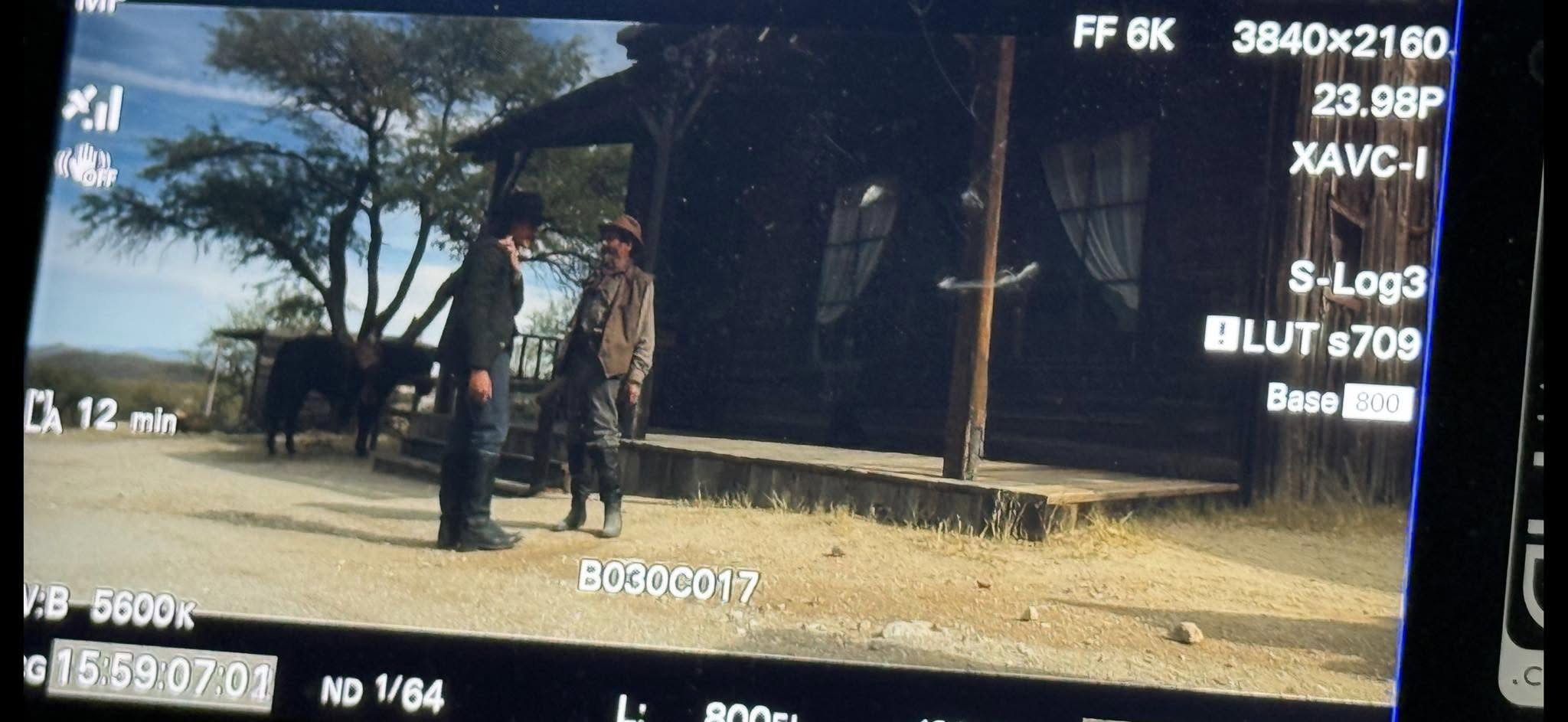


Here’s a glimpse of Billy the Kid: Blood and Legend, the new Western from director Michael Feifer, which has just started post production. I interviewed Mike just before he rolled camera, and that interview is coming soon to the pages!


Finally, back in 2021, an excellent Western was made in Australia, which has gone under two titles, The Legend of Molly Johnson, and The Drover’s Wife. Based on an 1892 story by Australian writer Harry Lawson, it’s about a pregnant mother at home alone on her farm in the Outback, caring for her children, and waiting for her husband’s return. It stars, and is written and directed by Leah Purcell, and it is an absolute knock-out. I interviewed Purcell back in 2021, but I never ran it because the movie was never released in the U.S., but it’s now running on Amazon Prime, and I’ll be posting the interview very soon!


…And that’s a wrap!


If you’re wondering why I haven’t mentioned the blockbuster miniseries American Primeval yet, I’m deep into an article about it for True West Magazine! Speaking of which, please check out our Annual January/February “Best of the West” issue, with my selections for the best Western movies, DVDs, and TV shows of the year!

Have a great February!

Henry

All Original Content Copyright February 2025 by Henry C. Parke - All Rights Reserved


Saturday, August 31, 2024

JULIET MILLS ON JIMMY STEWART, MAUREEN O’HARA, AND ‘THE RARE BREED’, PLUS INSP’S ‘BLUE RIDGE’ FINALE, ‘WILD WEST CHRONICLES’ SEASON 4 PREMIERE, ‘LONE PINE!’


JULIET MILLS ON JIMMY STEWART, MAUREEN O’HARA, AND ‘THE RARE BREED’


Jack Elam, Jimmy Stewart, Juliet Mills


“But soft! What light through yonder window breaks? It is the East, and Juliet is the sun!”

Juliet Mills’ sole feature Western is 1966’s The Rare Breed. Maureen O’Hara stars as a recently widowed Englishwoman whose late husband’s dream was to introduce hornless Hereford cattle to the American West, with an eye towards mating them with Texas Longhorns. Maureen’s daughter is Juliet Mills, and the men who variously help and hinder their efforts are cowboy Jimmy Stewart, meat packer David Brian, and rancher Brian Keith. There are a handful of Hereford bulls, and the one with the biggest role is named Vindicator.

I first spoke to Juliet Mills three years ago. I was gathering material to do audio commentary with my constant partner-in-commentary-crime C. Courtney Joyner, for a Blu-ray edition of Mills’ excellent Western, 1966’s The Rare Breed. Atypically, that BluRay still has not been released. This was during COVID time, and nothing was normal. Juliet and husband Maxwell Caulfield had then just celebrated their 40th wedding anniversary, and when I wound up my interview by asking Juliet when we would next see them on the screen, she replied, a bit anxiously, “It's all been very quiet lately. I haven't worked this year at all; neither has my husband, but there's no point worrying about it because there's really not much going on.” What a difference a few years can make. Since our interview, Juliet has appeared in six episodes of Grey’s Anatomy, co-starred with Wendy Mallick – and Maxwell – in the movie 7000 Miles, starred in the fantasy adventure The Primevals, and performed voices in animated features and series including Bigmouth, Human Resources, Ark: The Animated Series, and voiced the whale in Metalocalypse: Army of the Doomstar. Maxwell has been equally busy in multiple episodes of The Bay, numerous movies and TV-movies, and was particularly memorable as Penthouse publisher Bob Guccione in the miniseries Pam and Tommy. And Max played Jacob Marley to Juliet’s Ghost of Christmas Future in the podcast Scrooge: A Christmas Carol.

Terms like “Showbiz Royalty” are tossed around promiscuously, but few families have more clearly earned the “Theatrical Royalty” designation than the Mills family. Juliet’s father, John Mills, had a magnificent 75-year career in film and television here and across the sea, an even longer and finer stage career, and won the Best Supporting Actor Oscar in 1971, in David Lean’s Ryan’s Daughter.  Juliet’s sister, Hayley Mills, was the biggest child movie star of the 1960s, and is still very active. Juliet, with nearly one hundred screen characters to her credit, who will always be beloved for portraying the first title character in the 1970s series The Nanny and the Professor, began her screen career as an infant, in 1942.


“I was brought up watching my father on a film set. My first visit was in In Which We Serve, a (Noel) Coward film that my dad was doing. I was 11 weeks old, so I do hardly remember that, but there were a couple of others, October Man (1947), So Well Remembered (1947), and The History of Mr. Polly (1949). In all of them. I had little scenes, particularly in History of Mr. Polly. I had a little scene with daddy, a rather sweet little scene, but then of course I always visited him. I remember very, very well visiting him on Great Expectations (1946). I suppose I was about five at the time; that was David Lean. A great movie. What I'm really getting at is that on a film set, wherever it is, I always felt at home and relaxed and happy.

HENRY PARKE: You were very busy in British comedies in the 1960s: No, My Darling Daughter, Twice Around the Daffodils, Nurses on Wheels, Carry on Jack. You were so busy; what seduced you to come over to the United States?

JULIET MILLS: Well, as a matter of fact, I was in New York. I did a play called Alfie, with Terence Stamp. It didn't run that long, I think about three months. It was a little before its time, in the sense that (the cast spoke with) very strong cockney accents and the American audience didn't understand half of it. But while I was there, a casting director called Boaty Boatwright, who was very famous in that time -- I hope she's still with us. (Note: She is.)  She saw me in the play, and suggested me for the role in The Rare Breed. And I didn't do a test or anything, come to think of it. I got the part from the theater.

HENRY PARKE: How was filming in the United States different from filming in England?

JULIET MILLS: Well, the actual work, on the set, it's the same really wherever you are, except it was on a grander scale, in the sense of fantastic locations and huge sets and a Western. I'd never dreamed of doing a Western. My father always wanted to do a Western: he was very jealous. (Note: the following year, John Mills got his wish, starring in the short-lived but well-remembered Dundee and the Culhane, as one of a pair of frontier lawyers.)

HENRY PARKE: I would think the location work for The Rare Breed would have been quite different from what you'd done in England. Was it a physically difficult shoot for you?


Juliet Mills, Maureen O'Hara and Jimmy Stewart

JULIET MILLS: I wouldn't say too physically difficult. I did quite a bit of riding, which I loved, and I did ride anyway. We used to ride in Richmond Park when I was a child. The only slightly difficult part of that shoot was that it was quite hot, which I wasn't used to. We were shooting near Palm Springs, and so it was quite unusually hot for me. But they looked after us beautifully with ice, shammy leather around your wrist and all the rest of it, keeping it cool with umbrellas and stuff. But the only physical… I remember the time, there's a crash, the horses pulling a cart. The stampede. And we did a bit of that. I mean, obviously doubles did a lot of it, but some of it, Maureen (O’Hara) and I did. We were cowering under a huge rock when all these animals went thundering over. That was the only slightly scary bit, I think. But of course, the doubles did all the really dangerous parts.

HENRY PARKE: I've got to say it works. It looks very scary on film.

JULIET MILLS: Yeah, it does; it's very well done. (Director) Andrew McLagan was so experienced in doing that kind of thing, and he was just wonderful. He was one of the tallest men I've ever seen; he was huge. His feet were huge! He was a very, very, very nice guy, very good director. It was a very happy experience for me, as you can imagine. I mean, working with Jimmy Stewart, it was a dream. He was such a lovely guy. He was just as he seemed to be, you know, he was just himself. He was very, very sweet to me, very welcoming. There were three dozen red roses (from him) in my dressing room when I arrived. And he was always very friendly and we stayed friends after the film. And I used to go and see him in his house on Roxbury. I remember he had a huge vegetable garden. Of course now there's a house where his garden was. (I remember) being in a bar with him and the whole crew was after shooting, when we were on location. Because we did a lot at Universal, in the studio, of course. And they built all that whole set in there, that sort of compound area with the house and all that. That was amazing. I'd never been on a set of that size and scale before. But anyway, we were in this bar and I remember he said, “Do you do drink beer, Julia?” I was 22, and I said, “Oh yes, I do. I do have half a pint at home in the pub.” And so he said, “I'm going to order you a yard of beer.”

Maureen and Juliet

You probably know what it is, it's a long glass thing with a ball, a bulb, on the end, so you can't put it down, you have to drink it! That was one of my memories of Jimmy. He was so sweet. And then Maureen, of course I knew anyway. When I was first in New York at the age of 17, doing a play called Five Finger Exercise, which was Peter Schaffer's (Equus, Amadeus) first play actually. She and I did a live TV performance of Mrs. Miniver. So that's when I first met her. And then of course she did The Parent Trap with Hayley, where she played her mother. She actually played my mother twice and Hayley's mother once. So I adored her. I was very, very fond of her. The last time I saw her actually was when she came to Los Angeles for the TCM (Classic Film Festival). They were doing a tribute to her and they showed The Corn is Green. I had tea with her at the Roosevelt Hotel. I think she was 90 then. She was still so beautiful. When I did Rare Breed with her, she was breathtaking. Her skin was like alabaster. She had that wonderful red hair and those huge green eyes. She was an Irish beauty for real.

HENRY PARKE: Yes, absolutely. Someone who didn't look quite as for real was Brian Keith with all that red hair all over him.

Maureen O'Hara and Jimmy Stewart flank Brian Keith
in a horrendous fake wig and beard

JULIET MILLS: (laughs) Oh, he was a sweet guy. I loved him, but I know what you mean. It was rather over the top, all that hair. He really got into that Scottish thing in a big way. He was like a throwback, a Scottish landowner from way back when.

HENRY PARKE: Don Galloway played your romantic interest. He's an actor that I know primarily from from television, from the Ironside (1957-1975) series.

JULIET MILLS: I didn't know him, because having not been living in America, and doing a theater only in New York, I never watched television. I didn't know anything about him. He was a very nice guy and a very good actor. I don't -- what happened to him? I don't remember seeing, I never saw him again personally. And in real life, I'm sure he went on and did lots of things, but, um, did he do anything, any more movies after that?

HENRY PARKE:  He did several Westerns right after The Rare Breed, and years later he was in The Big Chill, but mostly he was a very busy television actor.

JULIET MILLS: We never met again, but that's this strange business we’re in. You're in each other's pockets, kissing each other on the lips, first thing in the morning. And you never see each other again.

HENRY PARKE: You also worked with a great villain, especially in the stampede, Jack Elam.

JULIET MILLS: Oh yes, he was wonderful, wasn't he? He was such a famous villain, and I'd seen him in so many movies, always playing the baddy, with those amazing eyebrows, and he was wonderful. And the stunt people were amazing too. Hal Needham was the stunt coordinator, and did a lot of stunts in that film. I think he actually played me at one point with a wig on. Jimmy's double, Ted Mapes, he always doubled for him; he was the same height, and he was a great friend of Jimmy's. Everything about that film was a happy memory, I have to say. Actually I saw it maybe a year ago on TCM and it's entertaining; it's good. I remember (stuntwoman) Patty Elder very well. She doubled for me. They were so courageous, those stunt people. They’d do anything on those horses, falls and crashes, oh my goodness. Amazing. Hal Needham, he loved his work. He was so experienced. I think he must have broken every bone in his body by the end of it all. He was always hurting himself. You know, they really do bash themselves up terribly.

HENRY PARKE: He's one of the very few stuntmen I know of who went from stuntman to director. (John Ford was another)

JULIET MILLS: I suppose that was partly his great friendship and association with Burt Reynolds. I think that's how he got into that. I will tell you one little funny story that I just remembered. We did all the location work first, then we went back into the studio. There were lots of horses in that set, that compound area. And when they dumped a load, as it were, the guy came and scooped it up with a shovel, so it wouldn't be in the shot. One time I was just standing around, I wasn't in the scene, and he wasn't around. And they were going “ny-ny, ny-ny, ny-ny,” because that's what they call them, the ones that scoop up the shit. I grabbed a shovel and I went in and scooped it up. And that was a huge joke with the crew. I had a gold charm bracelet that I always wore myself, not in the film. At the end of the shoot, Jimmy gave me a little gold shovel charm because they used to call me ny-ny. That was my nickname on the set.

HENRY PARKE: Any other fond memories of the filming?

JULIET MILLS: One of my favorite scenes that I remember so well. Jimmy was living in a little shack out on the prairie. I rode up on my horse and got off, and we had a scene together. That was wonderful for me, working with him on a one-to-one basis like that. He was such a giving actor, like all the greats. I did the film with Jack Lemmon (Avanti! 1972), and he was the same. Working with great film actors, all you have to do is react, really. You don't have to act at all. They're so generous.

Juliet and Vindicator

One other thing I will tell you. You know Vindicator the bull? We all became very fond of Vindicator and Jimmy especially. Jimmy wanted to make sure that Vindicator would be retired to a lovely life and not carved up or anything. So he actually bought him, and he went and lived out his life on Jimmy's ranch in Idaho.

When I heard that you wanted to talk to me about The Rare Breed, I started to think about it and things just come back, you know? It was the first time I ever worked in Hollywood. It was my film debut in Hollywood. And it was an important time for me in my life. I’d just had my first child. My son was about six months, I think, when we came out to do the film. That was my first husband -- I've been married to Maxwell Caufield for 40 years, so that's almost like another life.

HENRY PARKE: You did a couple of Western TV shows after The Rare Breed. You did A Man Called Shenandoah (1966).

JULIET MILLS: I don't remember much about that show, but I do remember Alias Smith and Jones very well, with Pete Duel. I remember that being on location, I think it was the Fox Ranch. I did a lot of episodic television around that time, and movies for television. Sometimes they were very, very good.

HENRY PARKE: How did you like working on The Man From UNCLE?

JULIET MILLS: Oh, great fun, great fun. Robert Vaughn and David McCallum, lovely, sweet guys. Very happy with their lot, feeling lucky to be in such a hit series. It was a very happy set. Honestly I don't remember much of the plot or my part, but I remember enjoying it very much.

HENRY PARKE: It’s been such a pleasure to talk to you. I've always enjoyed your work. I remember Nanny and the Professor very fondly. But one of your films that I’ve heard so much about, but never seen, is your “possession” thriller, Beyond the Door (1974).

JULIET MILLS: Oh my God, that's a scary movie! I took my son. He was about five, I think. I took him to see it at the Grauman's Chinese. He was so scared that when it was over, he wouldn't walk out with me. He said, “Mommy, I don't want to walk out with you. I don't want anybody to see me with you!” It was a strange.


INSP’S ‘BLUE RIDGE’ SUNDAY FINALE IS THE BEST EPISODE YET!

Jonathan Schaech


I’ve been catching a little heat from some friends that I turned on to Blue Ridge. “How can it be the finale?” they ask. “Didn’t it just start in July?” TV seasons have gotten shorter and shorter since the 1950s, when 39 episodes was the average, and I must admit a 6-episode season is a new low, count-wise, but the good news is that season 2 is coming in 2025, and it will have more episodes!

And the more urgent good news is that the Sunday, September 1 season closer is the best written and performed Blue Ridge story yet. One of the biggest strengths of Blue Ridge, movie and series, which separates it from other police dramas, is its rural setting, and its creators’ true understanding of that world, of the sort or crime found in that world, and the realities of underfinanced law-enforcement: it is still the wild west when it comes to self-reliance and teamwork.

They have PLENTY of reasons to be scared!

Sunday night’s story concerns not only very real human relationships under life-and-death pressures, but eminent domain, problems faced by some of our returning military, impenetrable government bureaucracy – and I won’t say any more. It’s too good to start telegraphing. If you missed my July article on Blue Ridge, you can click HEREor just scroll down a little.

‘WILD WEST CHRONICLES’ SEASON 4 PREMIERE WEDNESDAY, SEPTEMBER 4TH!

Director Jim Orr watching Byron Preston Jackson
as Bass Reeves

Since Bat Masterson is a superhero to western historians and western movie- and TV-fans alike, what could be more appropriate than to begin season 4 of INSP’s Wild West Chronicles with a ‘superhero origin story’ for Bat? And because we are in the 21st century, what could be more relevant than the fact that it’s not a ‘creation’ story, but a ‘reinvention’ story, the tale of how Bat, elegantly portrayed by Jack Elliot, redefined himself from lawman to journalist.

A familiar western street to Chronicles viewers.

A few months back I had the rare privilege to visit the Peppertree Ranch Studios in Acton, California, to witness a bit of the filming of two INSP Western series, Wild West Chronicles, and Elkhorn. Roaming the Western movie sets, I felt a connection not only with the West, but with the movie-making west of the early 20th century, when two movie crews would be shooting on opposite ends of a Western street, and care had to be taken so they didn’t film each other!

Jim Orr directing Byron Preston Jackson

I was particularly happy to be present for some of the filming for what will be episode 2, Bass Reeves: A Father’s Justice, with Byron Preston Jackson as the legendary lawman. When I’d attended an early screening of the first episodes of the Paramount + series Lawmen: Bass Reeves, I’d spoken to the show’s creator, Chad Feehan, and I was amazed when he told me that they wouldn’t be including the most dramatically personal manhunt of Reeves’ career: when he set out to capture his own son for murder. Feehan told me they hadn’t dramatized that story because they wanted an upbeat tone to the piece. I understood, but I’m delighted that Wild West Chronicles is tackling that story.


‘RENDEZVOUS WITH A WRITER’ PODCAST CELEBRATES 101ST EPISODE THIS THURSDAY WITH C. COURTNEY JOYNER AND ME!


On Thursday, September 5th, filmmaker, screenwriter, novelist, and film historian C. Courtney Joyner, writer of the brand-new horror movie Quadrant, and Henry C. Parke (that’s me!), author of the new book The Greatest Westerns Ever Made and the People Who Made Them, will be the guests of Bobbi Jean Bell and Jim Bell on Rendezvous with a Writer #101! And you need not wait! You can see Quadrant right now on Tubi and Prime Video, and you can buy Greatest Westerns right HERE.


I GUESTED ON THE EXCELLENT ‘HOW THE WEST WAS ‘CAST’ PODCAST

I’m going to be putting up links to all of the podcasts I’ve done recently, and How the West Was ‘Cast is exceptionally good – even the episodes that I’m not on! Hosts Andrew Patrick Nelson and Matthew Chernov have tremendous passion for and knowledge of the genre, and I’m sure you’ll enjoy it! Here’s a link to my episode, where we discussed – you guessed it – The Greatest Westerns Ever Made, and the People Who Made Them! https://westernpodcast.buzzsprout.com/884218/14709372?fbclid=IwY2xjawFANGRleHRuA2FlbQIxMQABHdoHIKZRoiYQZ5xeIPlyWDvp8MaQS0fmRqZTjZCq5vCsfY2YkDV3_3O7eA_aem_M-rkJIE359PPFdpdvpC3RA

LONE PINE FILM FESTIVAL OCTOBER 10 – 13!


The Lone Pine 34th Annual Film Festival is right around the corner, and the link below will take you to the official website, where you can learn all about the films you can see, the tours of the spectacular Alabama Hills – the locations of the movies you’ll have just seen, and all of the notable guests who will be attending. https://lonepinefilmfestival.org/


On Friday morning, October 11th, I’ve have the pleasure of interviewing Sandra Slepski, niece of Western star Tom Tyler, about his later years, spent with her family. This will be followed by a screening of Tom Tyler’s 1936 Western boxing film, Rip Roarin’ Buckaroo, which was shot all around Lone Pine, in the Hills and in town, and later in the day there will be a tour of the film’s locations. I’ll also be signing and selling my book, The Greatest Westerns Ever Made and the People Who Made Them. Keep an eye of our Facebook page, because I’ll have A LOT more info on Lone Pine as the date gets closer!


…AND THAT’S A WRAP!

Happy Trails,

Henry

All Original Contents Copyright August 31, 2024 by Henry C. Parke – All Rights Reserved


 [HP1]

Monday, October 6, 2014

‘MEN FROM SHILOH’ REVIEW, PLUS ‘GENE AUTRY CHRISTMAS BOOK’, LONE PINE FEST!


THE MEN FROM SHILOH – A Home Video Review


The good folks at Shout Factory/Timeless Media Group have released a ‘special edition’ of THE MEN FROM SHILOH, the 9th and final season of THE VIRGINIAN series.  The nine disk set includes all twenty-four episodes, as well as a disk of interviews.

The TV series THE VIRGINIAN was ground-breaking in many ways when it arrived on NBC in 1962.  It was the first Western series with a literary pedigree, being based, however loosely, on the Owen Wister book which many consider to be the birth of the serious Western novel.  It was the first TV series of any genre to star an actor with the stature of Lee J. Cobb, who’d created Willy Loman on Broadway in Arthur Miller’s DEATH OF A SALESMAN, and was twice Oscar nominated for his work in ON THE WATERFRONT and THE BROTHERS KARAMAZOV.  And while it was preceded by brilliant anthology series like PLAYHOUSE 90, which did live full-length plays on television, THE VIRGINIAN was the first series to do a feature-length, color film, single camera, largely outdoor action movie every week!  They did thirty of them that first year, and by the end of their 9th and final season, they had produced 249 movies.  

The title character was played by James Drury, from the first to the final episode, and to a great degree the series rose and fell on his portrayal of the mysterious man who never revealed his name, or much else about himself outside of the state of his birth.  I’ve heard Drury comment that he was the original ‘man with no name,’ and it’s true; his and Eastwood’s subsequent, quietly confident, sardonic, mysterious characters have much in common.  The Virginian was the foreman of Judge Henry Garth’s (Lee J. Cobb) Shiloh Ranch, outside of Medicine Bow, Wyoming.  Doug McClure, like Drury, was there from the first episode to the last, playing the top hand after the Virginian and his best friend, Trampas – an ironic choice of name, considering that, in the novel, Trampas was the Virginian’s most despised enemy.

Many of the successful Western series up to that date had focused either on families, like BONANZA and THE RIFLEMAN, or groups of working men, like RAWHIDE.  THE VIRGINIAN wisely did both; there were plenty of men in the bunkhouse, and in the big house, Judge Garth, a widower (this is 1960s television after all), always had nieces and nephews to help raise and/or tame.  Among the ‘youngins’ who graced the series were Roberta Shore from 1962 to 1965, Diane Roter from 1965 to 1966, Sara Lane from 1966 to 1970, and Don Quine from 1966 to 1968.  There always needed to be a patriarch, and when Lee J. Cobb left after 120 episodes in 1966, he’d be replaced first by Charles Bickford, and then by WAGON TRAIN’s John McIntire.  Among the many fine actors who appeared as regulars for a few seasons as lawmen or drovers were Clu Gulager as Sheriff Emmet Ryker, Gary Clarke, Randy Boone, L.Q. Jones, and Tim Matheson. 

I had the pleasure of attending the 50th Anniversary Celebration of THE VIRGINIAN series, and its move to the INSP Network, at the Gene Autry Center.  These links will bring you to my four-part coverage of the event, and several interviews:   PART ONE; PART TWO; PART THREE; PART FOUR.

Eight years was a terrific run, but by 1970, a lot of the world had changed.  The once-dominant Western genre was no longer TV’s favorite, at least in part as the result of an anti-violence policy at the networks that restricted how much action an episode was allowed.  WAGON TRAIN and RAWHIDE were gone for five years, THE BIG VALLEY had just ended, and HIGH CHAPARRAL would only last one more season.   GUNSMOKE, which had begun in 1955 and would run until 1975 (plus TV movies), had saved itself from extinction by refocusing its plot-lines around guest stars rather than regulars, and BONANZA had added semi-brothers David Canary and Mitch Vogel to perk things up.


(Here's the VIRGINIAN theme from season three by Percy Faith)

Plus, the freshness and youthful energy of the spaghetti westerns tended to make Western TV appear a bit staid and tired.  That’s when the powers-that-be at NBC decided to try and re-think THE VIRGINIAN (now they’d say re-brand or reinvent), and turned it into THE MEN FROM SHILOH.  Unlike any of the other Western series of the time, SHILOH took its revamping cues from Sergio Leone and Sam Peckinpah.  Gone was the sweeping heroic theme by Percy Faith, replaced by a new, beautiful theme by Leone’s signature composer, Ennio Morricone which was, by turns, wistful and relentless.  Gone was the familiar title sequence with each star riding on horseback towards camera. Instead there was a mix of sunrise footage, historical photos and high-contrast graphics that could have come straight out of the previous year’s THE WILD BUNCH. 


(Here's the MEN FROM SHILOH theme by Ennio Morricone)

Then there were the stars – a new patriarch in one-time big-time MGM leading man Stewart Granger; Lee Majors, fresh from THE BIG VALLEY, as Roy Tate, sporting a big, mean-looking mustache; Doug McClure, back as Trampas, sporting an even bigger mustache; and James Drury as the Virginian, sometimes sporting a gun the length of his leg!  McClure’s and Drury’s wardrobe, unchanged since 1962, were completely different.  Granger played a retired British colonel who had bought Shiloh Ranch, and was maintaining its personnel – but there would be no more nieces and nephews to clutter up the place: this was now a series strictly about men.


The bosses at NBC scored quite a coup in signing Granger.  Not only was he a talented and popular actor, although no longer a leading man, his presence would make the show more valuable in Europe.  Though the films were largely unseen in the United States, Stewart Granger had starred in two of the immensely popular German Westerns which gave birth to the spaghetti westerns.  Based on Karl May’s WINNETOU novels, Granger played the beloved character of Old Surehand.  With Granger, the series had a built-in European fan-base.

As had been the pattern of the series for some time, most episodes focused on one of the younger men, sometimes with and sometimes without Granger.  The first, THE WEST VS. COLONEL MACKENZIE, is noticeably influenced by the spaghetti western.  In the aftermath of the lynching of an accused rustler, the colonel is out to catch the culprits, and the town’s class division between the ranchers and the rabble, bordering on the divine right of kings, is distinctly European rather than American, and the filmmakers have fun with the fact that it’s an upper-class Brit who is trying to see justice done.  The second episode, THE BEST MAN, centers on Trampas, and his efforts to help a friend marry the senorita of his dreams.  As would become clear, in show after show the producers were willing to spend money for an exceptional guest cast; this one included James Farentino as the friend, and Desi Arnaz and HIGH NOON’S Katy Jurado as the bride’s parents. 

In GUN QUEST, a very well-written (by Robert Van Scoyk) and produced (by GUNSMOKE creator Norman MacDonnell) noir episode featuring the Virginian trying to prove himself innocent of murder, the cast is again staggering: CITIZEN KANE stars Joseph Cotten and Agnes Moorehead are reunited (although, as in KANE, they have no scenes together), joined by Brandon DeWilde, Anne Francis, John Smith –late of LARAMIE, former Western leading-man Rod Cameron, and Neville Brand, whose LAREDO series was a spin-off of THE VIRGINIAN.  And when Monte Markham, as the man the Virginian has been misidentified as, shows up, he is wearing -- I kid you not -- the Virginian’s red shirt and black leather vest from the first eight seasons! 


Former VIRGINIAN regular L.Q. Jones and James
Drury in the SHILOH episode TOWN KILLER


LADY AT THE BAR, this time with Trampas accused of murder, stars Oscar winner (for MRS. MINIVER) Greer Garson as his lawyer, E.G. Marshall as the judge, twice Oscar-nominated James Whitmore as the judge’s marshal, along with Kenneth Tobey, RIFLEMAN’s Paul Fix, Ian Wolfe, and Oscar-nominated (for THE BIG SKY) Arthur Hunnicut as the assayer. 

Not that the producers never cut corners.  THE MYSTERIOUS MR. TATE, which introduced Lee Majors’ character, had a good cast, with Majors and Granger joined by Robert Webber, Dane Clark, and young and blossoming Annette O’Toole, but it takes place almost entirely on-board an interior train set.  Similarly, in WITH LOVE, BULLETS AND VALENTINES, Trampas ‘wins’ a riverboat in a poker game, and Universal must have pulled stock footage from every film they ever had with a paddle-wheel – some of the mix of different film-stocks in jarring.     

Among the many other fine actors that turn up in the series are Susan Strasberg, John Ireland, Jane Wyatt, Lew Ayres, Elizabeth Ashley, and many others. 


Lee Majors' character makes an
inauspicious entrance in
THE MYSTERIOUS MR. TATE


As with any series, some shows are better than others, but all of the MEN FROM SHILOH episodes I’ve seen are worth watching, and some are extremely good.  The changes were an attempt to invigorate the series, and not a matter of ‘jumping the shark,’ by any means.  Of course, that raises the question of why it was the last season of THE VIRGINIAN.  At least a partial explanation is suggested by James Drury in the interview disk: many fans of THE VIRGINIAN didn’t even realize that MEN FROM SHILOH was THE VIRGINIAN, so they didn’t watch it. 

Another theory also came from James Drury at the 50th Anniversary Celebration.  When moderator Boyd Magers of Western Clippings  put the question to Drury, this was his reply:

They gave the show a new look, and everybody kind of signed on to it.  I got myself a new horse and a longer gun.  (big laughs from the audience) From a 5 ½ inch barrel to a 7 ½ inch barrel.  Longer sideburns. Much bigger hat.  A sense of accomplishment or…a sense of entitlement – let’s put it that way.  I smoked cigars on the show.  And I just mowed down anybody with my firearms.  But the thing is, we all thought it was a good idea at the time; it was a terrible idea.  And the worst of the terrible ideas was putting Stewart Granger in the same position that Lee Cobb had occupied, that John McIntire had occupied, Charles Bickford had occupied; that John Dehner had occupied.  These were truly great western actors.  Stewart Granger came in and decided that he was going to be the big star of the show:  fired my crew, fired my Academy Award-winning cameraman, got all new people.  He pissed off everyone in the entire organization.  And he sunk the show.  So thank you, Stewart, wherever you are.”

Indeed, there is a smugness and pomposity to Granger’s character that grates on you at times.  My feeling is that after 249 movies, there wasn’t a whole lot left to say.  I thoroughly enjoyed watching the shows, and one of the high points of this collection is the disk of interviews, featuring James Drury, Clu Gulager, L.Q. Jones and Roberta Shore.  They run from 20 minutes for Shore to 45 for Drury.  Each interview covers the subject’s life and career in general, and THE VIRGINIAN in particular, and the insights are often fascinating.  They’re all good, but James Drury’s is the best; in fact, it’s one of the very finest career interviews that I’ve ever watched.      

You can learn more about, or purchase, THE MEN FROM SHILOH, or many other Westerns series and movies, from Shout Factory, HERE


THE GENE AUTRY CHRISTMAS BOOK – Just in time for Christmas!


If you’re not a fan of Gene Autry’s Christmas music, then you either (a) hate Christmas, or (b) don’t realize how many of the best Christmas songs can be traced back to Gene.  Gathered together for the first time are twenty-five Christmas classics that Gene performed and helped popularize, each with sheet-music arranged for piano, vocal and guitar. 

Gene was inspired to write the lyrics to HERE COMES SANTA CLAUS in 1946, when he was Grand Marshal of the Santa Claus Lane Parade in Hollywood, and heard children chanting for their other favorite, just a couple of floats behind.   He had one of his greatest hits with RUDOLPH THE RED NOSED REINDEER, when he sought the song out after everyone had passed on it.  Some of the most amusing songs are not that well remembered – can you sing HARDROCK, COCO AND JOE (the three little dwarfs) without checking the sheet music?  How about SANTA’S COMING IN A WHIRLYBIRD? 

Some of the included songs are available in sheet music for the first time – eight of them, including WHIRLYBIRD and THE NIGHT BEFORE CHRISTMAS (IN TEXAS, THAT IS) were transcribed from Gene’s recorded performances.  Published by Hal Leonard, with an introduction by Gene Autry Entertainment President Karla Buhlman, and featuring photos, including some of Gene’s own Christmas cards, this book is sure to give the musically inclined something new to play and sing around the piano at that special time of year when we all like to think we can carry a tune.  You can buy it wherever you buy your sheet music, or direct from Gene Autry Entertainment HERE.  

And even if it’s a few months early, it’s never the wrong time to hear Gene sing HERE COMES SANTA CLAUS!


25TH ANNUAL LONE PINE FILM FESTIVAL OCT. 10-12!


Come join the stars and other fans at one of the world’s prime Western movie locations, Lone Pine, this coming weekend.  Since the 1920s, hundreds of Western movies and TV shows have been shot in and around the famed Alabama Hills.  Stars from Tom Mix to William Boyd to Gene Autry to Roy Rogers to John Wayne – the list goes on and on! 


Among the guests who will be attending are Bruce Boxleitner, stuntman and author Dean Smith, stuntman Diamond Farnsworth, Oscar-winning sound designer Ben Burtt, THE RIFLEMAN star Johnny Crawford, Republic Western stars Peggy Stewart and Donna Martell, seven-time John Wayne co-star Ed Faulkner, THE SHOOTIST screenwriter Miles Swarthout, plus Clayton Moore’s daughter Dawn Moore, Roy and Dale’s daughter Cheryl Rogers Barnett, Randolph Scott’s daughter Sandra Tyler, and many more.

To learn about all the events and all of the movies to be screened – from THE MACCAHANS to GUNGA DIN – visit the official website HERE

And if you've never been to Lone Pine, here's an excellent featurette to show you why you shouldn't miss it!


THAT’S A WRAP!

As we near 200,000…

This weekend The Round-up surpassed 190,000 hits!  Thank you to all of you folks who keep visiting the site week after week.  We’re read in well over 90 countries these days, and we added two this week, Luxemburg and Bahrain.  And this week’s new Facebook followers are from L.A.; Running Springs, CA.; New York City; and Moscow.  It’s great to know the appeal of Western stories is still international!  Have a great week!

Much obliged,

Henry

All Original Content Copyright October 2014 by Henry C. Parke – All Rights Reserved