Showing posts with label Texas Rising. Show all posts

Sunday, July 19, 2026

INSP'S 'BLUE RIDGE' RETURNS TONIGHT! TALKING WESTERNS WITH JOHNATHON SCHAECH!


INSP’S ‘BLUE RIDGE’ RETURNS SUNDAY 7-1

Updated July 20, 2026


This Sunday, Justin Wise, former Green Beret-turned-rural sheriff returns to the mountains of North Carolina in season two of Blue Ridge.  Yes, it’s a contemporary police story, but as creator/producer and frequent director Gary Wheeler points out, “It’s certainly a modern-day Western in the vein of Longmire; some might call it Western adjacent. It's in the wide-open spaces.”

In technological terms, it’s a bit of a throw-back to a simpler time, one that it’s star, Johnathon Schaech responds to, even with his big-city background. “My father was a Baltimore City cop. He had a beat that he had to walk, and he didn't have a radio. He had a call box in the street. So he had to really rely on his neighborhood for safety. So when I read (the original Blue Ridge script), I kept thinking, this guy really needs to rely on this crazy town for his own safety. Phones don't always work up in the mountains. There's a lot of similarities. And my father's a pretty tough man, especially when he was working the beat. I just thought, it's so funny: I've become my dad.”

Justin Wise has also come to town in hopes of getting back together with his ex-wife Elli (Sarah Lancaster), and to be a bigger part in the life of his daughter Maddie (Taegen Burns), another part of his character that feels at home to Jonathon. “My parents separated when I was younger. They did get back together, so I could see Justin trying to win his wife back, the way my father was trying to get my mom to come back to him. My mom left because of my father's work. He just couldn't calm down. He saw horrible things, and he was stressed out all the time. It’s literally like Justin; he’s always at work, and that's why Maddie left him, same as my father. So he’s trying to deal with himself, to be softer and more present with her, because he loves her and she loves him.”

Gary Wheeler directing Johnathon Schaech

“He's the lone hero who always stands for what's right,” notes Wheeler. “He's a character that runs toward the fire, not away from the fire, and that's very traditional, classic western television. That’s Matt Dillon, that's the Cartwrights, The Rifleman -- that’s probably my favorite from my childhood. Jonathan's character, Justin Wise, is certainly cut out of the same cloth as Matt Dillon.”

Schaech is certainly in shape for season 2, as the opening of episode 1 demonstrates.  “We opened with this kind of ‘Rocky Balboa’ montage of him carrying logs, chopping wood and all that,” Wheeler recalls. “And when Johnathon read it, he said, ‘I'm gonna do that scene shirtless!’” Johnathon explains, “in between the two seasons, I did a bodybuilding contest, kind of a bucket list thing of mine. So I (trained), dieted for about five and a half weeks, and I went out to this bodybuilding contest up in Franklin, Tennessee, and I won <laugh>! I won for over 50.” He looks amazing in the show, Wheeler notes: “He got in the best shape of his life.”

Johnathon Schaech doing some heavy lifting!


As with season one, each episode has a stand-alone plot, or as Wheeler calls it, “a case of the week or a problem of the week.” Besides Juston’s ex-wife and daughter, the other regular characters are back, including warring patriarchs Jeremiah Wade (Tom Proctor) and Connor McGrath (A Martinez), and deputies played by Greg Perrow and Avianna Mynhier are still working not out of the police station, which burned in the pilot episode, but from the local history museum since, as Mayor Brady (Odessa Feaster) explained, it’s the least-used municipal building.

Jonathon Schaech, Sarah Drew and Greg Perrow in
the season 2 opener
    

Among guest stars this season, Bruce Boxleitner returns as Oak Miller, a character he created in the TV movie before the series began. Gary says, “He's one of my great friends, and I love to text him and talk movies with him. We brought Oak Miller back, and that's always a great adventure, because Oak Miller is a really tough character, really a tough cowboy. Bruce grew up in that genre, the guy from The Gambler. And one thing about Bruce is you can put him on a horse and say, hit that mark.” Also, “the incomparable Doug Jones, who does all these creature features,” having starred in Hellboy, The Shape of Water and Pan’s Labyrinth, “is in episode three, (playing) a hermit.”

One highpoint will be Moving Mountains, the final episode of season two, with guest star, the legendary Keith Carradine as a preacher, Brother Rusty, who has a potentially deadly accident that is the focus of the story. Saying more about his predicament would ruin it, but Gary describes it as “the emotional core of the entire season of Blue Ridge, I think.”

When I asked Keith Carradine if it was his first time playing a man of the cloth, he told me, “Yes, I believe so. When they came to me, I just responded to the material, and particularly because it was a story of redemption, it was just a wonderfully positive message. I'm a fan of Johnathon's, and I love that he has used that life experience to be a part of what he's doing now in Blue Ridge. I was just happy to be invited into that world and to be given a chance to tell the story of Preacher Rusty and their sort of mutual redemption in the course of that episode.”


Brother Rusty (Keith Carradine) is in rough shape
when Justin Wise (Johnathon Schaech) finds him


Wheeler says, “I had re-watched The Grapes of Wrath, and Keith’s Dad, the great John Carradine, has an amazing role as a preacher. Keith came to me and said, ‘I want to play my paw in the Grapes of Wrath.’ That was one of the (motivations) for him to take the project. The way he looked with the overalls, that hat he wears, just very ‘Joadian’, very ‘John Steinbeckian’.”

It’s a very physically demanding episode, and the first one that Johnathon Schaech directed. “The one thing I've learned over the years of making movies is casting is everything,” says Schaech. “So when you get an actor like that, who wants to come out and play a part for you. You just make sure the camera is ready, make sure he's lit, and give him anything he wants and needs. And he was such a trooper.”

I wondered if Taylor Sheridan’s successes had rubbed off on other rural shows like Blue Ridge. “I think anybody who is playing in our space would say, how could it not?” says Wheeler. “How could those doors not be opened for us? Wide open spaces, a sense of family, interesting mountain rural settings. You know, we shot on the Blue Ridge Parkway. Season two deals with the impact of Hurricane Helene. Blue Ridge season one was very successful, especially on the streaming platforms, and you know, I do think people want to watch PG Yellowstone, they want to see a PG version of Reacher.  Blue Ridge aspires to be something hopeful. I hope that they can watch it with their family, and find that sense of community, and that it's fun and that it has action, has good mysteries, and all of those things.”

Season 2 of Blue Ridge begins on Sunday, July 19th, 10 pm Eastern Standard time. Check your local listings.


JOHNATHON SCHAECH ON HIS WESTERNS

Henry Parke: It's remarkable how many westerns and sort of westerns you've been in. Are you a fan of the genre?

Johnathon Schaech: You know, I am. One time at Creative Artists Agency (CAA), I sat down with this big agent, and he said to me, you're like a cowboy <laugh>. And I'm like a smiling goofball, trying to make jokes all the time. I'm like, how am I like a cowboy? He goes, the presence about you. And it reminded me when I first started acting, I had a legendary acting teacher named Roy London. And I kept saying to him, I really want to be like Robin Williams. And he’d get so angry at me. He goes, ‘You're never gonna be Robin Williams! <laugh> <laugh>. You're like that guy, Clint Eastwood.’ And so I was like, but he's kind of angry all the time. I think I'm a lot like my father, who’s very much like a cowboy. And those Westerns find me. And I love doing 'em, and I can't wait to do more.

Henry Parke: Did you watch any of them growing up?

Johnathon Schaech: Oh, my dad, we watched them all the time. John Wayne films like Red River.

Henry Parke: Your first western that I'm aware of is an episode of Brisco County Jr. in 1993.

Johnathon Schaech: Oh my God. Right. That started my career as a cowboy.

Henry Parke: You were the youngest attendee in a Bounty Hunter convention. Did you enjoy doing that one?

Johnathon Schaech: I had a frigging blast. It was the first time I did something light like that, you know? And I really was a very bold young actor. I really took center stage when it was my time.  “Nevada Cooper! Friends call me Coop!” <laugh>. I watched it not too long ago, and I was like, wonder if I offended the lead, Bruce Campbell? But I talked to him years later and he was like, ‘Hey, you're such a pleasure to have on the show.’ And I thought, wow. They like when you take those big chances; it's important for a young actor to know they're allowed to take center stage and not to bow down. The actor wants you to rise up.

Henry Parke: And it was inherent in the character you were playing. He was not a wallflower at all. But tell me about That Thing You Do. That was pretty soon after Brisco County, and you are much more suave when you come into that. How did you get That Thing You Do?

Liv Tyler and Johnathon Schaech in That Thing You Do

Johnathon Schaech: I used to journal, and I remember journaling that I was going to work with Jessica Lang and Tom Hanks: those were my goals. I remember putting that down on paper, and then I got a phone call from my agent that I had an audition for Tom Hanks' next movie that he was directing! I remember preparing for the role, and the sides (note: screenplay pages sent to an actor before an audition). One of the scenes was, it said, “I quit. I quit.” And he walks out, he quits the band and leaves. I remember preparing it and thinking, he's a singer. He should sing it. So I prepared myself to sing it for the audition. When I went in, Tom Hanks was there with a reader, who would read the scenes with me. I dressed the part, I dressed like 1960s; the Beatles is what I dressed like. Tom watched. And when that moment came up, I tapped the microphone and I sang it, “I quit!”, and I walked out the door. And Tom Hanks came and got me, said, “Get back in here kid.” And I knew I got the part. I was like, I won. And once we were cast, we were put in almost like a school, to learn how to play the instruments and sing. I just was doing it nonstop for about eight weeks. And I learned how to play the guitar, and I learned how to sing.

Henry Parke: So you were not a musician coming in?

Johnathon Schaech: No.

Henry Parke: Wow! You're real convincing. Do you do your own singing in the film?

Johnathon Schaech: No. Tom told me, “We're not gonna have you sing in the movie, but we want you to learn how to sing so you're hitting all the notes. And sometimes we'll do playback, and sometimes we won't.” And it was hard once they got the singer, Mike Viola (note: of Dawes and Panic at the Disco), it was even harder, because that guy’s singing really high. But you know, it sounded great. By the end, I couldn't sing like him, but I could sing a little bit better than I could before. But, you know, I get credit for singing the, “I Quit song.” <laugh> I got to work with Tom recently again, 30 years after we'd made That Thing You Do. He cast me in Greyhound II,  the sequel to the first one. That movie is awesome. Tom wrote it, and he wrote a part for me. So I just went out there to Australia and shot that.

Henry Parke: In 1998, you starred as Harry Houdini in the biopic of that title. In addition to being a great showman, magician, escapologist – a word I think he coined -- he was a remarkable physical athlete. Much of what he did was more about muscle control than misdirection. How'd you like playing him?


Johnathon Schaech: That's one thing I really got involved in. I had to do all the tricks and I had to do all the stunts. So there were some things I really couldn't do, like hanging upside down and getting out of the straight jacket: it was very hard. So in my training, I started doing Pilates every single day. It made my core incredible, so I could do anything after I did that for three or four weeks And so I was, I took all those stunts and I did all of them. Then I went to Vegas and I worked with Lance Burton, Johnny Thompson. I even met with Siegfried and Roy, Penn and Teller, like these different magicians to learn why they did what they did and how they did it. And they were great.

Henry Parke: After Brisco, I don’t think you did another Western until 2015 where you play another historical character, besides Houdini, in Texas Rising.

Johnathon Schraech as Sidney Sherman in Texas Rising


Johnathon Schaech: Yes, Colonel Sherman, not the Union soldier, but the head of the Calvary. I have been riding horses in movies as long as I can remember now. And this was different. Because it was now in Mexico, so they didn't speak English. <laugh> <laugh>. So those horses, they'd still respond to the same things; your legs, and tugging on the reins. I had to ride a great deal in that. The best part of doing that thing was I got to be with Bill Paxton. And we spent a lot of time just being buddies. And just seeing him on a horse: he was great on a horse. And he had big speeches on the horse, you know, and sometimes a horse would move. He'd be like, “Oh man, we gotta go back and start the speech up again!”

Henry Parke: I just rewatched the first episode last night, and I'd forgotten what a terrific series that was.

Johnathon Schaech: What a cast -- Brendan Fraser's in there, Ray Liotta's in there. Olivier Martinez, Jeffrey Dean Morgan.

Henry Parke: And your director, Roland Joffe. What's it like shooting in Durango?

Johnathon Schaech: That's where they shot all the John Wayne movies. They still had some of his sets up. It was neat. We would film out in the middle of the desert from sunrise to sunset. I have one great story. I was head of Calvary.  I had to lead the charge, literally, the sword out front, full gallup – dadun! Dadun! Dadun! Dadun! Bill wasn't in the charge. He was on the other side of the camera, watching me, he's giving me all this encouragement -- You could do it! You could do it! I’ve got about a hundred guys behind me when we did it the first time. And the horse to my left was buddies with my horse. So my horse went to the left, <laugh> <laugh>. And so by the time I got through all the cannon fire and smoke, I was too far left of the camera. So I moved up in front of that other horse for the second charge. So when they said action, I was way ahead of it. But what happened was one of the blank charges from cannon fire split right in front of my horse. And he reared up and I fell off the back of him with a hundred guys charging up behind me! Oh man! The guy behind me, it was a young kid, he was probably 13 years old. He had the  Texas flag, and he stopped because he saw me, but because he had the flag, all the guys went around him; therefore, they went around me, or I would've been killed. And when they saw my horse, they come charging over through the smoke to see if I was okay. I got back on my horse, and did the charge again. This time, I'm going towards the camera, and I had my sword out front. And Bill Paxton, I could see him, his hand out, and he was telling me to lower my sword so that the camera could capture my face <laugh>. So I'm charging, he's like, down, down, down! <laugh>. So I lowered my sword just enough. Then I had to jump over this barrier and ran past the camera. We nailed it. Third take. Pretty exciting stuff.

Henry Parke: When you first started acting, did have experience with horses before? Did you grow up riding?

Johnathon Schaech: I rode when I was younger, but I wasn't around horses all the time. It was my first, I did a film called Hush, with Jessica Lang and Gwyneth Paltrow --

Henry Parke: So you go to work with the two actors that you most wanted.

Johnathon Schaech: Exactly. First I went to Maryland. My cousin had a bunch of horses, and I told him what I had to do, and so he just put me on a horse every single day. I just spent time out there just riding and got really comfortable. And then I went to Virginia probably a month prior to filming and got on the horses that they wanted. They were all race horses, and I just would take the horse and go up into the woods and just rode. That's the best way to do it. So that was my first real riding, and I got really comfortable riding horses. I even learned how to ride English. And I got another great story. You want to hear it?

Henry Parke: You bet!

Johnathon Schaech: <laugh>. It was with Gwyneth Paltrow. We had this one scene where we're riding, and her horse starts to gallop to the left, off camera, across the field. Riders chased her down and brought her back. And she's like, I'm not getting on a horse anymore. So we wind up getting on the shoulders of two of the biggest grips, and doing this acting scene together as if we were on horse. You’d never know. This is movie magic.

Henry Parke: In 2016, you began a recurring role on Legends of Tomorrow as comic book hero, Jonah Hex. Has there been any talk of following up the 2010 film?

Johnathon Schaech: Not with me. I tried to get them to do the comic book version of Jonah Hex, I just wanted to do it so badly. I just thought people would love the love to see the real Jonah Hex from the comic book, at least that's what I got from the fans. But I couldn't get it made.

Henry Parke: Is the comic book version radically different from the Josh Brolin version?

Johnathon Schaech: Yes, it's vastly different. They took liberties to the detriment of the movie, I think. Josh Brolin is a great actor, so he brought like a lot of Jonah to it, but the story elements took away from his portrayal. He's just a hardcore; basically, he’s Clint Eastwood. He’s tough, gritty, and they made him almost like sci-fi, and they just didn't need to do it. He just needs to be a gritty cowboy. That's what he, how he's written in the comic book.

Henry Parke: How do you like playing him in Legends of Tomorrow?

Johnathon Schaech: Well, I played the comic book guy, but they had him dealing with real sensitive issues. <laugh>. You know, it was kind of fun. He was dealing with like a female co-star who's tough and he's gruff around her. But he's respectful to her, which he would be in the comic books as well. It was different, but it was fun. I enjoyed it. People really loved my portrayal of Jonah Hex from what I got from social media.

Johnathon is about to swing, as Jonah Hex

Henry Parke: I guess it's probably good and bad that you get that kind of feedback. That's something that traditionally actors in old Hollywood didn't get.

Johnathon Schaech: Exactly. One thing about social media is, we do something for the comic books, and there's a million people involved. It's a big fan base.

Henry Parke: People could say, technically it's not a Western, but Hawaiian or not, I think The Wind and the Reckoning is for all practical purposes a Western. I don't think it got nearly the attention it deserved. I thought it was a fascinating picture, and you gave a great performance in it.

Johnathon Schaech: Well, thank you for watching. I love that movie, John Fusco is my favorite writer.

Henry Parke: He's been very kind, helpful to me over the years. He's a great guy. Tell me a little about making The Wind and The Reckoning.

Johnathon Schaech in The Wind and the Reckoning 

Johnathon Schaech: Well, that was a COVID movie. I got the phone call that they wanted me to play that role, the marshal, and I was like, wow --  I mean, first off John Fusco! This is unbelievable. I call up Steve' Zahn (from That Thing You Do), saying, I have to fly out to Hawaii. I’ve got to go get a COVID deal. Do you know where I could go? And he's like, “You're kidding me. I'm going out to Hawaii. I'm just gonna film this thing at the Four Seasons.” It was White Lotus <laugh>. And so I'm going out. I'm not at the Four Seasons, on the big island. It turned out to be a retreat. They rented the whole place so that we could shoot the movie. And we had rats. So he was at the Four Seasons, I’m at this rat-infested resort! <laugh>. And everything was shut down. You couldn't even go to the beach in Hawaii.

Henry Parke: That's got to be torture.

Johnathon Schaech: It was, it was really in, but we were so remote. But you know, I really got close to the cast. Jason Scott Lee and his family was there. David Cunningham, who wrote the finale for Blue Ridge season two, he directed that. So there's a full circle right there. But it was great to film it. The scenery was just as beautiful. It's incredible. I said, we're shooting a Western in Hawaii. This is fantastic. It doesn't get any better.

Henry Parke:  You were talking about Jonah Hex, and that he’s an Eastwood kind of character. If you were making movies, westerns or anything else, in the 1930s, ’40, ‘50s those golden years, whose parts would you want?

Johnathon Schaech: Hmm, let's see. Spencer Tracy.

Henry Parke: I can see that.

Johnathon Schaech: Now I could, because I'm older now. Because he was always kind of like a man's man.  He was a little tortured too. He's something special, that guy.


HAPPY BIRTHDAY PATRICK WAYNE AND ROBERT WOODS!

Wednesday, July 15th was Western movie star Patrick Wayne’s 87th birthday, and Sunday, July 19th was Western movie star Robert Wood’s 90th birthday! A couple of weeks ago Rob Word, of Rob Word’s a Word on Western fame, held a get-together luncheon at Celia’s Mexican Restaurant in Burbank, where we celebrated both of those important events!

Photo courtesy of Rob Word

There are a few gents in the photo whose names I don’t know, but I’ll update this as soon as I do. Front row l to r, Woody Wise, Robert Woods, Patrick Wayne, Robert Pine, Bruce Davison, Bill Burton. Back row, 2 men I don’t know, Bruce Scivally, C. Courtne Joyner, a stranger, Darby Hinton, Mitch Danton, Rob Word, a mystery man, and me – Henry Parke.

Patrick Wayne and Natalie Wood between scenes
shooting The Searchers

Here’s a link to my True West interview with Patrick Wayne:

https://www.truewestmagazine.com/article/patrick-wayne-2/

Incidentally, that interview is featured in my book, The Greatest Westerns Ever Made and the People Who Made Them, which is available from fine booksellers everywhere, including HERE. 

Robert Woods gave me my first movie-star interview for Henry’s Western Roundup 16 years ago. I’m reprinting it below.

While the mentioned Eddie Brandt’s Saturday Matinee is, sadly, gone, Spudic’s Movie Empire, though no longer a brick-and-mortar store, is very much in business online: check out his Facebook page to learn more. And Robert Woods’ films have become much more available. A search of his name on Tubi lists six titles: My Name is Pecos, Pecos Cleans Up, Black Jack, 7 Guns for the MacGregors, The Belle Starr Story, and Six Bounty Killers for a Massacre.

THE MAN WHO WOULD BE PECOS

Robert Woods at Spudic's Movie Empire
Photo by Henry C. Parke

An Interview With Spaghetti Western Star Robert Woods

A couple of Sundays ago, Spudic’s Movie Empire in Van Nuys played host to an American star of European Westerns, Robert Woods. During the 1960s and 1970s, he starred in fifty movies, at least half of them spaghetti westerns. The event was to celebrate the digitally re-mastered DVD release of THE GATLING GUN (1968), which kept firing behind us during our conversation.
Born in Colorado and raised at a ranch near the Continental Divide, it seems natural that he should want to be a cowboy actor, but that wasn’t his goal at the start. “I felt there was a world out there – I loved Colorado, loved the Rocky Mountains. But I always wanted to see far off lands. I had dreams about Paris, about the places I’d read about in books, in school. And so I joined the Navy during the Korean thing. When I came out I went to San Diego State, and I wasn’t thinking of becoming an actor at that time. I was studying in a little theater because it was quiet. And they were having readings for a play, VICTORIA REGINA, and I laughed, because they were pretty bad. And the director said, and I quote, ‘Are you gonna read?’ And I said, ‘No,’ and he said, ‘Then shut the F up!’ And then I said, ‘Okay, I’m reading.’ So I went down and I read, and he loved me, and I got the lead in the play.”
That led to more plays and musicals. “I did West Side Story in San Diego, (and) they brought me to L.A. to test for the part of Tony in the film. But it turned out they really already had a Tony, and they were gathering people from all over the country as a publicity thing. I was pretty disappointed. But I did a lot of musical stuff. I played valve trumpet, I played jazz, I sang, I recorded for Fontana.”
He went from being a teaching major to a speech major, but the acting seed had been sown. “I had letters of recommendation (for people) in L.A., and thought I was going to set the world on fire. I ended up sleeping on somebody’s floor for a month, starving, and running out of money, and no gas for my car. So I said the hell with it, and went down to Central Casting, and got on line to be an extra. They sent me out to MGM, where I became George Hamilton’s stunt double for WHERE THE BOYS ARE (1960). There’s a scene in a (mermaid-themed) nightclub with a (big cement) conch shell, and I dive over it, (into the tank) where Barbara Nichols is swimming in two feet of water. So I did this little stunt, and that day (producer) Joe Levine was there, and he said, “You’re an actor!” And I said, “Well, no, I’m doubling George. I’m just an extra.” He says, “No! You’re an actor! Go stand over there by Chill Wills, I’ll give you a line.” It was easy as that (he snaps his fingers). All this time I’ve been sweating it out, wondering how I’m going to get a (S.A.G.) card without a film, I can’t get a film without a card, and it was over in a micro-second.”
Now he had a S.A.G. card, but the work wasn’t exactly pouring in. He was working as a singing waiter at the Chinese restaurant Flower Drum Song, “When some guy came in and offered me a part in a film, and he gave me a script. I went to read for the producer, and he was gay, and I didn’t understand any of that at the time. The script was called THE NUN AND THE SERGEANT (1962), and it was to be my first big break. And (when I understood the deal), I threw the script in his face. He said, ‘You’ll never work in this town again!’ It was one of those dramatic scenes. ”
He got a crash course in dealing with gay people when famous drag queen Lynne Carter hired him to be the straight-man in her act. “Nineteen weeks in (Greenwich) Village, right across the street from The Bon Soir, where Streisand was doing her act. I’d go across the street and see her; she’d come across and see me. It was a fun time. And Carter offered me to go on the road, offered me great money to go to Australia, but I didn’t want that image, so I said no.”
When he auditioned for Otto Preminger for THE CARDINAL (1963) casting director “Bill Barnes told me, ‘We really like you, but we don’t have the budget to send you over to play this priest. But if somehow you can find yourself in Italy, you’ve got the part.’ And I said, ‘Strangely enough, I’m going to be in Italy.’”
With his life savings, $450, in his pocket, and with time to kill before the summer and THE CARDINAL, he flew to Paris, where he made some money dubbing films. “And I’m sitting on the Champs Elysee, and a guy walks by me, I thought he was gay, and he says, ‘Are you a model?’ ‘No, I’m an actor.’ ‘Well, you should really try modeling. Here’s my card.’ So I stayed talking a little longer than I should, wound up getting back to the dubbing studio late, and the guy I was working for blew his cool. And I said, ‘What did I know, I didn’t want to be rude.’ I gave him his card. It was Helmut Newton. He said Newton was big: I have to do it. So I became a model – I was the highest paid male model in Paris for a year. You don’t ever talk about that in acting circles (laughs), but it was great money, and I got to go all over the world with Newton -- and he was married, he wasn’t gay. Kinky, but not gay.”
Robert never got to do THE CARDINAL. But he was modeling and doing theatre, “…when a guy came backstage with a contract and wanted me to do a western. I said, ‘no, thank you.’ I was doing theater and modeling, and the money he offered wasn’t that good. The next night he was back with a contract for five pictures. Well that was a whole lot better. So I went down to do my first film (1965’s PISTOLEROS DE ARIZONA – FIVE THOUSAND DOLLARS ON ONE ACE in the U.S.) for (director) Alphonso Balcazar about two months later.”
He was in Madrid, waiting to begin his second western, sitting in an ice cream shop, “…and a guy says, ‘Man, you’re just right for the pilot in THE BATTLE OF THE BULGE. Go see (director) Ken Annakan.’ And I walked into his office, and he looked up and he said, ‘My God, you’re my pilot!’ I didn’t even have to read, it was just done. I signed a contract and was out the door. Two minutes later I get a call from the William Morris Agency, from David Niven Jr., to be my agent.”
He didn’t know whose pilot he was playing. “I walk on the set and there he is: Henry Fonda. He couldn’t have been more gregarious – what a nice man. We hit it off. He once told me I looked more like his son than his son. (laughs) We became life-long friends. My part was one week’s work, but I had a nine-month contract. I was in Madrid, and a man walks up to me on the street and asked me if I was an actor. I said I was doing BATTLE OF THE BULGE, and he said, ‘You’ve got to come over and do Geraldine Chaplin’s screen test.’ It was Roy Rizzotti, the right hand of David Lean at the time, and they were making DR. ZHIVAGO. And I said, ‘I can’t do that, because I can’t get out of the contract (with Warner Brothers).’ Hank Fonda was sitting with me, and he said, ‘Just be quiet about it. How long can it take?’ So I did. And I have a great story – I was sitting in the Hilton, with the cast of BATTLE OF THE BULGE, hardly anyone knew who the Hell I was anyway, because I was just the pilot, and there’s a lot of mingling, and (Rod) Steiger had just come in for DR. ZHIVAGO. And at the far end of the lobby the door opened and David Lean walked in. There was a hush over the crowd, and people whispered, ‘That’s David Lean! That’s David Lean!’ He walked straight to me, shook my hand, and thanked me for doing the test. And everyone says, ‘Who the Hell are you?’ And David Lean actually offered me something in (ZHIVAGO), but Warner Brothers wouldn’t let me out of that damned thing I was doing (BATTLE OF THE BULGE) – I mean, I was stuck in. I got paid well. There are a lot of people in the business that I liked, but I didn’t really work with. David Lean and Henry Fonda were, I think, the two most important people I worked with in my career.”
His interest in music was put to good use in at least one of his westerns. “One of them, STARBLACK (1966) I wrote the lyric and sang the theme. It was funny because I had just come in from England, from a recording gig, to do this movie, and they took me right over to this (recording) studio, and in two hours I sat down and wrote this stupid lyric, and sang the song, thinking, ‘They’re never gonna use this,’ and there it is, after forty years it’s still playing.” Ennio Morricone did the soundtrack for GUNS OF THE MACGREGGORS (1966), but it’s a little harder to say who did the music for Woods’ movie with the biggest cult following. “It’s strange, because the music for EL PURO (1969) was a combination of three composers: Morricone; Alessandro Alessandroni, who (officially) wrote the music -- he’s the one who wrote the original ‘whistle’ song for A FISTFUL OF DOLLARS (1964) -- and a guy whose name I can never remember. The three composers had an agreement between them to use each others’ material, so it’s a combination, a mĆ©lange of three composers. So on EL PURO we had (some of) the same soundtrack as A FISTFUL OF DOLLARS.”
Which were his best written scripts? “I like MY NAME IS PECOS (1966), (written by Adriano Bolzoni). BLACK JACK (1968) was a well-written film (by Luigi Ambrosini and Giuseppe Andreoli), and was my first touch with what was intended with spaghetti westerns. They had me way overacting is some scenes -- oh God, it was so hard. ‘Go, over the top, you’re laughing! Keep laughing! Keep laughing!’ Laugh forever? I can’t laugh forever. But the script, though, was excellent. Allen Bianquini wrote a script called HYPNOS (MASSACRE MANIA) (1967), a modern film that I really liked, about subliminal suggestion over the television.”
His favorite director was David Lean. As to the others, “I like (Franco) Giraldi a lot, great feel to 7 GUNS FOR THE MACGREGORS (1966). Paolo (Bianchini) I liked a lot, actually when I did GATLING GUN (1968). I chose Paolo (for director) because I liked HYPNOS. Alphonso Balcazar directed EL PURO – he was flexible. We sort of wrote the film around him, while he was directing it.”
One of the unusual aspects of doing movies in Europe in the 1960s was the international casts. “In the beginning it was all guide track, and you’d loop it later. In fact the first film I went down to do, I spoke a little bit of French, but not any Spanish, not since school, and I arrived there, and everyone was speaking their own language. Helmut Schmid was doing German, there were French guys, Italian guys, Spanish guys -- everybody spoke their own language. I had to learn the whole script because it was my first film, and I wanted to know exactly what this guy was saying -- I’m trying to react! I learned everything. It was mostly guide-tracks and looping, except in France, where they were allowed to shoot in nothing but French. I did a thing called THE MERCENARY AND CAPTAIN SINGRID (1968), for French Rank, shot it in Africa, and I had to speak classic French. Well, I speak argot, I don’t speak classic French, and it was like sixteen hours a page trying to get the dialogue down so I could perform it.”
Sometimes the number of productions Robert starred in made looping his own dialog impossible. “I did it as much as I could. 7 GUNS FOR THE MACGREGGORS was one where I really wanted to – it’s a Columbia Pictures release, it’s great, they send me a ticket to New York. But I did seven pictures that year, one right after the other, you can’t break away, and you can’t hold these guys up from releasing their product because I can’t dub it. I said, ‘Just find somebody good.’ And they didn’t. I was not pleased at all with the guy’s performance, but it’s a good film.”
He did two films back-to-back, co-starring John Ireland: “GATLING GUN (1968), where I played the lead,” and in the next picture, CHALLENGE OF THE McKENNAS (1970), he played the lead. He almost always played the hero, but in MCKENNAS he played such a villain that at one point he tries to rape his own sister. Did he like to play bad guys? “Well I liked it, but I wasn’t crazy about that film. I didn’t like (Leon) Klimovsky as a director. I own the American rights to that film, I never wanted it released here.”
But one thing he did like about the experience was working with John Ireland.
“John became my life-long friend. He opened a restaurant in Santa Barbara, and when I came back (to the U.S.) he threw this huge party for me. We became really close friends. In fact, two days before he died, I was up in Santa Barbara, and I said, ‘Come on, I’ve got a limousine, let’s go. We’re going to John Beck’s and see a screening.’ And he said, ‘I’m sorry, I’m not feeling well.’ And he died two days later. He didn’t tell me he was dying! I would have stopped everything and just been there! He was great. I loved John, you know, he was nominated for an Academy Award for ALL THE KING’S MEN (1949).”
Which are his personal favorites among his westerns? “7 GUNS FOR THE MACGREGGORS, because it was a light comedy. It was violent, but it was light. The other one was THE GATLING GUN. And MY NAME IS PECOS, I really like that. It was an enormous success in all of these little third-world countries. I’d been doing those awful – and I mean awful – WHITE FANG (1974-1975) films in the Alps. And I just wanted to forget about that and get some sun. I went on a vacation to Senegal, and a customs officer asked me to come over, and I think, ‘I’m not hiding anything,’ and he asks, ‘Are you Pecos?’ Stores were named after Pecos, my guide was named Pecos! The diplomatic corps of Senegal invited me to parties, I mean, it made quite an impression – this whole country was so taken by this little film. It’s a dark film, but where the little guy wins, and I think that’s why it appeals to these third worlders.”
What are his favorite westerns that he’s not in? “THE WILD BUNCH (1969). Before that I guess my favorite western movie was VERA CRUZ (1954), with Gary Cooper and Burt Lancaster, and then I saw THE WILD BUNCH (1969), and I thought that was the best western I’d ever seen – it’s an authentic display of the west. You know, I grew up in the west, and some of the old guys I knew were there when people were shooting each other in the back. Jack Elam became a friend, and he was telling me about his grandfather, who was a Texas Ranger, and he used to hide behind doors and shoot ‘em in the back: that was his (method). And he said there was not any of this meeting guys face to face in the street, there was no such thing. The quick-draw, I don’t think ever existed, unless it was some kind of a contest.”
Would he want to do another western? “Yeah, probably, (if) we do it as a comedy. Burt Reynolds talked to me about doing a thing called ‘Spaghetti Western’, make it a comedy, make it a behind-the-scenes thing. Wake up in the morning in the bunkhouse, and the guys get up and each has a glass with his teeth in it. That kind of thing.”
And he has another movie in the works. “We’re starting a film called THE HITMAN’S BIBLE, the story of a decrepit old hitman – perfect casting – he’s popping pills all the time, but he won’t kill anybody unless they’ve sinned against God. He has to rationalize it – it’s a very cool script. It’s not done yet, it needs a little work, but the ideas are fantastic.”
GATLING GUN is available from Dorado Films Inc. Another film, SAVAGE GUNS, is in the 20 Movie Pack from Mill Creek Entertainment entitled MEAN GUNS. And at least a half dozen of his films can be rented, most or all VHS, at Eddie Brandt’s Saturday Matinee.

...AND THAT'S A WRAP!

ALL ORIGINAL CONTENTS COPYRIGHT JULY 2026 BY HENRY C. PARKE -- ALL RIGHTS RESERVED

NOT TO BE USED FOR A.I. TRAINING

Monday, May 25, 2015

‘TEXAS RISING’ REVIEWED, PLUS WORD ON WAYNE, LEE POWELL TRIBUTE


Updated 5-25-2015 -- See Ft. Tejon Civil War Reenactment

DEDICATED TO LEE POWELL


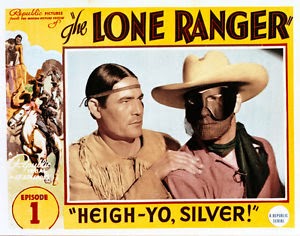
This Memorial Day edition of the Round-up is dedicated to all of our fighting men and women who made the ultimate sacrifice for our freedom.  And in particular to actor Lee Powell, who in 1938 became the screen’s very first Lone Ranger, starring in the Republic serial.  He appeared in several more films, including FLASH GORDON CONQUORS THE UNIVERSE, starring in six ‘Frontier Marshals’ films for PRC, before enlisting in the Marines in 1942.  Sgt. Powell saw action on Tarawa, Saipan, and Tinian, in the Marianas Islands, where he died on July 30, 1944, at the age of 36.  He was posthumously awarded the Purple Heart, the Asiatic-Pacific Area Campaign Medal with two stars, and the Victory Medal World War II. 


Chief Thundercloud, Lee Powell


‘TEXAS RISING’ A Miniseries Review


Henry, Deaf and Anderson


The same production team who brought you the five Emmy-winning HATFIELDS & MCCOYS miniseries is back with the story of Texas statehood, and the formation of the Texas Rangers, TEXAS RISING, beginning Memorial Day night on History.  It’s directed by Roland Joffe, twice Oscar-nominated for THE KILLING FIELD (1984) and THE MISSION (1986). It written by Darrell Fetty and Leslie Greif -- Greif created WALKER, TEXAS RANGER,  Bill Paxton is back, now as Sam Houston, and this time he just might win the Best Actor award he lost to HATFIELDS co-star Kevin Costner.  With so many characters stirring about, he is the heart of the story, just as Olivier Martinez, as General Santa Ana, is the anti-heart, a handsome, swaggering, arrogant swine. 


Sam Huston


I am not very knowledgeable when it comes to the history of Texas, and I must admit that a character that I thought was so ‘convenient’, post-DJANGO UNCHAINED, that I assumed she was a contrivance, turned out to be not only real, but the basis of the song, ‘The Yellow Rose of Texas’, and is played by Cynthia Addai-Robinson. 


Santa Ana and Emily


The story opens with the Alamo in ashes, the last few surviving defenders being butchered before the eyes of a handful of their women.  Travis, Crockett, Bowie and all the rest are gone, but Travis’ call for help is still travelling, and many, not knowing it is too late, are still hurrying to answer the call.  Texians, furious at the slaughter at the Alamo, are eager for Sam Houston to attack, but he issues orders to wait, retreating until they can draw Santa Ana into a position where the Texians will have the advantage.  There are accusations of cowardice, and whispers of mutiny.    


The focus moves frequently, from Houston and his men, to a young pair of would-be Texas Rangers trying to prove themselves worthy, to a friendly if mis-matched redneck and aristocrat, to a low-life extorting money to help people flee, to Santa Ana and his ‘take-no-prisoners’ advance.  There are military battles, Indian attacks, seduction, humor, the occasional throat-cutting and eye shooting.  The story doesn’t always move in a straight line, but it moves, with plenty of action. 


The cast is packed with talent, including Brendan Fraser as Billy Anderson, Jeffrey Dean Morgan as Deaf Smith, Thomas Jane as James Wykoff.  JUSTIFIED fans will be happy to see Jeff Fahey as Thomas Rusk and weasely Jeremy Davies and Knowles.  I got a kick out of seeing Darby Hinton, Dan’l’s son Israel from the DANIEL BOONE series, as Texas President Burnet.

Having seen only the first four of ten hours, I can’t review the show as a whole, but I found the first two nights of the show very entertaining, and I’m eager to see the rest.  Not that I am entirely without criticisms.  Occasionally the script strains to be vulgar – there is excessive talk about soiling or wetting ones clothes, things to be shoved up orifices, and Bill Paxton must have it in his contract that he gets to urinate on-camera at least once per episode.  Ray Liotta, an actor I very much admire, plays an ‘angel of death’ character who has escaped from the Alamo, and is on a private killing spree.  He looks great, but when he speaks, his voice is so contemporary that the ghostly characterization evaporates.  They had Kris Kristofferson there to play President Andrew Jackson – they should have had him dub Liotta. 


Finally, if you have seen the teaser spot where various men and woman are reading Lt. Col. Travis’ ‘Victory or Death’ letter, you know how beautiful Texas looks (even if it’s really Durango, Mexico).  It doesn’t look like that in TEXAS RISING at all!  Arthur Reinhart’s composition of shots is beautiful, but for some reason, in post-production, some genius decided the entire movie should be in sepia.  So all of the color has been drained from the image, and a yellowish overlay added.  This sort of ‘make it look like old news photos’ idea works fine in a title sequence, but at least on my screener, the entire movie is like this.  I love black and white films, but when you shoot black and white, you use contrast to make up for the lack of color.  There’s almost no contrast here – there are no solid blacks, just murky greys at the darkest, and there’s so much haze at times that it hurts the eyes to watch.  I’m enjoying TEXAS RISING, and I’ll definitely watch the rest; but I may wear shades.      


FT. TEJON CIVIL WAR REENACTMENT MAY 30-31


This Saturday and Sunday, travel to Ft. Tejon State Historic Park to enjoy battle reenactments, a replay of the Lincoln/Douglas debates, as well as vendors, food and cooking demonstrations.  To learn more, go HERE .


‘WORD ON WESTERNS’ RIDES AGAIN IN JOHN WAYNE TRIBUTE LAST WEDNESDAY!


Rob Word with Johnny Crawford


Rob Word’s ‘Word on Westerns’ luncheon and film discussion programs, such a hit last year at The Autry, are back, starting with this past Wednesday’s tribute to John Wayne, whose birthday is May 26th.  Among those attending and sharing anecdotes were Johnny Crawford of THE RIFLEMAN, who costarred with the Duke in EL DORADO, and Edward Faulkner, a member of the Wayne stock company, who appeared in MCCLINTOCK!, RIO LOBO, THE GREEN BERTS, CHISUM, THE UNDEFEATED and HELLFIGHTERS.  Also there to remember were actor Frank Pesce, and music was provided by The Suguaro Sisters, accompanied by Will Ryan.  The next event will be in July, and I’ll fill you in as soon as I have the details.


THAT’S A WRAP!


Have a great Memorial Day!  On Tuesday, you can buy your own Blu-Ray copy of MAN, PRIDE & VENGEANCE from the good folks at BLUE UNDERGROUND.  Next week I’ll have details about a new HBO miniseries about lawman Bass Reeves.  And soon I'll have my review of John Farkis' book about the making of THE ALAMO!

Happy Trails,

Henry

All Original Contents Copyright May 2015 by Henry C. Parke – All Rights Reserved


Sunday, May 17, 2015

CARRADINE’S ‘SHANE’ SERIES, PLUS INTERVIEW W/SHANE STORY ED. WM. BLINN!


SHANE TV REVIEW


Many of David Carradine’s fans might be surprised to learn that the tremendously popular KUNG-FU (1972-1975) was not his first Western series.  In 1966 he starred in the short-lived but entertaining and commendable SHANE. 

Based on the much-loved film SHANE (1953), which was itself based on the much-loved novel SHANE (1949) by Jack Schaeffer, it only lasted for seventeen episodes, but in today’s terms that would be nearly two full seasons.  TIMELESS MEDIA GROUP has released the series in a three DVD set, and it is well worth watching.   

The movie SHANE is a classic among American films of any genre.  The story of a mysterious drifter who allies himself with a family of sodbusters trying to stand up to a wealthy, violent and unscrupulous cattleman, it appeals to the very core of American belief, that one person with courage and skill can make a difference.  Director George Stevens, screenwriter A.B. Guthrie Jr., and actors Jack Palance and Brandon DeWilde were all nominated for Oscars, and cinematographer Loyal Griggs won for Best Color Cinematography.  SHANE was also nominated for Best Picture.  

So the folks who made SHANE into a TV series had some mighty big boots to fill.  The movie starred Alan Ladd as Shane, Jean Arthur and Van Heflin as the sodbusters, the Starretts, and Brandon DeWilde as their young son who idolizes the gunman Shane.  Wisely, the series cast newcomers David Carradine as Shane and Jill Ireland as Marion Starrett, who were much closer to the vision in Schaeffer’s book.  While there is no fault to be found in the film’s actors, Ladd was 43 and Jean Arthur was 53, noticeably older than their characters, while Carradine and Ireland were both 30.  The TV writers wisely killed off the Van Heflin character, making an honorable romance between Shane and Marion possible; in the feature, Shane and Marion were clearly thinking about it, but too decent to act on it.  Filling in for Van Heflin was Tom Tully, Oscar-nominated for THE CAINE MUTINY (1954) as Ireland’s father-in-law, with 8-year-old Christopher Shea in the Brandon DeWilde role of Joey Starrett.  As Ryker, the villainous cattleman, the movie featured one of the coarsest and most intimidating of screen bad-men, Emile Meyer.  The TV producers did surprisingly well with the menacing Bert Freed in the Ryker role.


Bert Freed (l) as Ryker


One of the strengths of the series, continued from the feature, is an ever-present sense of danger.  With most Western series, there’s a sense that once you get to the Ponderosa or the Barkley Ranch, you’re safe.  But the Starretts are no Cartwrights – they’re very small-time farmers trying to carve out an existence.  Ryker despises the Starretts and all of the other ‘nesters’, doesn’t recognize their rights to their land, and will stop at nothing to run them off.  Though it’s never addressed directly, we suspect he’s the reason Marion is a widow.   In the opening episode, a teacher played by Diane Ladd arrives to start a school for the local children.  When Ryker learns that classes will be taught in a barn, he has no qualms about burning them out.

Another unusual element is the growing, mature, largely unspoken romance.  Marion isn’t the sort of fantasy girl a Cartwright will date for one episode, until he learns she’s a con-woman.  She’s very real, with responsibilities, and baggage.  The acting ensemble, not just the family, but Shane and Ryker, and Sam Gilman as Sam Grafton, who runs the saloon and store, are a cut above many of the TV actors of their time.  While Ladd played Shane with a wistful toughness, Carradine has a burning rage just below the surface, and you sense the shame he feels for his life, and for loving a woman whom he feels he has nothing to offer.  As with the movie, you sense the his hope for salvation lives at least as much in the love of the boy as it does in the love for his mother.

The plotting and the guest casting is often very strong.  In one episode, Warren Oates and his brood come to town to kill Shane for killing a family member – it looks like they’ve got the wrong man, but no one wants to listen.  In another, a young Robert Duvall plays a family man and farmer whose failures are gradually driving him insane.  In one of my favorites, the marvelous character actor John Qualen plays nearly a ghost of a man seeking out Shane, who killed his son. 


After the series’ brief run, the stars went their separate ways, the leads to great success.  Carradine was a popular and respected actor until his death in 2009.  Jill Ireland went on to a long film career here and in Europe, frequently co-starring with husband Charles Bronson.  She joked that, “I’m in so many Charles Bronson films because no other actress will work with him.”  Sadly, she died at the age of 54 of breast cancer.  Tom Tully would continue to work in character roles, frequently for his friend Don Siegel, but had serious medical problems.  While traveling with Bob Hope, entertaining troops in Vietnam, he contracted a worm parasite, which would eventually lead to the loss of hearing, and the amputation of a leg.  He died in 1982, at the age of 73.   Christopher Shea’s face may not be that familiar, but his voice is, and no wonder: he provides the voice of Linus is all of the classic PEANUTS perennials.  He also died young, at 52, in 2010.

SHANE is available on DVD from TIMELESS MEDIA GROUP, and can be purchased from Amazon HERE.   

AN INTERVIEW WITH ‘SHANE’ STORY EDITOR WILLIAM BLINN


William Blinn at a book signing


William Blinn has had a career that any screenwriter would envy.  Among the series he created were THE INTERNS, THE ROOKIES, EIGHT IS ENOUGH, PENSACOLA: WINGS OF GOLD and STARSKY AND HUTCH.  He won EMMYS for writing BRIAN’S SONG and co-writing ROOTS.  Of late he’s been writing Western novels.  He wrote A COLD PLACE IN HELL, and when I tracked him down, he was working on the sequel.  When I asked him about an interview on SHANE, he said, “I’ll be happy to, but I can’t do it now.  I’m in the middle of a scene, and I can’t get my characters to do what I want them to.”  A couple of days later, he’d whipped those characters into shape, and had time to talk.  

HENRY: You’ve had, and continue to have, a very impressive career; you won Emmys, you created STARSKY AND HUTCH, you wrote the Prince movie PURPLE RAIN.  But you began your career in Westerns, and after writing a RAWHIDE, a LARAMIE, and four BONANZAS, it was still very early in your career – 1966 – when you did SHANE.  How did you get involved with SHANE?

BLINN:  I did two BONANZAS, and during the third one I said, “I’ll do the rewrite from New York,” and they said, “No, you’ll do the rewrite from out here.”  Which was there way of getting me out here, to see if I wanted to be on staff.  I came out; they offered me the staff job, which was just about the best thing that could ever happen to a young writer, in terms of education and experience.  The guy who was the story editor was Denne Bart Petitclerc.  Denne had been a reporter in San Francisco, on The Examiner, and we were about the same age.  I started out to be an actor, and had worked as a stage manager, and so I had more of an awareness of the nuts and bolts of how you put a show together.  He did not know actors; he did not know the nomenclature.  We were like a jigsaw puzzle:  we fit together very well.  I brought something to the table that he didn’t, he brought something to the table that I didn’t.  He was a wonderful writer, wrote a terrific Western novel called RAGE OF HONOUR, and did the screenplay for ISLANDS IN THE STREAM.  Terrific guy.  He and I hit it off wonderfully because we didn’t know what we didn’t know.  We were trying stuff that BONANZA hadn’t done before.  It was the first season without Pernell Roberts.  The other three actors didn’t like Pernell; they didn’t know how (his leaving) would affect the show.  They tended probably to trust us more than they should have.  And Denne and I were complimentary parts of a jigsaw puzzle.  Got along very well, with our wives we saw each other socially.  And he was just a more experienced writer in terms of knowing the literature of the craft.  He was a good friend, a little bit of a protĆ©gĆ© of Ernest Hemingway.

HENRY:  No wonder he wrote ISLANDS IN THE STREAM.


BLINN:  And he’s got a picture – well he’s gone, we lost him about a year and a half ago.  But there’s a picture coming out in about a year called PAPA that Denne wrote.  I read the screenplay and I think it was brilliant.  And it dealt with Hemingway’s days in Cuba after Castro came to power.  Denne and I were young rebels, but we probably didn’t deserve the term.  After that season was over, Denne was offered the job of producing SHANE.  He offered me the job of story editor.  As I said, BONANZA was a lot of inexperience in the office.  The same was true of SHANE.  Denne had never produced a show; I had never been a story editor.  The executive producer, a dear and talented man named David Shaw, had been the head writer on THE DEFENDERS.  And Ernie Kinoy, who I would go on to share an Emmy with on ROOTS, Ernie and David were probably the writing mavens on that show.  But David had never written a Western in his life.  And there are things you do in a Western that you don’t do in other shows.  Maybe that’s a kind of limited focus, but stuff that works in a contemporary, kind of casual cop show becomes more tightly focused in a Western.  There’s a reason why Westerns were called horse operas; because the passions were larger, the motivations were larger.  The feuds went back for decades and decades, which would seem silly for the twenties and thirties, forties and fifties.  But back in the 1860s and 50s, no, not at all; that’s how we rolled.  So there were times when David would write a good script, and it just wasn’t a Western.  Ernie had the most offbeat and wonderful ideas in the world, and I just used to almost sit at his feet when he came in the office.  Because hearing him talk about dramaturgy, and the nature of conflict, and what a character could or could not do or should or should not do – not that he lived by rules, but he had wonderful, insightful instincts.  I was 26, 27, 28, and hearing him talk about what could and could not work, and the stories that he came up with – it was a great education, and I got it for free, and probably got to buy a lunch or two.  Denne and I, as we were on BONANZA, we wrote some really, really interesting scripts, and the actors were game.  We got along well with David and Jill, and Tom Tully and Bert Freed, who was the resident heavy, Ryker.  And they were all game – let’s try this, let’s try that.  And David was…David’s always been out there, on a limb of his own construction.  But he was always professional.  And there were just some times when you just had to say, I’m not quite sure what he just said, but I think we’re going to trust him and see how it works, and usually it worked.  He was just heading into some pretty heavy chemical abuse, and there are times when it did get in the way.  Good guy, I liked him.  I must say that the mode of his death did not totally surprise me.  It was a very pleasant experience in terms of SHANE. 

We got along well with the directors, Bob Butler and a bunch of really good people.  The only problem we had was being caught between the Production Company, TITUS, and (ABC).  Herb Brodkin was the owner and the executive producer (of TITUS).  One of his rules was that you made the show for exactly what the network would pay you, and not a penny more.  So when it came to going into deficit, the network would say we need some more action.  And the budget people would say, that will cost a little more money.  We’re going to be a little short this week because we’re going to have this big gunfight they want.  Brodkin wouldn’t pay for it.  Absolutely not; we’ll do it for the money ABC pays us.  (Note: In television, deficit spending has long been a given.  The idea is that the network would pay a licensing fee to show the program in first run.  That fee would often not cover the whole cost of making the show, but the producer would own the show, and make his profit in syndication.) He did have rules.  He didn’t like the title of the show.  That didn’t make any sense, since we were coming off of this big mega-movie hit.   His thing was, if you title the show the name of the lead character, you can’t fire him. (laughs)

HENRY:  Plot-wise, what would you have if you fired him?


Jill Ireland as Marion


BLINN:  He didn’t care.  He was a dollar and cents guy, very nice man, but that was his bottom line.   We think Paramount said, well, you’re going to call it SHANE because that’s all we’ve got to sell.  Nobody knows who David is, and Jill’s very pretty, but nobody knows who she is, either. 

HENRY: Looking back, do you have favorite, and least favorite episodes?

BLINN:  There was one show, it embarrasses me to think of it.  It was a script both Denne and I disliked intensely; we got kind of backed into it by budget problems.  We thought we’ll have this terrible script, but the director will come in and say, I can’t shoot this, and then we can make the director the heavy, and rewrite the script.  Well, the director was a very nice man named John Brahm, who was German, born in Hamburg.  A good director, directed a wonderful picture called THE LODGER (1944) and HANGOVER SQUARE (1945), both wonderful suspense pictures.  But again, not a bit of experience or insight into Westerns.  He directed the show, and after the first cut, the editor said, are you aware of the fact that we are five minutes short?  So we extended scenes endlessly.  And there’s one point where Shane, David Carradine, says, “I’m going to ride go into town and talk to Ryker.”  Well, I mean to tell you, it was the longest ride probably ever put on television.  We covered every mile of the route between the cabin and the town.  God, it was an awful show.  We did some very good shows.  There’s one I remember I liked a lot called THE HIGH ROAD TO VIATOR (SPOILER ALERT!) David and Jill end up in an abandoned saloon, making believe they are at a dance. 

Denne and I, it was a great school to go to.  The dollar and cents producer was a very gifted man named Buzz Burger.  And Buzz had to make some very difficult decisions.   I can recall watching him, at one point we had to fire a set designer, and somebody said you ought to pick up the phone and call him.  And I remember him saying no, that’s not how you a fire a person.  You go to him and look him in the eye, and tell him, this is why we’re letting you go.  I remember at the time thinking, so that’s what a producer does.  That’s the difference between a so-so guy, and someone who has all his ducks in a row and both oars in the water. 

HENRY: Did you consider the series an adaptation of the novel, the movie, or both?

BLINN: Almost totally the movie.  At one point they were in the process of hiring composers to do the pilot.  And for reasons that to this day I do not comprehend, I was the only person in the office who could remember the theme song.  So I’d be rewriting a scene, and I’d be called down to David Shaw’s office, and there would be Lalo Schifrin or Jerry Fielding, and Bill would say, tell him the theme.  And I would go, “Dad-da-DA!  Dad-da-DA-da….”  We didn’t have enough cassettes around.


Tom Tully, left


HENRY: When the movie SHANE was made, Alan Ladd was 43, Jean Arthur was 53; in the TV version, David Carradine and Jill Ireland were both 30.  How did having actors so much closer to the characters’ intended ages effect the show?

BLINN:  I think it helped the mother-son relationship.  Jill had a pretty nice acting relationship with Chris Shea, the boy.  And obviously it helped the romantic charisma between Jill and David.  And of course at that time she was Charlie Bronson’s girl.

HENRY:  I was wondering if she was still married to David McCallum.

BLINN:  No, she’d just come off of being David McCallum’s lady and was now Charlie Bronson’s.  And if you wanted to watch thirty guys just disappear, occasionally Bronson would stop down on the set to see her.  And people would just look at him and say, oh I see, that’s a man, and I’m just a little piece of fluff over here.  But he was very nice.

HENRY:  One of the big differences going from the feature to the series is that Tom Starrett, the Van Heflin character, was gone, replaced by her father-in-law, Tom Tully.  She’s a widow, but it’s never quite said.  Did Ryker kill her husband?


BLINN:  That was something that was never quite said.  We wanted to get into it, had we got more episodes.  We thought it would be interesting to open up half-way, for David to find out that Ryker possibly was the guy, but there was no absolute proof.  And as long as it was left open, he would still have to find ways to compromise with Ryker even though this dark shadow was hanging off in the wings.  We never got there.  We hinted at it a little bit, and Denne and I wanted to go there, but we wanted the network to sign off on it first, and the network was gone by the time the question was there to be asked.    

HENRY: When SHANE came on-air in 1966, it was in the midst of some long-running hits and hot newcomers – GUNSMOKE, BONANZA, THE BIG VALLEY, HIGH CHAPARREL – all of which you eventually wrote for.  How did SHANE distinguish itself from the pack?

BLINN:  Well, it didn’t.  Our ratings were always frail.  We had a very small cult following, people 
who said, well, that’s a pretty good show.  Largely based on David, who was developing a following.  He’d just come off a Broadway show that was highly thought of, ROYAL HUNT OF THE SUN.  He got great reviews, and he was a wonderful actor.  I think it was a shame that he opted to stick totally to film after that.  Because he could be a big actor; he had the intensity to go big.  He loved acting.  At one point we had written a thing that I thought his father would be very good for this.  I went to him and I said, how do you and your dad get along?  Would there be a problem if we wanted to hire him?  He said, I’d be the happiest guy in the world.  I love my old man – he’s a great guy.  And we tried to, and his father was not available.  But it was kind of nice to hear that there wasn’t some dark undercurrent we had to deal with, especially from David.  There were intimations of trouble in that guy’s soul. 

HENRY:  Unfortunately you didn’t get John Carradine, but you did get some very interesting people, old Hollywood people like John Qualen –

BLINN: Yes, in an Ernie Kinoy script that was one of the most imaginative and offbeat kind of things I ever read in my life.

HENRY: I loved that one, and I loved the Robert Duvall episode.  Who was your favorite guest star?

BLINN: Probably John Qualen.  He was sweet as he could be.  And the fact that I was sitting, talking 
with someone who was one of the minor leads of the John Ford stock company, I just couldn’t believe my good luck.  And Bert Freed; we’d have to talk him into things, but once you talked him into it, he gave you full measure. 

HENRY:  One of the things that I think is so unusual about SHANE as a series, and due to Bert Freed and the writing, is that there is a tangible sense of menace at all times.  There was never a sense that you were safe at any time with SHANE.

BLINN:  I would agree, and Denne and I worked hard to accomplish that, and to try and get the reality of the west, not the fictional legend, but the reality, that Bert could kill Shane and probably get away with it.  And the only thing that stopped him from killing him from time to time was the fact that he knew he wasn’t physically capable of it.  And they were both very good with that.  Bert and David certainly did not compete off-camera, but they enjoyed the competition on-camera.   

HENRY:  Tom Tully was Oscar-nominated for THE CAINE MUTINY.  What was he like to work with?

BLINN:  Very sweet; probably too sweet.  By that I mean, if you wanted him to say, “You sonovabitch, I’ll kill you!”  He’d say it, but coming out of him, the words just didn’t click.  A very dear man, very pleasant to work with.  When Herb Brodkin saw the first day’s dailies, and he saw Tom wearing a pair of half-glasses, he immediately sent a telegram saying, take off those half-glasses – he’ll be looking over those glasses, being cute, for the next forty years.  And he was right. 

HENRY:  Joey Starrett, the Brandon DeWilde character, was played by Chris Shea, and I believe that was the start of that kid’s career.  What was he like?

BLINN:  He was brand new, out of the box; it’s hard to know what to think of him other than he did what we wanted him to do.  He was a happy kid.  When I saw that he was signed on to do the voice in the Charlie Brown films, I said that was probably a real good thing for a child actor.  Because you’re not on camera, but you’re never-the-less the center of attention, and you have a chance to learn without exploding in front of everyone in the world.  When I was doing FAME, we had a chubby girl in the running cast, very sweet, and she went on to be Bart Simpson, and she can now buy and sell half of Calabasas and all of the San Fernando Valley, Nancy Cartwright.  A very nice young woman.

HENRY:  The town, which is really little more than Grafton’s store and saloon, is a close match for the movie.  Was it shot in the same place?

BLINN:  No, didn’t get to Jackson Hole, which is where the Grafton’s and the town were shot.  So we never got the majesty of the Grand Tetons.  But the saloon exterior and interior were damn near to what they were in the feature.  

HENRY:  Where were they shot?

BLINN: Exteriors were in the San Fernando Valley; we had a road out in front of Grafton’s that was on a soundstage, very well done and, I think, hard to tell. 

HENRY:  It was a much more convincing green set than most of the ones you see.

BLINN:  Well, that and GUNSMOKE I think were the best ones of the era.  It saves you a fortune to be able to stay in the soundstage, but it does something to the morale of the crew, I think.  But that’s the best we could do with Brodkin saying no, ‘too expensive, too expensive, too expensive.’

HENRY:  When you say it does something to the morale of the crew, do you mean in a positive or a negative way?

BLINN:  Well, they like to get out.  At that time there were no women on the crew; it was a rough and tumble teamster attitude group of guys.  You’d say, we’re going out to Lake Sherwood, and they’d say, great!  I’ll bring my fishing rod!  But that wasn’t available on SHANE. 

HENRY:  How did your experience on SHANE compare with other later Western shows, such as HERE COME THE BRIDES?  And Robert Brown, who played Jason Bolt on BRIDES, was a romantic lead in an episode SHANE.

BLINN:  Yes, absolutely.  Robert’s a good guy – I saw him four or five years ago at a reunion dinner for HERE COME THE BRIDES.  It was very interesting, because the guys who were doing HERE COME THE BRIDES, the producers and executive producer, had been sitcom guys.  Very Pleasant, very intelligent, very funny – all good things.  But because I did some westerns, there were times when the executive producer would say, ‘And then Jason will say I’m going to do so and so, and we cut to the saloon.’  And I would say no, Jason says I’m going to do so-and-so, and he slams out of the office, and he stomps down the stairs, and he stomps across the street.  You do it just like a John Wayne picture, like ‘here comes trouble!’  And they’d be oh, yeah, we can do it that way.  Because on a sitcom it was like I DREAM OF JEANNIE – dissolve to kitchen.  But they were fine with it. 

HENRY: In the last episode, Shane and Marion finally kiss.  Where was the relationship going if you got to a second season?

BLINN:  I don’t think we knew.  It was just, we can’t just keep teasing, teasing, teasing – at some point this has to pay off.  Now, the accepted wisdom for that kind of thing was, the two sweethearts should not kiss, could certainly never sleep together.  Because if you did that, all of the tension of the relationship would go away.  And I think that’s accurate.  So I don’t think we took it that far.  We just said we’ve gone this far, we’ve got to have them kiss.  I know Jill was very pleased about it, not because she liked David – she liked David, but not because of some romantic interest, but because this is what the very sexy womanly woman I am playing needs.

HENRY:   It’s interesting comparing David Carradine’s and Alan Ladd’s performances.  Alan Ladd’s character was wistful.  Carradine’s Shane seemed much more bitter.

BLINN:  He absolutely had an edge.

HENRY: Was a lot of that the fact that Ladd had the advantage in a way that his love would have to be unrequited because Jean Arthur was married to Van Heflin?

BLINN:  I think that’s true.  I also think – I’m mindreading now, because I wasn’t on the set of the motion picture.  But when George Stevens did the picture, his first choice for Shane was Montgomery Clift.  Now wouldn’t that have been interesting? 

HENRY: Oh yeah; a lot more like David Carradine.

BLINN:  Absolutely.  And Clift in RED RIVER was wonderful; just brilliant.  And also in THE MISFITS, which I think is a horribly underrated picture.  But they didn’t have Montgomery Clift.  Alan Ladd had a presence and a sound and a look.  He was not the most facile actor to ever come down the pike.  He had a safe place he could go to, and it was very effective.  But David was looking to stretch, always.

HENRY:  In the novel and the film, Shane’s background was mysterious.  Did you invent a whole backstory for Shane?


"I love you, Shane!"


BLINN: The only time we went there, there was an episode where one of the bad guys, in the first act, said, you and I met before.  And Shane says no, I never saw you before.  And in the second act the guy says, no we did.  Was it in Houston?  No, I’ve never been to Houston.  And finally, at the very end of the show, when there’s been a gunfight, and people dying left and right, Shane walks by him and says, Galveston.  And that’s all there is to it.  And the Ernie Kinoy script with John Qualen where Shane had killed someone, and forgot it.

HENRY:  I found that one of the truly remarkable stories, because it made so much sense, and yet I’d never seen it done.

BLINN:  Nor have I, up till then, and not since then.  And he was so spiritually appalled by the fact, not that he killed someone – he knew who he was and what he had done.  But that apparently he had killed with such regularity that he had actually forgotten one death.  And the horror that that brought to him was really wonderfully done.

HENRY:  You wrote many Western episodes for different shows, and when we first met five you were writing western novels.  What keeps you coming back to the genre?  And are you still writing Western novels?

BLINN:  I’m waiting to hear about an extension of the first Western novel I did, which is called A COLD PLACE IN HELL.  No one is committed to it, but I hope to hear from people in the next three months.   I write Westerns just because I like to write Westerns.  Again, the story-telling is bigger than life.  It’s realistic in a way, and in a way not realistic.  It’s large and more muscular emotionally, and it makes sense because my favorite fiction author is John O’Hara, who writes so close to the vest.  Almost nothing but dialogue and no description.  I don’t think he ever wrote a Western.  It just talks to me, and I can’t tell you why.

HENRY: Who are your favorite Western authors?

BLINN:  E. L. Doctorow wrote one called WELCOME TO HARD TIMES, which was an interesting, offbeat, dark picture.  My friend Denne Petitclerc wrote RANGE OF HONOUR, which is to this day one of my favorite novels.  Then I go back to the Zane Grey people.

HENRY:  Any last thoughts on the series?

BLINN:  SHANE was a very pleasant experience with some very good people. 


‘MAN, PRIDE, & VENGEANCE’ REVIEWED IN DVD-TALK – I’M THRILLED!


On May 26, Blue Underground releases their beautiful Blu-Ray version of MAN, PRIDE & VENGEANCE.  I’m frankly overwhelmed by Adam Tyner’s review of Courtney Joyner’s and my commentary.  “Audio Commentary: The commentary track for Man, Pride, and Vengeance is easily overlooked as it's not listed alongside the rest of the extras, but it's worth the additional couple of button presses over to the 'Setup' menu. Spaghetti western scholars C. Courtney Joyner and Henry C. Parke -- who'd previously provided commentary for CompaƱeros, The Grand Duel, and The Big Gundown -- contribute a tremendous discussion here. Joyner and Parke have forgotten more about Eurowesterns than I'll ever know, and although their familiarity with the genre and this film in particular is beyond encyclopedic, their commentary never once comes across as dry or dull. Their expertise is matched only by their enthusiasm, and Joyner and Parke excitedly tackle most everything you'd hope to hear: the film's clean and almost episodic structure, its editing, the Bazzoni brothers' direction and cinematography, the uncredited score, the course the lead actors' careers took both before and after this film, and what sets Man, Pride, and Vengeance so far apart from the traditional Spaghetti western. A staggering amount of insight and analysis are offered here, and from Django Zhivago to tales of opium being smuggled into Italy inside little Buddha figurines, it's a hell of a lot of fun too.”

Here’s the link to the whole review: http://www.dvdtalk.com/reviews/67619/man-pride-and-vengeance/

If you'd like to buy MAN, PRIDE AND VENGEANCE from Blue Underground , go HERE.


‘WORD ON WESTERNS’ RETURNS TO THE AUTRY WEDNESDAY, MAY 20TH!

As noted here a couple of weeks ago, Rob Word’s fun and fact-filled A WORD ON WESTERNS luncheon programs will be returning to the Autry starting on Wednesday, May 20th, with  A Salute to Duke.  They’re going to be every other month, so the next one will be in July.  No word from Word on guests yet, but I’m posting the clip below as a teaser, with Rob interviewing Mariette Hartley about RIDE THE HIGH COUNTRY.


‘TEXAS RISING’ PREMIERES MEMORIAL DAY ON HISTORY

A tremendous cast is featured in this ten hour telling of the Texas Revolution and the creation of the Texas Rangers.  From the folks who brought you the HATFIELDS & MCCOYS mini-series, it’s directed by Roland Joffe, director of THE MISSION and THE KILLING FIELDS, here is a glimpse of what’s coming.  Hold onto your hats!


THAT’S A WRAP!

I’ve just finished my first movie column for True West, which will be in the July issue, and am deep into August.  Have a great week!

Happy Trails,

Henry

All Original Contents Copyright May 2015 by Henry C. Parke – All Rights Reserved