Showing posts with label Mabel Normand. Show all posts

Wednesday, December 4, 2013

BEST OF THE WEST 1898-1938 FROM NAT. FILM PRES. FOUNDATION!


TREASURES 5 – THE WEST, 1898-1938 – Video Review
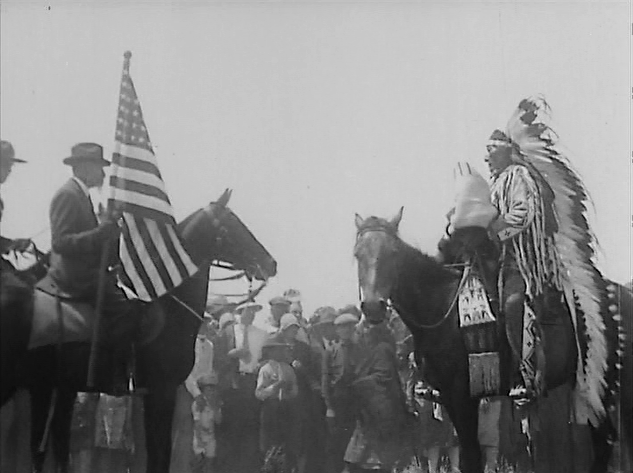

Cavalry & Indians at Little Big Horn


The wonderful, dedicated folks at the National Film Preservation Foundation, who brought you LOST & FOUND – AMERICAN TREASURES FROM THE NEW ZEALAND FILM ARCHIVES (if you missed my review, HERE is the link . ) have outdone themselves for Western fans, and just in time for Christmas. 

TREASURES 5 – THE WEST, a three disk set, plus a 110 page book, runs for more than ten hours, and contains forty films, from one-minute newsreel clips to several full-length features.  From slapstick to melodrama, from documentary to real drama, they offer a kaleidoscopic view of the American West from a vast range of perspectives.  Additionally, each film has an optional audio commentary, from experts in Western history, filmmaking, and film preservation.  It’s wonderfully entertaining, highly informative, and I cannot recommend it highly enough. 

Nearly every important film company of the era is represented – Biograph, Selig, Nestor, Kalem, Essanay, Vitagraph, Thomas Ince, Famous Players – Lasky (later Paramount).  The stars featured include Tom Mix, Clara Bow, Richard Dix, Bronco Billy Anderson and Mabel Normand.  The directors include D.W. Griffith, Victor Fleming, Gregory La Cava, Mack Sennett and W. S. Van Dyke.  The story sources include authors Bret Harte and Sinclair Lewis. 

Among the unexpected delights are every-day events filmmakers recorded nearly a century ago. HOW THE COWBOY MAKES HIS LARIAT (1917), though only three minutes, shows the entire process, starting with culling the hair from his horse’s tail; it’s probably the only in-depth recording of the all-but-lost process ever made.  LIFE ON THE CIRCLE RANCH (1912), presents typical daily ranch work convincingly.  But wait until you watch it again with the commentary, and realize how much of it was staged for the camera, and all of the rules of ranching that were broken in the process!

from OVER SILENT PATHS


On D. W. Griffith’s very first trip to make films out west, in 1910, he filmed OVER SILENT PATHS: A STORY OF THE AMERICAN DESERT.  Starring Marion Leonard and Dell Henderson, the barren desert also stars; it was an unusual film locale at such a time, when most Westerns were shot in and around lush East-coast forests.  Marion and her prospector father W. Chrystie Miller are a set to pack it in and go to civilization, when her father gets robbed and killed by unsuccessful prospector Henderson.  When she, desperate, meets up with Henderson, she has no idea he killed her father.  Can you see the romance coming?  Shot by the great Billy Bitzer, using the then-ruined and abandoned San Fernando Mission as a location, it’s as emotionally affecting as you expect with Griffith.  And fast?  It was shot in two days the first week in April, and released in May.  And the previous week he’d shot RAMONA, with Mary Pickford, at the ranch where Helen Hunt Jackson had set her story.

from THE TOURISTS


TOURISTS (1912) was also shot by the Biograph Company, by a small ‘B’ unit following the bigger Griffith unit.  Slight but fast and amusing, this one’s directed by Mack Sennett shortly before he left Biograph to start his Keystone company.  Shot entirely in the Santa Fe Train Station in Albuquerque, using the exteriors of Fred Harvey’s (as in THE HARVEY GIRL) Indian Building, and clearly improvised, it stars Mabel Normand as a tourist who gets in trouble with local Indians when she and her friends miss their train, and the chief takes a liking to Mabel.  And going against the not-yet-established Hollywood tradition, many Indians are played by Indians.  Speaking of Fred Harvey, also included is the 1926 film THE INDIAN DETOUR, a how-to film as well as a travelogue, featuring the wonders of ancient New Mexico as seen from modern Harvey trains and buses.  This film helped Harvey introduce and popularize the concept of cultural tourism.
Some sponsored films are more subtle than others.  SUNSHINE GATHERERS (1921), in often stunning color, shows and tells the story of Father Serra bringing Christianity to the beautiful new world of California.  Only gradually do we realize that the ultimate master plan is to make the riches of California available to the world through Del Monte canned fruit.  I felt positively noble eating my canned peaches while watching this with breakfast! 

Many of the fictional films make great use of their exotic locations.  A prime example is THE SERGEANT: TOLD IN THE YOSEMITE VALLEY (1910).  Part of the great treasure-trove of American films discovered in the New Zealand Film Archive, SERGEANT is a Selig-Polyscope film, starring one of the screen’s first great leading men Hobart Bosworth as the title character, trying to rescue his kidnapped  beloved.  Taking full advantage of Yosemite’s remarkable features, the film’s inter-titles both advance the story, and identify where each sequence is shot.  Similarly, SALOMY JANE, A STORY OF THE DAYS OF ’49, PRODUCED IN THE CALIFORNIA REDWOODS (1914), opens with the title gal emerging from a cut in a redwood.  Made by the once-thriving California Motion Picture Corporation of Northern California, it’s the only one of their films known to survive. 


Clara Bow


Among the more unexpected pleasures of this set are a pair of sophisticated comedy features with western settings, MANTRAP (1926), starring Clara Bow, directed by Victor Fleming and lensed by James Wong Howe; and WOMANHANDLED (1925), starring Richard Dix and Esther Ralston, and directed by Gregory La Cava.   When New Yorkers Dix and Ralston meet, she tells him she’s tired of prissy city-men – metrosexuals before the term was coined – and Dix sets out to become the westerner she wants.  Not only does he remodel himself to please her, finding the West she longs for to be gone, his does his best to recreate it.  In MANTRAP, big-city manicurist Clara Bow marries backwoodsman Ernest Torrence, but devoted as they are she soon becomes bored with his life, and falls for his unlikely friend, big-city divorce lawyer Percy Marmont.  It’s set in Canada, but shot around Lake Arrowhead.  And Clara Bow is an absolute delight, playing a woman so independent and naughty and lacking in guilt that she could only exist in Hollywood in the pre-Code days.

BRONCO BILLY AND THE SCHOOLMISTRESS


In fact, one notable feature of many of these westerns is that the women are so plucky and strong.  In BRONCO BILLY AND THE SCHOOLMISTRESS (1912), Billy’s romantic pursuit of the new teacher puts him at odds with every other man in town.  His judgment is so clouded that he nearly gets himself killed – and guess rescues the cowboy hero?  In the similar LEGAL ADVICE (1916), Tom Mix, who wrote, directed and starred in the film, tries to get himself into legal trouble in order to make time with the new lady lawyer!

THE BETTER MAN


Of course, it’s not all hijinks and hilarity.   In THE BETTER MAN (1912), a Vitagraph film shot in Santa Monica, the heroine and her sick child are alone as the worthless husband goes off to drink and gamble.  An Mexican outlaw with a price on his head comes to the house to get food, and is about to make his escape when the plight of the mother and child touches his heart, and he goes out seeking the doctor, not guessing that the erring husband is looking for the outlaw, and a quick reward.

LADY OF THE DUGOUT - Al & Frank Jennings 
question a lawman


Made six years later, the feature THE LADY OF THE DUGOUT (1918) has a similar plot to THE BETTER MAN, but with a remarkable twist: some of the actors are playing themselves!  Ten years earlier, former U.S. Marshal Bill Tilghman, whom, with fellow Marshals Chris Madsen and Heck Thomas rode for Judge Parker, and were known as The Three Guardsmen, decided to make a western movie.  Called THE BANK ROBBERY (not a part of this set), it starred himself, Heck Thomas, Quanah Parker, and bank and train robber Al Jennings.  Jennings found he loved the movie business, at least in part because he could rewrite his own history.  His film BEATING BACK (1904), which is considered lost, set the pattern for films about outlaw do-gooders. 

Al robs the bank


Produced and co-written by Jennings, and starring himself and his brother Frank, and Corinne Grant, LADY OF THE DUGOUT is directed by the great W.S. ‘One-take-Woody’ Van Dyke, and is one of the greatest treasures of this collection.  The plot is much like that of BETTER MAN; a pair of outlaws robs a bank, and when they run short of food, they come upon a woman living in a dugout house on the prairie, she and her child starving as they wait for worthless dad to come home with some food.  The outlaws are so moved that they get provisions and bring them back, endangering themselves.  Director Van Dyke, who would go on to direct TARZAN OF THE APES, the THIN MAN MOVIES, and so many more, is a wonderful visual storyteller, and his use of reflections and night-for-night photography is memorable.  But it’s his collaboration with Jennings that shows off the startling authenticity of the criminal behavior.  There’s a chilling naturalness to a gunman’s stance while shooting away; removing a bullet from a shoulder room is shown unflinchingly by the camera, born indifferently by the wounded man.  Incidentally, the little starving boy grew up to be Ben Alexander, Jack Webb’s first DRAGNET partner.

Lawman in the dust, Al & Frank
make their getaway


Of course, Jennings spins the story his own way.  The criminals are so noble, and the law so venal that when a train is reported robbed, it’s assumed that the sheriff is behind the crime.  Poor real lawman Bill Tilghman must have concluded that he’d created a monster, and he produced and starred in PASSING OF THE OKLAHOMA OUTLAW (1915) as a response to the glorification of the bad guy.  Though not complete, it’s a satisfying chunk of film detailing the apprehension of many of the Oklahoma Territory’s most infamous bandits, and the lawmen are in many cases played by the very men who did the deed: again Bill Tilghman and Heck Thomas, as well as Arkansas Tom Jones.

The travelogues are stunning, some going as far back as 1898, and featuring railroads, Yosemite, Yellowstone, and Hot Springs, Arizona.  Among the remarkable finds is an 8 minutes segment from the feature-length FROM THE GOLDEN WEST, an amateur film made by an unknown Easterner for club screenings.  It’s ‘L.A. as seen from a blimp’ footage is delightful.

Soundstages seen from a blimp in
THE GOLDEN WEST


Newsreel clips are included, some celebrating the American Indian, others patronizing him, and one sequence features 7th Cavalrymen and Lakota and Cheyenne warriors ‘burying the hatchet’ at The Little Big Horn fifty years to the day after the event. 

In DESCHUTES DRIFTWOOD (1918) we get a travelogue of Oregon trains and waterways from the point-of-view of a hobo who’s been sprung from jail to do the honors.  Eighteen years later, in a Hearst newsreel, we see THE PROMISED LAND BARRED TO HOBOES (1936), showing roadblocks set up in California to keep the unemployed out.   

Made during the Mexican Revolution, MEXICAN FILIBUSTERS (1911) is a romantic tale about gun-smuggling.  AMMUNITION SMUGGLING ON THE MEXICAN BORDER (1914), is also about gun-smuggling, but stars a sheriff re-enacting his own kidnapping and his deputy’s murder, just weeks after it had actually happened. 

The Los Angeles Department of Water and Power produced ROMANCE OF WATER (1931), about getting water from the Owens Valley.  It’s followed by a Hearst newsreel clip, A NEW MIRACLE IN THE DESERT (1935), and no matter how loudly you turn up the sound on these two, you can still hear John Huston and Jack Nicholson talking in the back of your head.

I know that I’ve just brushed the surface of this terrific collection – I haven’t even mentioned a great Thomas H. Ince feature, THE LAST OF THE LINE, but hopefully I’ve given you a sense of the wonders to be found in this set.  And I should mention that each of the forty films has an original music score.  I heartily recommend it as a gift for anyone on your list with a love of Western movies or Western history, or American history in general.  At more than ten hours – twice that with the commentary – this is not a set to be consumed at a sitting, but to be savored over days or weeks or months.  Then again, if you’re a binge watcher, have at it!

Although it lists for $59, you can buy it from Amazon for $32 HERE

THAT’S A WRAP! 

I apologize again, for the Round-up being several days late again.  I’m still getting over this bug I’ve had for nearly two weeks.  I’m very touched by all the get-well wishes I’ve received.  I don’t want to give the impression that something serious is wrong – it’s just an upper respiratory infection; not even the real flu!
Anyway, I’d better get well soon, as I’ve got a bunch of book and movie reviews coming up, and some very cool giveaways just in time for Christmas! 

Happy Trails,

Henry

All Original Contents Copyright December 2013 by Henry C. Parke – All Rights Reserved


Wednesday, March 30, 2011

ROUND-UP TO BE FEATURED ON TURNER CLASSIC MOVIES!


(Updated April 1st -- see SILENT SOCIETY)

I spent Monday afternoon on top of a mountain in Griffith Park, one of three Western fanatics being interviewed for a TCM featurette. It was great fun to discuss which films I consider to be the great Westerns, and the significance of the genre. The crew had spent the earlier part of the day filming at the Autry Museum. At around 2:30 p.m. a Park Ranger unlocked the gates so we could drive up the mountain, steering around a large rattlesnake. On the way down around 5:30 p.m. I spotted a large deer grazing, and throughout the afternoon hawks circled overhead. Also interviewed that day were make-up artist and Western film historian Michael F. Blake (whose father, Larry Blake, has a memorable role as the bartender in HIGH NOON), and DAEIDA MAGAZINE publisher David Ybarra. The film is scheduled to air in June to coincide with a singing cowboy festival.

EDDIE BRANDT DIES AT 90

Eddie Brandt, the man whose North Hollywood store, Eddie Brandt’s Saturday Matinee, has been a unique film resource and unofficial studio archive since the 1960s, died at the age of 90 on February 20th. In a town that routinely bulk-erases its own history, the Saturday Matinee is the last bastion of film information, posters, stills, and especially videotapes and DVDs.

But Eddie was much more than a man with an encyclopedic knowledge of American film, particularly the Western. He was also a successful musician, songwriter and composer. He wrote Rock & Roll Wedding for Nat King Cole, and had a major success with There’s No Place Like Hawaii. He also wrote Let’s Have A Heart To Heart Talk, to be sung by Huntz Hall in the Bowery Boys film BLUES BUSTERS.

Eddie’s son Donovan Brandt recalls, “He started with Spike Jones in ’47. My dad and Spike (co-wrote) CARMEN MURDERED, (the famous parody of Bizet’s Carmen), and a bunch of other songs that are more popular than that. Later on, my dad wrote Spike’s television show, and still wrote songs.” A self-taught pianist, Eddie occasionally played with Spike Jones and His City Slickers on stage and TV. “Then Spike got emphysema real bad, (retired), and after that my dad moved over to the Spade Cooley Show. He wrote Spade’s show, and I only have two episodes of it on tape, but I happen to have one which has my dad’s first wife, (singer Ruthie James). Then Spade went to jail for manslaughter. My dad worked with Stan Freeberg and Paul Frees, and he was in Stan’s garage when they made the first Beany and Cecil hand-puppet shows. He helped write those.”

Later Brandt wrote some of the POPEYE cartoons of the 1960s, then moved to Hanna-Barbera, where he wrote cartoon shows like THE IMPOSSIBLES, and created FRANKENSTEIN JUNIOR. It was there that he met and married his second wife, Claire, who was an animator and in-betweener. They started their North Hollywood thrift shop, which evolved into the Saturday Matinee. There are dozens of ‘The Films of…’ books, and in the acknowledgments, Eddie Brandt’s is always thanked for providing rare stills. As Eddie explained it to me some years ago, his store was a place for guys to hang out and talk about the kind of movies guys like – westerns and serials and horror films and comedies. Everyone is welcome in the store, and they carry an astonishingly wide range of movies, but it’s still very much a ‘guy’ store in terms of atmosphere. Every important studio and production company has an account there. You can frequently see well-known actors, directors and writers doing research, and often renting their own films, when they don’t have their own copies.
Eddie’s particular favorites were Westerns, and Donovan explained how his father got to know many of his screen idols in the 1970s. “Well, we sold memorabilia, and a lot of these guys had nothing on themselves. I mean, Gene Autry bought posters from my dad. He owned real estate, radio stations, television stations, major league baseball teams – but not his own posters. And if Gene with all his money didn’t have that stuff, you can bet Eddie Dean didn’t, Johnny Mack Brown didn’t, Bob Steele and Tim McCoy didn’t.” Eddie converted his back-yard to a screening-room, and the stars came. Donovan recalls, “I got to meet Bob Steele, Gene Autry, Pat Buttram, Iron Eyes Cody.” Col. Tim McCoy wouldn’t let him handle his single-action Colt, “…but I got to touch it. Got to meet Lash LaRue, seen many whip-tricks when I was just a wee kid. He was a skilled technician, let me tell you.”

Donovan and his mother Claire have run the store for a number of years now. Brandt is also survived by four daughters – Kelly, Tracy, Holiday and Heidi – another son, Eric, and four grandchildren.

(Photos, top to bottom -- HOLLYWOOD SIGN IN THE HILLS; TCM crew setting up; 1976 photo of musicians Johnny Bond, Ken Griffis, Bob Nolan and Eddie Brandt; crowd at the Paperback Show; Buck Jones Big Little Book; POKER ACCORDING TO MARVERICK; Rainbow Over Texas poster; Hills of Utah poster; Chief Lean Wolf of the Gros Ventres; Chief Mad Bear of the Lower Yanktonas Sioux)

HOLLYWOOD SHOW AT BURBANK MARRIOTT

Yes, their last show was just over a month ago, but on Saturday and Sunday, April 2nd and 3rd, the Burbank Airport Marriott at 2500 North Hollywood Way in Burbank will host The Hollywood Show, a great place to meet stars, get autographs and all manner of collectibles. This time around it’s kinda slim pickings for Western fans. But there’ll be one of the sagebrush screen’s finest villains, Morgan Woodward (to read our interview with Morgan CLICK HERE), and Academy Award winner Martin Landau, who was delightful as Chief Walks Stooped-Over,a.k.a. 'Sky Eyes', a.k.a. Symbol of Good Faith in John Sturges’ wonderful Western comedy THE HALLELUJAH TRAIL, and terrifying in NEVADA SMITH. This event is fun, but it’s not cheap – admission is twenty clams for one day, thirty-five for both, and having something signed will usually cost $20 and up.

PAPERBACK SHOW PACKS ‘EM IN

The 32nd Annual Paperback Collectors’ Show and Sale, held this past Sunday at the Valley Inn in Mission Hills, was a rousing success. Black Ace Books honcho and show host Tom Lesser confirms that admissions are up. “It’s very good, good attendance, and it seems like a lot of interest in the show.” As I’ve noted before, this is an event where authors sign their books for free. There were hundreds of Western books for sale, but unfortunately, no Western authors were signing. “We used to have some, but they’re deceased. Gordon Shirreffs (RIO BRAVO) was one.” In addition to filling in some gaps in my Luke Short collection, my best finds were a Big Little Book: BUCK JONES AND THE KILLERS OF CROOKED BUTTE, and POKER ACCORDING TO MAVERICK. Not bad at all for two bucks each (the Big Little Book was missing its spine).

ROY RIDES RANGE AT RFD-TV

Thursday afternoon, March 31st, at 2:30 p.m. Western time, you can catch RAINBOW OVER TEXAS (1946), featuring Roy, Dale, Gabby, the Sons of the Pioneers, and the great heavy Sheldon Leonard in a tale based on a Max Brand story. Incredibly, the lovely Dale tries to pass for a man! She’d never have fooled me! On Saturday, April 2nd, at 9:00 a.m. Western times, repeating Thursday at 2:30p.m., it’s BELLS OF CORONADO (1950), written by Sloan Nibley, directed by William Whitney, and starring Roy, Dale, Pat Brady, and the Riders of The Purple Sage. Keep your eyes peeled for Rex Lease, once a Western leading man who plays the shipping-company foreman.

FREE MATINEE DOUBLE-FEATURE AT THE AUTRY

On Saturday, April 2nd, from noon ‘til 2 p.m., catch the double-bill of Gene Autry in SPRINGTIME IN THE ROCKIES (Rep. 1937), with Smiley Burnette. It’s directed by the great Joe Kane, and features not only the title song but Vitamine D and Down In The Land of Zulu (!). Paired with it is HILLS OF UTAH (Col.1951), with Pat Buttram, directed by John English, and featuring, in time for Easter, Here Comes Peter Cottontail. I like that the Autry has been double-billing an early Republic with a later Columbia, to give the viewer an idea of how Gene’s pictures changed over the years. The movies are free with your museum admission. And don’t forget, next Saturday it’s THE MAGNIFICENT 7 on the big screen in the Wells Fargo Theatre at 1:30 p.m.!

THE AUTRY NATIONAL CENTER

Built by cowboy actor, singer, baseball and TV entrepeneur Gene Autry, and designed by the Disney Imagineering team, the Autry is a world-class museum housing a fascinating collection of items related to the fact, fiction, film, history and art of the American West. In addition to their permenant galleries (to which new items are frequently added), they have temporary shows. The Autry has many special programs every week -- sometimes several in a day. To check their daily calendar, CLICK HERE. And they always have gold panning for kids every weekend. For directions, hours, admission prices, and all other information, CLICK HERE.

SILENT SOCIETY CELEBRATES 25 YEARS SATURDAY APRIL 2ND!

To mark their 25th anniversary, the Silent Society will have an all-day celebration, featuring the most popular leading ladies of the silent screen. At 1:30 it's THE INNOCENCE OF RUTH with Viola Dana, at 2:30 THE VEILED ADVENTURE with Constance Talmadge, at 4:00 THE FORBIDDEN CITY with Norma Talmadge. After the dinner break, at 7:00 it's A DASH THROUGH THE CLOUDS with Mabel Normand, and at 7:45 it's Colleen Moore in ELLA CINDERS. All the prints are 16mm, and all movies will have a live musical accompaniment by Michael Mortilla. Okay, I know none of these are Westerns, but the Silent Society shows more silent Westerns than anyone else! Tickets for the public are $15 for all day, or $10 per movie. For members it's $10 all day or $5 per movie. It's at the Lasky-DeMille Barn -- read about it below. For more information, CLICK HERE.

HOLLYWOOD HERITAGE MUSEUM

Across the street from the Hollywood Bowl, this building, once the headquarters of Lasky-Famous Players (later Paramount Pictures) was the original DeMille Barn, where Cecil B. DeMille made the first Hollywood western, The Squaw Man. They have a permanent display of movie props, documents and other items related to early, especially silent, film production. They also have occasional special programs. 2100 Highland Ave., L.A. CA 323-874-2276. Thursday – Sunday 12 p.m. to 4 p.m. $5 for adults, $3 for senior, $1 for children.

WELLS FARGO HISTORY MUSEUM

This small but entertaining museum gives a detailed history of Wells Fargo when the name suggested stage-coaches rather than ATMS. There’s a historically accurate reproduction of an agent’s office, an original Concord Coach, and other historical displays. Open Monday through Friday, from 9:00 a.m. to 5:00 a.m. Admission is free. 213-253-7166. 333 S. Grand Street, L.A. CA.


FREE WESTERNS ON YOUR COMPUTER AT HULU


A staggering number of western TV episodes and movies are available, entirely free, for viewing on your computer at HULU. You do have to sit through the commercials, but that seems like a small price to pay. The series available -- often several entire seasons to choose from -- include THE RIFLEMAN, THE CISCO KID, THE LONE RANGER, BAT MASTERSON, THE BIG VALLEY, ALIAS SMITH AND JONES, and one I missed from 2003 called PEACEMAKERS starring Tom Berenger. Because they are linked up with the TV LAND website, you can also see BONANZA and GUNSMOKE episodes, but only the ones that are running on the network that week.

The features include a dozen Zane Grey adaptations, and many or most of the others are public domain features. To visit HULU on their western page, CLICK HERE.

TV LAND - BONANZA and GUNSMOKE

Every weekday, TV LAND airs a three-hour block of BONANZA episodes from 11:00 a.m. to 2:00 p.m. They run a GUNSMOKE Monday through Thursday at 10:00 a.m., and on Friday they show two, from 6:00 to 8:00 a.m.. They're not currently running either series on weekends, but that could change at any time.

NEED YOUR BLACK & WHITE TV FIX?

Check out your cable system for WHT, which stands for World Harvest Television. It's a religious network that runs a lot of good western programming. Your times may vary, depending on where you live, but weekdays in Los Angeles they run DANIEL BOONE at 1:00 p.m., and two episodes of THE RIFLEMAN from 2:00 to 3:00 p.m.. On Saturdays at 2:00 p.m. it's THE RIFLEMAN again, followed at 2:30 by BAT MASTERSON. And unlike many stations in the re-run business, they run the shows in the original airing order. There's an afternoon movie on weekdays at noon, often a western, and they show western films on the weekend, but the schedule is sporadic.

Well, pardners, that’s it for this week!

Happy Trails,

Henry (certified TCM Western authority!)

All contents copyright March 2011 by Henry C. Parke – All Rights Reserved