BOBBY CRAWFORD REMEMBERS ‘LARAMIE’
BY HENRY C. PARKE

LARAMIE's Bobby Crawford, Robert Fuller
and John Smith
When the Emmy nominations for
1959 were announced, the Crawford clan managed a trifecta that no other
show-business family has ever matched – not the Barrymores, not the Hustons,
not the Fondas -- even though none of the Crawfords won. Robert Crawford Sr. was
nominated for Best Editing of a Film for Television for THE BOB CUMMINGS SHOW,
and lost to Silvio D'Alisera on PROJECT 20. Son Johnny Crawford’s work on THE
RIFLEMAN saw him nominated for Best Supporting Actor, Continuing Character, in
a Drama Series, which he lost to Dennis Weaver, playing Chester in
GUNSMOKE.
But perhaps the most impressive
nomination was for Johnny’s older brother, 14-year-old Robert Crawford Jr., whose
appearance on PLAYHOUSE 90, in an episode called CHILD OF OUR TIME, would not
only earn him a nomination for Best Single Performance by an Actor, but pit him
against Fred Astaire, Paul Muni, Rod Steiger, Christopher Plummer, and Mickey
Rooney. “I got to sit right in front of Fred Astaire during the show,” Bobby
recalls, “And he tapped me on the shoulder and he says, ‘Oh, we're the same
category, and that's ridiculous.’ And he
won the award that night.” But remarkably, fourteen years later, Bobby would
re-team with his show’s soon-to-be-legendary director, George Roy Hill, not as
an actor, but as producer on a string of classic films including THE STING, THE
GREAT WALDO PEPPER, SLAPSHOT, A LITTLE ROMANCE, THE WORLD ACCORDING TO GARP,
and THE LITTLE DRUMMER GIRL.
In the heat of this past summer,
I had the opportunity to chat with Bobby about his wide-ranging career, and his
family, who already had a history in “the biz.” His mother, Betty Megerlin, was
a stage actress with parents who were both vaudeville violinists. “On the other
side of the family tree, my grandpa Bobby Crawford was a music publisher.” When
he met his soon-to-be-bride, Thelma Briney, Bobby relates, “She was a piano
player at a five and dime store. My grandpa later on was a music publisher with
DeSylva, Brown and Henderson. And they created the song, I Found a Million Dollar Baby in a Five and Ten Cent Store.” Grandpa
Bobby, who managed Al Jolson, built Crawford
Music,
“Sold it to Warner Brothers in 1928. And then lost his fortune in the
1929 [Stock Market Crash].”
Jump ahead a generation, and
it’s déjà vu: Robert Crawford (the
soon-to-be-editor), is working as an extra at Universal Pictures when a fellow extra wants to introduce him to
the girl he’s been courting.
“So, my
dad walked into the room and my mom was playing the piano and he was smitten
immediately by her.” It took some time, but he stole her away, and they were
married in New York City by Norman Vincent Peale, the Minister famous for his
bestseller, THE POWER OF POSITIVE THINKING. Robert was working as a film
librarian at Columbia Pictures when
he was drafted into World War II. He joined the Marines, wanting to be a
cameraman, but when they learned of his background, he was made a military film
librarian at Quantico. “He never talked a lot about it, but he felt guilty
about doing the librarian work because he would get all this footage in; the
cameraman's shooting everything, and then oftentimes you'd see the camera
images fall into the sand, as the man had been hit. He did that from ‘43 to ‘46
and I was born in Quantico.”
HENRY PARKE: When did you start
acting?
BOBBY CRAWFORD: [My parents] did
some shows at the Pasadena Playhouse. He had a scooter and they'd go out to
Pasadena from Hollywood, Mom riding on the back, and then have to change from
her scooter clothes into the costume. I remember being a child and watching
them in a small theater in Hollywood. My brother I think was four years old
when he did Little Boy Lost in a
stage show somewhere in Hollywood. And I did a few little things that I don't
recall except I recall being Tiny Tim in some Christmas show. I was about eight
years old. My folks never really belonged to a church, but Grandma sent us off
to Sunday school; we went to the Christian Science Church on Olympic Boulevard,
and our Sunday School teacher just happened to be one of the major agents for
children in Hollywood. She took an interest in both John and I, and she started
representing us and sending us out on commercials. John started getting MATINEE
THEATRE [an hour-long daily live TV drama anthology], and small parts, and I'd
get a commercial now and then. Johnny was the Anglo-looking blond kid and I was
the Hispanic-looking Latino, and I did Indians and French and Spanish-looking
roles as a child. I remember the Fritos
commercial, being at the factory and eating them hot off the assembly line; it
was really good.
HENRY PARKE: Did you take acting
classes, or did your parents teach you?
BOBBY CRAWFORD: My mom was our
coach. We’d go on interviews, and we'd sit out in the lobby and read through
the lines. And the instruction I got from mom, then reinforced when I got my
first big break, by the director George Roy Hill, is the most important thing
about acting? Don't. Don't act. Just be real. I think that was my cue. Therefore,
I figured I'd better not study acting, I'd better just do it. I remember years
later reading the James Cagney autobiography. They asked him, what's your
secret to acting? And he says, stand there and tell the truth. So, I think
those are my two bits of instruction. And I was afraid to get into school plays
or get into theater at UCLA, thinking whatever it was that I did -- and I
didn't know what it was I did -- it seemed to be working, and I was afraid I'd
get corrupted if I started to try to learn it.
HENRY PARKE: You appeared on a
number of TV shows – DONNA REED, WYATT EARP, ZORRO.
BOBBY CRAWFORD: I did a couple
of ZORROS. I remember, I loved being at the Disney
Studios and I also loved being with Zorro, Guy Williams, a wonderful man
and a beautiful man. And Mary Wickes played my aunt. And the sergeant on ZORRO,
Henry Calvin. I didn't realize he was a great opera singer. A roly-poly fellow,
and a wonderful man. Zorro saves me from the well, I guess, but I remember
hugging the big burly Spanish soldier.

Bobby in Playhouse 90's
A Child of Our Time
HENRY PARKE: Before LARAMIE, you
were nominated for an Emmy for A CHILD OF OUR TIME, where you play Tanguay, a
boy who winds up in a Nazi Concentration Camp. How big an effect was your Emmy
nomination on your career? Had you already been cast in LARAMIE?
BOBBY CRAWFORD: No, I got LARAMIE
immediately after doing A CHILD OF OUR TIME, right about the time we were
nominated. A Producer, Robert Pirosh, cast me, wanted me. He was the writer of
the pilot, [and] strongly committed to the series, involved and in charge. I
came out to do a reading with Bob Fuller, a screen test; we did the scene
together. Slim [Sherman, the role John Smith would ultimately play], was the
part that he had originally been cast for, and he went up to talk to a fellow I
later worked with, Pat Kelly, and said, ‘It's wonderful, but the part's wrong.
I should be Jess.’ And Pat Kelly said, ‘Oh yeah?’ He said, ‘Absolutely, I can't
do it otherwise.’ John Smith was a very nice man and he said, ‘It's fine with
me.’ Fuller said, ‘Let me test for it.’ And so we did the scene in which he was
going to convince the powers that be that he should play Jess. And he convinced
them that I should play Slim’s brother. Of course, me being the Latino, I’d had
my head shaved. It's just, John Smith was blond, and I'm supposed to be his brother, and I looked a lot more
like Bob Fuller. So they dyed my hair blond for the pilot. And it grew out in
like four months. I went from being a short haired blond to brunette with long
hair in the series. But anyway, it didn't really matter. They had their show
and it went on the air along with RIVERBOAT which featured some unknown guys, one
of them being Burt Reynolds. I just remember Eastwood starting RAWHIDE and Burt
Reynolds on RIVERBOAT our same season, and I was astonished that our show was a
hit. I just said, wow, I got a job, and I get to go to the studio every day.
And then I was worried. I still wanted
to get into UCLA at that time. I was just starting high school, and I’d just
run into the first defeat of my career in school, geometry. But I remember
getting a leg up because I had a private tutor on LARAMIE.
HENRY PARKE: What were Robert
Fuller and John Smith like?

John Smith and Bobby
BOBBY CRAWFORD: They were jolly.
They were in their prime. They were just thrilled to be starring in the series.
They were congenial and having fun on the set, which is the only time I got to
be with them for the most part. We had some publicity stunt things that we did,
I did a double- date with Bob Fuller once. At 14 or 15 years old I got myself a
moped, and I would tool around, in the Hollywood Hills, before I could have a
driver's license. And there is a shot of Bob Fuller on my moped. Other than
that we had very little social contact off the set. But it was like going to
Disneyland each a day of work when you walked into the set. The guys were all
about the business of shooting the scene and the story and getting onto the
next one. There isn't a whole lot of time between takes and so would have our
chairs. I remember that first Christmas in the show, Bob Fuller bought us all
nice leather director's chairs, with our names engraved on them.
John Smith was the most
beautiful man I had ever seen in my life. I don't know what kind of curse that
was on him, but he just wasn't real to see in life. He was decent, charming man,
but it was so hard to get over -- it was like he was back-lit all the time. He just
glowed in the dark, in the sunlight. You couldn't be help but be struck by it. He's not real, he's so good looking. And Fuller
was good-looking, but rugged; it wasn't quite the same impact.

Robert Fuller and Bobby
Bob Fuller had a forearm as big
as my thigh. And my ambition as a kid in that series was to get a forearm as
big as Bob Fuller's. So I would do my push-ups and pull-ups and my fencing. But
I never learned how to build my body so I'd get a forearm like Bob Fuller. Bob
was a great charismatic fellow. He was a quick draw. What I was learning on LARAMIE
was my lines, and how to be a quick draw. I got the steel holster that helped
make you a quick draw. But I could never quite out-draw Bob. I came close, but
I didn't get the cigar.
HENRY PARKE: How about Hoagy
Carmichael?

Smith, Fuller, Hoagy Carmichael and Bobby
BOBBY CRAWFORD: I adored Hoagy
Carmichael. I'm ashamed to say I didn't get to know Hoagy other than in
passing. We have a couple of episodes
where he's showing me the piano, and he's singing a cute song. Now in my later
years, I find myself driving down the road singing Stardust in the morning. And I'm thinking, if only I'd known about
that when he was playing at the piano.
HENRY PARKE: Did you have any favorite
guest stars?

Ernest Borgnine plays a former soldier accused
of cowardice in this episode
BOBBY CRAWFORD: It was just
terrific fun to work with Ernie Borgnine. I remember being under the table with
him. I knew he was an Academy Award winner, and doing TV was still a second gig
for a movie actor. He was always playing these mean tough guys, but in person,
he was just the most easygoing, charming guy who just loved being there on the
set, as I did. And on the first episode, Dan Duryea, playing the bad guy. He had
this wonderful demeanor about him. I just remember him being scary. A scary
man. He was good casting, a dangerous fellow. I loved all the actors that I got
to be around. Every one of them was a character, but it was true of all the
grips, electricians, the prop men; everybody who would be on a Hollywood set is
a pro, especially if you got lucky enough to get into the major leagues, and I
was in the majors then. Those guys are having fun. They're so confident about
what they do that they can just have fun doing it. There's the pressure of
getting it done, but they're very confident they're going to get it done well. You’re
imbued with confidence when you're on a set like that. Everything works, and nobody
gets hurt. You only appreciate as an adult, that movie-making is all about
moving. You are moving arcs and lights, and in those days the equipment was
big, heavy. And it's horses and wagons and, and I only appreciated later how
physical making a good movie can be, and making a Western in particular. And
also how absolutely prone to accidents things can be, and that's why you want
guys who don't have accidents.

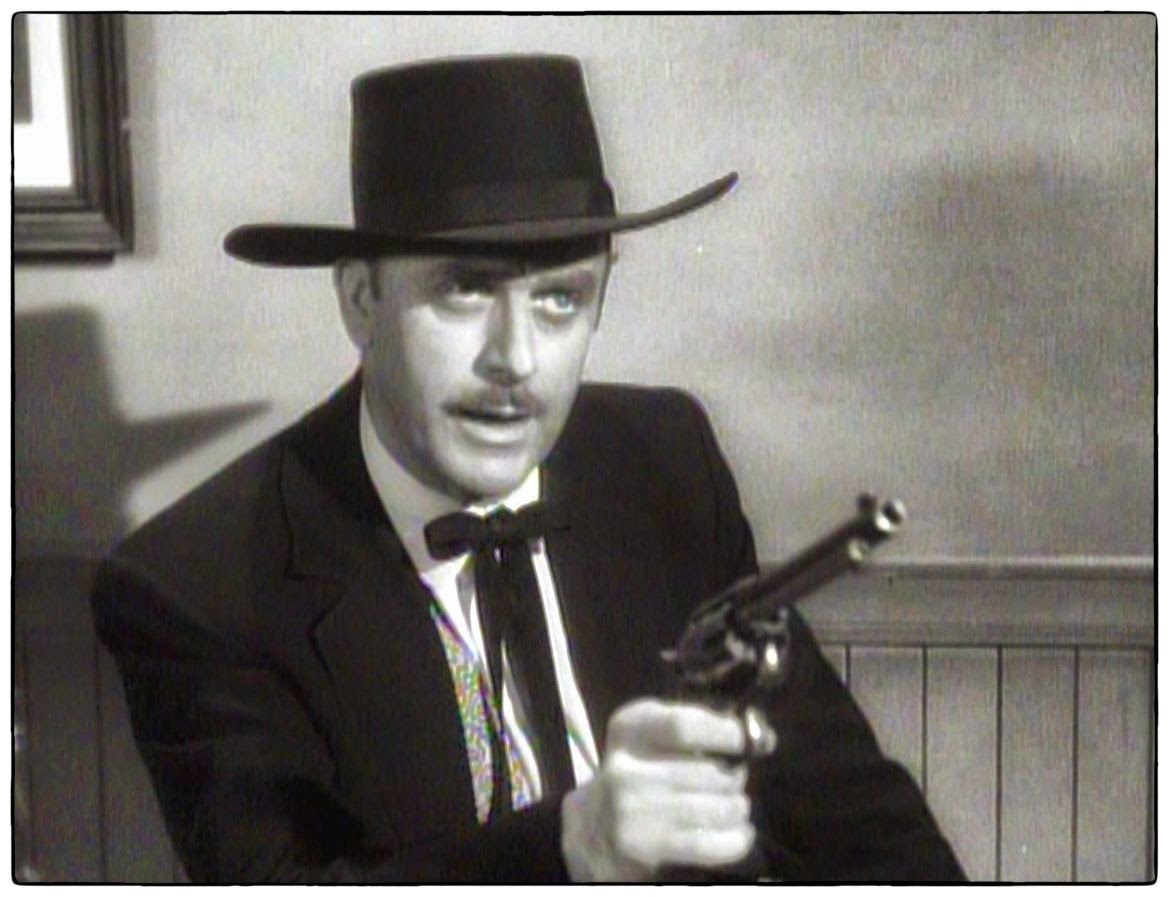
Dan Duryea is the villain in
Laramie's pilot
HENRY PARKE: On LARAMIE you had
two of my absolute favorite action directors, Leslie Selander and Joe Kane. Do you
have any memories of working with them?
BOBBY CRAWFORD: I remember
Leslie Selander, because I loved his name. I remember the directors telling me
what to do. I don't remember them vividly; in fact the only director I remember
vividly was Lee Sholem, who was a director on CHEYENNE. Who was called “Roll
'em Sholem.” Which was because -- look, there's an airplane! Roll 'em! He was a
forceful character. And you didn't want to do two takes with Roll 'em Sholem.
You wanted to do one take. I remember
the cameramen and I remember faces, but I think I was kind of intimidated and
shy on the set; I didn't develop relationships with the crew. I was always
feeling a bit like I was the kid on the show, not necessarily the pro on the
show. I don't know. Somehow, my brother John would get around to every member
of the set, [even]the background extras. He knew everybody on the set, and I
knew everybody to say hi, but I didn't develop relationships. I think I just
sort of passed through my experience as a kid on LARAMIE, enjoying the moments
and remembering some of them, but mostly just saying this too will pass.
HENRY PARKE: You did a few guest
shots on THE RIFLEMAN. How did you like working with your kid brother?
BOBBY CRAWFORD: I did, and the
problem was it was just a couple of days work. We got to get on horses, we'd be
here and we'd be there. We had to go to school for three hours and then we’d
get to be on the set a bit. We got to wrestle in one of them; we got a lot of
practice at that.
HENRY PARKE: Early in season two
of LARAMIE, you and Hoagy Carmichael disappeared.
BOBBY CRAWFORD: Bob Pirosh left, and then John Champion came
along. [Note: Writer and producer John Champion had made several successful
Westerns for Allied Artists, and
would produce LARAMIE and write 36 episodes.] I didn't know who John Champion
was, and I didn't make it a point of trying to stay in the show, or even think
that I wouldn't, until the next season began and they said well, they've
written you out. And I said, okay, I'll do something else. Whether Hoagy wanted
to leave or not, I don't know. And I never talked to anybody about it.
With LARAMIE, my experience with
the cowboys and the horses, what was probably 20 weeks of working and being
part of it, was sensational. It made me feel like a real Hollywood cowboy, and
I could go to Griffith Park, where I had a horse for about three years, that I
would groom and take care of, and be the king of corral 17, and go on parades
and riding. I felt comfortable around horses and always have felt at home in a
stable around the big animals. That I thought was my gift from LARAMIE.
HENRY PARKE: A couple of seasons
later they brought in a new kid, Dennis Holmes and Spring Byington essentially
playing a female version of Hoagy Carmichael. Did you feel vindicated?
BOBBY CRAWFORD: Well, I'm
ashamed to say I haven't watched it, but I don't think I was watching it when I
was making it, either. I didn't want to be inhibited. I do have the DVD set of
the first season, and I have watched some episodes. If I'm going to a signing
show, I'll run an episode or two, but I'm ashamed to say I haven't done that
with THE RIFLEMAN episodes either. So I am an uninformed participant. And
before I go to Kanab, I think I'm going to run some RIFLEMANS and some more LARAMIES,
LARAMIES I haven't been in. I owe Dennis Holmes a look.
In the next Round-up, the second
and final part of my interview, Bobby Crawford discusses his work on BUTCH CASSIDY
AND THE SUNDANCE KID, and twenty years as Producer to iconic movie Director George
Roy Hill.
SHOUT FACTORY has put LARAMIE out on DVD, although season one is out of print. The entire series is available on STARZ.
KCET PRESENTS ‘TENDING NATURE’ PREMIERING
NOVEMBER 7TH!
Following up on the fascinating
Emmy-winning documentary TENDING THE WILD, produced in partnership with KCET
and THE AUTRY MUSEUM OF THE AMERICAN WEST, the partners have made a 3-year
commitment to continue with the series TENDING NATURE, which premieres Wednesday,
November 7th. Just as TENDING THE WILD examined land management
techniques used for centuries by American Indians, TENDING NATURE will explore
California’s Native stories, traveling across the state to visit and hear from
several Indian communities striving to revive their cultures and inform western
sciences. This season, the Tolowa Dee-Ni’, Ohlone, Pit River tribes, and the
multi-tribal Potawot Health Village, will welcome the series and share their
knowledge on topics including ocean toxicity, decolonizing cuisine, tribal
hunting, food deserts, and traditional sweats.
Henry’s Western Round-up is honored to share the exclusive following
first look.
HERE’S ‘THE CONDEMNED’, A NEW
TEN-MINUTE SPAGHETTI WESTERN SHOT ON AN iPHONE!

Director Edwards on location
Filmmaker Jay Wade Edwards set
out to make an American film, pretending to be an Italian film, which is itself
pretending to be an American film: an Italian-language Spaghetti Western shot
in, well, the West! Not just any west, but around one of the most photographed
of western locales, Pioneertown! And he
shot it, spectacularly, on an iPhone! I’ll
have more details coming soon to the Round-up, but for now, here is the
wonderfully daft movie itself. Enjoy!
UNSPOOLED ‘HIGH NOON’ PODCAST
POSTED!

UNSPOOLED’s Paul Scheer and Amy
Nicholson are re-examining all of the films on the AFI 100 Best Movies of All-Time list, with 100 individual podcasts. They're very knowledgeable about film, but are not Western nerds, which
makes their discussion of HIGH NOON, and its placement on the list all the more insightful and entertaining. They’re also
funny as Hell. I had a great time as their guest on this segment, and think
you’ll enjoy it – especially since, whether you’re a HIGH NOON or RIO BRAVO loyalist,
you’ll find plenty to be offended by! Here’s the link to the series. HIGH NOON is #19, and APOCALYPSE NOW, #20, begins with listener comments about HIGH NOON. Enjoy them all!
ONE MORE THING…

If you’re looking for a spooky
Western to watch on Hallowe’en (and who isn’t?) Here’s a link to my True West
article on the best and worst of the ‘Weird Westerns.’
AND THAT’S A WRAP!
Happy Trails, and Happy Hallowe'en!
Henry
All Original Content Copyright
October 2018 by Henry C. Parke -- All Rights Reserved