Sunday, June 1, 2014

‘MILLION WAYS TO DIE’ AND ‘STOLEN RANCH’ REVIEWED, PLUS ‘LONGMIRE’ RETURNS!


A MILLION WAYS TO DIE IN THE WEST


A Film review

I’m wary of bestowing possessive titles on films:  I’m fine with ‘John Ford’s THE SEARCHERS’ or ‘Howard Hawks’ RIO BRAVO’ because those men have earned that credit over time.  To my surprise, I really think it’s ‘Seth McFarlane’s A MILLION WAYS TO DIE IN THE WEST’, because not only does he direct and star in the film, he co-wrote it, and his fellow writers Alec Sulkin and Wellesley Wild attest to the fact that MacFarlane is the driving force, the one with the long-term commitment to making a western, in this case a western comedy.  He has done it surprisingly well; A MILLION WAYS TO DIE IN THE WEST is a charming, raunchy delight!


Liam Neeson


From the opening moments, you know the film is no throwaway – Universal loves McFarlane after the money he made them with TED, and it’s said they’ll give him anything he wants as long as he makes TED 2.  Following the unwritten but crucial rule that you can’t successfully parody something if you can’t do it as well, the film is breathtakingly shot and beautifully scored.  Much is shot in Monument Valley, and cinematographer Michael Barrett lenses those John Ford buttes and valleys and mesas as gorgeously as anyone ever has.   Composer Joel McNeely, who won an Emmy for his YOUNG INDIANA JONES scores, creates a score that, while not derivative or imitative, brings to mind the best of Dimitri Tiomkin, Elmer Bernstein, Alfred Newman and George Bassman. 


Set in Arizona in 1882, though largely shot in New Mexico, it’s the story of Albert Stark, a sheep-rancher, and since it is a measure of impressive self-restraint – not something MacFarlane is known for – let me astonish you: there is not even one reference to BROKEBACK MOUNTAIN in the entire film!  Instead, the film opens with poor Albert about to be gunned down by a cattleman for letting his sheep stray and overgraze the prairie – see, MacFarlane has actually seen a lot of westerns!  Portraying a character not unlike Bob Hope’s in his westerns, Albert, with no hope of outdrawing the man, manages to negotiate a deal – and in the process loses the love of his girlfriend Louise (Amanda Seyfried), who now sees him as a coward as well an incompetent sheepherder.  Her affections are stolen by the ultimate mustache-twirling villain, Foy (Neil Patrick Harris), who actually runs a mustache emporium! 


Matt Clark, with and without the fur


In the desert just outside of town, an old prospector is riding along, his donkey pulling a buckboard, the old sourdough telling the animal how their gold strike will make them rich.  Then their way is blocked by a band of outlaws led by Clinch (Liam Neeson), who exudes the kind of smiling menace only a man with supreme confidence can produce.  Despite the protests of Clinch’s wife Anna (Charlize Theron), the old man doesn’t live long.  And cheers for MacFarlane’s love of the genre for casting Matt Clark as the prospector!  The Elisha Cook Jr. of his generation, Clark has played victims and low-level villains in scores of westerns: in 1972 and 1973 alone he appeared in THE COWBOYS, THE CULPEPPER CATTLE CO., THE GREAT NORTHFIELD MINNESOTA RAID, JEREMIAH JOHNSON, THE LIFE AND TIMES OF JUDGE ROY BEAN and PAT GARRETT AND BILLY THE KID.   Displeased at his wife’s behavior, Clinch sends her and one of his men to the nearest town to sit out the next train robbery – they’ll be back for her in twelve days. 


In town Albert and Anna meet, and circumstances free her from her gun-toting wet-nurse.  They become friends, and Anna’s attempts to help him win back Louise, by making her jealous, backfire when the outcome is Albert challenging Foy to a duel.  Of course, Louise has to teach Albert how to shoot.  Now, as a reader of the Round-up, I’m going to guess that, between movies and TV, you’ve probably seen ‘teaching-the-beginner-how-to-shoot- bottles-off-a-fence’ sequences a hundred times – maybe more.  Somehow MacFarlane, who really takes his time with this, manages to make it fresh and convincing and funny, and ultimately romantic.  And the barroom brawl is the best scene of its kind I can recall in twenty or thirty years, all the more because it acknowledges its own absurdity: when the fight breaks out between two characters, all the uninvolved men throughout the bar give a, “Oh well, here we go again” shrug, and start randomly beating each other.


The big 'Mustache' dance number 


A lot of the fun grows out of the history: when Anna and Albert want to sing, they have to acknowledge that there are only about three songs, and all of them are by Stephen Foster.  In fact, in a square-dance sequence that is something of a nod to 7 BRIDES FOR SEVEN BROTHERS and CAT BALLOU, Foy leads them in a song about mustaches, which is credited to Foster as well.  When Albert, missing Louise, is leafing through pictures of them together, instead of the sort of snapshots that are usually used, and historically ridiculous, he is looking at tintypes, and much fun is gotten from the fact that you couldn’t smile in them, because the exposures took so long.


Sarah Silverman and Giovanni Ribisi


Wes Studi has a nice part as Cochise, who introduces Albert to the exciting world of peyote. Also enjoyable in supporting roles are Albert’s friends, the local whore, played by Sarah Silverman, and her virginal boyfriend, played by Giovanni Ribisi – they’re saving him for marriage.  Taking a bit of the fun out of them are the frequent references to them being Christians, as if there is some Christian dictate that it’s okay to be a prostitute but not an unmarried non-virgin.  Of all the world’s religions, only Christians – Mormons included – are expected to tolerate this crap incessantly. 

And speaking of the offensive stuff, the obscene dialogue and occasional sheep-urinating-on-the-star’s-face ‘gags’ seem oddly arbitrary, often forced, and usually not funny beyond shock value.  Although maybe this was meant as a jab at DEADWOOD’s excessive obscenity, and the pious and absurd claims that ‘this was how they really talked back then,’ when in truth, using ‘fighting words’ as mild as ‘sonuvabitch’ could get you legally shot.

As opposed to, say, BLAZING SADDLES, which is pure burlesque from start to finish, A MILLION WAYS TO DIE IN THE WEST is at its core a sweet movie with likable characters you grow to care about.   A great deal of its potential rises and falls on Seth MacFarlane’s ability as a leading man, and he carries the movie very well.  Aside from youngsters who do not need to be rushed into adulthood, and adults for whom the obscenity would ruin the fun, I recommend it highly!


THE STOLEN RANCH – A Silent Western

A  DVD Review


Grapevine Video just keeps expanding my knowledge of the silent western, this time with a Fred Humes starrer, THE STOLEN RANCH (1926).  Not familiar with Humes?  He was a pretty big name towards the end of the silent days.  Under contract to Universal in the twenties, in popularity he was a runner-up to the studio’s reigning kings, Hoot Gibson and Jack Hoxie. 

THE STOLEN RANCH is an unusual story, set not in the old west of the 19th century, but the nearly contemporary – for 1926 – west of the First World War.  Humes plays Breezy Hart, a soldier who befriends another in the trenches, Frank Wilcox (Ralph McCullough).  The stress of endless war has caused Frank to crack: only Breezy’s tight grip and calming talk keeps Frank from an ugly death in ‘no man’s land’.  After the war Frank, suffering from what would be called Post-Traumatic Stress Syndrome today – then it was ‘shell-shock’ – is heading to his late Uncle’s  ranch.  Frank expected to be left the ranch, but his uncle’s foreman claims a new will gives the ranch to him. 

Determined to get a look at the inside of the ranch operation, Breezy gets a job there as the cook’s assistant, and does some snooping.  Also in the cast are Louise Larraine as a ranch girl and Humes’ love interest, Nita Cavalier as the lawyer’s daughter and Frank Wilcox’s love interest, and villains like William Bailey, Slim Whitaker and Jack Kirk, who each have more than 300 screen credits, nearly all of them westerns.  Humes is a cheerful, likable performer, and the movie skillfully switches back and forth between the western mystery elements, comic romance, and the trauma of war flashbacks triggered by the sound of a random gunshot.
Admittedly, the film is not a classic in its storytelling: too much plot relies on overheard conversation.  And by today’s standards, the amount of male hugging and other physical bonding borders on the homoerotic.  But overall it is a thoughtful and entertaining movie, with all the action elements you want in a western, and enough unexpected aspects to make it memorable.


Men psychologically damaged by war, and the mixed welcome soldiers received when coming home, were not usually the stuff of western programmers, but then, most western programmers were not directed by the likes of William Wyler.  One of the truly legendary directors of Hollywood, Wyler’s sophistication, intellect, and heart would earn him three Oscars, for BEN HUR (1959), MRS. MINIVER (1942), and most relevant to this discussion, THE BEST YEARS OF OUR LIVES (1946), the story of returning veterans of the Second World War.  For the record, Wyler also directed Walter Brennan to an Oscar playing Judge Roy Bean in THE WESTERNER, excelled in romantic comedies like ROMAN HOLIDAY, and drew two of the best child performances ever – from Bonita Granville and Marcia Mae Jones – in THESE THREE (Merle Oberon, Miriam Hopkins and Joel McCrea are pretty good, too).  He also put aside his career for several years to go to war, making films for the government, entertainingly  detailed in the new book, FIVE CAME BACK: A STORY OF HOLLYWOOD AND THE SECOND WORLD WAR, by Mark Harris. 
Another pro on the project was writer George H. Plympton, an unsung master of entertaining storytelling whose over 300 credits, often shared, include FLASH GORDON, and many of the best Republic serials, plus b-westerns and Bowery Boys films. 

Humes and Wyler would make two more westerns the following year, but the actor, who as a sideline played gorillas in several movies, would have a minor career once sound came in.  Although he worked steadily for many years, it was mostly unnamed characters in uncredited roles.  Humes, who played sidekicks and villains to Hoot Gibson in five of the star’s silents, may have made a personal connection.  In 1935, when Hoot was a big star, and Humes was reduced to playing bit parts, Hoot used him in two more movies. 

THE STOLEN RANCH, which features a lively piano score by David Knudston, is available from Grapevine Video.  http://www.grapevinevideo.com/stolen_ranch.html


‘LONGMIRE’ MARATHON PRECEDES SEASON 3 PREMIERE MONDAY NIGHT!


Monday, June 2nd, at 10 p.m., LONGMIRE returns to A&E for a third season.  I can’t tell you too much about the new season because I haven’t seen any yet – I hope to have a screener on Monday, and will review it next Sunday.  What I can say for sure is that of all the current dramas of the past several years, there are only two that I never miss: HELL ON WHEELS and LONGMIRE.  If you are behind in your episodes, or you just want to refresh your memory, A&E is running all of season two earlier in the day – check your local listings!

THAT’S A WRAP!

That’s it for today!  Have a great week!

Happy Trails,

Henry

All Original Contents Copyright June 2014 by Henry C. Parke – All Rights Reserved


Monday, May 26, 2014

CANNES REPORT – TARANTINO ON ‘DJANGO’ MINI; ‘HOMESMAN’ NABS A DOMESTIC DISTRIBER, PLUS ‘B-MOVIE’ REVIEW!


TARANTINO AT CANNES: ‘HATEFUL 8’ AND ‘DJANGO’ NEWS


Franco Nero, Quentin Tarantino, Uma Thurman
picture by Getty Images


Quentin Tarantino was at Cannes to present A FISTFUL OF DOLLARS on closing night, and had plenty to say – or tease – about his upcoming Western projects, according to Deadline: Hollywood.  About THE HATEFUL EIGHT, once cancelled, then revived after doing the live audience reading: “I have calmed down a bit from the knife in the back. The wound is starting to scab.” He said the staged reading was “…a blast. I might do that on every script.  It was great to have three days of rehearsal and hear it out loud.” The second draft is nearly finished, and he’s contemplating a third. “I’m in no hurry. Maybe I’ll shoot it. Maybe I’ll publish it. Maybe I’ll do it on the stage. Maybe I’ll do all three.”

Also, with an hour and a half of unused scenes from DJANGO UNCHAINED, he’s considering a four-hour miniseries.  “The idea is to cut together a four-hour version…cut it up into one-hour chapters like a four-part miniseries and show it on cable television. People love those!”

SABAN FILM ACQUIRES ‘THE HOMESMAN’ AT CANNES


In what was described by Deadline: Hollywood as “a competitive situation,” Saban Films, a brand-new entity of Saban Entertainment, has acquired the North American distribution rights to the well-reviewed Western, for about $3,500,000.  Based on Glendon Swarthout’s 1988 novel, the film is directed by and stars Tommy Lee Jones, co-starring with Hilary Swank, with a supporting cast that includes Meryl Street, James Spader, John Lithgow, Hailee Steinfeld, and Barry Corbin. 

Saban Entertainment has a long history of kid entertainment, long associated with various incarnations of the MIGHTY MORPHIN POWER RANGERS, but they have had considerable experience in distribution and production of features as well, beginning in 1988 with the remarkable HEATHERS.  They’ve also been involved with at least two previous Westerns.  In 1994 they distributed TRIGGER FAST, based on a J.T. Edson novel, starring Jurgen Prochnow, Martin Sheen and Corbin Bernsen.  That same year they produced the Western comedy SAMAURI COWBOY, starring Hiromi Go, Robert Conrad and Catherine Mary Stewart.  They also own the beautiful Saban Theatre in Beverly Hills, built in 1930 as the Fox Wilshire.

ORIGINAL ‘DJANGO’ ATTENDS CANNES ‘FISTFUL’ CLOSING SCREENING


Franco Nero with DJANGO LIVES producer
David Hollander


Franco Nero, the original DJANGO, soon to star in DJANGO LIVES!, attended the Cannes closing screening of A FISTFUL OF DOLLARS; he’s seen here with DJANGO LIVES! producer Davis Hollander.  The screening was to honor the 50th anniversary of the Spaghetti Western, and it’s amusing that Nero attended, as the great debate among fans has always been whether the Sergio Leone/Clint Eastwood films or the Sergio Corbucci/Franco Nero films are the greatest of the genre.  I refuse to choose.  But what is inarguable is that Clint Eastwood is the image of the Spaghetti Western in the United States, and Franco Nero is the image in Europe.

‘RESURRECTION OF EL PURO’ STARTS PRE-PRODUCTION


Not all the Western action was at Cannes this week!  Here’s Chip Baker Film’s Cesar Mendez with the original El Puro, Robert Woods in Los Angeles, on the first day of pre-production of RESURRECTION OF EL PURO, the sequel to the 1969 EL PURO (a.k.a. La taglia è tua... l'uomo l'ammazzo io) .  The script is finally locked, and they plan to roll camera in late September, after the 2014 Almeria Western Film Festival has wrapped.  Starring Woods, of course, the cast will include Western stalwarts Brett Halsey, Simone Blondel, Nicolleta Machiavelli, and Antonio Mayans.


B MOVIE – A Play by Michael B. Druxman

A Review


In a way, traveling to the period of B-MOVIE, Michael Druxman’s play about the Barbara Payton/Franchot Tone/Tom Neal scandal, is more of a time-warp than going back to the Civil War: it’s a trip from the Post-Morality present to the 1950s, when a morality clause was something to keep an actor, not a basketball-team owner, in line. 


Today, there may be no such thing as bad publicity – the once-clear line between fame and infamy has been erased.  Kim Kardashian became a media star with no other talent or credentials than staring in a home porn video: this week she and rapper Kanye West had an exorbitantly expensive wedding in Italy, her third, and she wore white.  In the 1950s, one single still photograph was taken of Barbara Payton and Tom Neal doing something similar to Kim’s video: it ended both of their careers.


B-MOVIE is a two-act, three-character play about three very real characters, who suddenly were forced into the spotlight of public moral judgment.  They were all known actors with varying degrees of success.  Franchot Tone was the big star, ever since 1935, and the splash he made with MUTINY ON THE BOUNTY.  Under contract to MGM, and later other studios, he worked regularly with Jean Harlow, Clark Gable and Spencer Tracy.  Suave, elegant, educated; but his character rarely got the girl.  He was Ralph Bellamy until Ralph Bellamy came along.   His first marriage was to Joan Crawford, and he’d have three more, including Payton.  I liked him best, cast against type, in an underrated noir from Universal, THE PHANTOM LADY.  It’s the only role I recall where his character was as dangerous as Tone could really be, when crossed.


Barbara Payton, 22 years Tone’s junior, was a platinum blonde beauty who impressed in the early 1950s opposite Cagney with KISS TOMORROW GOODBYE, opposite Gregory Peck in ONLY THE VALIANT, and opposite Guy Madison in the Civil War drama DRUMS IN THE DEEP SOUTH.  Not coy, she admits in her autobiography that she slept with most of her producers, directors and leading men.  Gregory Peck found her presence so distracting and disturbing that he had her banned from their set when she wasn’t working.  Even when she was going with Tone, she and Guy Madison were less than discreet about their relationship.


from JUNGLE GIRL


Compared to Tone and even to Payton, Tom Neal was a bit out of his league.  Even with a long list of credits going back to 1938, his roles were usually minor, often unnamed characters  – typically, in an episode of THE GENE AUTRY SHOW his character is ‘animal abuser.’  But he was a big, handsome guy with a strong jaw and a great physique, shown off well without a shirt, as the male lead in the Republic serial JUNGLE GIRL.  He was with the Duke in FLYING TIGERS, with Rondo Hatton in THE BRUTE MAN, and his biggest break doubtless was as the star of Edgar G. Ulmer’s no-budget noir, DETOUR.  But what a picture to be the lead in; sometimes described as the best B-movie of all time, it is only considered that by the sort of moviegoer who would rather laugh at a bad movie than enjoy the qualities of a good one.  It is ironic indeed that Neal plays a hapless dope traveling to L.A. to meet up with his fiancé, and en route keeps accidentally killing people.  When he finally did kill someone in real life, he’d claim that was an accident, too.
Druxman’s play starts in the 1960s, with Tone, his career and dignity somewhat recovered, living in a New York brownstone.  Neal is in Palm Springs, in a cell, waiting to go on trial for the murder of his third wife.  Tone is astonished and amused to be asked to contribute money to Neal’s defense – the former Golden Gloves fighter nearly beat Tone to death over Payton.  And yes, it really did happen.  And yes, Tone did contribute.


Gregory Peck and Barbara Payton in
ONLY THE VALIANT


They sometimes address each other, sometimes speak directly to the audience.  The story bounces back and forth between the two men and their memories of Barbara Payton, the woman who loved them both, who made and changed decisions, who made and broke promises, and ruined both men’s lives, and her own.  Although some would say that what ruined Payton and Neal was the photograph, and what ruined Tone was being a husband brought so low that he papered the studios with it.


Payton and Tone


It's a fascinating and tragic story, told with humor and empathy, and a great sense of the people and time and place involved.  After I read it, I watched MUNTINY ON THE BOUNTY, and DETOUR, and Payton in BRIDE OF THE GORILLA, and was struck by how well Druxman captured their voices in his words.  No surprise, really.  After a long career as a publicist, Michael became a very busy writer and sometime-director for Roger Corman, scripting CHEYENNE WARRIOR, one of the best Westerns of the last twenty years. 


As much devoted to theatre as he is to film, Druxman has written and published a series of one-person biographical plays of the stars, called THE HOLLYWOOD LEGENDS, which have seen numerous productions.  Their subjects include Spencer Tracy, Clark Gable, Orson Welles, Errol Flynn, Nelson Eddy and Jeanette MacDonald, Clara Bow – his best-selling, and Al Jolson – his most successfully produced. 
In addition to his talent, all of us struggling writers can take a lesson from Michael, who aggressively gets his work out there like no one else I know.  B-MOVIE is in negotiations currently, but it is a very new play, and there have been as yet no stage productions.  If you’re looking for a two male, one female play with simple sets, check it out.  You can purchase this play or his others through Amazon.com.  If you’re interested in licensing a play, write to him: Michael B. Druxman, PMB 142, 6425 S. IH-35, Suite 150, Austin, TX 78744, or email him at druxy@ix.netcom.com.  You can visit his official site HERE . You can read my interview with Michael HERE .


Neal and Payton


SILENT SCREENINGS SAT. AT EGYPTIAN FEATURE MICKEY ‘MCGUIRE’ ROONEY!


On Saturday, May 31st, the Retroformat folks, the ones who show rare silents in 8mm, are taking a break from their D.W. Griffith series to show a varied program including the role that made Mickey Rooney a star – and no, it’s not Andy Hardy.  It’s the Mickey McGuire films, a silent series capitalizing on the success of Hal Roach’s Our Gang comedies.  They’ll be screening Mickey in MICKEY’S MOVIES; Harry Langdon in SOLDIER MAN, one of his earliest collaborations with Frank Capra; DANGER GIRL, a Mack Sennett Comedy starring Gloria Swanson; Larry Semon (why didn’t he change his name?) in THE SHOW; and chapters 11 & 12 of the serial THE WOMAN IN GREY.  There will be a live musical accompaniment by Cliff Retallick. 

THAT'S A WRAP!

I hope you had a great Memorial Day weekend, and I hope you took time to remember that it's more than a three-day weekend: it's a day to honor the memory of men and women who gave their lives to preserve our freedom!

Happy Trails,

Henry

All Original Contents Copyright May 2014 by Henry C. Parke - All Rights Reserved


Monday, May 19, 2014

WESTERN ‘HOMESMAN’ SCREENS AT CANNES, MEL BROOKS ON ‘BLAZING SADDLES’, PLUS JOHN WAYNE COWBOY LUNCH!


TOMMY LEE JONES' 'HOMESMAN' PREMIERS AT CANNES


‘THE HOMESMAN’ had its world premiere Sunday night at the Cannes Film Festival.  While hundreds of films will screen during the festival, and thousands will be bought and sold, only a handful of films are accepted into competition every year, and THE HOMESMAN is one of the few.  Based on the novel of the same name by Glendon Swarthout, who also wrote the novel THE SHOOTIST, it’s the story of a man set to be hanged as a claim-jumper, who is given the chance to redeem himself by helping transport three madwomen to an insane asylum.  The star and director is Tommy Lee Jones, and the woman he’s helping is played by Hilary Swank.  Both Oscar-winners, they are joined by a third, Meryl Streep, and the rest of the exceptional cast includes Hailee Stanfield from TRUE GRIT, Oscar nominee John Lithgow, James Spader, William Finchner, Barry Corbin and Grace Gummer.  At the recent Santa Clarita Cowboy Festival I had the opportunity to interview Miles Swarthout, son of Glendon, who scripted THE SHOOTIST, and has plenty to say about both films.  You’ll be reading that interview soon in the Round-up.


Tommy Lee Jones and Hilary Swank Sunday at Cannes


CANNES TO HONOR SPAGHETTI WESTERN’S 50TH ANNIVERSARY


Acknowledging that the explosion of Western action with a Italian/Spanish flavor began five decades ago, the Cannes Film Festival will feature screenings of two of Sergio Leone’s classic films. THE GOOD, THE BAD, AND THE UGLY was screened on Saturday night.  The one that started it all, A FISTFUL OF DOLLARS, will screen on Sunday, May 24th, after the Awards Ceremony, and will be hosted by Quentin Tarantino.  The copy will be a new restoration done from the original Techniscope camera negative.


And what better way to honor the subgenre than to demonstrate that the Spaghetti Western is alive and well.  Franco Nero, the screen’s original DJANGO (1966) will star in DJANGO LIVES! and producer Mike Malloy (of THE SCARLET WORM fame) is at Cannes with Resolution Entertainment hoping to wrap up financing.  In the sequel – actually the third Franco Nero/DJANGO outing following 1987’s DJANGO STRIKES AGAIN – the gunman will have turned up in Los Angeles in the early days of the silent movie industry, working, as many former lawmen and outlaws did, as a technical advisor on westerns.  I am very eager to see this movie made, so if you’ve got a hankering to invest, drop me a line and I’ll put you in touch with Mike.


DJANGO LIVES director Joe D'Augustine & Franco Nero


MEL BROOKS AT THE TCM FEST ON ‘BLAZING SADDLES’


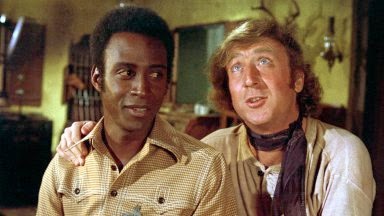
Cleavon Little and Gene Wilder


One of the high points of this year’s TCM CLASSIC FILM FESTIVAL for Western fans was on Friday night, April 11th, when the tremendous Chinese Theatre, now with a huge IMAX screen, was 100% packed to see Mel Brooks introduce his 1974 western comedy sensation, BLAZING SADDLES.  There are quite a few western comedies when you think about it.  Among my favorites are CAT BALLOU, CITY SLICKERS, the Burt Kennedy comedies like SUPPORT YOUR LOCAL SHERIFF, and the TRINITY films.  That’s not to mention Bob Hope’s THE PALEFACE, and recent entries like SHANGHAI NOON and THE THREE AMIGOS.  There was once a time when every comedy movie star did a western comedy, like Jack Benny in BUCK BENNY RIDES AGAIN, Laurel and Hardy’s WAY OUT WEST and THE MARX BROTHERS GO WEST.  Almost every series eventually had one – from OUT WEST WITH THE HARDYS to BOWERY BUCKAROOS with the Bowery Boys.  In twelve days we’ll have another, A MILLION WAYS TO DIE IN THE WEST.  But few would argue that the best known, and one of the funniest, is Mel Brooks’ BLAZING SADDLES.

One serious note about Mel Brooks.  Speaking as a transplanted New Yorker who loves the city and loves Broadway, we can never applaud Mel Brooks enough, following the 911 attack, for having the courage and independence to open THE PRODUCERS on schedule, not only bringing much needed laughter to a terrified city and nation, but letting the terrorists know that they hadn’t broken our spirit, and couldn’t change our way of life.

As always, practically everything Mel Brooks says is actually shouted, and should be followed with an exclamation point.  In a town of false modesty, his very real immodesty is wonderfully refreshing.  After he walked onto the stage to deafening applause, singing the theme of the movie, and before he was joined by Robert Osborne, Mel spotted some very young audience members. 


MEL BROOKS:  You kids have never seen BLAZING SADDLES.  They’re in for a weird surprise.  It may be my favorite movie.  It may be the funniest movie ever made.  Bless you for all coming here and being a part of this night.  I really appreciate it.  I’m going to talk to Mr. Osborne,

ROBERT OSBORNE:  That standing ovation was well-deserved.  I think it’s also amazing that this movie came out in 1974, as did YOUNG FRANKENSTEIN. 

MEL BROOKS:  The same year, and they were #1 and #2 for the year.

ROBERT OSBORNE:  Two of the funniest movies of all time – no question about it.  This was a difficult movie to sell, wasn’t it?

MEL BROOKS:  I remember the first screening for the executives at Warner Brothers.  John Calley was running the studio.  Dick Shepherd had left, and there were like eight other guys, all executives at Warner Brother, and they all said (with expressions of disgust), “Oi!  Oooh! Ay!”  This one said, “We can’t release it.  It’s too vulgar for the American public.”  At any rate, John Calley said, “Let’s try it in New York, Chicago and L.A., and if there’s any love for it, we’ll release it.”  So they released it in those cities, and believe it or not, it was the biggest hit Warner Brothers had that year. 
ROBERT OSBORNE:  Before they released it, did they ask you to cut anything from the picture?


MEL BROOKS:  That’s a good question, Robert.  He knows his stuff.  The truth is, the head of Warner Brothers at the time, who will go nameless, was Ted Ashley.  The preview was really great.  We had cattle in the lobby.  We had cowboys riding up and tying up their horses outside the theatre.  We had tons of Raisenetts.  And the audience loved it.  And Ashley took me by the scruff of the neck, threw me into the manager’s office, handed me a legal pad and pencil, and said, “Take these notes!”  I said yessir.  He said, “No farting!  You can’t punch the horses!  You can’t beat old ladies up!”  There were like twenty of those notes.  And if I followed all of these notes the movie would have been twelve minutes long.  So when he left, I crumpled up all my notes.  And I threw the balled-up notes across the office, into a wastebasket, and John Calley said, “Good filing!”  I didn’t cut a sentence, or a word, or even an expression.  A lot of people don’t know that.  So keep it under your hat.      

ROBERT OSBORNE:  That was a daring movie to make at that time, the (scatological) jokes and stuff; that was dangerous territory to go into. 

MEL BROOKS:  It was beyond vulgar.  It was dirty.

ROBERT OSBORNE:    Where did you get the courage to do that?

MEL BROOKS:  I didn’t know better.  You know, if I was wiser, if I was more diplomatic, or smarter, or if I realized what the rules of courtesy and kindness were, I never would have made the movie.  I was a scruffy little kid from Brooklyn, and there are no rules, or there are just a few.  And there were some things that I just had to say.  I’d been watching westerns all my life – three westerns on a Saturday morning.  Hoot Gibson, Tim McCoy, Ken Maynard!  I loved westerns!  And they’d sit around the campfire.  And they’d eat straight beans off a tin plate -- a lot of beans.  And they’d drink black coffee from a tin cup.  And you never heard a sound across the prairie!  I decided to…let the boot drop.  I wanted to tell the truth about westerns.


The German version


Richard Pryor, one of the writers, I asked Warner Brothers to hire him as the black sheriff, to play Black Bart.  And they said no, we can’t get him insured because he was arrested for drugs; we can’t do it.  Richard and I did a lot of auditions, looking for our sheriff.  Finally there was this guy from Broadway, and his name was Little, Cleavon Little.  And he was absolutely wonderful.  And beautiful.  And Richard said something really profound.  He said, “If I had the part, I could be Cuban, light as I am; I’m coffee-colored.  And I’ve got a mustache; I could be the Cuban sheriff.  This guy is so black, and he’s gonna scare the shit out that town.  And he’s what you want – he’s so damned handsome and so talented.”  And we were so lucky to get him, to play the lead.  And by the way, a lot of the people in that movie are long gone (note: of the top-billed stars, Cleavon Little, Slim Pickens, Harvey Korman, Madeline Kahn, and David Huddleston are all gone.  Only Mel, and Gene Wilder are still around).  But in the audience tonight is the school marm who punches one of the bad guys -- Carol Arthur is sitting somewhere out there!  (Carol Arthur, who will be 80 in August, once married to Dom Deluise, and a veteran of four Mel Brooks movies as well as THE SUNSHINE BOYS, stands for tremendous and well-earned applause)

ROBERT OSBORNE:   Also you had a lot of casting changes.  Gig Young was originally going to play the Waco Kid, right?

MEL BROOKS:  I hired Gig Young to play the Waco Kid.  He was a great actor, he’d won the Academy Award for THEY SHOOT HORSES DON’T THEY, and I knew he was a recovering alcoholic, so he was perfect for the Waco Kid. Unfortunately he was not really…recovered.  So we’re in the first scene, there’s something green on his mouth.  And he’s spraying the jail-cell all green, and I said, I don’t think he’s ready yet.  I was stuck, and I didn’t know what to do.  So I called my best friend in New York, I called Gene Wilder and said, what am I going to do?  And he said just get a costume for me to wear, and a gun, and a horse to ride on, and I’ll be there tomorrow.  And he did.  And he saved me, and he saved the picture.  It was fate. 

ROBERT OSBORNE:   And fate that you had Madeline Kahn.


MEL BROOKS:  She came to my office, and after I heard her sing, I said, raise your skirt; I want to see your legs.  She said, “Oh, it’s that kind of an audition.”  I said no, no.  It’s just that you’re playing like Marlene Dietrich, and you’ve got to straddle that chair.  She said okay, she raised her skirt, she straddled the chair.  She sang I’m Tired, and I fell madly in love with her.  She was so good, so talented, so richly talented.  You know, Madeline could have been a coloratura in opera.  That’s how great a voice she had.  Also she had a sense of comedy, with her own strange timing, and her own weird little takes – she was just amazingly talented.  And she died of ovarian cancer – just awful.  And Harvey, the great Harvey Korman.  One of my favorite moments is Harvey making love, physically, to the globe.  And when he says, “My mind is aglow with whirling, transient nodes of thought careening through a cosmic vapor of invention.”  And Slim Pickens says, “Ditto.”  And Harvey says, “Ditto?  Ditto, you provincial putz?”  There are some moments that tickle me so much.  I think this could be the funniest picture of all time. 

ROBERT OSBORNE:   One last question.  Could this motion picture be made today?

MEL BROOKS:  Well, you couldn’t say the ‘n’-word. You know, I said we don’t have to use the ‘n’-word, but Richard Pryor said, “No.  We are writing a story about racial prejudice.  It’s a fact; it’s real.  And the more we use it, from the bad-guys and redneck side, then the more the victory of the sheriff, the black sheriff, who in the end is loved by the townspeople.”  And I said okay Richard.  The ‘n’-word will be all over the screen.

ROBERT OSBORNE:   Thank you for this movie.  Thank you for being here.  Thank you for Mel Brooks.


WEDNESDAY’S ‘COWBOY LUNCH @ THE AUTRY’ SALUTES JOHN WAYNE!

At 12:30 pm on Wednesday, May 21st, Rob Word’s third-Wednesday-of-the-month Cowboy Lunch @ The Autry will salute John Wayne just a week short of what would have been 107th birthday.  Admission is free (although you have to buy your own lunch) and after the feed, Rob will lead a discussion with folks who worked with the Duke in various capacities, and are admirers of his work.  Last month’s luncheon celebrated THE WILD BUNCH, and Rob brought together actors Bo Hopkins and L.Q. Jones, master horse and car stunt-man Gary Combs, and costumer-turned-screenwriter-turned-producer for Peckinpah Gordon Dawson.     

As people’s schedules can change at the last minute, Rob understandably plays it cagey as to who will take part.  But I can tell you that among the folks he’s invited are one of Wayne’s greatest romantic co-stars, a co-star in Wayne’s best TV comedy turn, a fine character actor who did six films with the Duke, and the man who scripted Wayne’s last movie.  And you never know who will turn up in the audience.  Last time I found myself sitting among actors Paul LeMat, Morgan Woodward, and GUNSMOKE writer Jim Byrnes. 
Below is a poignant teaser, with director Rupert Hitzig talking about directing Mickey Rooney and Ben Johnson in a western at the end of the trail.


THAT’S A WRAP!

That’s it for now – have a great week!

Happy Trails,

Henry

All Original Contents Copyright May 2014 by Henry C. Parke – All Rights Reserved